

Key takeaways for property managers
- Cape Town: A draft by-law would require a City registration number on every listing, and listing without one would be a strike against managers as well as owners
- Wales: Every host must join the new national register by March 31, 2027, whether or not their council charges a visitor levy.
- Budapest: The citywide block on new registrations ends December 31. In Budavár, 58.6% of residents who voted backed a full ban, though only 21% took part and the poll isn’t binding.
Registration links this week’s three stories: who has to register, and what that lets the authorities do next. Cape Town wants a City-issued number on every listing, Wales has opened a national register that every host must join, and in Budapest, districts are deciding what replaces a citywide block on new registrations when it ends on December 31.
Cape Town Wants a Registration Number on Every Listing
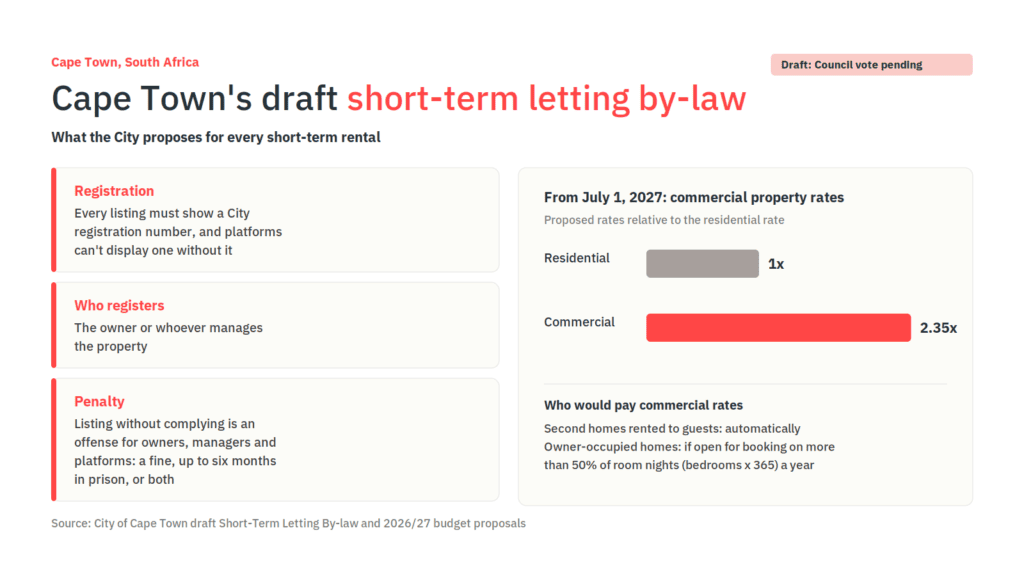
- Cape Town has published a draft Short-Term Letting By-law that would require every short-term rental to be registered with the City, either by the owner or by whoever manages it. It is not law yet: the Council has yet to vote on it.
- Every listing would have to show its City registration number, and platforms could not display a property without one.
- From July 1, 2027, the City plans to use registration data to move qualifying rentals onto commercial property rates (Cape Town’s local property tax). Under its 2026/27 budget proposals, those are about 2.35 times the residential rate.
- Second homes rented to guests would pay commercial rates automatically. Owner-occupied listings would pay them if open for booking on more than 50% of its room nights in a year (bedrooms × 365), whether or not those nights are booked.
- Listing a property without complying with the by-law would be a strike for owners, managers, and platforms, punishable by a fine, up to six months in prison, or both.
Adit’s Views
- Number checks belong in onboarding: a manager who lists a home without one would be committing an offense, not just the owner.
- A manager who leaves an owner-occupied home’s calendar open all year could push it onto commercial rates, even if most of those nights stay empty.
- Cape Town first proposed charging full-time rentals like hotels in early 2025 and signaled tougher enforcement in February 2026, and registration is what lets it act. With South Africa’s national code still a non-binding draft, which we covered on May 29, the City’s rules are the ones Cape Town hosts will actually face.
Wales Opens Its Mandatory National Register
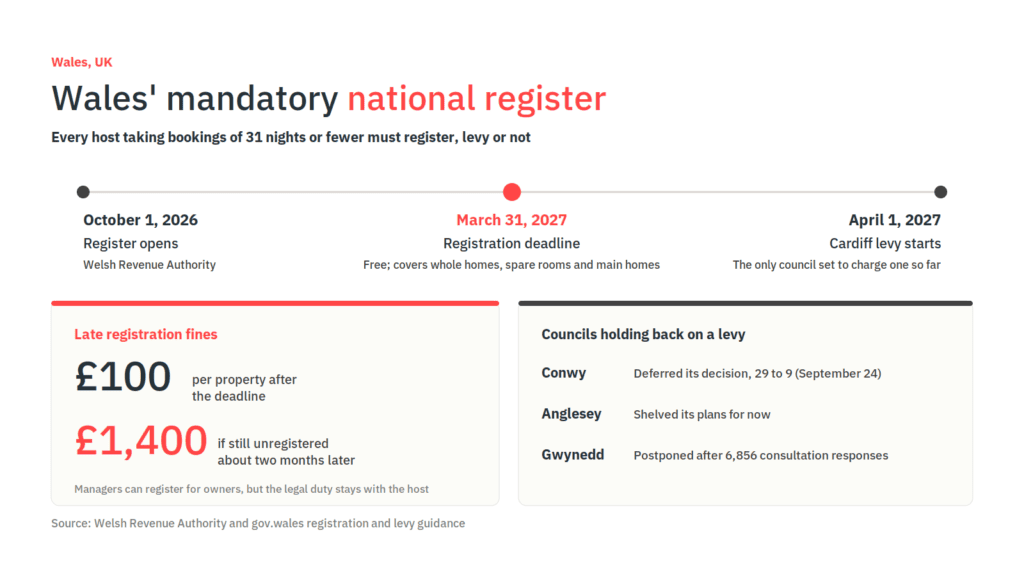
- The Welsh Revenue Authority opened its register on October 1. Short-term rental hosts and managers who accept bookings of 31 nights or fewer must register by March 31, 2027.
- Registration is free and required across Wales, even where the council charges no visitor levy. It covers whole homes, spare rooms and main homes rented out even once a year.
- Managers can register for owners, but the legal duty stays with the host.
- Hosts who miss the deadline face a £100 fine per property, rising to as much as £1,400 (about $1,870) if they still haven’t registered about two months later.
- Cardiff is the only council set to charge a levy, from April 1, 2027.
- Other councils are holding back on the levy: Conwy voted 29 to 9 on September 24 to defer its decision, Anglesey has shelved its plans for now, and Gwynedd postponed its decision after its consultation drew 6,856 responses.
Adit’s Views
- Wales is not alone. England is building its own register, which we covered on September 17, so managers with listings in both countries face similar registration work.
- Since managers can register for owners while the fine stays with the host, I expect registration to become part of the service managers offer.
- A levy can apply to bookings confirmed months before it starts. Edinburgh’s 5% levy covers stays from July 24, 2026 that were booked on or after October 1, 2025. Conwy’s guidance shows Wales would work the same way: a levy from October 2027 would cover bookings taken from April 2027. So council decisions made now can affect 2027 stays that managers are already quoting.
Budapest’s Castle District Voters Back a Ban in a Non-Binding Poll
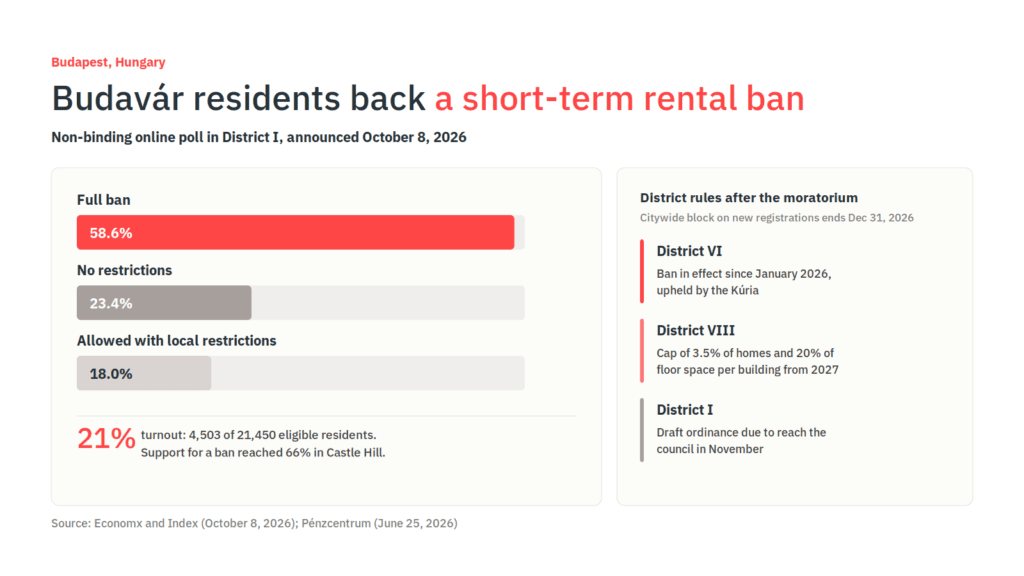
- Voters in Budavár, Budapest’s District I, backed a full ban on short-term rentals in an online poll announced October 8. Of 21,450 eligible residents, 4,503 took part.
- A full ban won 58.6% of votes, no restrictions won 23.4%, and allowing rentals with local restrictions won 18%. Support for a ban was highest in the Castle Hill area itself, at 66%.
- The poll is not binding, and the district says an impact study is under way. A draft ordinance is due to reach the council in November.
- Until December 31, 2026, a citywide moratorium means no new rentals can be registered anywhere in Budapest. If the person registered as running a rental changes, for example after a sale, the new person cannot register it until the moratorium ends.
- After that, each district council can set its own rules, from capping how many homes can be rented to banning rentals outright.
Adit’s Views
- The poll matters because of its timing. When the citywide block on new registrations ends on December 31, each district sets its own rules, and Budavár ran its poll ahead of a draft ordinance due in November.
- Districts are already splitting. District VI residents voted for a ban that took effect in January 2026, and Hungary’s top court, the Kúria, has since upheld it. Józsefváros (District VIII) instead approved a plan in June to cap short-term rentals at 3.5% of homes district-wide and 20% of floor space per building from January 1, 2027.
- I expect the January reopening to bring little room to grow in central Budapest. District VI has banned short-term rentals, District VIII plans to cap them, and if the poll shapes its ordinance, District I could be next to ban.
Bottom line: Budapest’s moratorium ends December 31, but new registrations will depend on each district’s rules. Welsh homes must be on the register by March 31, 2027, or hosts face fines. And from July 1, 2027, Cape Town homes listed more than half the year could move onto commercial rates of about 2.35 times the residential rate, a cost that belongs in any owner’s revenue projection now.
Track short-term rental regulation trends and what each shift means for your operating environment. Subscribe to the RSU newsletter.

Related Articles:
 Goliday Expands to the UK, Edinburgh’s Temporarily Relaxes Regulations, Booking.com’s Top Welcoming Cities for 2025
 Houston Sets the Clock, DC Opens Hosting, Industry Builds an Advocacy Fund
 EU Short-Term Rental Data Sharing Goes Live, Australia Calls for Sweeping Reforms, US States Preempt Local Rules
 Mexico City Enforces Registration, England Delays Planning Class, Cleveland Caps Density