Milano-Cortina 2026 isn’t just a sponsorship cycle for Airbnb.
It’s a Gen Z acquisition strategy.
A short-form media experiment.
A cultural legitimacy campaign.
And a long-term positioning move in politically sensitive European markets.
While professional managers were optimizing pricing, navigating supply surges, and capitalizing on event-driven demand, Airbnb, as an official Worldwide Partner of the Olympic and Paralympic Games, was focused on something bigger.
In our opening-week analysis, PriceLabs data showed occupancy dipping even as Revenue Per Available Rental (RevPAR) hit historic highs. But that economic visibility is precisely what makes global sporting events powerful. They expose accommodation shortages, amplify tourism demand, and place short-term rentals at the center of public conversation.

Airbnb understands that. And its Milano-Cortina marketing campaign reflects it.
Bring It Home: The Narrative Airbnb Chose
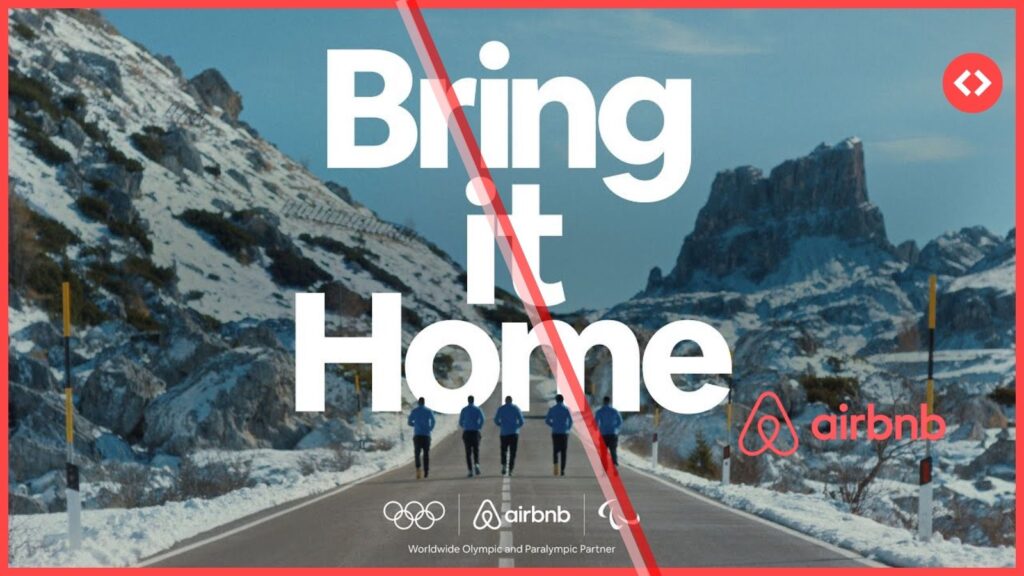
On January 23, 2026 Airbnb released Bring It Home is a short documentary directed by Walter Thompson-Hernández. It follows six Olympic and Paralympic hopefuls supported by the Airbnb Athlete Travel Grant:
- Donovan Carrillo (Figure Skating, Mexico)
- Laura Vargas (Skeleton, Colombia)
- Edson Bindilatti (Bobsled, Brazil)
- Andrea Macrì (Para Ice Hockey, Italy)
- Joanna Butterfield (Wheelchair Curling, Great Britain)
- Asa Toyoda (Snowboarding, Japan)
The film’s core message is simple:
“Home is fundamental for performance.”
There is no aggressive branding. No promotional crescendo. The tone is restrained, observational, and human.
Athletes speak about:
- Living out of suitcases
- Missing weddings and birthdays
- Funding careers independently
- Mental health pressure
- Representing nations rarely seen in winter sports
Strategically, this matters.
Airbnb isn’t positioning itself as a marketplace. It’s positioning itself as infrastructure, the stability layer that enables global movement.
That narrative builds emotional legitimacy.
Built for the Feed: The Real Distribution Strategy
If the documentary builds emotional depth, the Shorts build reach.
Alongside the film, Airbnb released a steady stream of YouTube Shorts:
- “Donovan Carrillo Brings It Home”
- “Laura Vargas Brings It Home”
- “Edson Bindilatti Brings It Home”
- “Andrea Macrì Brings It Home”
- Jamaican Bobsled Team house tours
- Athlete Q&A clips
- “Always On” mindset ”
- Jamie Anderson’s Airbnb Experience breakdown (subtly promoting Airbnb Experiences, a product Airbnb has been aggressively expanding through recent city-led campaigns).
These are vertical, fast-cut, platform-native edits designed for mobile-first consumption. The pacing is tighter. The framing is intimate. They feel TikTok-native, not broadcast derivatives.
This isn’t random creative output. It’s distribution architecture.
And property managers should care because this is how travel discovery is shifting.
Milano-Cortina 2026: The First Truly Gen Z Winter Games
The age distribution of athletes at Milano-Cortina 2026 tells a powerful story. Across most winter disciplines, average ages cluster between 20–28. Snowboarding and freestyle skiing skew even younger. One freestyle athlete highlighted in broader coverage is just 16.
This is the Gen Z Olympics.
And Gen Z athletes are creators:
- They share behind-the-scenes moments
- They discuss mental health openly
- They build audiences before medals
- They use TikTok, Reels, and Shorts as primary channels
The International Olympic Committee (IOC) accelerated this transformation by relaxing social media restrictions ahead of Paris 2024. The “Team USA Creators” initiative reportedly generated around 100 million views.
Milano-Cortina builds on that momentum.
Airbnb’s content strategy mirrors this media shift:
- Long-form for emotional storytelling
- Short-form for algorithmic amplification
- Athlete-first narratives
- Minimal hard selling
Gen Z is Airbnb’s future traveler demographic.
Milano-Cortina is a generational stage.
The Legitimacy Play: Why Global Events Matter Beyond Revenue
Here’s the deeper layer.
Brian Chesky has previously suggested that major global sporting events — particularly when executed in collaboration with governments, offer opportunities to demonstrate Airbnb’s positive economic and civic contribution.
The data supports why that matters.
Our Winter Olympics analysis showed:
- Supply growth of up to 56% in some markets
- ADR increases nearing 200% in Cortina
- RevPAR surging despite lower occupancy
- Professional managers outperforming event-only hosts
Mega-events make short-term rentals economically visible.
They expose accommodation shortages.
They reveal demand exceeding hotel capacity.
They force tourism policy conversations.
At the same time, Airbnb’s campaign reinforces a parallel narrative — one of cultural participation rather than pure economics.
By embedding itself in:
- Paralympic inclusion
- Emerging winter nations
- Underdog athlete stories
- Travel infrastructure support
Airbnb positions itself as a contributor to the Olympic ecosystem, not merely a booking intermediary.
In European cities where short-term rental regulation remains politically sensitive, that distinction matters.
Because regulation is shaped as much by perception as by data.
The Strategic Signals Property Managers Should Read Behind the Spectacle
There are three structural shifts here:
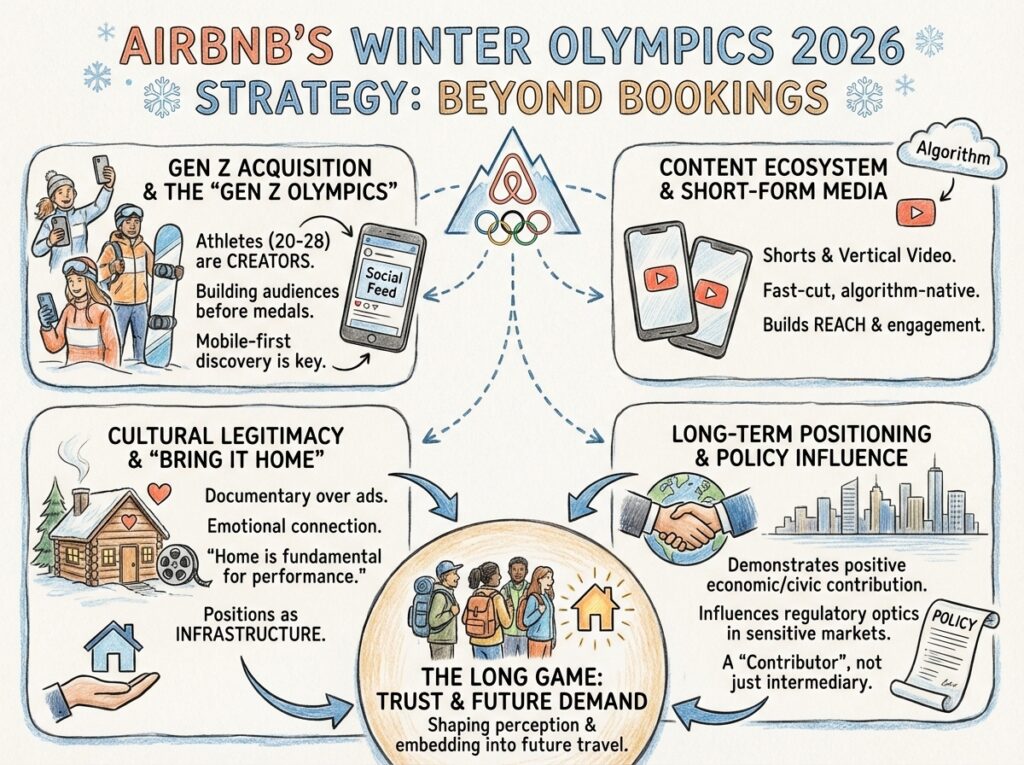
1. Events Are Now Content Ecosystems
Demand spikes are surrounded by narrative framing. Platforms shape perception alongside pricing.
2. Gen Z Will Redefine Travel Discovery
As we noted in our 2026 Travel Trends report, data from Airbnb, Expedia, and Booking.com shows Gen Z driving event-led and emotionally intentional travel. Discovery increasingly happens through short-form and social platforms before traditional search.
The Olympics are now consumed the same way.
The next wave of demand won’t be driven by static listings alone, it will be shaped by algorithm-native storytelling.
3. Platform Positioning Influences Policy Climate
How Airbnb is perceived during high-visibility global events affects long-term regulatory discussions, which in turn influence supply conditions and competitive landscapes.
Final Thought
Milano-Cortina 2026 isn’t just about peak-season pricing. It’s about narrative control.
The opening-week data showed pricing power. The content strategy shows platform power.
Together, they reveal how Airbnb is embedding itself into the future of travel demand, media consumption, and regulatory optics.
For property managers, the lesson isn’t just to optimize rates during mega-events. It’s to understand the bigger platform strategy unfolding around them.

Snigdha Parghan is a Content Marketer at RSU by PriceLabs, where she creates articles, manages daily social media, and repurposes news and analysis into podcasts and video content for short-term rental professionals. With a focus on technology, operations, and marketing, Snigdha helps property managers stay informed and adapt to industry shifts.