

Updates in short-term rental policies this week:
Spain reissued its two housing decrees on October 6, one day after calling a November 29 snap election, while Alameda pulled final passage of its primary-residence rule from the October 6 agenda.
- What changed: Spain’s government reissued both decrees four days after Congress rejected them, and Alameda’s City Council advanced a rule on September 15 that would limit short-term rentals to a host’s primary residence. PriceLabs‘ Global Host Report 2026 found that 53% of respondents fear regulation will hurt their revenue, up from 48% and the only worry that rose.
- Who it impacts: Managers with Spanish inventory, operators evaluating Alameda or other California acquisitions, and portfolios concentrated in a single jurisdiction.
- What to watch: The Diputación Permanente’s validation decisions on Spain’s decrees within the 30-day window, Alameda’s next council vote, and the November 29 election.
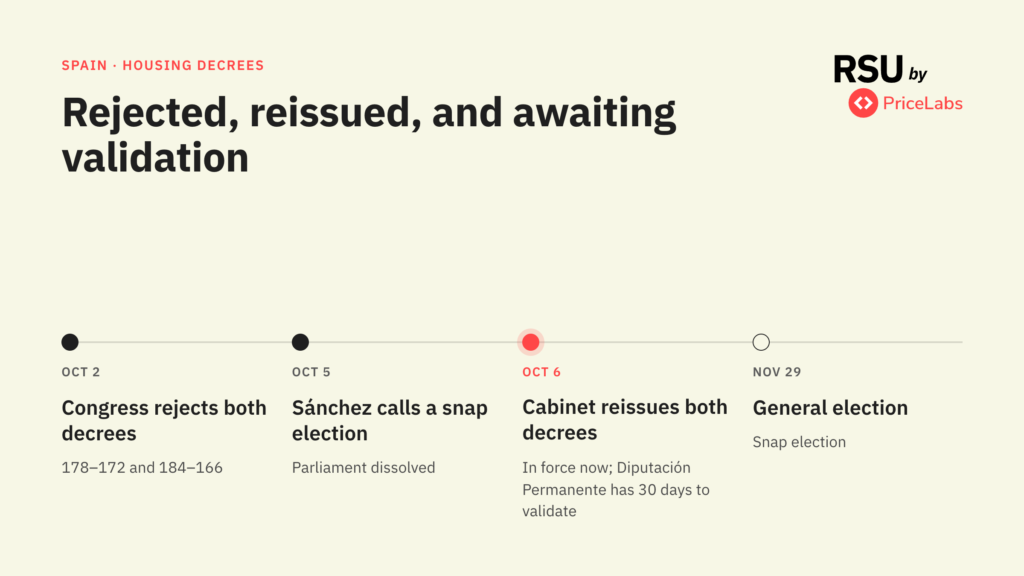
Spain reissued its two emergency housing decrees on October 6, one day after Prime Minister Pedro Sánchez called a November 29 snap election and four days after Congress voted the decrees down. The reissued package keeps the short-term rental policies, and its fate now rests with a smaller parliamentary body while the election campaign runs.
The reversals land as operators grow more anxious about short-term rental policies. In PriceLabs’ Global Host Report 2026, 53% of respondents said short-term rental rules will hurt their revenue, up from 48% a year earlier. In California, Alameda advanced a primary-residence requirement on September 15, then pulled the final vote from its October 6 agenda.
Spain reissued its housing decrees one day after calling an election
- Congress rejected both emergency housing decrees on October 2, by 178 to 172 and 184 to 166, after Junts voted against them alongside the PP and Vox.
- Sánchez called a snap election for November 29 on October 5.
- The cabinet approved both decrees again on October 6, with only minor changes, according to Olive Press reporting.
- The reissued package introduces new short-term rental rules and tougher taxes on tourist apartments.
- The decrees took effect on approval, and Spanish law gives parliament 30 days to validate them.
- Parliament is dissolved, so the Diputación Permanente, made up of 68 MPs plus the Congress president, will decide on validation.
- Junts’ support is no longer decisive for the first decree, but the second faces a harder vote because the PNV opposed it on October 2.
Aishwarya’s Views
- Plan for short-term rental policies that change mid-contract: Two housing decrees have now been voted down and reissued within four days, with a national election pending. Rules can be in force, unvalidated and replaced again inside a single month, which makes revenue hard to underwrite.
- Managers can add compliance-change clauses to direct booking terms and owner contracts, so a sudden rule change can be handled without breaching either one.
- Model the tax measures before validation: RSU’s October 1 coverage of the original decree described a 10% VAT on stays up to 30 nights and IBI surcharges of up to 150%.
- If the reissued package keeps those measures, managers with Spanish inventory can model net revenue under them now, while validation is still open.
Alameda advances a primary-residence rule, but final passage is on hold
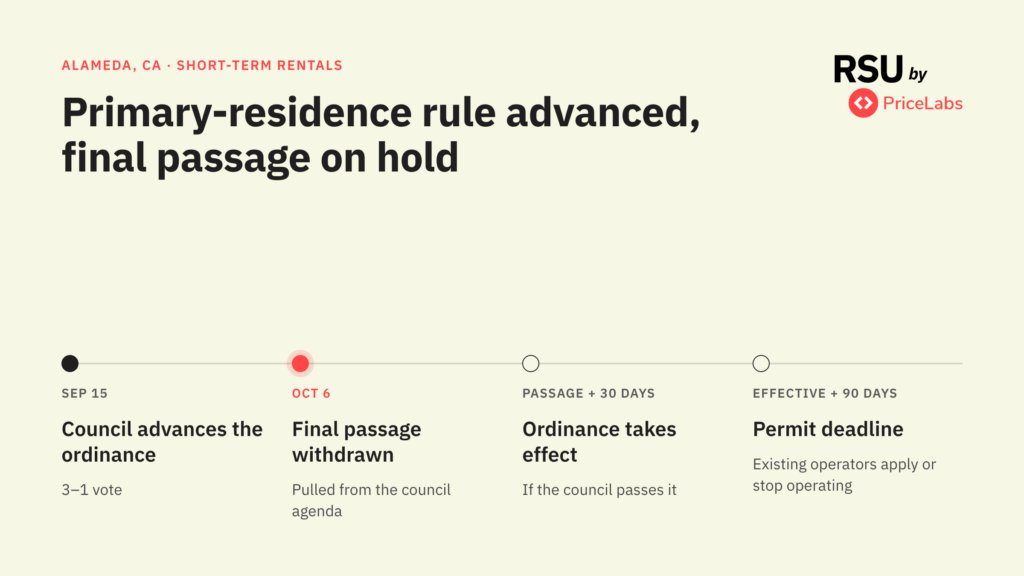
- Alameda’s City Council voted 3-1 on September 15 to advance an ordinance that would limit short-term rentals to a host’s primary residence.
- The city listed final passage for October 6, then withdrew the item from that agenda.
- Owners could also host in another unit on the same property, up to four units and one at a time, and renters could host in their own home with the owner’s written consent.
- Operators with at least one year of hosting before adoption could keep operating outside the primary-residence rule, but the exception would not pass to later buyers.
- ADUs and JADUs would be barred from short-term use unless the host lives in them, with an exception for legacy hosts whose ADUs were created before 2017.
- Existing operators would have 90 days from the effective date, which is 30 days after final passage, to apply for a permit or stop operating.
- Operators would need $1 million in liability insurance unless a platform provides similar coverage, a permit number on every listing, and a local contact who can respond in person within 60 minutes.
Aishwarya’s Views
- Legacy status becomes an asset: Alameda’s draft lets existing operators continue but does not transfer that right to later buyers.
- Managers can document each client’s operating history now and underwrite any Alameda acquisition without legacy rights.
- Growth stops at the host’s own address: Operators without legacy status could not add unhosted units in Alameda, so expansion there would mean mid-term or long-term leasing.
- Until the council votes again, every provision above remains proposed, so managers can prepare permit paperwork without restructuring portfolios yet.
- ADU bans spread across California: Alameda joins Burlingame, Daly City, Hercules and Piedmont in barring short stays in ADUs.
- Operators evaluating California acquisitions can underwrite on the primary structure’s revenue alone.
Regulation is the only worry that grew in PriceLabs’ Global Host Report
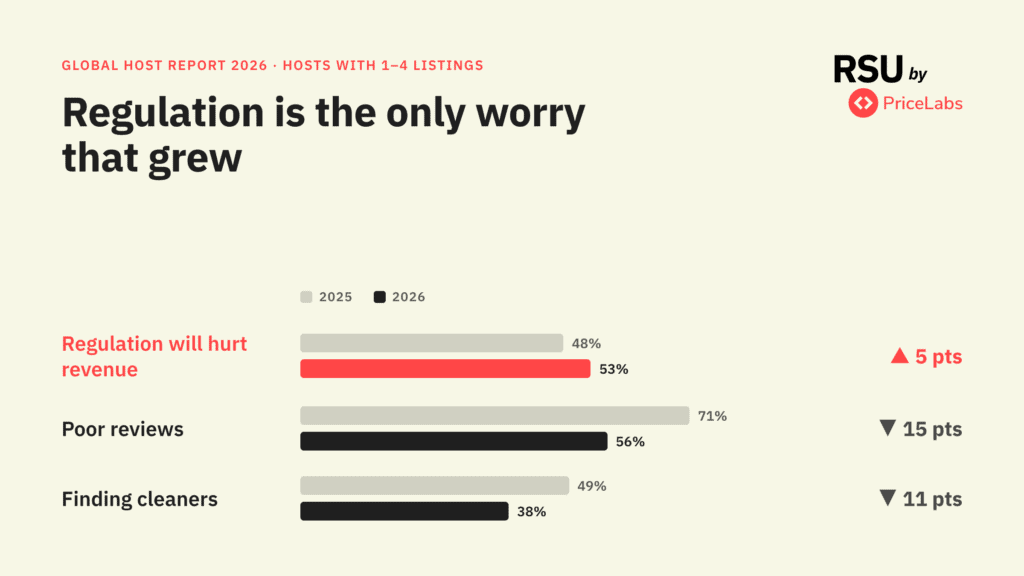
- PriceLabs’ Global Host Report 2026 found that 53% of respondents managing one to four listings fear regulation will hurt their revenue, up from 48% in 2025.
- Regulation was the only worry in the report’s ledger that rose. Concern about poor reviews fell from 71% to 56%, and difficulty finding cleaners fell from 49% to 38%.
- Regulation ranks third among the five worries, behind marketing and ranking at 63% and poor reviews at 56%.
- The share of respondents who say keeping up with short-term rental policies and regulations takes real effort rose from 41% to 46%.
Aishwarya’s Views
- A worry with no lever: The report describes regulation as the item operators can do least about, which helps explain why it rose while worries that respond to effort, tools or time eased. This week’s Spanish reversals and Alameda’s pulled vote show how little operators control the timing.
- Concern runs higher among larger operators: RSU’s regulations coverage cites the Global Property Manager Report 2026, where 62% of operators running five to fifty properties worry about regulatory change.
- Managers can reduce single-jurisdiction exposure by spreading portfolios across municipalities and mixing short-term with mid-term leasing, so one council vote does not decide an entire revenue stream.
Operators tracking short-term rental regulation have two dates to watch. Spain’s Diputación Permanente will decide whether to validate the reissued decrees within the 30-day window, ahead of the November 29 election, and Alameda’s ordinance still needs a final council vote before any of its provisions take effect.

Related Articles:
 France’s New Anti-Airbnb Law: What It Means for the Vacation Rental Industry
 Airbnb Under Fire in Spain: What the 66,000 Listing Purge Means
 California’s Crackdown Widens: Beverly Hills Moves to Ban Short-Term Rentals Entirely
 Pennsylvania Advances Caps, Italy Enforces New Tax Rules, Ventura Hikes Fees and Caps Permits