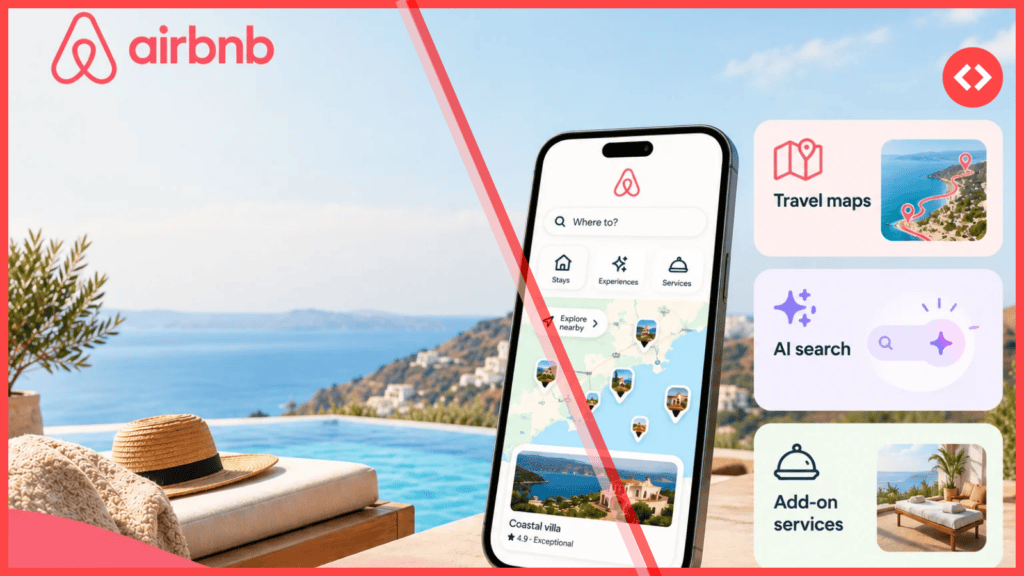
Airbnb has spent years saying it wants to be a real-life social network rather than a booking site. The Airbnb fall update 2026, published on September 30, 2026, is the clearest move toward that so far: guests can now connect with people they know, see where those people stayed, and explore an area inside Airbnb, while an AI layer sits over the search, the filters and the comparison that follows.
For hosts and professional managers, that combination changes two things at once: where a booking originates, and what a listing is judged on once a guest is looking at it. Here is each guest feature, where it is live, and what it means for your listings. The host tools announced in the same update are covered in our fall update article for hosts.
Airbnb Fall Update 2026: New Guest Features and Where They Are Live
| Guest feature | What it does | Where and when |
|---|---|---|
| Connect | Links a guest’s profile to people they know | Airbnb has not stated a market |
| Travel Map | Shows where connections stayed and where they are going | Airbnb has not stated a market |
| Neighbourhood pages | Area overviews with things to do, food and transport | Paris first, more to come |
| AI search with voice | Plain-language or spoken search across homes, experiences and services | US launch |
| AI filters | Typing a keyword surfaces the related filters | US launch |
| AI listing descriptions | Airbnb-written summaries of a home in search results | US launch |
| AI comparison | Side-by-side view of saved homes with AI summaries | Announced at the summer release, now launching in the US |
| AI customer support | Chat in more than 50 languages, voice support coming | No market stated, not US-only |
| New add-on services | Meal delivery, laundry, baby gear, gear rental | Varies by market, see below |
Airbnb describes the AI features as “starting in the US,” so treat the US column as a launch market rather than confirmation that every feature is live for every US guest today.
Airbnb Connect and Travel Map: Guests Can Now See Where Their Friends Stayed Before They Search
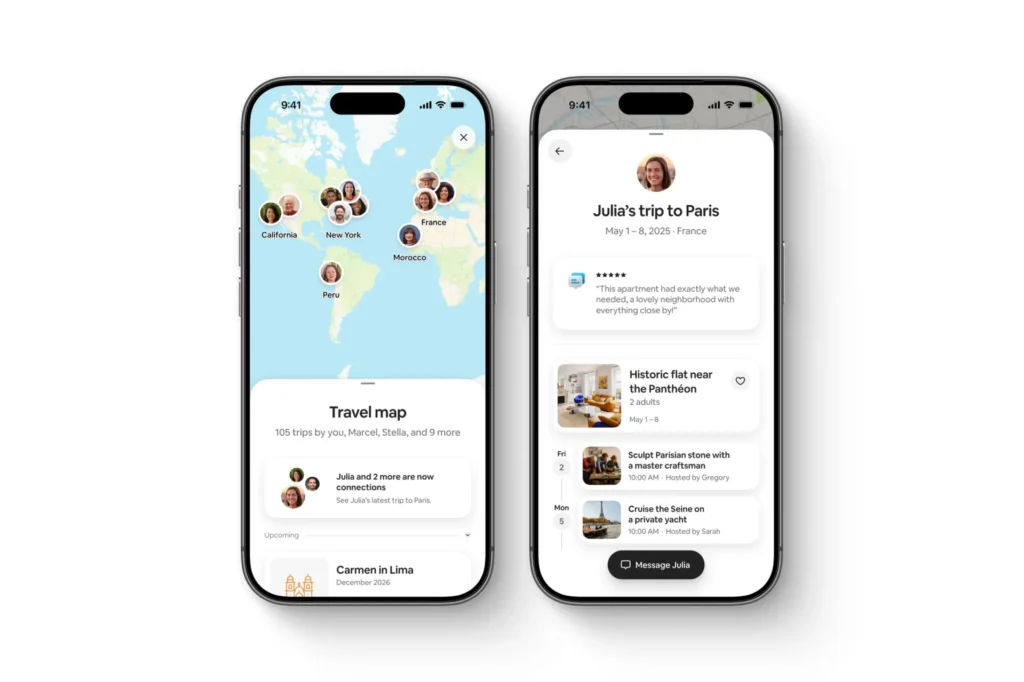
Airbnb’s social features now cover stays, not just experiences. According to Airbnb, guests can:

- Invite people they know to Connect, and see each other’s trips once connected
- View where connections have travelled, or are going next, on an interactive Travel Map
- Explore where a connection stayed, and which experiences and services they booked
- Read a connection’s reviews, save a stay to a wishlist, or message that person in the app
- Receive suggested connections based on past trips
The map fills in as a guest adds more connections, so the feature rewards people who invite several friends rather than one. On privacy, Airbnb says guests choose which trips appear and how much of each trip they share, and can hide a trip, remove it, or block a connection at any time. Connections are mutual.
We first covered Airbnb’s social ambitions when the platform let guests connect with people from shared experiences, which we described at the time as a real-life social network: people meet offline first, then connect on the platform.
The direction was visible in May too. Airbnb invested $58 million in WeRoad, an Italian company that sells group trips to travellers who do not want to travel alone, and hired its CEO as VP of Hotels. WeRoad’s standout number is that 60% of its customers book again, which it attributes to people coming home from a trip with new friends. The Travel Map applies that idea to ordinary stays.
Word of mouth is already one of Airbnb’s biggest strengths. In Airbnb’s Q2 2025 earnings call, CEO Brian Chesky said “90% of our traffic coming from direct and unpaid sources continues to be the state of the business.” Connect extends that, and gives Airbnb a signal that search history cannot provide: where a guest’s friends stayed, what they saved, and what they liked.
What it means for hosts
Guests may now arrive at your listing already sold on it, or already put off, based on what a friend’s map showed them. Reviews and repeat stays travel through personal networks rather than only through your listing page, which makes a past guest’s experience visible to people you will never message. A stay that disappointed one guest is now visible to everyone they connect with.
Airbnb Neighbourhood Pages: Guests Can Now Explore an Area Before Picking a Listing
Tapping the map opens an overview of an area: what it is like, things to do, where to eat, and how to get around, with top experiences from local hosts attached. Airbnb says these pages are built from what guests and hosts tell the company, alongside other sources. They start in Paris, with more neighbourhoods to come.
Until now, a traveller comparing the 11th arrondissement with Montmartre left Airbnb to do that research. The neighbourhood page keeps that decision inside the app, next to the listings.
What it means for hosts
Guests now pick the area inside Airbnb, before they compare individual listings. If your property sits in a neighbourhood Airbnb has not yet written up, or one its page describes unfavourably for a given trip type, that filtering happens before anyone sees your photos. The local guidance many managers put into welcome packs and digital guidebooks is also now reproduced at platform scale, partly from information hosts supplied.
Airbnb AI Search and Voice: Guests Describe the Stay They Want Instead of Setting Filters
AI search is now launching in the US. Guests can search across homes, experiences and services “using your own words or voice,” according to Airbnb.
Airbnb briefly tested natural language search with US users in May, as RSU reported five days before the summer release, then removed it. It wasn’t part of the summer 2026 release announcements. What’s new now is the official launch, and voice.
Two related changes sit alongside it:
- AI filters. Typing a keyword surfaces the related filters rather than making a guest scroll the list. Airbnb’s example is “baby,” which brings up cribs, playgrounds and children’s books and toys. Those filters draw on the amenities hosts tick on their listing.
- AI listing descriptions. Search results now carry Airbnb-written summaries of what it considers a home’s key features, shown alongside the host’s own photos and title.
Spoken searches also tend to be longer and more specific than typed ones, which gives the model more to match a listing against.
What it means for hosts
An untagged amenity is an invisible amenity. If a guest types “baby” and your crib lives in a sentence in your description rather than in the amenity field, your listing is not in that filter. The AI-written summary in search results is also the first description many guests will read, and you did not write it, so the structured fields it draws on now carry the weight your prose used to.
Airbnb AI Comparison: Airbnb Chooses Which Features Two Listings Are Judged On
AI-powered side-by-side comparison was announced at the summer release and is now launching in the US. Guests can put homes from a wishlist into a single display, with AI summaries of the key features of each.
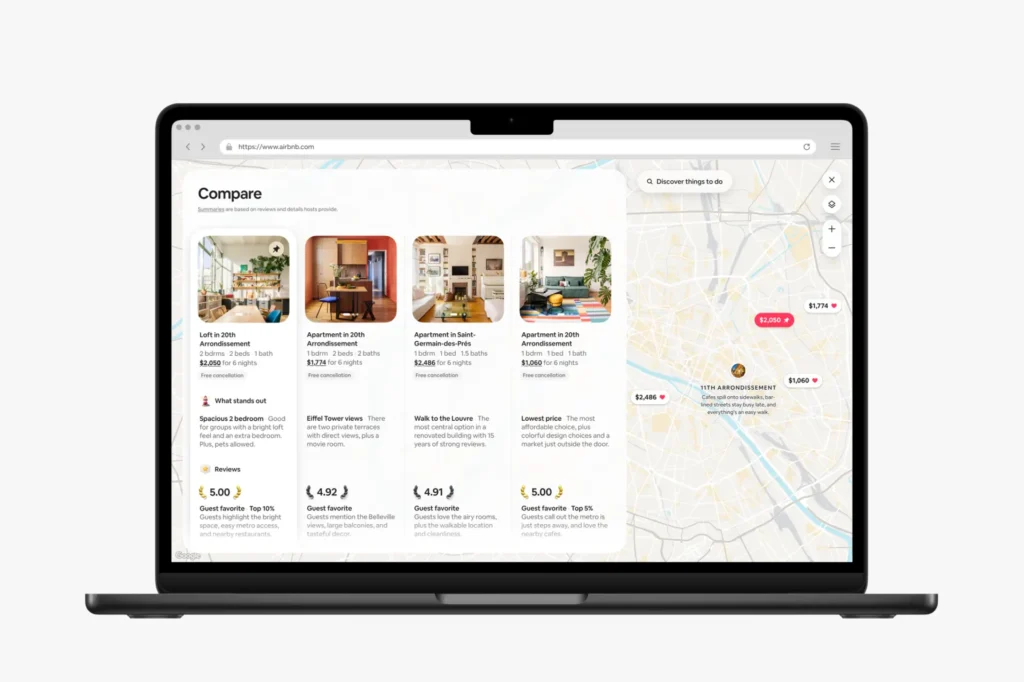
Shortlisting used to mean opening several tabs and reading each listing in full. Airbnb now draws that comparison itself and selects which attributes to line up.
What it means for hosts
You compete on what the AI picks out, not on what your description emphasises. If the model decides a comparison turns on outdoor space, layout and walkability, those attributes need to be present and structured in your listing, whatever your copy leads with. I think this is the change in the update with the most direct effect on conversion, because it sits at the moment a guest chooses between you and one other property.
Airbnb AI Support: Guests Get Answers in More Than 50 Languages Without Messaging the Host
AI chat support now runs in more than 50 languages, and Airbnb says voice support is coming so guests can get answers over the phone. Airbnb has not limited this feature to the US.
What it means for hosts
A guest’s first contact about a problem during a stay is increasingly with Airbnb rather than with you, which removes some messaging load and also removes some of your visibility into what went wrong. For hosts taking international bookings, multilingual support arguably reduces one of the reasons a traveller might prefer a large hotel chain over an individual property, though Airbnb has published nothing to confirm that effect.
More Add-On Services Guests Can Book With a Stay
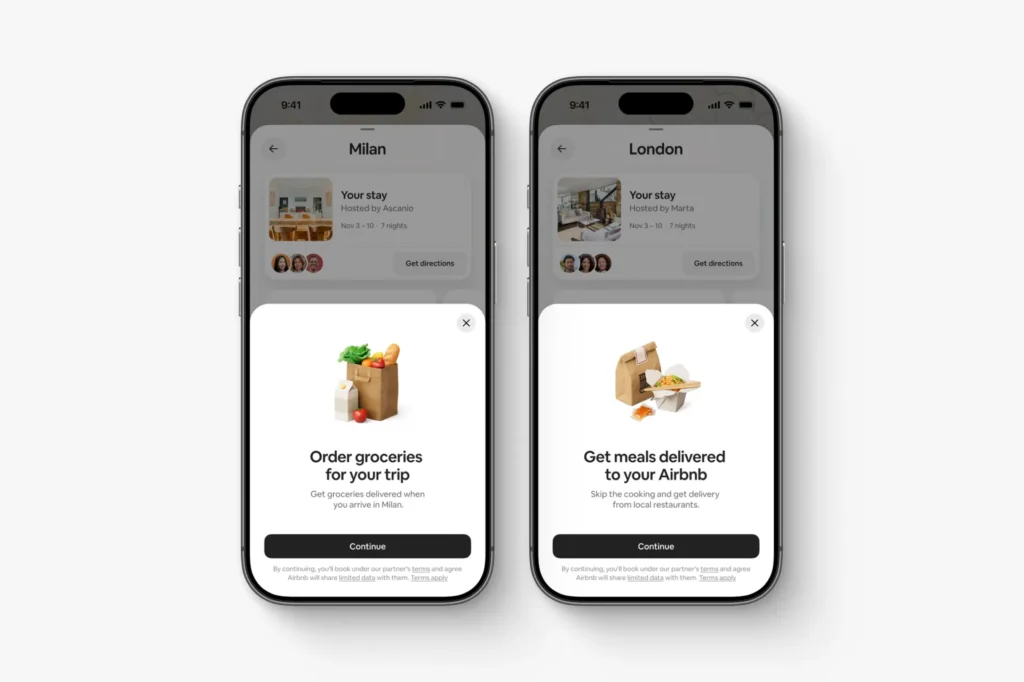
Airbnb is expanding the services guests can book alongside a reservation, fulfilled by partners and rolling out through the end of 2026. Meal delivery and an expanded grocery service are coming to Europe, laundry and baby gear are launching in US cities, and ski and snowboard rental arrives in the French Alps alongside boat rentals in South Florida.
What it means for hosts
Aervices many managers sell at a small margin now sit inside the Airbnb app, usually with a discount attached, and outside the Phoenix and Orlando grocery stocking option the host is not part of the transaction.
The full market-by-market breakdown, the partner list and the discounts attached to each are in our fall update article for hosts.
One Update, Two Regions: What Hosts Should Take From the Airbnb Fall Update 2026
The release reads as a single global announcement but lands unevenly. Airbnb names the US as the launch market for AI search, filters, listing descriptions and comparison. It names Paris for neighbourhood pages. It names specific countries and cities for each new service. For Connect, the Travel Map and multilingual AI support, it names no market at all.
That leaves most hosts outside the US with the social features and the services, and little of the discovery layer, at least for now. It also means the features Airbnb has been least specific about are the ones with the widest potential reach.
Three practical conclusions follow for hosts.
- Audit your structured fields before the AI features expand. Every amenity, every detail currently sitting in a paragraph rather than a tagged field, is content the AI filters and the comparison view cannot read. Markets outside the US get these features eventually.
- Treat a disappointed guest as a visible event, not a private one. Connect makes a past stay legible to everyone that guest connects with, which changes the cost of a bad turnover.
- Check how your neighbourhood reads. If Airbnb writes a page about your area and it does not mention what your property is actually near, that gap is now in front of guests before they reach your listing.
Airbnb has not said when the AI features reach other markets, how many neighbourhoods follow Paris, or whether a host can correct an AI-written description that misstates a property.

Guneet has spent five years working at PriceLabs, developing deep expertise in short-term rental operations and hospitality technology. She brings that practitioner’s lens to her writing at RSU, covering platform updates and making sense of market data for property managers.
Related Articles:
 Airbnb Launches Co-Host Marketplace in Japan, Vrbo to Delist Poor Listings, Booking.com Bets Big on India and AI
 Airbnb’s AI Era Isn’t About Automation, It’s About Emotion and Understanding
 Airbnb’s Fourth Pillar: How AI Became a Strategic Defense Against an AI Future
 What Airbnb’s New Privacy Terms Reveal About Its AI Plans for Summer 2026