
Vrbo’s switch to a single 12% commission simplifies what hosts pay, and for most of them it also raises it. The bigger question for property managers is how to respond.
Vrbo’s email suggests hosts “review and adjust your rates accordingly.” Its new Host Terms, effective the same day, link what hosts offer on Vrbo to what they offer everywhere else.
Vrbo 12% commission will be applied to all hosts starting October 29, 2026
In an email to hosts on September 29, Vrbo said: “Beginning October 29, 2026, you will transition to a single, transparent 12% commission fee.” Vrbo says the goal is to help “travelers find the most competitive rates,” with a commission “lower than many of our competitors.”
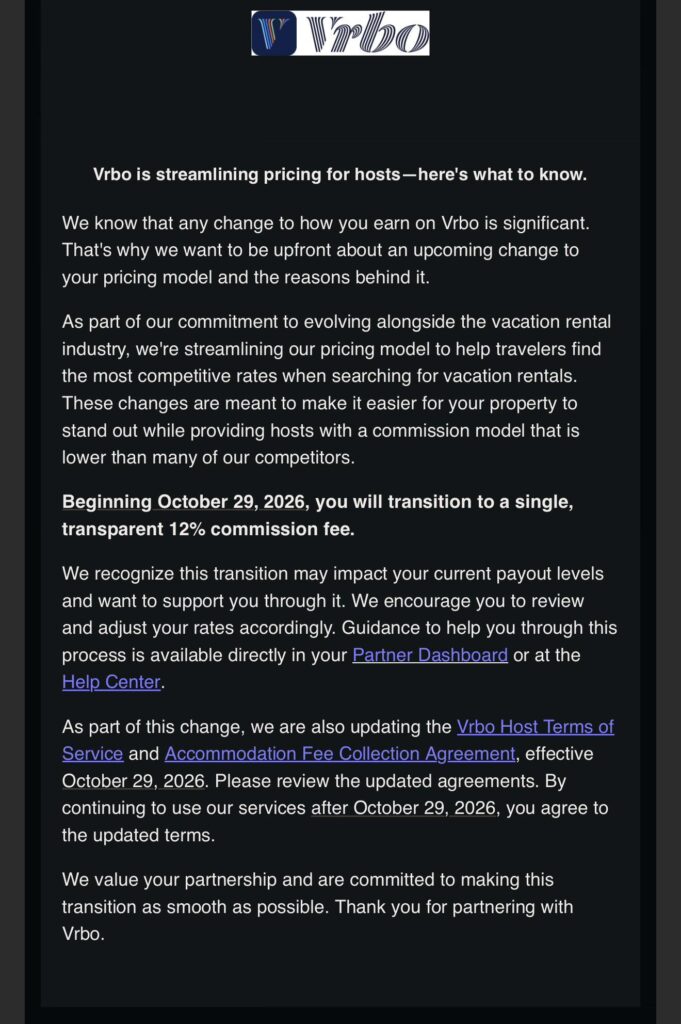
The email also acknowledges the change “may impact your current payout levels.” For most hosts, the new rate is higher than what they pay today.

| Host type | Before October 29 | From October 29 |
|---|---|---|
| Pay-per-booking, no PMS | About 8% (5% commission + 3% payment processing) | 12% |
| Pay-per-booking, PMS-connected | 5% | 12% |
| Legacy annual subscription | Flat yearly fee | Not disclosed by Vrbo |
PMS-connected property managers see the largest change
For managers connected through a PMS, the commission goes from 5% to 12%. On a $1,000 booking, that is about $120 instead of $50.
PMS-connected listings make up a significant share of Vrbo’s supply, and most are run by professional managers. That places the largest change on the operators who list the most inventory on Vrbo.
Two agreements change on the same date
Vrbo is also updating its Host Terms of Service and its Accommodation Fee Collection Agreement, both effective October 29. According to the email, hosts who keep using Vrbo after that date accept the updated terms.
Unlike Airbnb, Vrbo keeps a guest service fee
The obvious comparison is Airbnb, which recently moved to a host-only fee. Airbnb presented that change as a restructure to simplify pricing for guests: fees moved off the guest’s side, so guests see one price.
Vrbo’s email does not mention guest fees, and its guest fee appears to stay in place. Vrbo’s help article on the service fee still describes it as “a percentage of the reservation total (before taxes and refundable fees) that the traveler pays at checkout,” adding that “the percentage varies depending on the reservation amount.” The new Host Terms also keep a guest “Service Fee.”
Why the guest fee matters for hosts
With a guest fee in place, travelers on Vrbo still see the host’s rate plus Vrbo’s fee. Vrbo has not publicly said whether that fee will change alongside the new commission.
It is possible Vrbo lowers the guest fee, which would narrow the gap in what guests pay. Until it says so, hosts are comparing a higher commission against a guest-facing total they can’t fully see.
Adjusting rates on Vrbo alone is more complicated under the new terms
Faced with a higher commission on one channel, many managers would raise their rates on that channel. Vrbo’s new Host Terms add a complication.
The terms never use the words “rate parity.” In effect, though, they create a parity obligation that covers both nightly rates and add-on fees.
What the parity obligation says
Section 4.5.7 of the new Host Terms requires hosts to give Vrbo “Content and Host Ancillaries” that are “at least as complete, accurate, current, detailed, and favorable” as what they offer on other channels. The terms define both:
- Content (Section 5.5.1) includes “availability, rates, discounts, fees, taxes, cancellation policies, booking conditions.”
- Host Ancillaries (Section 5.5.2) covers add-ons such as early check-in, cleaning options, parking and pet fees, whether “optional or mandatory.”
The channels named are broad:
- A host’s “own websites, applications, booking engines”
- “Property management systems”
- “Any third-party booking, marketing, advertising, distribution, metasearch, AI-enabled agent” or other channel
Section 12.7.2 adds that listings may not be “materially more complete, accurate, current, structured, machine-readable, searchable, bookable, or useful to travelers” on any other channel, unless the law requires it or Vrbo approves in writing.
Rates also appear in how Vrbo ranks listings. Section 7.1 lists “rate consistency” among the factors in a listing’s quality score, alongside calendar accuracy, response times and host cancellation rate. The terms do not define what rate consistency measures.
What it means for pricing
The obligation is consistent with Vrbo’s stated goal of showing travelers competitive rates. For hosts, it means rates and fees on their own site or other channels should not be more favorable than on Vrbo.
That makes a Vrbo-only price increase harder to square with the terms. The practical choice is between adjusting rates across channels and absorbing more of the commission on Vrbo bookings.
Parity obligations have drawn regulatory attention in Europe
European regulators have acted on parity before. On September 28, the European Commission published a factsheet on Booking.com explaining how the Digital Markets Act (DMA), the EU law governing the largest online platforms, lets accommodation providers set different prices and conditions on other channels.
The DMA applies only to platforms the Commission designates as “gatekeepers,” which does not include Vrbo. Still, it is possible that parity obligations draw scrutiny in markets where regulators have already acted.
What Vrbo has not disclosed yet
Several details that affect what hosts will pay are still open.
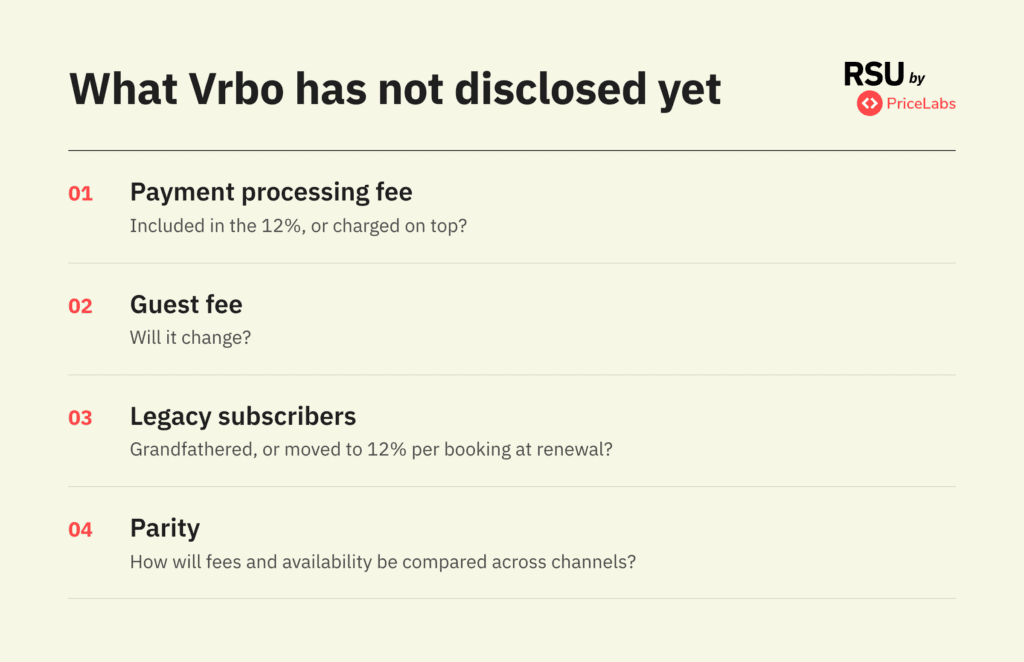
- Whether payment processing is on top of the 12%. The email describes a “single” commission. The new Host Terms still list “a commission” and “a payment processing fee” as separate charges, and the new Accommodation Fee Collection Agreement says any processing fee rate will be shown on a separate disclosure page.
- The new guest fee. Vrbo has not said whether it will change.
- Legacy subscribers. Vrbo has not disclosed whether current annual subscribers will be grandfathered or moved to 12% per booking when their term ends. The new terms say only that Vrbo “is not accepting new Subscription Listings and may not allow the renewal of prior Subscription Listings.”
- How parity will be applied. The terms don’t say how Vrbo will compare fees and availability across channels.
What Vrbo’s commission change means beyond Vrbo
The new commission and the new terms work together. A fee set on one channel now connects to pricing across every channel a manager sells on.
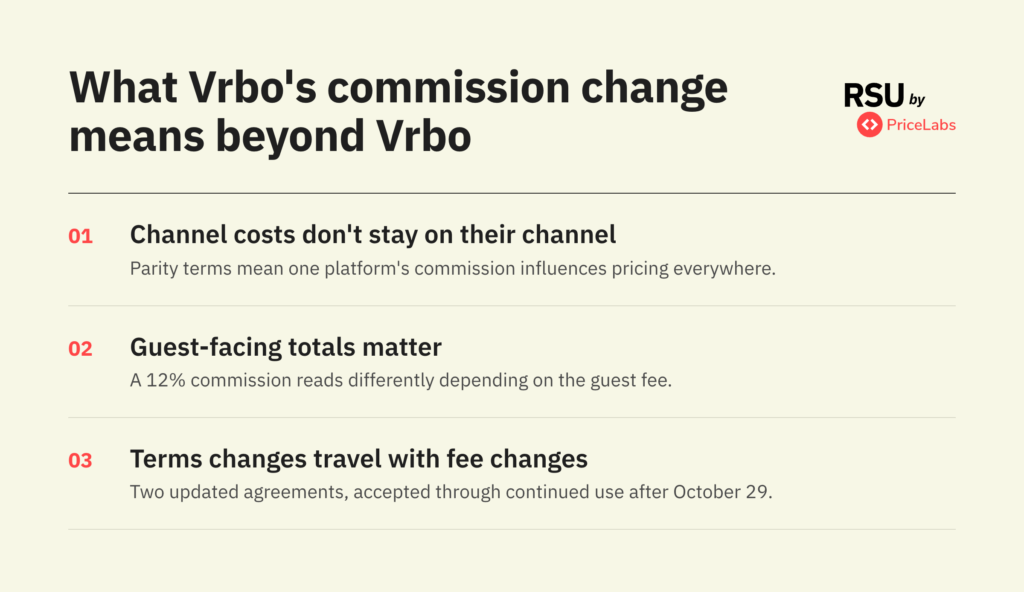
- Channel costs no longer stay on their channel. When a platform’s terms require offers at least as favorable as a host’s own site, its commission influences pricing everywhere.
- Guest-facing totals matter as much as the headline fee. A 12% commission reads differently depending on the guest fee alongside it.
- Terms changes travel with fee changes. Vrbo’s new rate arrived with two updated agreements, accepted through continued use after October 29.
RSU will keep tracking how Vrbo applies the new terms, including any update on guest fees and legacy subscriptions.

Uvika Wahi is the Editor at RSU by PriceLabs, where she leads news coverage and analysis for professional short-term rental managers. She writes on Airbnb, Booking.com, Vrbo, regulations, and industry trends, helping managers make informed business decisions. Uvika also presents at global industry events such as SCALE, VITUR, and Direct Booking Success Summit.
Related Articles:
 Airbnb Launches Co-Host Marketplace in Japan, Vrbo to Delist Poor Listings, Booking.com Bets Big on India and AI
 Vrbo’s Rolls Out New Promotions Suite: What Managers Should Know
 Vrbo’s Host-Initiated Cancellation Policy: Why Property Managers Are Worried
 Vrbo Members Only Deals Shift to Auto-Enrollment: What Hosts Need to Know by September 10