At VRMA International in Nashville, I designed and co-presented a session where a room of property managers scored their own company on a four-stage AI scale, function by function. Most put themselves at a 2 out of 4, a few at a 3 in one or two places, and nobody I heard claimed a 4.
Why it matters: Moving to 4 is rarely a technology change; it is about someone in your company owning the rules that define when the full AI automation kicks in. If you were not in Nashville, I’m giving you here the chance to run the same scorecard by yourself, and then with your team.
Key takeaways
- Michael Vialpando scored Renjoy, a company further along than most, at 3 in four functions and 2 in the other two.
- Two camps are forming: managers building their own AI tools on top of their software’s connectors, and managers waiting for their software vendors to ship AI agents. Both are legitimate, and both work.
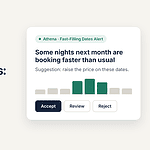
- An AI revenue analyst such as PriceLabs‘ Athena is a solid 3, with one foot on the line.
Do it yourself, now and later with your team. Download the scorecard (PDF): the sheet I handed out at VRMA Nashville. Download the team guide (PDF): it will help you run the same workshop with your team leaders.

Why I was nervous about an AI workshop at VRMA 2026
I came back from Nashville with my favorite kind of souvenir. Not (just) a Dolly Parton t-shirt or a Bless Your Heart sticker, but the memory of a room full of property managers telling each other what they are actually doing with AI.
Each and every vendor in the exhibition hall was showcasing its agents, chatbots, AI-powered this and AI-guided that, and some of these tools were weeks old. So, I wanted to know what AI tools your VRMA peers are running today, in which function, and whether it works. That is a question you can only answer by asking them, which was the whole point of the workshop Michael Vialpando of Renjoy and I hosted.
As you may know, Rental Scale-Up is published by PriceLabs, and I run product marketing there. Nashville was also where we launched Athena, our AI revenue analyst, which the RSU team covers in a separate article.
When VRMA selected “Map Your Team Against AI” back in the summer, I was not sure anyone would come. A self-assessment could feel either too basic for the people building things or too abstract for the people who have not started. We were also scheduled at noon on the Monday, against lunch and against a revenue workshop my own CEO Richie was running next door. Tough competition!
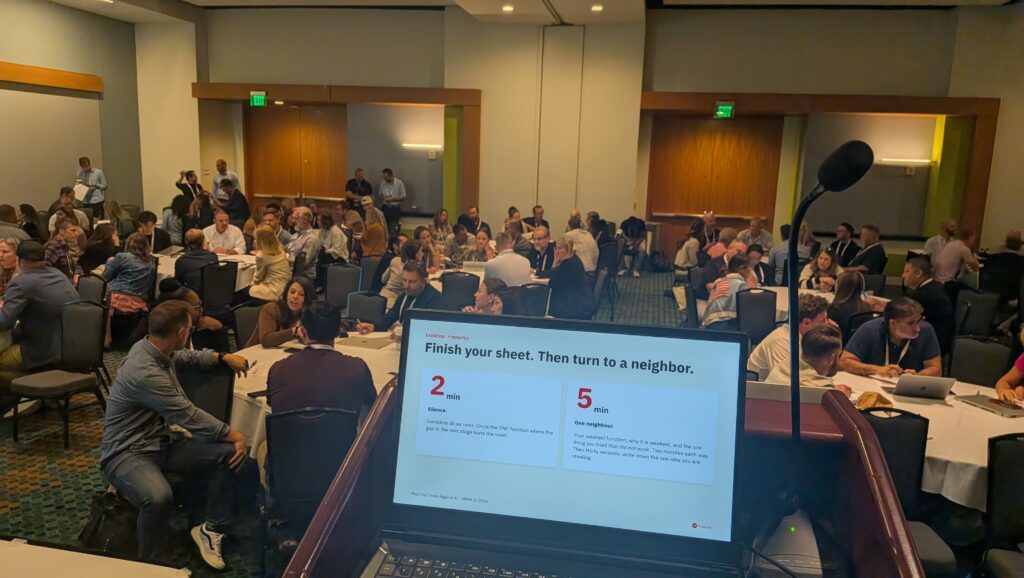
So, what happened? The room was full, with people standing along the walls, and it stayed full for the 45 minutes. Managers are not tired of AI, they are tired of being told about AI. Give them a good scorecard and a table full of like-minded managers and you can get the party started.
Six functions, four stages: the AI scorecard for property managers
The exercise is simple. For each of the six core functions of a property management company, you tick the stage that describes your company today, not the one you are aiming for. Then you circle the function where the gap to the next stage looks the most urgent to fix.
| Stage | What it looks like | How you know |
|---|---|---|
| 1 · Unacceptable | People do everything by hand, from memory. | One person’s phone or inbox is the system. |
| 2 · Capable | A person starts and finishes each task; AI helps in the middle (drafts, suggests, categorises). | The output is AI-drafted, but every number in it was looked up by a human. |
| 3 · Adoptive | The work runs on its own rules; a person checks the exceptions. | You open the tool to see what needs you, not to check everything. |
| 4 · Transformative | Work runs itself across the function. | Someone owns the rules that govern your AI tools and processes, and keeps them relevant and updated. |
And the six functions, each with the audit question we asked the room to answer before ticking a box:
| Function | The audit question | What stage 3 looks like |
|---|---|---|
| Supply (acquisition & onboarding) | How many human hours does it take to bring one new home from first contact to live listing? | Leads are scored and followed up automatically; listing text and checklists are generated; a person reviews before go-live. |
| Operations | When a turnover goes wrong at 4pm on a Saturday, who, or what, notices first? | Jobs are assigned and routed from the booking calendar; issues are flagged before check-in; a person handles exceptions. |
| Guest experience | What share of guest messages does a human still type from scratch? | Routine messages are answered day and night within rules you wrote; a person gets the ones that need judgement. |
| Owner relations | When the algorithm drops a peak-season rate, how does the owner find out, and from whom? | Every owner gets a plain-language explanation of their month, generated from your data; a person reviews the sensitive ones. |
| Finance | How many days after month-end do owners get their statements? | Reconciliation, anomaly flags and reports run on their own; a person reviews what is flagged and signs off. |
| Revenue management | Who reviews prices before they go live, and what would happen if nobody did for a week? | Prices update daily on demand signals; a tool tells you each morning which listings need a look; a person reviews and decides. |
Moving from 3 to 4: very often the tool does not change at all
If a person still has to touch it for the loop to close, you are a 3. It does not matter how much AI you have in the process. What many of us get wrong, and I include myself when I first drew the grid, is that moving from 3 to 4 is not a technology upgrade.
Take maintenance. At stage 3, a guest reports a broken lock, the system classifies it, routes it to the right technician, and a human approves the job before anyone is sent. At stage 4, the same system runs under a rule your company wrote: any repair under $200 (or €200) needs no approval, and anything above that line comes to a person.
Same software, same technician, same guest. Humans are not out of the way at stage 4; they have moved from doing the approving to owning the rules.
What Michael’s scores say
Michael was the ideal co-presenter, because he was willing to put Renjoy’s scores on the screen, great and not-so-great scores included: Supply 3, Operations 3, Guest experience 3, Owner relations 2, Finance 2, Revenue management 3. For a company that runs its own data warehouse and has engineers on staff, those are honest numbers, and they gave everyone else permission to be honest too.
Operations, a move from 2 to 3. Maintenance requests used to land with one person who read each one and texted whoever seemed right. They are now classified automatically into ten categories, routed against who is actually clocked in, and confirmed once the job is picked up.
Finance, still a 2. Categorization and payout matching are fully automated, and a human still closes every month and reads every line. Being a 2 in finance, he argued, is rarely a tooling problem; it is usually a sign that the context has never been written down anywhere a machine can read it.
What happened in the room at VRMA 2026
We had planned to collect the room’s scores and show the result on screen, and we dropped it, because the conversation at the tables was worth more than a bar chart. People were opening laptops to show each other what they had built, trading the names of tools, and in at least two cases I overheard, arranging to talk after the conference.
One manager said, almost apologetically, “I’m a 1 out of 4 on owner relations, I’m really behind.” The person next to him said, “me too, but here’s what we’re trying.” A year ago, the same question at a conference would have produced either silence or a vendor’s pitch.
Build your own AI or wait for your PMS? Two camps, and both are work
The first camp builds. These managers are technical, or have someone technical in-house, and use the connectors their property management system (PMS) or pricing tool now exposes, PriceLabs‘ own included, to pull their data into Claude or ChatGPT. We wrote about this path in AI Agents for Property Managers: Build Your Own in Five Levels. The downside, which Michael named on stage: nobody checks your work, and the day the person who built it leaves, the function drops a stage.
The second camp waits, and it is not passive. These managers let their software vendors ship the AI and put their energy into becoming power users of what arrives. As you would expect from us, that is the path Athena is built for: the manager’s job is to set goals, say yes or no, and audit the log.
What I did not expect was how much appetite there was for this in the room. The questions were not “will it work?” but “which rules can I give it, and what does it do when I’m not looking?”. The room split the same way our readers did in our June debate, Build Your Own AI or Wait for Your PMS?, with a lack of technical knowledge the most cited reason for not building.
My own view, and it is only a view: the camp you are in matters less than whether you can say, for each function, who on your team wants the change to work. Otherwise, one person ends up running it alone on their own laptop, which is not a stage, it is a single point of failure.
So, where does an AI revenue analyst like Athena land on this scale?
Most of us, and I include myself on a busy day, assume that using an AI revenue manager makes a company a 4. It does not.
Every tool in this category today, Athena included, reads your account, finds the mispriced listings, works out why, and recommends what to change. Then it waits for you. A human closes the loop, so it is a 3. A solid 3, with one foot on the line, and I said as much in the room when someone asked.
How to run the AI scorecard with your property management team
Here is the part I most want you to use. Start with the scorecard: it gives you your own view of your company in about ten minutes. Then run the 45-minute version from the team guide with your team leaders:
- Score separately, before you compare. Each function head scores their own function only, alone, using the audit question. The CEO scores all six.
- Put both sets side by side. Wherever leadership and the function head differ by a stage or more, that function goes first. The gap is the conversation.
- Dig into each gap. Does the loop close without a person? What is the one thing that moves this function to the next stage, what does it cost, who owns it, and who wants it?
- Pick one function to move this quarter. Write the action, the owner, the date, and the tell that will show it moved.
- Re-score every quarter. A function that has not moved in two quarters is a decision, not an accident.
Thank you to everyone in Room 207AB who attended the session. And we made it happen 😉
Go deeper
- The conference: VRMA 2026 in Nashville
- AI Agents for Property Managers: Build Your Own in Five Levels
- Our June reader debate: Build Your Own AI or Wait for Your PMS?
- My keynote framework, first shown at Scale UK in Manchester, November 2025

Thibault Masson is a leading expert in vacation rental revenue management and dynamic pricing strategies. As Head of Product Marketing at PriceLabs and founder of Rental Scale-Up, Thibault empowers hosts and property managers with actionable insights and data-driven solutions. With over a decade managing luxury rentals in Bali and St. Barths, he is a sought-after industry speaker and prolific content creator, making complex topics simple for global audiences.
Related Articles:
 Sykes Cottages AND Casago/Vacasa on AI: Lessons for Smaller Property Managers from The Short Stay SUMMIT 2026
 Will AI Destroy the Revenue Manager? What I Heard at Scale UK 2026
 AI in Vacation Rentals: Build Your Own AI or Wait for Your PMS?
 We’ve Been Explaining MCP in Theory. PriceLabs’ New AI Connector Lets Us Show You in Practice.