
EU “Anti-Airbnb” Law? What the Affordable Housing Act Actually Says
Could this EU proposal make it harder to operate your rentals—or give you better protection against unfair restrictions? Rental Scale-Up has read the leaked draft. Our answer: potentially both. But nothing changes simply because this document has been published.
Why the EU Affordable Housing Act deserves your attention
When I read a proposal like this, my first question is not whether Brussels is “for” or “against” Airbnb.
It is: Could this affect the properties I manage, the promises I make to owners, or the markets where I want to grow?
The leaked Affordable Housing Act draft published by Euractiv deserves attention on all three counts.

Short-term rentals appear in the third substantive paragraph of its introduction. They are not a passing reference in a document about something else.
But the preceding paragraph matters too. The draft identifies a shortage of housing supply as the underlying problem. It says that using some homes for purposes other than someone’s main residence can make that problem worse in certain places. It does not blame the entire housing crisis on short-term rentals.
Rental Scale-Up covered the EU’s move toward housing-related rental regulation last September. This draft now gives us something more concrete to examine.
The central idea is to set clearer conditions for when national, regional and local authorities can restrict rental activity to protect housing.
That is different from setting one rental-day limit for all of Europe. It is also different from giving every city permission to do whatever it wants.
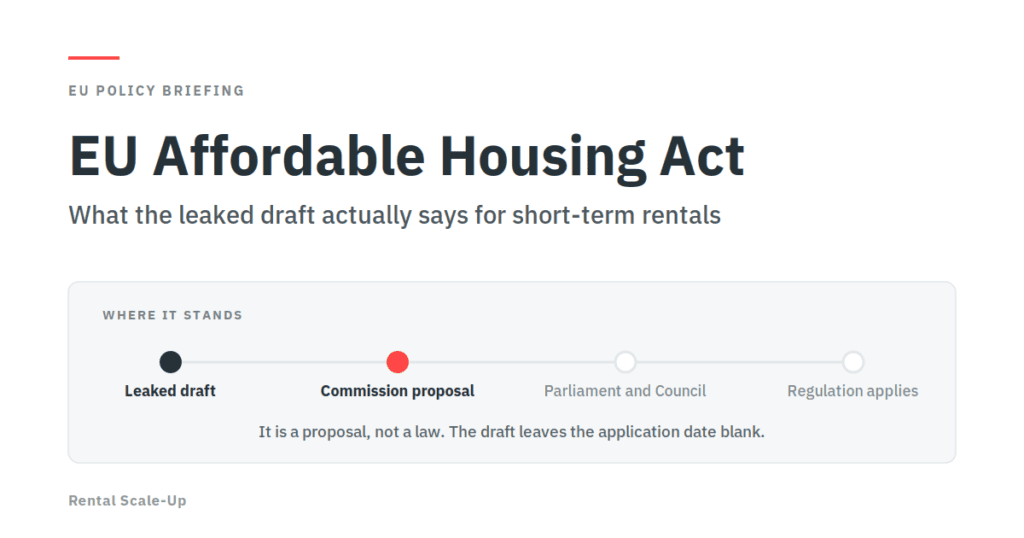
Before the five findings: is EU Affordable Housing Act already a law?
No.
Euractiv reports that the Commission’s proposal is expected to be presented on September 9. A presentation would be an important step, but it would not make the proposal law.
Under the EU legislative process, the European Commission proposes legislation. The European Parliament, elected by EU citizens, and the Council of the EU, representing national governments, then negotiate and must agree on the text.
They can change it.
Even the expression “the Commission has adopted the proposal” means it has agreed on the version it wants legislators to consider—not that the law has passed.
The leaked document also leaves the application date blank. There is no new compliance deadline for managers in that empty space.
Why can EU law affect a rule made by your town?
Because local housing decisions can also affect rights protected by EU law, including the ability to provide services and establish a business.
That does not mean a host has an unlimited right to rent any property.
In the 2020 Cali Apartments case, the Court of Justice of the European Union recognised that a shortage of long-term rental housing could justify requiring permission to operate short-term rentals. But the restrictions still had to be justified and go no further than necessary.
The EU court explained the European legal principles. The French court had to apply them to the dispute.
For managers, the important point is this: a local restriction can be challenged because of EU law, even though housing policy is largely decided nationally and locally.
The draft says the existing principles leave too much uncertainty about which restrictions will stand up in court. It proposes more detailed tests for answering that question.
Is this really an EU “anti-Airbnb” law?
POLITICO Europe has just gone with “EU to crack down on short-term rentals in bid to slash housing prices,” adding that Brussels wants to give local governments tools to rein in Airbnb and other STR operators. The FT previously ran “EU to help tourism hotspots crack down on Airbnb-style holiday rentals,” while France’s L’Écho touristique went further with “Bruxelles veut faciliter les mesures anti-Airbnb.”
That framing is understandable: the draft really could make it easier for authorities to defend restrictions on some short-term rentals. But after reading the document itself, we think calling it simply an “anti-Airbnb law” misses a large part of what is actually being proposed. The text would also require authorities to prove housing stress and an adverse STR impact, consider less restrictive alternatives, target measures proportionately, protect primary-residence hosting within this framework, and give affected people and businesses access to judicial review.
So the question for a property manager is not just “Is Europe passing an anti-Airbnb law?” It is: under what conditions could your city restrict your rentals, and would it actually be able to meet the new European tests?
Here are the five findings that matter most to your business.
1. Check how each property is used—not just how many properties you manage
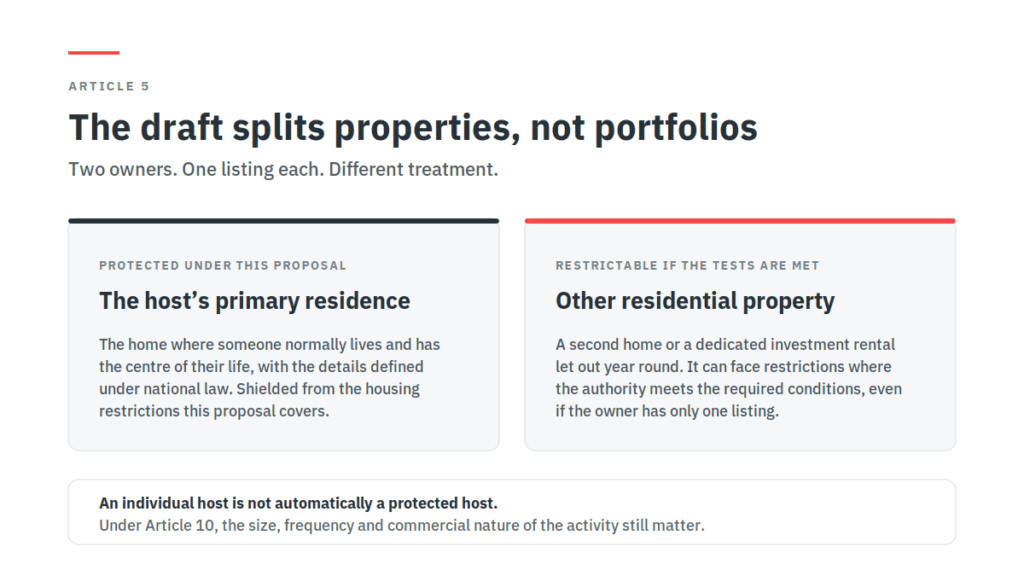
The most important distinction in the draft is between the host’s main home and other residential property.
The legal term is “primary residence”: broadly, the home where someone normally lives and has the centre of their life, with the details defined under national law.
Under Article 5, rentals of the host’s primary residence would be protected from the housing-related restrictions covered by this proposal. Other residential rentals could face restrictions if the authority met the required conditions.
That means “individual host” and “protected host” are not the same thing.
Imagine two owners.
One rents out the home they normally live in while they are away. The other lives elsewhere and rents out a separate investment apartment throughout the year.
Each has one listing. But the draft would not necessarily treat them in the same way.
Our reading is that an individual with one dedicated rental apartment would not automatically be exempt. Equally, hiring a property manager would not, by itself, determine how a property should be treated.
The size and frequency of the business would still matter
Article 10 says restrictions should be directed toward activity whose size, frequency or commercial nature makes it more likely to reduce the supply of long-term housing.
The draft does not set a simple threshold such as “two properties makes you professional.” Nor does it say that operating through a company automatically makes restrictions justified.
For management companies, there is an unanswered question: When you manage properties for several separate owners, whose activity would be counted together?
The draft mentions the number of dwellings offered by a “single host.” It does not give a specific counting rule for a company managing fifty homes for fifty owners. We should not assume that all fifty would automatically be treated as one host’s portfolio—or promise the opposite.
“No direct obligations” does not mean “no business impact”
The explanatory section on small businesses says the proposal does not directly impose obligations on service providers. Instead, it sets conditions for authorities making restrictions.
But a local restriction could still reduce an owner’s bookings and your management income. The impact would arrive through the local rule, rather than through a new EU form you must complete.
The document also says very small businesses are not specifically exempted.
One caution: that same page contains a sentence apparently excluding non-primary-residence rentals. It contradicts Article 5 and the explanation on page 14. Our analysis follows Article 5, but this inconsistency needs clarification in the official proposal.
For your business: classify properties individually. Do not assume every home you manage has the same position simply because it belongs to the same management portfolio.
2. Authorities would need more than “housing is expensive” to justify a restriction
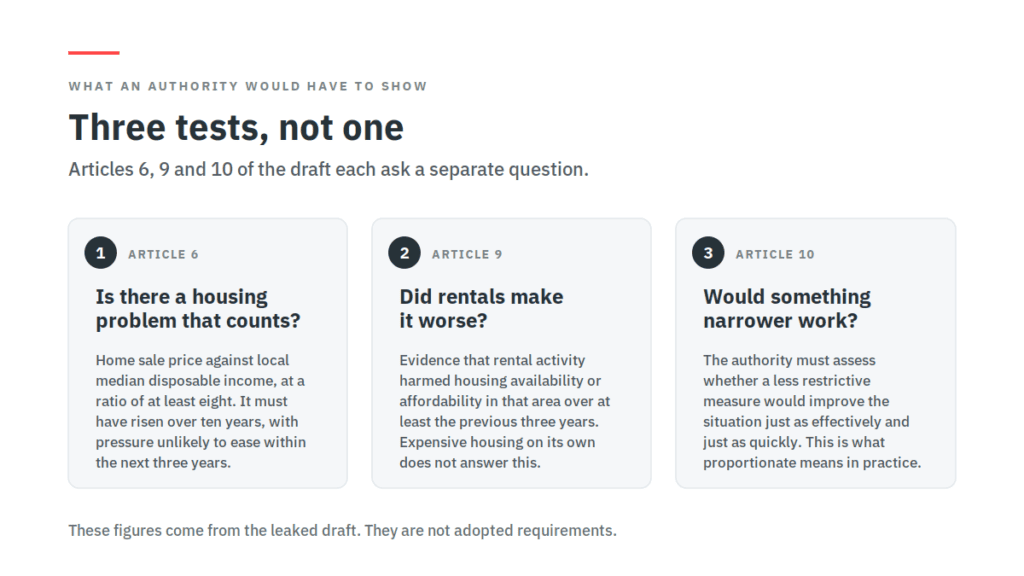
The draft asks authorities to answer three separate questions.
Is there a qualifying housing problem?
Article 6 proposes a specific test.
It compares the average sale price of a home with local median disposable income. The resulting ratio must be at least eight.
That ratio must also have increased over the previous ten years. And the authority must assess whether housing pressure is unlikely to ease over the next three years, considering population trends, housing supply and demand.
These numbers are in the draft. They are not adopted requirements, and the precise calculation method deserves attention in the official proposal.
Have short-term rentals made the problem worse?
Article 9 requires evidence that rental activity harmed housing availability or affordability in the area over at least the previous three years.
That is a separate question from whether housing is expensive.
It does not require showing that holiday rentals are the only cause of the shortage. It also does not expressly require proving that every individual holiday apartment previously housed a long-term tenant. The provision concerns the effects of rental activity in the area.
Would a less restrictive approach work?
Article 10 asks authorities to assess whether a less restrictive measure would be equally sufficient to improve the situation effectively and quickly.
This is the practical meaning of “proportionate”: the restriction should address the problem without going further than necessary.
For example, an authority considering a very broad restriction would need to assess whether a narrower approach could achieve the same result. The draft does not prescribe the answer for every destination.
What this means for France’s zones tendues
French managers already know the idea of a zone tendue: an area identified as having a serious housing supply-demand imbalance.
The French criteria applicable in 2026 refer to indicators such as high rents, high purchase prices, pressure on social housing and, for the relevant category of municipalities, a high share of homes that are not primary residences.
The EU draft describes the different methods countries use to identify housing pressure. It does not single France out or declare its system invalid.
But our reading is that being labelled a French zone tendue would not automatically satisfy the proposed European tests. The authority would still need the relevant evidence for a restriction covered by this proposal.
There is a question worth debating here. The draft puts considerable weight on purchase prices, although some destinations’ immediate problem is finding homes to rent. Its authors argue that purchase-price data can help indicate rental pressure. Whether that works equally well in every destination remains a question.
For your business: do not judge future risk only by whether a destination says it has a housing shortage. Look at the evidence behind the restriction it wants to introduce.
3. The draft takes business interests into account—but does not guarantee your right to keep operating
There is a passage I would particularly draw to property managers’ attention.
On page 11, the draft recognises that different national and local rules increase costs and make business decisions less predictable.
It specifically mentions hosts with multiple properties in different EU countries, alongside platforms and investors.
Managers are not only part of the activity being regulated. The difficulties they face are also part of the problem the document is trying to solve.
The proposed protections could matter when you are hiring a team, signing an owner contract or deciding whether to enter another market.
You would have a clearer basis for examining a restriction
Under Articles 10–13, authorities would have to publish the restriction and its supporting assessments, explain the area covered and state its duration.
Affected people and businesses would have access to legal challenges. Authorities would also need to review restrictions at least every five years and withdraw them if the required conditions no longer applied.
For a manager, that could mean being able to ask more specific questions: What evidence supports this rule? Why does it cover this neighbourhood? Were less restrictive options considered? Does the original justification still hold?
Existing lawful businesses may need time to adjust
The draft requires appropriate transitional arrangements where necessary when a restriction affects an existing lawful situation.
In everyday terms, that could mean arrangements to help an already lawful operation adapt. But the wording does not guarantee a particular notice period or promise that every existing rental can continue forever.
Likewise, reviewing a restriction every five years does not mean it automatically ends after five years. And having access to court does not guarantee a successful challenge.
Clearer rules can still hurt a business
This is the balance we should not lose.
A city that meets the proposed tests may be in a stronger position to defend its restrictions. A manager could therefore face a rule that is easier to understand but still reduces the number of homes they can rent.
There is also a technical change requiring scrutiny: Article 3 would replace parts of the existing EU services-law process for covered restrictions, including a notification requirement. We should not assume the proposal simply adds new protections while leaving every existing procedure untouched.
For your business: the proposed benefit is fairer and more predictable decision-making—not a promise that your current business model will always be protected.
4. The data-sharing rules already in place would help shape future restrictions
There are two different EU initiatives here, and they do different jobs.
Regulation 2024/1028 is the existing rental registration and data-sharing regulation, applicable since May 20, 2026. It helps authorities obtain more reliable information about rental activity through relevant registration systems and platform reporting.
The Affordable Housing Act draft addresses when authorities could justify certain housing-related restrictions on that activity.
A useful way to remember the difference is:
The first helps authorities understand what is happening. The second would set conditions for what they can do about it.
The document itself describes the two measures as complementary.
This is also the connection we discussed in Rental Scale-Up’s coverage of the May 20 data deadline.
The important detail is enforcement
Article 10(1)(e) says authorities using the relevant restriction provisions must apply and enforce the existing data regulation.
It mentions registration, verification, data sharing and orders dealing with listings that have missing, invalid or misused registration numbers.
For a compliant manager, that raises a useful question: Is the authority properly applying the existing system when making the case for additional restrictions?
But it does not mean every illegal listing must disappear before an authority can act. It also does not mean a valid registration number protects a property from every future restriction.
Nor does the three-year evidence requirement mean authorities must wait until three years after May 2026. The draft allows relevant, verifiable evidence; it does not say all historical evidence must come from this particular reporting system.
For your business: keep registration records and property information accurate. Those records may matter not only for today’s compliance, but also for tomorrow’s local policy decisions.
5. Do not expect the EU proposal to cancel your existing local rules
This is essential for anyone already operating under permit limits, rental-day caps or other restrictions.
Article 14 says the proposed regulation would not apply to measures adopted before its eventual application date. It also addresses authorities amending or renewing earlier measures under the new rules.
So a headline about protecting primary-residence rentals is not a reason to stop following an existing local limit.
An EU regulation can be binding across Member States without each country first passing its own version. And applicable EU law can take precedence over conflicting national or local provisions.
But the first question is always: Does this particular EU rule apply to this particular local restriction?
The draft’s treatment of earlier measures makes that question especially important.
An old rule and an existing business are not the same thing
Consider two situations.
In the first, a town is enforcing a restriction it adopted before the future EU regulation starts applying. Article 14 would be relevant.
In the second, a town introduces a new restriction affecting an already lawful rental business. The draft’s provisions on transitional arrangements could matter.
Those are different legal questions. Neither creates a blanket promise that all existing licences or businesses will continue unchanged.
The date the restriction was adopted is important—not just the date it begins affecting bookings. The treatment of later changes and renewals will need checking against the official text.
Other rules would still matter
The draft also excludes restrictions justified on public-interest grounds other than housing affordability and availability, and treats registration-only measures separately.
It is not a general exemption from safety rules, nuisance requirements or every other obligation affecting a rental.
For your business: you would still need to understand the rules in each destination. The EU proposal would not replace that work with one Europe-wide permission to operate.
What I would do now as a property manager
I would use this draft to improve my understanding of my company’s portfolio—not to make a rushed change to it.
Start with the properties. Which are genuinely the host’s main home? Which are second homes or dedicated investment rentals? Who legally provides the accommodation under each management arrangement?
Then look at the destinations. What restrictions already exist? When were they adopted? Are local authorities considering new measures, and what evidence are they using?
Finally, be precise with owners. The message is not “Brussels is banning your short-term rental.” It is also not “Brussels will protect you from your council.”
It is: the EU is considering clearer conditions for housing-related restrictions, with consequences that could differ by property and location.
The official proposal will need to clarify the inconsistent primary-residence wording, how different management arrangements are treated, the housing-stress calculations and the relationship with existing local measures.
Until then, continue following the rules that apply today.
My main conclusion is this: the draft could make justified restrictions easier to defend and unjustified restrictions easier to question. For a property manager, understanding both possibilities is more useful than deciding whether this is simply “good” or “bad” news for Airbnb.

Thibault Masson is a leading expert in vacation rental revenue management and dynamic pricing strategies. As Head of Product Marketing at PriceLabs and founder of Rental Scale-Up, Thibault empowers hosts and property managers with actionable insights and data-driven solutions. With over a decade managing luxury rentals in Bali and St. Barths, he is a sought-after industry speaker and prolific content creator, making complex topics simple for global audiences.
Related Articles:
 Lisbon Imposes Bans and New Limits, Mabrian Launches Rental Monitoring Tool, and Airbnb Reboots Experiences
 Survive the EU Short-Term Rental registration Deadline: What Managers Must Do Next
 Los Angeles Eyes Olympics Airbnb Deal, Santa Ana Court Voids Ban, Saratoga County Imposes Registry and Tax
 French Short-term rentals and the Hoguet Law: What the FNAIM Report from April 2026 Says