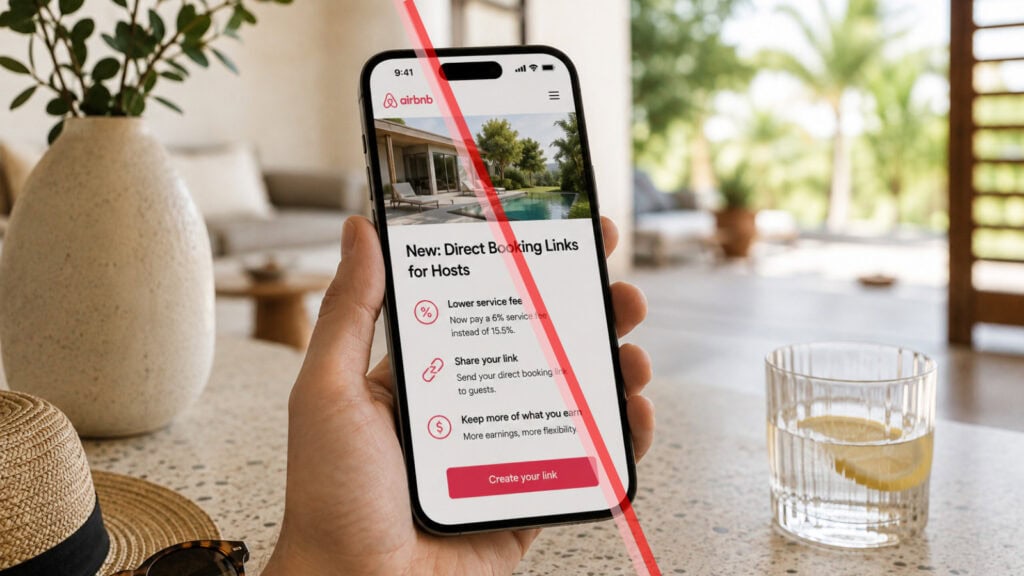
Airbnb is now offering select hosts a way to significantly lower their commissions by sourcing their own guests. By sharing a custom link generated in the Listing editor, a host’s standard 15.5% fee drops to either 6% or 10%.
Airbnb calls this a “direct booking link,” borrowing a familiar phrase from the movement built around operating independently of major platforms. In practice, however, this new feature doesn’t provide the complete autonomy or data ownership that true direct booking usually promises.
While the recognizable name will undoubtedly grab attention, the underlying math is the real story. By offering this discount, Airbnb has effectively unbundled its pricing, revealing exactly what the platform charges purely for demand generation: between 5.5 and 9.5 percentage points.
How the Airbnb Direct Booking Link Pilot Works
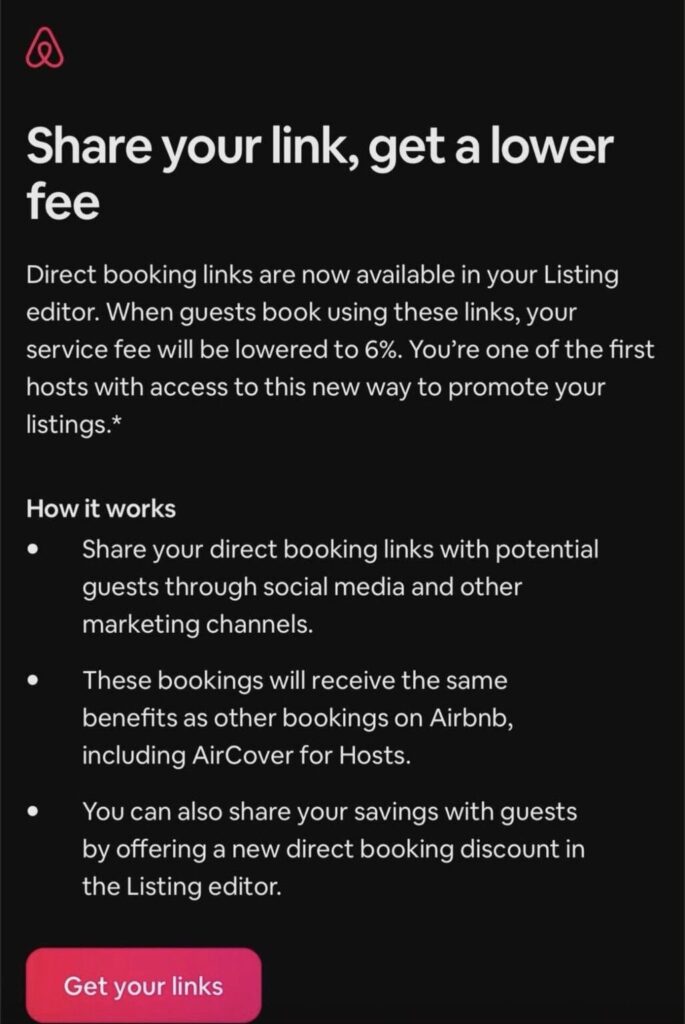
In late August, Airbnb began emailing a select subset of hosts with the subject line, “Get a lower service fee with direct bookings”. Because Airbnb has not yet published an official help-center article or newsroom post, all current details stem directly from these rollout emails and what hosts can see in their own account dashboards.

- The Core Mechanism: Invited hosts can access a new “direct booking link” toggle inside their Listing editor to generate a custom URL.
- The Fee Reduction: When a guest books a stay using this specific tracked link, the host’s service fee drops to either 6% or 10%.
- The Guest Discount Slider: Hosts can choose to pass a portion of these fee savings directly to the guest using a new discount feature.
- The Standard Benefits: The rollout email explicitly noted that bookings generated through these links still carry all normal platform benefits, including AirCover for Hosts.
News of the unannounced pilot initially broke as screenshots of the email circulated on LinkedIn. The email has since been widely shared and discussed across various host Facebook groups.
Rules and Restrictions for Airbnb’s Reduced Host Fees
Here is exactly how the pilot functions based on what we can see, along with the critical missing details Airbnb has yet to clarify.
What We Know
- Link Destination: The generated URL points directly to your Airbnb listing, not to an independent direct booking website. This is the most common point of confusion.
- Unexplained Fee Tiers: The standard 15.5% host fee drops to either 6% or 10%. Airbnb has not explained why some hosts get 6% and others get 10%.
- Platform Control: The transaction remains entirely on Airbnb. The platform still processes the payment, provides AirCover, handles support, and keeps the guest’s contact data.
- The Discount Slider: Hosts can pass a portion of the fee savings to the guest, capped at the size of the fee cut. For example, a host on the 6% tier can pass up to 9.5% to the guest. You can either keep the savings or give them away, but you cannot do both.
- Partial Rollout: The pilot is not universal; many hosts do not yet have access to the toggle.
What Remains Unconfirmed
Because Airbnb has not published official documentation, several technical mechanics are still unknown:
- Tracking Mechanics: Is the reduced fee tied strictly to the exact URL, or does it use tracked clicks?
- Attribution Windows: Does the host still get the reduced fee if a guest clicks the link, but switches devices or returns days later to complete the booking?
- Traffic Sources: Will Airbnb honor the reduced rate for paid ad traffic pointed at the link?
- Rate Permanence: Is the 6% or 10% rate locked in once enabled, or is it subject to change?
Fee Breakdown: 15.5% Standard vs. 6% Direct Link
Here is how the numbers stack up on a $1,000 booking subtotal comparing the single host-paid fee to the pilot rates:
| Booking Scenario | Host Fee Rate | Airbnb Service Fee | Host Retains | Host Savings (vs. Standard) |
| Standard Booking | 15.5% | $155 | $845 | Baseline |
| Direct Link (10% Tier) | 10.0% | $100 | $900 | +$55 |
| Direct Link (6% Tier) | 6.0% | $60 | $940 | +$95 |
Hosts keep $55 to $95 more per $1,000 on reservations sourced through their own marketing channels.
Why Airbnb’s “Direct Booking” Label is an Affiliate Play
A host shares a tracked URL, Airbnb pays a commission for the referral, and the commission takes the form of a fee reduction rather than a payment. That is an affiliate arrangement.
It is not what direct booking generally means in this industry. Direct booking means the guest books on a channel the operator controls, the operator owns the guest relationship and the contact details, and no OTA commission is charged. The term belongs to a movement built specifically around leaving platforms like Airbnb.
Airbnb’s link does none of that. The guest stays Airbnb’s guest. The data stays Airbnb’s data. The rate stays Airbnb’s to change.
The practical consequence: “direct booking link” now means two incompatible things in the same industry, and every PMS, coach and conference panel will be disambiguating it for the next year.
I do believe the wording is a choice, not an accident. A host who believes they already have a direct booking link has one less reason to build the real thing.
What the 6% Fee Reveals About Airbnb’s Guest Acquisition Costs
Historically, Airbnb’s standard host fee bundled two distinct services into a single, all-inclusive rate:
- Demand Generation: Brand marketing, search algorithm placement, traffic acquisition, and mobile app distribution.
- Transaction Infrastructure: Payment processing, AirCover protection, customer support, and trust and safety services.
By cutting the fee to 6% or 10% when a host supplies the guest, Airbnb has unbundled these two components for the first time.
The resulting gap of 5.5 to 9.5 percentage points is what Airbnb effectively charges purely for finding you a guest. Previously, hosts evaluating direct channel investments had to measure their independent marketing expenses against a single blended commission. Now, Airbnb’s own internal pricing provides operators with an explicit benchmark for the exact cost of demand generation.
Read more: Airbnb’s Host-Only Fee Explained
Variable Host Fees: Airbnb’s Hidden Lever for Growth
In a recent analysis, Rental Scale-up founder Thibault Masson highlighted how the industry-wide shift to a single host-paid fee gave Airbnb a discreet financial dial to adjust without impacting guest-facing search results.
Under the former split-fee model, raising commissions meant increasing the total price visible to guests at checkout. With the host-only fee structure, adjustments happen entirely behind the scenes in host email notifications. While recent regional updates pushed host rates upward, such as 15.5% in Europe and 16% in Brazil and Mexico, the direct booking link pilot applies this exact same mechanism downward.
Why Host-Side Fee Flexibility Matters
- Inconspicuous Price Testing: Because these fee adjustments are only visible within host dashboards, Airbnb can experiment with dynamic rates at very low friction. They can lower fees for specific host cohorts or incentivize desired behaviors without altering the guest experience.
- Reinvesting Margin into Traffic: On Airbnb’s Q2 earnings call, CFO Ellie Mertz noted that take-rate expansion was being used partly to fund promotional discounts for launching new products. The direct booking link fits this pattern, using commission flex to acquire traffic.
- Institutional Backing: Equity research firm Bernstein recently cited the single host-paid fee migration as a key structural growth driver for Airbnb, alongside AI-driven search improvements.
Read more: Insurance, Airbnb Pay Later, Cancellation Fees: What Airbnb Now Earns on Top of Your Stay Rates
The Takeaway on the 6% vs. 10% Tier Split
The variance between the 6% and 10% reduced fees is almost certainly a deliberate elasticity test rather than a random rollout bug. Airbnb is evaluating how much host-sourced traffic it generates per basis point of commission sacrificed. The rate will eventually settle at whatever tier maximizes overall platform volume. Moving forward, operators should anticipate more variable host rate structures, not fewer.
Profiting from a Self-Created Margin Problem?
Airbnb spent the past year moving every host onto a single 15.5% fee. Operators repriced or absorbed it, and a lot of the industry conversation since has been about margin.
Airbnb is now offering some of those same operators a way to pay less than the number Airbnb set, on condition that they do Airbnb’s marketing.
I read that as Airbnb testing a lever it built for itself, not as relief it decided hosts had earned. The workaround and the problem come from the same place. That does not make the money less real, and the arithmetic above holds either way. But it is worth knowing which direction this came from.
The Strategic Timing: AI Competition and Rising Marketing Spend
Two major industry developments surfaced in August that perfectly contextualize why Airbnb is suddenly highly motivated to reward host-sourced traffic.
- The Rise of Agentic Booking: On August 7, Google confirmed a limited US test of agentic hotel booking within its AI Mode, teaming up with major travel players like Booking Holdings, Expedia, Marriott, and IHG. Booking Holdings CEO Glenn Fogel noted on their Q2 call that a small share of Google traffic was already engaging with it.
- Airbnb’s Refusal to White-Label: Airbnb is noticeably absent from Google’s partner list. During the Q2 2026 earnings call, CEO Brian Chesky explicitly rejected the idea of offering business-to-business inventory, arguing that Airbnb’s brand is too distinct to be stripped away and fed into someone else’s AI assistant. While competitors are willing to become supply inside a third-party agent, Airbnb is betting everything on its own app and direct traffic.
- Surging Marketing Costs: Betting entirely on your own brand is expensive. Airbnb’s Q2 sales and marketing spend hit $875 million, a 27% increase that significantly outpaced their 17% revenue growth.
Read more: Google AI Mode: What It Means for Guest Discovery and Short-Term Rentals
When you view the direct booking link pilot against these rising acquisition costs, the financial strategy is brilliantly efficient. Traffic driven by a host’s personal Instagram, QR codes, or email list never passes through Google, avoids AI search engine intermediaries entirely, and requires absolutely zero upfront marketing spend from Airbnb. Shifting the cost of customer acquisition from the corporate marketing budget directly onto a flexible commission rate is a remarkably cheap way to acquire guests.
The Ultimate Choice for Short-Term Rental Operators
This new pilot program financially rewards the exact marketing assets required to run a successful, independent direct booking channel: past-guest email lists, social media followings, and in-unit QR codes. Those assets will drive traffic wherever an operator chooses to direct them.
Ultimately, hosts now have a clearer mathematical decision to make regarding their self-sourced traffic:
- What Changed: The platform fee for pointing your hard-earned audience toward Airbnb just dropped significantly.
- What Remains the Same: Airbnb still retains full ownership of the guest relationship, the data, and the terms of the transaction.

Uvika Wahi is the Editor at RSU by PriceLabs, where she leads news coverage and analysis for professional short-term rental managers. She writes on Airbnb, Booking.com, Vrbo, regulations, and industry trends, helping managers make informed business decisions. Uvika also presents at global industry events such as SCALE, VITUR, and Direct Booking Success Summit.
Related Articles:
 NYC Introduces Statewide Rental Registry, Top Luxury Villa Trends for 2025, and British Columbia vs. Airbnb
 Portugal Supply Mushrooms, Airbnb Scores Lobbying Win in Washington, Booking.com’s 2025 Travel & Sustainability Report
 Why Airbnb’s New Ads Focus on Experiences, Not Listings
 Airbnb’s 15.5% Fee Is Really 18.4% to 19.1% for Most Small European Hosts: The VAT Math Nobody Explains