A sudden wave of concern hit the property management community in late August 2026 when members of Reddit’s r/vrbohosts forum began sharing screenshots of a surprising notice from Expedia Group. The emails warned property owners that Vrbo would soon automatically apply “Members Only Deals,” ranging from 12% to 20% off, to their property listings unless they actively chose to opt out.
The authenticity of the notification was quickly confirmed via an official Expedia Group opt-out landing page, which shows that Vrbo is shifting to an auto-enrollment model, requiring hosts to manually opt out of the discounts before a strict deadline of September 10, 2026.
Vrbo Members Only Deals Auto-Enrollment: What to do, and by when
- Now: emails are going out to hosts in the Americas and EMEA
- September 10, 2026: the opt-out window closes
- September 18, 2026: the discounts go live on every listing that did not opt out
Before September 10. Property managers who cannot absorb a 12% to 20% reduction in gross booking revenue should locate the official Expedia Group submission page and formally opt out. The page allows either a single opt-out across every listing, or selection of individual listings by EID. The link should be in the Vrbo email sent to you as well.
After September 18. Missing the deadline is not permanent. The documentation states that once the promotions are live, property managers can edit or completely remove the promotion on their Vrbo dashboard at any time, under Calendar > Settings > Promotions. Any bookings taken between the launch date and the removal will carry the discount.

Understanding how the 12% to 20% discounts apply
If a listing is not opted out prior to the deadline, it will automatically begin displaying fenced price discounts targeted exclusively at One Key members. The platform justifies the automatic application by claiming that properties with promotions see over 1.4x higher conversions.
The automatic discounts scale directly with the guest’s One Key loyalty tier:
| One Key tier | Discount applied to the booking |
|---|---|
| Blue | 12% |
| Silver | 15% |
| Gold and Platinum | 20% |
While Expedia Group funds the OneKeyCash rewards that travelers earn, these specific promotional discounts (12% to 20%) are applied directly to the property’s nightly rate, reducing the gross booking revenue for that stay.
Worth knowing: Silver status is not rare. Per Expedia Group, every traveler starts at Blue, and Silver is earned after five trip elements in a year, where a trip element is any eligible booking of $25 or more across Expedia, Hotels.com and Vrbo. For a moderately active traveler, 15% is the realistic rate rather than 12%.
Important Consideration: How Discount Stacking Works
The most critical financial risk for property managers is not just the base loyalty tier discount, but how the platform calculates the final price when multiple promotions are active. The official opt-out documentation contains a crucial caveat regarding how these new deals interact with a listing’s existing pricing architecture:
To maximize savings for guests, the One Key promotions are added on top of any existing and future weekly and monthly discounts in a single booking.
What that looks like on a real booking. Take a seven-night stay listed at $1,000, on a property already running a 10% weekly discount to encourage longer stays:
- The weekly discount applies first, bringing the guest to $900
- A Platinum member’s 20% One Key discount then applies to that reduced rate, bringing the guest to $720
- The total discount on the gross rate reaches 28%, not 20%
The same compounding across the tiers, on a listing with a 10% weekly discount already in place:
| One Key tier | Loyalty discount | Combined off gross |
|---|---|---|
| Blue | 12% | 20.8% |
| Silver | 15% | 23.5% |
| Gold and Platinum | 20% | 28% |
On a property running a 20% monthly discount instead, a Platinum booking lands at 36% off gross.
This compounding effect can rapidly compress profit margins, turning what was intended as a slight occupancy boost into a booking that operates at a severe revenue deficit, particularly during off-peak seasons when fixed costs remain high.
Opting out may cost visibility? Not clear, yet the timing is interesting
The opt-out page tells hosts that promotions help them “stand out in search and fill calendar gaps with price-savvy travelers,” and that “opting out could mean less visibility to high-quality travelers.”
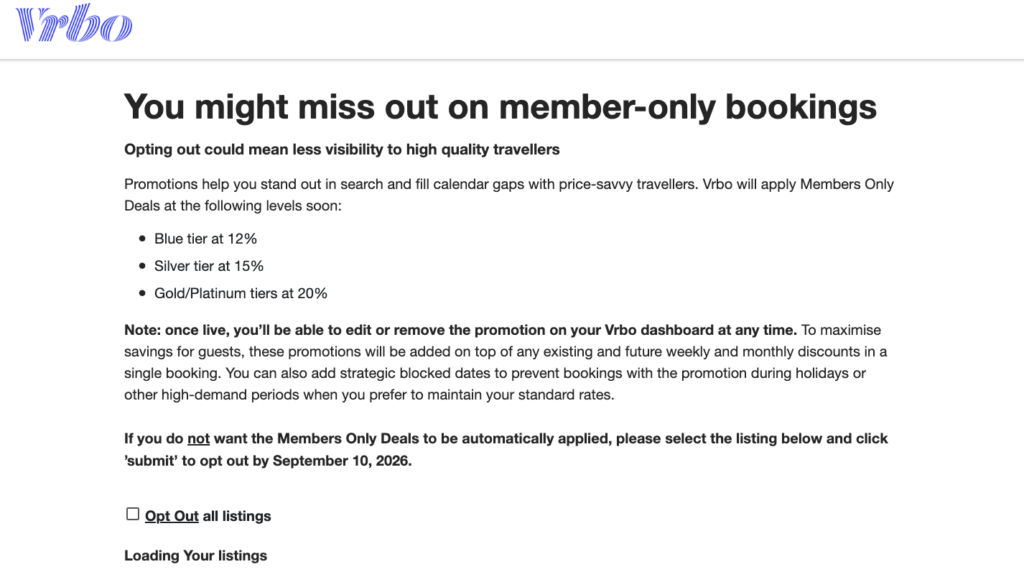
Read carefully, that is not an admission that Vrbo will demote listings which decline. It is a claim about traveler behavior: people respond to discount badges and filters, so a listing without one competes less well against listings with one. Vrbo has been careful not to say the algorithm itself will treat opted-out listings differently.
What Vrbo has said outright is more concrete. In its May 2025 promotions suite announcement, the company stated that across all promotion types, hosts benefit from enhanced listing visibility through improved sort order, special badging, promotion filters, and inclusion in Vrbo’s marketing campaigns.
That distinction matters and cuts both ways:
- What is confirmed: running a promotion improves sort order. Vrbo has published this.
- What is not confirmed: that opting out triggers a penalty beyond forgoing that boost.
For a property manager the practical difference is thin. If most listings in a market are auto-enrolled on September 18 and one is not, the opted-out listing does not need to be penalized to fall behind. It only needs to be the one without the boost, the badge, and the filter placement.
Two other developments make the direction hard to miss
I don’t think this can be read in isolation.
First, the auto-enrollment lands just as Vrbo launches its Sponsored Listings feature inside the Expedia Group Advertising Portal. Premier Host status and strong conversion used to be the main levers for organic placement. Now there are two paid routes to the top of a search page: bid for it through Sponsored Listings, or discount for it through One Key.
Second, Expedia Group is reporting the shift as a success. In its Q2 2026 earnings review, the company confirmed:
- Q1 2026: supplier-funded promotions covered roughly a third of all Vrbo bookings
- Q2 2026: that figure passed 40% of bookings for the quarter
In the short-term rental context, ‘supplier-funded’ means these promotional discounts apply to the host’s rates. As Expedia Group focuses on growing its One Key loyalty program, leaning on promotional discounts is becoming a larger part of their strategy, and it is telling investors the number is climbing.
My read: The shift to an auto-enrollment model aligns closely with Expedia Group’s broader push to expand these promotions. After reporting that promotional bookings grew from a third to over 40% in just one quarter, moving to an opt-out framework will naturally help sustain that momentum and drive those figures higher heading into Q3 and Q4. Additionally, the language regarding visibility serves as a strong nudge to keep hosts enrolled, emphasizing the competitive benefits of participation without explicitly confirming an algorithmic penalty for those who decline.
Action Plan: How Property Managers Should Navigate the Policy
Relying on default platform settings poses a financial risk either way. Property managers who choose to participate, or who miss the deadline and decide to leave the promotion running, should review their channel manager settings and Expedia Group communications to ensure their pricing strategies remain intact.
Audit existing length-of-stay discounts
Because the new Members Only Deals stack on top of existing promotions, it is worth auditing current weekly, monthly, and last-minute discounts. Specifically:
- Identify which listings carry weekly or monthly discounts, since these are the ones where compounding bites hardest
- Model the combined rate at the 20% Platinum tier, not the 12% headline rate
- Check whether the resulting net rate still clears your cost floor in shoulder and off season
Block high-demand dates
Blackout controls become important for anyone participating. Hosts can add strategic blocked dates to prevent the promotion from applying during holidays or other high-demand periods, so properties maintain their standard rates during peak seasons when bookings are largely secured without steep discounts.

Uvika Wahi is the Editor at RSU by PriceLabs, where she leads news coverage and analysis for professional short-term rental managers. She writes on Airbnb, Booking.com, Vrbo, regulations, and industry trends, helping managers make informed business decisions. Uvika also presents at global industry events such as SCALE, VITUR, and Direct Booking Success Summit.
Related Articles:
 Vrbo Q2 2025 Results Show Clear Shift Toward Promotions, Shorter Stays, and Bundled Value
 Vrbo Tightens Its Premier Host Standards: What Property Managers Need to Know (UPDATED)
 Vrbo’s New Tagline Signals the End of the Ad Wars — and a Bigger Strategic Shift
 Vrbo vs. Airbnb Is the Wrong Frame for 2026. It’s Expedia’s Grid vs. Airbnb’s Walls