Vacation rentals in France — In April 2026, the FNAIM Commission on Vacation Rentals and Recreational Real Estate published an eighteen-page report dedicated to the application of the Hoguet Law to short-term rental concierge services. The document, titled “The Hoguet Law in the Face of Emerging New Players: Focus on Concierge Services”, provides a precise legal framework for distinguishing what falls within or outside the scope of the 1970 law, in a sector undergoing rapid professionalization.
Who is the FNAIM, and why this report?
The National Real Estate Federation, founded in 1946, is the leading real estate association in France. It brings together several thousand agencies and represents thirteen professions within the sector (sales, rental management, property management, appraisal, vacation rentals, etc.). Its members are, by definition, professionals holding a professional license issued by the Chamber of Commerce and Industry (CCI) under the Hoguet Law, subject to strict requirements: financial guarantee, professional liability insurance, written mandate, separate accounting, continuing education, and a code of ethics. Its Vacation Rentals and Recreational Real Estate Commission, which authored the report, brings together members specializing in seasonal rentals — those on the front lines facing competition from Airbnb-style service providers.
In this context, it is perfectly logical that the FNAIM would advocate for this approach. For the past fifteen years, its members have faced competition from players who, by positioning themselves as “service providers,” have been able to avoid some of the constraints (license, financial guarantee, training, professional liability insurance) that weigh on traditional agencies. Advocating that the same regulations should apply to all who perform the same activities is a matter of professional consistency, not corporatism. The report should therefore be read for what it is: a well-reasoned perspective from a stakeholder with a natural interest in this interpretation — which does not invalidate its substance, since it is based on current legislation.
The legal framework outlined in the report
The report starts from a clear legal principle: Law No. 70-9 of January 2, 1970, known as the Hoguet Law, applies to “any person who, on a regular basis, engages in or assists with, even on a secondary basis, transactions involving the property of others”. It makes no distinction regarding the duration of the lease: seasonal rentals fall fully within its scope.

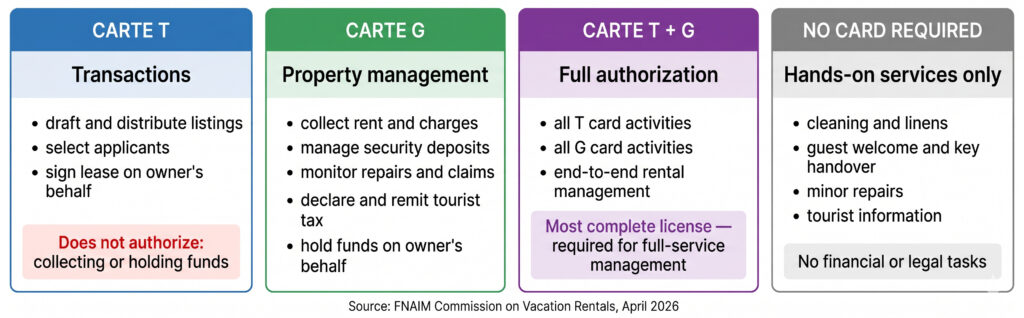
On this basis, the report proposes a classification into four categories, which forms the practical framework of the document.
The T Card (Transactions involving Real Estate and Business Assets) authorizes rental brokerage: drafting and distributing listings, selecting applicants, and signing the lease on behalf of the owner. It does not authorize the collection of funds, even on an occasional basis.
The G card (Property Management) authorizes full rental management: collection of rent and charges, management of security deposits, monitoring of repairs, handling of claims, and declaration and remittance of the tourist tax. Only the holder of a G card — or a property manager’s card — may hold funds on behalf of a landlord.
The dual T + G designation combines both activities.
No card is required for strictly hands-on services: cleaning, linens, welcoming guests, handing over keys, minor repairs, and providing tourist information.
This framework is then broken down into three tables that examine the typical operations of a concierge service: pre-rental operations, operations upon the traveler’s arrival, and tasks during the stay. For each task, the report specifies the required license type and the applicable legal provision.
Update on the Holding of Funds
The most significant section of the report, on page 9, concerns the collection and holding of payments. The FNAIM notes that, pursuant to Articles 54 and 64 of the Hoguet Decree of July 20, 1972, the mere holding of an uncashed check in the owner’s name is legally considered a “receipt of funds”. The G card is therefore required as soon as a management action involves sums belonging to the owner — even if these sums are never physically cashed by the property management company, and even if they are transferred directly from the platform (Airbnb, Booking) to the owner.
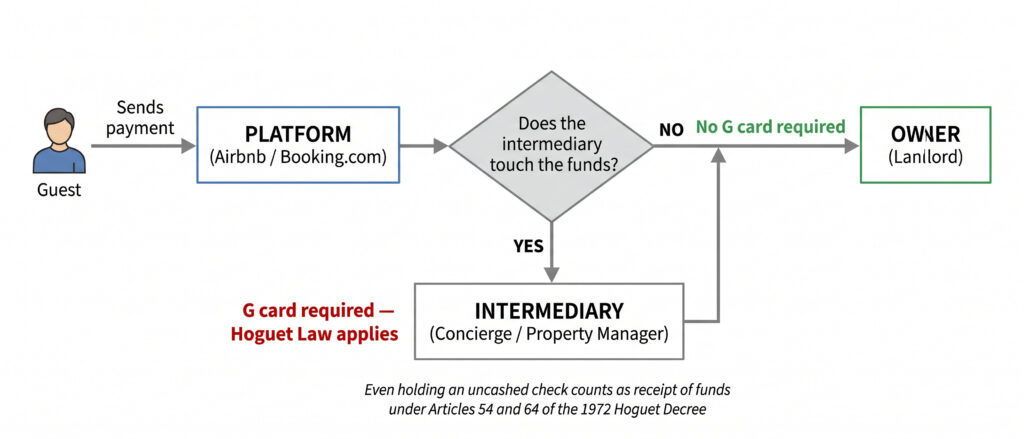
Under the Hoguet Law short-term rental, a concierge service that touches rental funds — even an uncashed check — must hold a G card. Direct platform-to-owner payments are the only clean bypass.
This point is important because it clarifies a widespread ambiguity in the sector, according to which the mere fact of not handling the money would be sufficient to fall outside the scope of the Hoguet Act.
Penalties Incurred
The report usefully highlights the penalties provided by law for operating an activity governed by the Hoguet Act without a license.
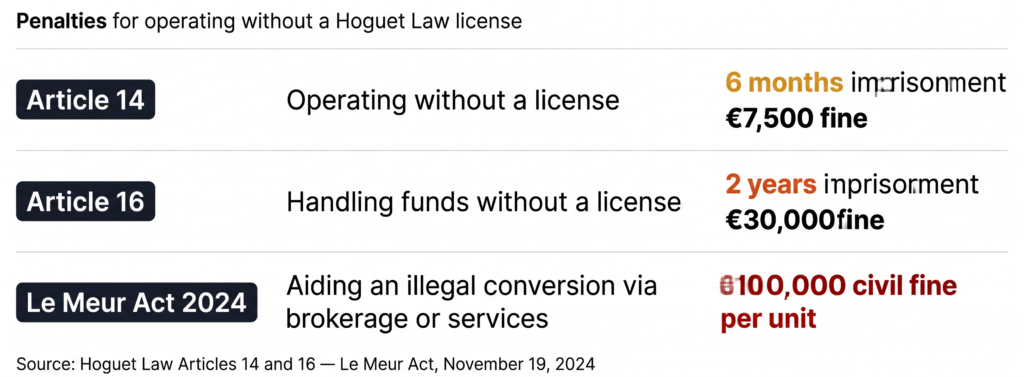
Article 14 punishes the habitual practice of such an activity without a license with six months’ imprisonment and a fine of 7,500 euros. Article 16 imposes harsher penalties for handling funds without a license: two years’ imprisonment and a fine of 30,000 euros. In addition, since the Le Meur Act of November 19, 2024, a civil fine of up to 100,000 euros per illegally converted premises has been introduced, now applicable to individuals who aid in a violation through brokerage, negotiation, or the provision of services.
This reminder is not an empty threat: it aims to make industry stakeholders aware that the legal risk is real, at a time when municipalities and courts are beginning to actively address these issues.
The legislative context: why now?
The timing of the report is explained by recent changes to the legal framework for short-term rentals.
The Le Meur Law of November 19, 2024, has substantially tightened the obligations imposed on owners and intermediaries of furnished tourist rentals:
Mandatory administrative registration of all furnished tourist rentals via a single national online service by May 2026, which will, for the first time, enable a comprehensive mapping of the market. France’s Declaloc portal — now delayed to Q4 2026 — is the mechanism through which that registration is being rolled out.
Reduction of tax deductions applicable to short-term furnished rental income, bringing the tax regime closer to that of long-term rentals.
Increased civil fines, with a cap raised to 100,000 euros per unit, now applicable to intermediaries.
Article L. 324-2-1 of the Tourism Code, which imposes an obligation on all intermediaries to provide information and conduct verification regarding the lessor.
In this context of strengthened regulation, it makes sense for FNAIM to publish a document that helps its members and industry professionals clearly define their position. The federation is fulfilling its natural role: translating a changing legal framework into an operational guide.
A Market Undergoing Professionalization
The report is part of a fundamental trend that extends far beyond the FNAIM. For several years now, the rental concierge market has been becoming more structured and professional. A growing number of concierge firms — both major national chains and regional players — have chosen to obtain the T or G license, either by earning it themselves or by hiring a manager or executive who meets the prerequisites (BTS in Real Estate Professions, bachelor’s or master’s degree, or equivalent professional experience).
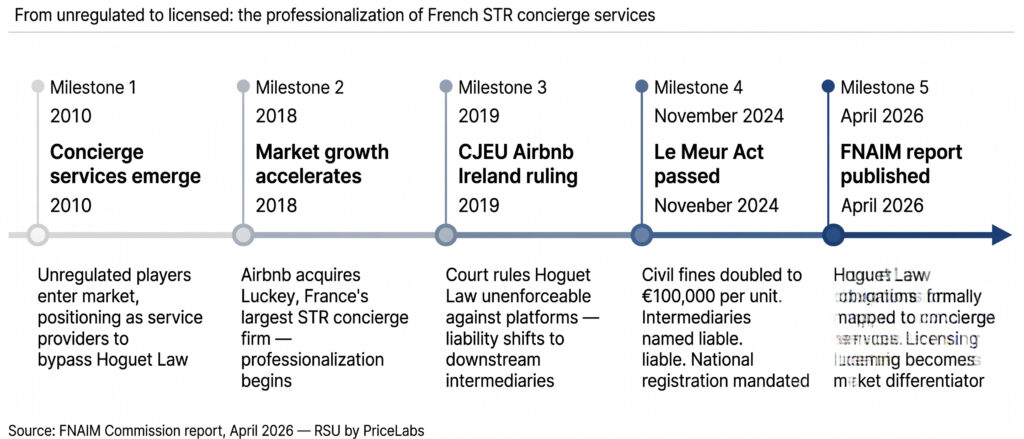
Several factors are driving this trend:
The maturity of the market: short-term rentals are no longer an emerging activity; they are an established industry attracting serious investors and operators.
Demand from property owners: those entrusting valuable properties want legal guarantees equivalent to what a traditional agency offers.
Regulatory pressure: municipal inspections are making legal status increasingly visible and a key differentiator.
The competitive logic: in a consolidating market, the license becomes a selling point and a differentiator.
Many concierge services that do not yet have the license are currently in the process of obtaining it. The FNAIM report supports and accelerates this trend rather than triggering it.
Remaining areas of interpretation
The report does not settle all debates. Several questions remain open and will likely be clarified by case law or new legislation.
The status of the Airbnb co-host. FNAIM considers that a co-host acting on behalf of a third party by managing rent payments, drafting listings, or coordinating reservations “should be” subject to the Hoguet Law (page 7). The use of the conditional tense reflects the lack of established case law. The issue remains to be decided, particularly in cases of occasional assistance between individuals that do not constitute a “regular” activity. Airbnb’s own Co-Host Network — which connects individual hosts with local property managers — sits squarely in this grey zone.
Application to platforms. The Court of Justice of the European Union, in its Airbnb Ireland judgment of December 19, 2019 (C-390/18), ruled that France cannot require Airbnb to hold a professional license, as it failed to notify the European Commission of this obligation pursuant to the E-Commerce Directive. The Hoguet Law is therefore unenforceable against the platform itself. This decision sets the practical scope of the FNAIM reasoning: if the platform is outside the scope of the law, the question of where its liability ends and that of downstream intermediaries begins remains a complex point of law.
Case-by-case application. The report itself notes on page 6 that “in the event of a dispute, judges assess on a case-by-case basis, depending on the circumstances of each case submitted, whether or not the activity falls under the Hoguet Law”. This clarification is important: the framework proposed by the FNAIM is rigorous, but it is the courts that will have the final say on each case.
What the report offers in practical terms
For industry professionals, the report provides a useful framework for assessing their own situation and anticipating potential disputes. Property management firms operating on the fringes of the Hoguet scope would be well advised to review the three tables and consider each task: which constitutes a simple material service, and which requires a license?
For landlords, the report sheds light on a choice that is becoming strategic. It reinforces a few key considerations.
Verify the legal status of the service provider. A concierge service or agency holding a G license offers a protective framework: mandatory financial guarantee, professional liability insurance, a regulated management mandate, separate accounting, and recourse in case of dispute (disciplinary board, mediator, financial guarantee). The license can be verified through the Chamber of Commerce and Industry (CCI) or via the certificate that the professional must be able to provide.
Examine the flow of funds. A clean system requires either that everything passes through a licensed entity, or that payments go directly from the platform to the owner without any intermediary holding the funds.
Read the contract carefully. A pure service contract is limited to physical tasks. As soon as it includes managing listings, setting prices, or signing lease agreements, the legal classification changes.
The good news: the majority of professional concierge services are already licensed or in the process of obtaining a license. This criterion becomes a distinguishing factor and allows owners to effectively distinguish between structured operators and others.
Conclusion
The FNAIM report from April 2026 does not create any new laws. It reiterates the state of existing law — the Hoguet Act of 1970, the 1972 decree, the Tourism Code, and the Le Meur Act of 2024 — and proposes a framework for application to a sector, rental concierge services, that has developed faster than case law has been able to keep up with. This is precisely the role of a professional association: to clarify for industry players the framework within which they operate.
Its practical impact will be all the greater as it comes at a pivotal moment: the entry into force of the national online declaration service, Paris enforcement gains momentum, the mobilization of tourist municipalities, and the first court rulings on concierge services. Professionals in the sector, whether they are members of a trade association or not, have every interest in drawing conclusions for their own business.
The trend toward professionalization of the market is underway. The FNAIM report is both a reflection of this trend and a catalyst for it.

Thibault Masson is a leading expert in vacation rental revenue management and dynamic pricing strategies. As Head of Product Marketing at PriceLabs and founder of Rental Scale-Up, Thibault empowers hosts and property managers with actionable insights and data-driven solutions. With over a decade managing luxury rentals in Bali and St. Barths, he is a sought-after industry speaker and prolific content creator, making complex topics simple for global audiences.
Related Articles:
 Airbnb’s Vision for Fair Regulations in Spain and Elsewhere
 EU Signals Short-Term Rental Regulation as Part of Housing Crisis Response
 The May 20 EU Data Deadline: Should Property Managers Expect Mass Delistings?
 Mexico City Enforces Registration, England Delays Planning Class, Cleveland Caps Density