

Short-term rental policies moved on three fronts this week: Pennsylvania, Italy, and Ventura, California, each advanced strategies that raise the cost or difficulty of operating. The pattern spans local councils front-running state legislation with absolute numerical caps, a national government redefining commercial operating thresholds and tax requirements for multi-property managers, and a coastal California city using a steep fee increase to do the capping work that zoning alone can’t.
Pennsylvania Localities Advance Restrictions Amid State Debates
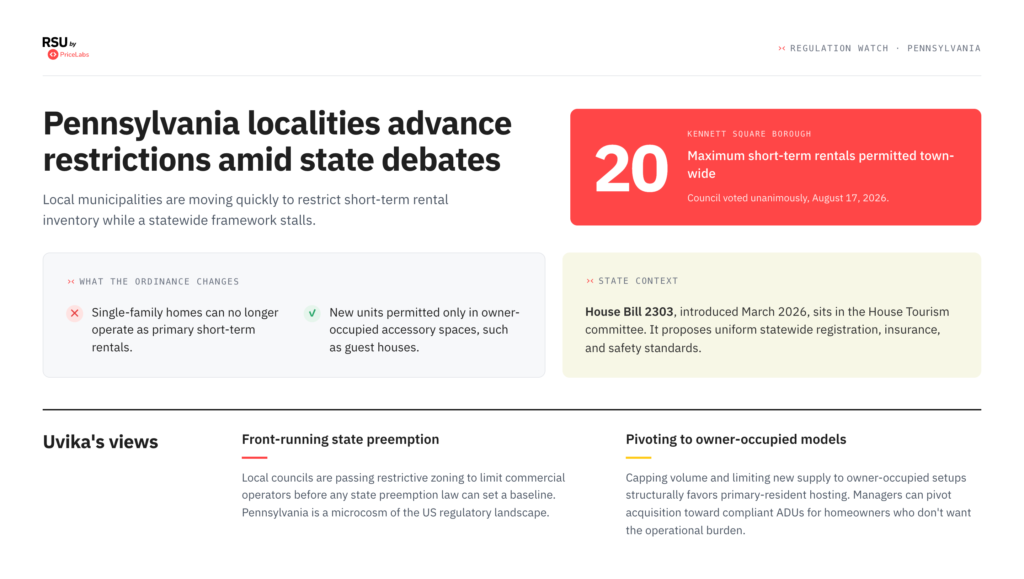
- Local municipalities in Pennsylvania are moving quickly to restrict short-term rental inventory.
- On August 17, 2026, the Kennett Square borough council voted unanimously to cap short-term rentals at a maximum of 20 units town-wide.
- Under this new local ordinance, single-family homes can no longer operate as primary short-term rentals; future units will only be permitted in owner-occupied accessory spaces, such as guest houses.
- The State Context: This local restriction is occurring while Pennsylvania House Bill 2303, introduced in March 2026, sits in the state House Tourism committee. The state bill proposes imposing uniform statewide registration, insurance, and safety standards.
Uvika’s Views
- Front-Running State Preemption: Pennsylvania represents a microcosm of the US regulatory landscape.
- Local councils are proactively passing restrictive zoning ordinances to limit commercial operators before any potential state-level preemption laws can establish baseline protections.
- Pivoting to Owner-Occupied Models: By capping total volume and limiting new supply exclusively to owner-occupied setups, municipalities are structurally favoring primary-resident hosting over commercial property investment.
- What professional managers can do is pivot their local acquisition strategies to focus on managing compliant accessory dwelling units (ADUs) for primary homeowners who prefer not to handle the operational burden of hosting.
Italy Advances National ID Codes and “Entrepreneur” Status
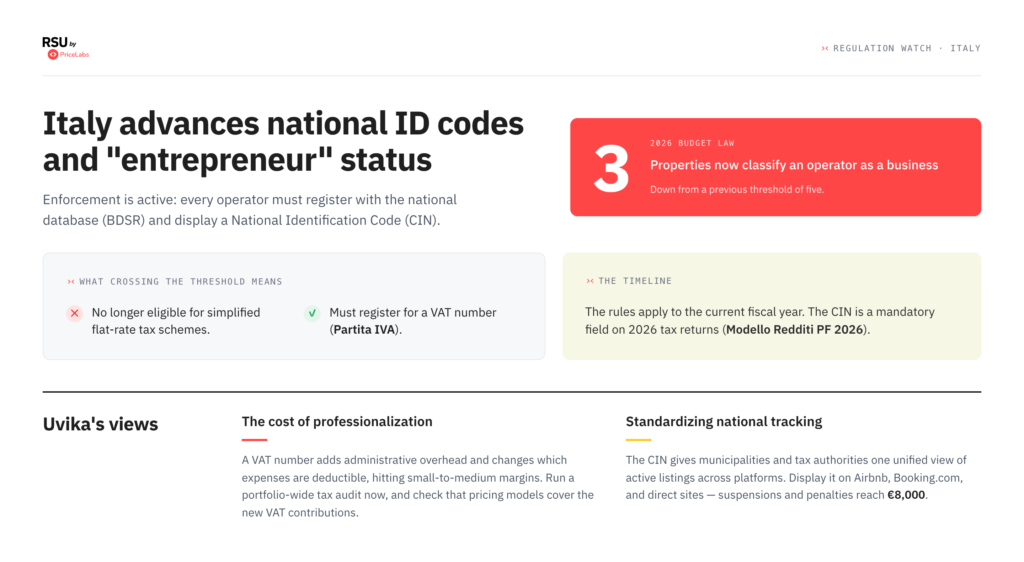
- Italy’s short-term rental regulations have entered their active enforcement phase, requiring all operators to register with the national database (BDSR) and display a National Identification Code (CIN).
- A critical shift in the 2026 Budget Law fundamentally changes the definition of a commercial operator: anyone managing three or more short-term rental properties is now legally classified as a business.
- The “Why”: Previously, the entrepreneurial threshold was set at five properties. By lowering the limit to three, the Italian government requires a larger segment of multi-property operators to register for a VAT number (Partita IVA) and transition away from simplified flat-rate tax schemes.
- The Timeline: The rules apply to the current fiscal year, and the CIN is now a mandatory field on 2026 tax returns (Modello Redditi PF 2026).
Uvika’s Views
- The Cost of Professionalization: Italy’s decision to lower the threshold for entrepreneurial status directly impacts the profit margins of small-to-medium operators.
- Operating with a VAT number introduces new administrative overhead and changes which expenses can be deducted.
- What professional managers can do is conduct a portfolio-wide tax audit immediately to ensure compliance and determine if their current dynamic pricing models adequately cover the newly required VAT contributions.
- Standardizing National Tracking: The mandatory CIN rollout ensures that local municipalities and tax authorities have a unified view of all active listings across platforms.
- Operators must ensure their CIN is clearly displayed across Airbnb, Booking.com, and direct booking sites to avoid listing suspensions and financial penalties of up to €8,000.
Ventura Overhauls Ordinance and Hikes Fees
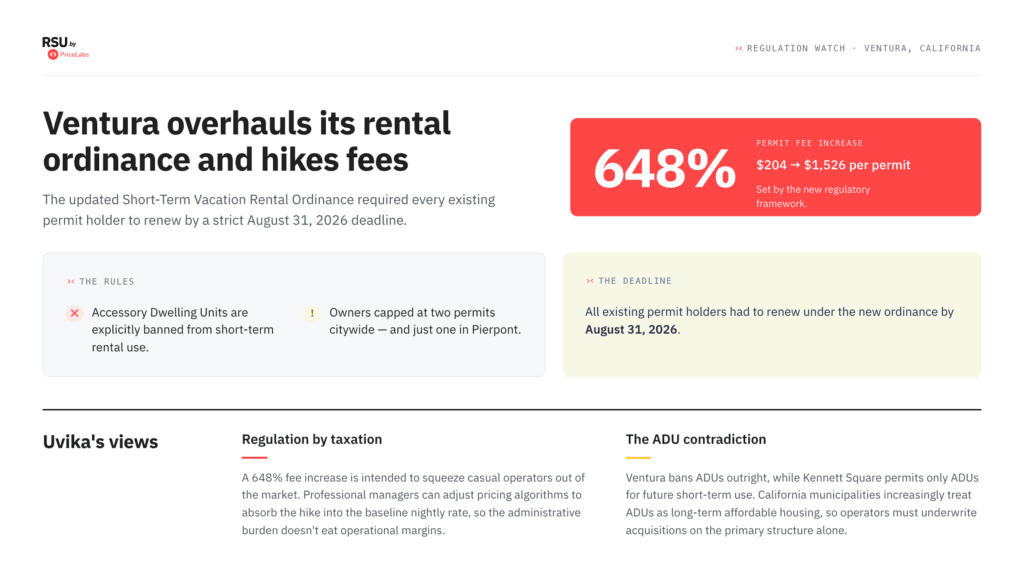
- The City of Ventura, California, finalized an updated Short-Term Vacation Rental (STVR) Ordinance that required all existing permit holders to renew by a strict August 31, 2026 deadline.
- The Fee Hike: As part of the new regulatory framework, the city drastically increased the permit fee from $204 to $1,526.
- The Rules: The ordinance introduces strict geographic capacity limits, capping owners at a maximum of two permits citywide (and just one in the highly trafficked Pierpont area). Additionally, in alignment with state housing laws, Accessory Dwelling Units (ADUs) are now explicitly banned from being used as short-term rentals.
Uvika’s Views
- Regulation by Taxation: When a municipality raises its permit fee by 648%, the regulatory intent is clear: to squeeze the margins of casual operators and force them out of the market.
- What professional property managers can do is adjust their pricing algorithms to absorb these fee hikes into the baseline nightly rate, ensuring the administrative burden does not eat into their operational margins.
- The ADU Contradiction: Ventura’s explicit ban on using ADUs for short-term rentals stands in contrast to markets like Kennett Square, which only permits ADUs for future short-term rental use.
- California municipalities are increasingly classifying ADUs as strictly long-term affordable housing stock, meaning operators in the state must underwrite new acquisitions based solely on the primary structure’s earning potential.
Stay on top of short-term rental regulation trends and what they mean for your operating environment.

Uvika Wahi is the Editor at RSU by PriceLabs, where she leads news coverage and analysis for professional short-term rental managers. She writes on Airbnb, Booking.com, Vrbo, regulations, and industry trends, helping managers make informed business decisions. Uvika also presents at global industry events such as SCALE, VITUR, and Direct Booking Success Summit.
Related Articles:
 Maui’s Vacation Rental Crackdown: What You Need to Know
 Arizona Mayors Seek Rental Control, Murcia Partners with Airbnb, and Minut Automates Energy Savings with Ecobee
 Portugal Supply Mushrooms, Airbnb Scores Lobbying Win in Washington, Booking.com’s 2025 Travel & Sustainability Report
 Ireland Launches National Register, Vienna Hikes Tourist Tax, Madison AL Caps Permits