

In the latest France Airbnb regulations news, a Paris court handed down a record €585,000 fine on April 15 against a société civile immobilière (SCI) that had converted an entire 9th arrondissement building into eleven Airbnb units. The judgment is the latest signal of a sharp upward trend in France Airbnb regulations enforcement: Paris has already issued close to €1 million in illegal short-term rental fines in just the first three months of 2026 — continuing a steep year-on-year climb.
Days before the ruling, the Conseil de Paris also approved a 150-person housing enforcement brigade tasked specifically with illegal tourist rentals, predatory landlords, and rent-cap violations. Together, these developments show how Loi Le Meur is being enforced on the ground in Paris — and because nine other major French cities operate under the same national framework, what Paris does next is a direct preview of enforcement across the country.
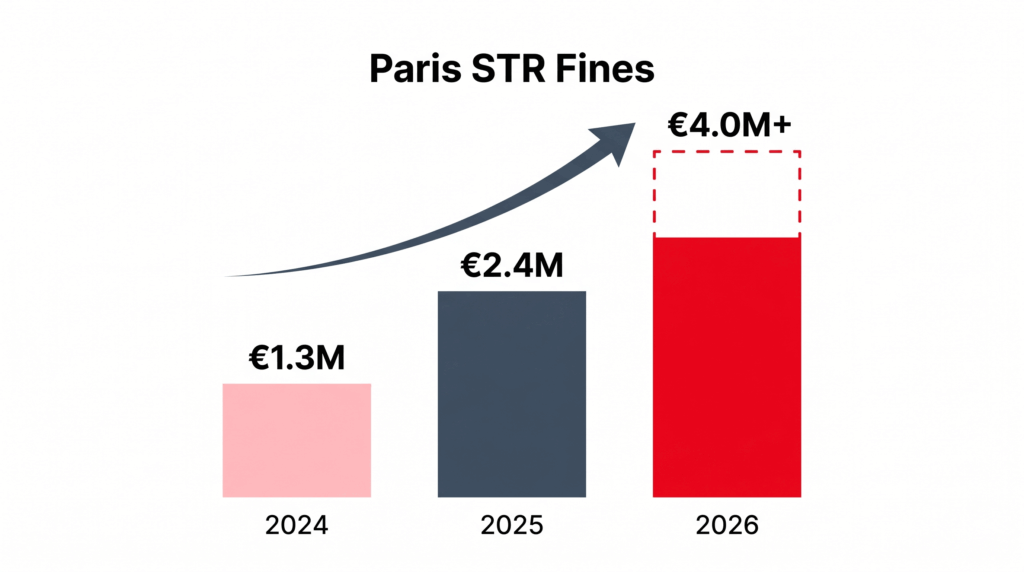
Paris fines doubled in 2025, and Q1 2026 is on pace to outpace that
Fines nearly doubled in Loi Le Meur’s first full year
The year-on-year data shows what has changed. In 2024, Paris’s total illegal-rental fines sat at €1.3 million — the last year before Loi Le Meur took effect in November. (The law is formally named Loi Echaniz-Le Meur, after its co-sponsors Iñaki Echaniz and Annaïg Le Meur, and is widely referred to in English-language coverage as France’s “anti-Airbnb law.”) In 2025, the first full year of the new framework, total fines nearly doubled to €2.4 million. The first quarter of 2026 is already close to €1 million — a figure disclosed by Jacques Baudrier, Paris’s Deputy Mayor for Housing, in a Mairie de Paris communiqué on April 17.
That run rate would clear €3.5 million for the full year if sustained, and it does not yet include the €585,000 April judgment, which will land in Q2.

Why judges can impose larger penalties now
The scale of these fines is not incidental. Before Loi Le Meur, the maximum civil fine for a change-of-use violation — the offence at the heart of the €585,000 ruling — was capped at €50,000 per unit. The law doubled it to €100,000. The Cour de cassation clarified in a March 11, 2026 decision that the new ceiling applies only to procedures initiated after the law’s entry into force; older cases still carry the €50,000 cap. The structural point is that judges now have the headroom to impose materially larger penalties against corporate landlord structures — and the Paris data shows they are doing so.
Three SCI fines in ten weeks: Paris is pursuing building-scale operators
The case: social housing converted to Airbnb without authorisation
The April 15 case illustrates exactly what that means. The building sits in the 9th arrondissement, was acquired by the SCI in late 2022, and had previously operated as a résidence sociale — social housing for people in precarious situations. By late 2023 it had been fully converted into eleven furnished tourist rentals listed on Airbnb, without the autorisation de changement d’usage that French law requires for that conversion. The tribunal imposed a principal fine of €445,000 plus additional penalties, for a total of €585,000 announced by the Mairie on April 17.
Two earlier SCI fines in February point to a pattern
Baudrier described the operator as representative of companies renting at scale, and the broader 2026 pattern supports that characterisation. Two earlier SCI fines were imposed in Paris in February — one around €80,000, another around €150,000. Three SCI judgments in ten weeks is not random; it is a targeting decision. The Mairie’s framing is pointed: a building that housed vulnerable residents, stripped and converted into Airbnb income. These are the cases Paris will pursue first, and publicise most.
The Grégoire administration is making Loi Le Meur enforcement a political priority
A new mayor and a new 150-person enforcement brigade
Loi Le Meur has existed since November 2024. What has shifted in recent weeks is how fully Paris is applying it. Emmanuel Grégoire, elected mayor of Paris on March 22, 2026, ran on a platform of tighter short-term-rental rules; his campaign position was that only Parisians going on holiday should be able to list their homes. Three days before the €585,000 judgment was made public, an extraordinary session of the Conseil de Paris approved the creation of a brigade de protection du logement — the 150-person enforcement unit tasked specifically with illegal tourist lets, predatory landlords, and rent-cap violations.
25,000 illegal rentals, and deliberate political framing
The Mairie de Paris estimates that roughly 25,000 illegal tourist rentals operate in the city — the scope Grégoire’s administration has now committed to reducing through the new brigade. Baudrier’s public description of the April 15 ruling as “a very big victory” is calibrated language, and the sequencing is deliberate: the Conseil de Paris approved the brigade three days before the €585,000 judgment was publicised. The brigade and the fine form a single message to operators, not two separate ones.
Lyon, Marseille, Bordeaux, and Nice are operating under the same national framework
The legal tools Paris is using are national, not local. Everything Loi Le Meur established applies across France. The €100,000 change-of-use cap per unit, the €15,000 penalty for exceeding the 90-day primary-residence limit, the €20,000 fine for false registration, and the €100,000 property-manager liability for client non-compliance are all national provisions. Lyon and Bordeaux activated 90-day caps on January 1, 2026; Marseille has operated one since early 2025; Nice is set for 2026 and has established its own Mission Protection des Logements. Nice’s new change-of-use regulation was partially suspended by the Tribunal administratif in February 2026 pending a Conseil d’État decision — a reminder that operator legal challenges are active — but the national framework itself is not in question.
May 20 gives French authorities monthly activity data on every listing
Monthly activity data will cover every listing in France
Until now, applying that framework has required cities to rely on complaints and individual investigations to detect violations. That changes on May 20, 2026. The EU’s short-term rental data-sharing regulation (Regulation 2024/1028) takes effect across member states, including France. Under the new regime, rental platforms — Airbnb, Booking.com, Vrbo, and every other operator above a listing threshold — will be required to transmit monthly activity data for every listing to a national Single Digital Entry Point. That data includes the unit’s specific address, the registration number, the listing URL, the number of nights booked, and the number of guests per night.

Cap breaches and unregistered listings will surface automatically
For enforcement, this is the difference between knowing there is a problem and being able to act on it. A city with a 90-night primary-residence cap, like Paris, currently has no reliable way to identify which listings are breaching it until a complaint is filed or an investigation is opened. After May 20, every booked night on every listing is reported monthly. A listing that clears 90 booked nights in a calendar year will surface in the data automatically — as will listings operating without a valid registration number, listings whose activity patterns don’t match their self-declared primary residence, and listings tied to addresses that have never received change-of-use authorisation.
Platforms report; municipal teams enforce with the targeting done for them
Enforcement still sits with the competent authorities in each Member State, and in France that means municipal enforcement teams like Paris’s brigade de protection du logement and Nice’s Mission Protection des Logements. What changes for those teams is that the targeting work, historically the slowest part of enforcement, is largely done for them.
Doubled fines, systematic data, and record penalties have changed the calculus for drift operators
For operators who have historically absorbed enforcement risk as a cost of doing business, the calculation has changed.
Per-unit fines have doubled under Loi Le Meur. Paris judges are imposing them at record levels. Property managers carry their own €100,000 liability for client misrepresentation. And from May 20, French authorities will receive monthly activity data on every listing in the country.
The law applies nationally. Nine other major French cities have the same enforcement tools as Paris. What Paris is demonstrating is how aggressively they can be used.

Uvika Wahi is the Editor at RSU by PriceLabs, where she leads news coverage and analysis for professional short-term rental managers. She writes on Airbnb, Booking.com, Vrbo, regulations, and industry trends, helping managers make informed business decisions. Uvika also presents at global industry events such as SCALE, VITUR, and Direct Booking Success Summit.
Related Articles:
 Airbnb’s Vision for Fair Regulations in Spain and Elsewhere
 The May 20 EU Data Deadline: Should Property Managers Expect Mass Delistings?
 EU Short-Term Rental Data Sharing Goes Live, Australia Calls for Sweeping Reforms, US States Preempt Local Rules
 French Short-term rentals and the Hoguet Law: What the FNAIM Report from April 2026 Says