
On April 20, every Airbnb host with an account older than February 5 will be asked to accept a new set of terms before they can book, manage listings, or receive payouts. For most hosts, this will take two minutes and feel like a routine click-through. For professional managers running large portfolios, reviewing several of the changes included in the Airbnb terms of service update would need more than two minutes of attention.
This is not an alarm. It is a read. Here is what actually changed, what triggered it, and what it signals about where the platform is heading.
After April 20, No Accept Means No Access
Airbnb has confirmed that existing users cannot accept the updated terms before April 20 — the prompt does not appear until that date. After it does, declining or ignoring it means losing access to new bookings, host tools, and future payouts until you accept. Existing confirmed reservations are honored.
Log in on April 20. Accept. Move on. The operational part is that simple. The rest of this piece is about what you are agreeing to.

The Damage Claims Section Got Rewritten. The AI Ban Is Only Part of It.
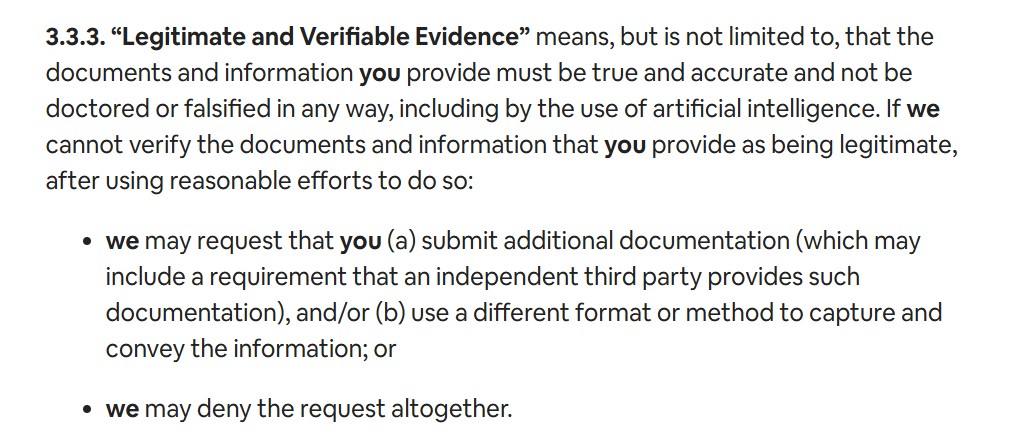
The most widely covered change in Airbnb terms of service update is Airbnb’s new ban on AI-generated or AI-modified evidence in damage claims. The backstory is well-documented: a Manhattan superhost submitted AI-fabricated photos to support a $16,000 claim against a guest in mid-2025. The guest identified the fabrication. Airbnb reversed the claim, apologized, and launched an internal review. These terms are the structural response.
For professional managers, the AI photo ban itself changes little in practice. Honest operators were already submitting real photos, real receipts, and real repair estimates. The ban closes a gap that bad actors were exploiting.
What actually changed is the entire evidence framework, not just the AI clause.
Alongside the AI ban, the updated Host Damage Protection terms also introduced:
A formal definition of “Legitimate and Verifiable Evidence” — now a defined term with specific requirements, where previously it was not defined at all.
Tighter and more specific evidentiary standards for smoke odor claims, including new requirements around proof of causation and restrictions on which types of remediation qualify for reimbursement.
Updated and narrowed eligibility rules for household linen stain claims.
A new “Consumables” definition formally excluding items like toiletries, kitchen supplies, and cleaning products from damage claim eligibility.
Taken together, this is a systematic narrowing of what AirCover, well, covers and a higher bar across the whole framework — not just in cases involving AI. Professional managers filing damage claims with any frequency are working under materially tighter rules than they were six months ago.
Why Booking.com and Vrbo have no equivalent rules — and what that tells you
Neither competitor has an AI evidence ban, and the reason is structural. Booking.com’s facilitated damage program is capped at €/$/£500 per incident; its US host property insurance through Generali covers up to $1 million in liability but is a separate product. Vrbo’s accidental damage protection, underwritten by a third-party insurer, tops out at $3,000. AirCover covers up to $3 million, platform-backed.
The tighter evidence requirements are the cost of the most ambitious host protection program in the market. That context does not make the new framework easier to navigate. But it explains why Airbnb has rules its competitors do not.
Airbnb Can Now Formally Deny Payout Access. What Qualifies as a Trigger Is Undefined.
The updated Payments Terms include new explicit language giving Airbnb the right to “prevent or deny” access to payment services based on internal policies, applicable law, or government orders. The previous version had termination and suspension provisions. This framing is new.
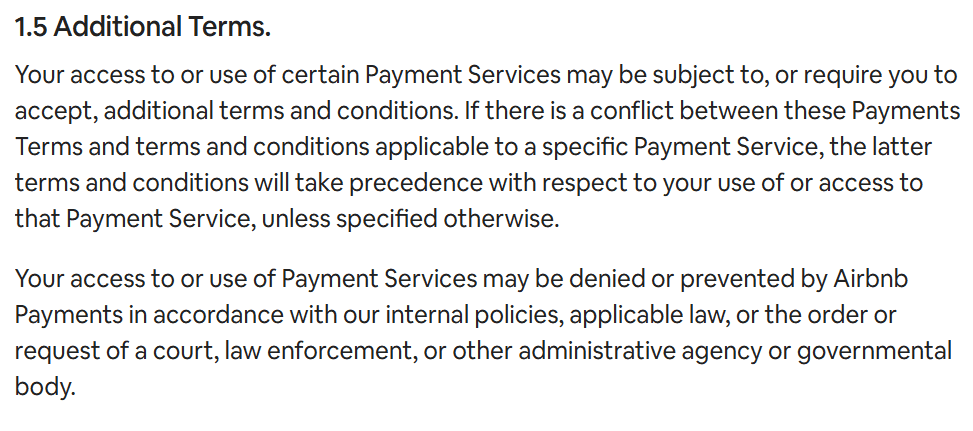
The trigger conditions are not defined.
The terms reference “reasonably necessary” judgments and “risk factors” without specifying what qualifies as either. There is no defined timeline for resolution and no obligation to disclose what triggered a hold.
For a solo host, this is largely theoretical. For an operator with a large portfolio concentrated on Airbnb, the structure of the risk is different. A flag on a single listing — an unresolved guest complaint, an incomplete documentation request, an account detail that trips automated review — can affect payout access across the entire portfolio until the issue is resolved. The terms provide no defined endpoint for that resolution.
This is not entirely new behavior. Airbnb has held payouts during investigations before. What is new is that it is now formally codified in the terms every operator is being asked to accept. For anyone who has not already built sufficient cash reserves to cover operating expenses independent of Airbnb payout timing, this language is an explicit prompt to do so.
The Privacy Policy Formally Declares What Airbnb Was Already Doing. The Timing Is What Matters.
The updated Privacy Policy includes, for the first time, an explicit statement that Airbnb uses personal information to “develop and improve our AI.” It also adds tracking of interactions with AI-enabled services as a new usage data category. Neither appeared in the previous version.
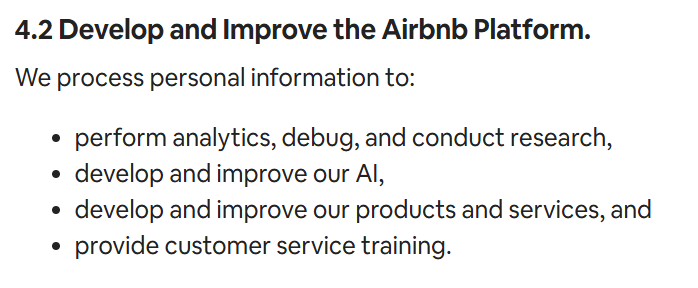
Airbnb was almost certainly already doing this. The question worth asking is why it is formalizing it now.
Airbnb’s AI ambitions are not a secret — and the legal infrastructure is now catching up
RSU has tracked Airbnb’s AI strategy across two pieces this year. The Q4 2025 earnings call confirmed that Airbnb is fine-tuning AI models on a dataset of 500 million reviews and over a million support interactions. The appointment of Ahmad Al-Dahle — who led Meta’s Llama model development — as CTO signals the scale of that ambition. The summer product release, historically when Airbnb makes its most significant platform announcements, is approaching.
The sequence: privacy terms updated in February, formal enrollment of all existing users by April 20, summer product cycle opening in the weeks that follow. Airbnb is not only describing what it currently does with host and guest data. It is building legal cover for what it intends to do next.
The Regulatory Clock Is Also Running
The regulatory environment is pushing in the same direction. EU Regulation 2024/1028, which RSU covered in depth, requires platforms to standardize data collection and sharing with local authorities by May 2026 — and the EU AI Act is tightening disclosure requirements around automated decision-making. Platforms operating at Airbnb’s scale are under pressure to have explicit, documented legal bases for how they process and use data. The February privacy update satisfies that requirement on both fronts simultaneously: it secures Airbnb’s rights over host data for AI development while also bringing its disclosure framework into line with what European regulators now expect.
What this means for operators contributing the most data
Professional managers running large portfolios are the platform’s most data-rich operators. Their pricing decisions, booking window patterns, response behaviors, minimum stay configurations, and occupancy rates generate more signal than any individual host. That signal is now formally part of what feeds Airbnb’s AI development — including, plausibly, the systems that determine search ranking and listing visibility.
The terms do not say that directly. The implication does not require much inference.
What These Changes, Read Together, Actually Describe
Accepting the April 20 terms is operationally simple. Nothing in these updates requires operators to change how they run their businesses today.
What warrants attention is the direction they collectively describe. A platform tightening its evidence standards, formalizing its discretion over payouts, and securing its data rights is a platform extending structural control over the operating environment — narrowing what it absorbs, broadening what it can do, and laying legal groundwork for a product cycle its leadership has been building toward publicly.
For most professional managers, Airbnb remains the highest-volume channel available, and the one with the most developed host protection infrastructure. The case for staying is not the question. The case for reducing portfolio concentration on a single platform — and understanding exactly what you are contributing to it — has never been more legible.

Uvika Wahi is the Editor at RSU by PriceLabs, where she leads news coverage and analysis for professional short-term rental managers. She writes on Airbnb, Booking.com, Vrbo, regulations, and industry trends, helping managers make informed business decisions. Uvika also presents at global industry events such as SCALE, VITUR, and Direct Booking Success Summit.