
A lot of short-term rental managers have spent the past two years doing the right things. Updating their websites. Thinking about how AI tools interpret their content and how to do generative engine optimization for short-term rentals. Showing up in ChatGPT results when someone searches for places to stay. And some of them are getting cited. Regularly.
And they’re still not seeing the bookings they expected.
Neely Khan thinks she knows why. Khan is the founder of Artwork Creative and the creator of Kahani, which she describes as the world’s first GEO plus storytelling framework for hospitality brands. The short version of her argument: getting found by AI and getting chosen by a human are two completely different problems. The industry has been solving for the first one while quietly ignoring the second.
We sat down with her to get into what that gap actually looks like, and what property managers can do about it.

The gap between AI citation and short-term rental bookings
When an AI tool recommends a property, a human still has to click on the link. Read the copy. Look at the photos. Decide whether to trust whoever is behind the listing. And if what they find doesn’t give them a clear reason to choose that property specifically, the AI citation has done nothing.
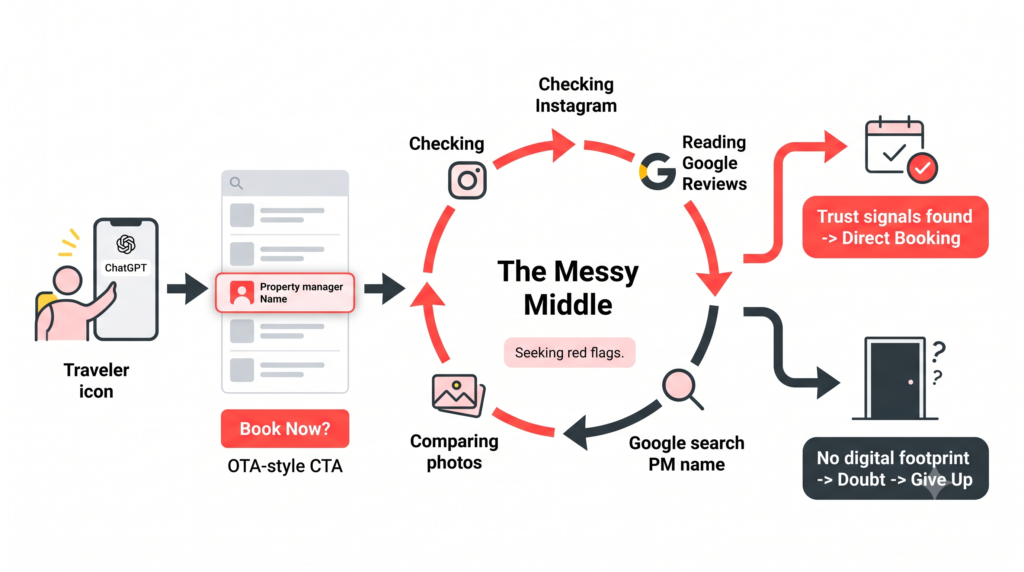
Khan points to Google’s 2020 “messy middle” research as a framework that has only become more relevant since. The idea is that consumers don’t move in a straight line from discovery to purchase. They explore, compare, pull back, reconsider, and loop. A traveler who finds a property on ChatGPT might then Google the property manager, scroll their Instagram, check if there are recent reviews, and quietly talk themselves out of it if the digital footprint isn’t there.
“As human beings, biologically, we are hardwired to seek out red flags,” Khan told us. “Our job is to make sure that after AI has recommended a brand, whatever is in that link is eliminating those risks and those doubts.”
For a property manager, that means the AI citation is only the beginning of the work. What happens on the other side of the click is what actually determines whether the booking happens.
EEAT: the framework that still applies
The EEAT framework, originally developed to help content rank on Google, turns out to map almost perfectly onto what AI search tools are looking for now. Khan uses it as the backbone of her approach. The four components are Experience, Expertise, Authority, and Trust, and for property managers each of them has a specific, concrete meaning.
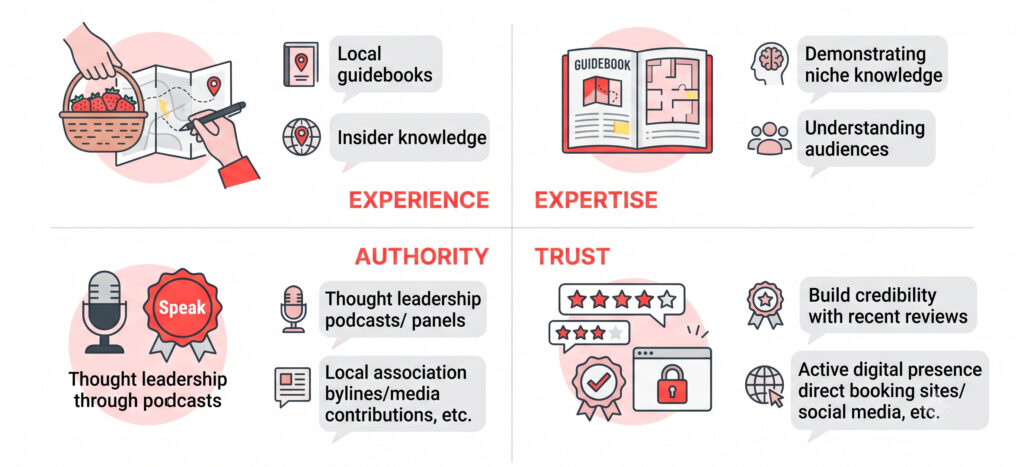
Experience does not require decades in the industry. Khan is emphatic about this. If you have been managing properties in the English countryside for three years and you know every local strawberry farm, foraging walk, and farmers market within twenty miles, that knowledge is your experience signal. The question is whether you are publishing it anywhere. A host who writes detailed, first-hand local guides is demonstrating experience in a way that AI tools can read and cite. One who doesn’t, isn’t.
LinkedIn, she notes, is currently one of the most actively crawled platforms by AI search tools. Story-led posts about your local knowledge, your business wins and losses, your perspective on your market: these are not soft brand-building exercises. They are technical inputs into how AI interprets who you are and what you know.
Expertise overlaps with experience but is more about the depth of your knowledge of your niche and audience. For a property manager, this means demonstrating that you understand your guest type, your market, and what makes your properties the right choice for a specific kind of traveler.
Authority is the one that tends to make managers without PR budgets nervous. Khan’s advice here is pragmatic: you do not need press coverage in trade news to build authority. What you need is third-party evidence that you are credible. Podcast appearances, panel discussions, webinar contributions, even writing a piece for a local business association’s newsletter and having them publish it: all of these create digital footprints that AI tools treat as authority signals. Khan built her own profile in this industry by contacting event organizers early in her career and offering to write about their conferences for free in exchange for a byline. Over time, she started getting invited to speak. The investment is time, not budget.
Trust is the most tactical of the four, and the most immediately actionable. It comes down to the presence or absence of things that a prospective guest would look for to confirm you are real and reliable: recent reviews, accreditation badges, a coherent and current social media presence, a direct booking site that looks like a real business. A property that gets cited by an AI tool but has a thin or outdated digital presence is actively undermining its own visibility.
Why personality is not a soft metric
One of the more pointed arguments Khan makes is about generic content. The internet, and especially the short-term rental corner of it, is filling up with copy that could belong to anyone. Words like “luxury,” “wellness,” and “five-star experience” appear everywhere and mean nothing, because there is no specific context wrapped around them. If your listing description, your website copy, or your social media posts could be lifted and used by a competitor without anyone noticing, Khan says, you are not doing enough.
This matters for AI visibility, not just for human conversion. AI tools are crawling content and looking for language patterns, semantic associations, unusual combinations of words that help them build a mental model of what a brand stands for. A property brand that consistently writes about the same specific niche, the same local context, the same voice, trains AI tools to associate that brand with those things. A generic brand teaches AI tools nothing, and gets treated as interchangeable with every other generic brand.
“If you use unusual metaphors that still answer immediate questions, AI will pick up on that,” Khan told us. “It will see your brand as different. And that is how it works it out.”
The implication for property managers is that the specificity you might have thought of as a nice-to-have, your niche, your local angle, your distinct personality, is now a technical input into how AI represents you. The managers who commit to it will accumulate a signal advantage over time. The ones who keep publishing generic content will continue to sound the same as everyone else, even if they are technically AI-optimized.
Two Practical Steps to Audit Your AI Visibility This Week
Exercise 1: Reverse-Engineer Your Prompts
Open an AI tool (like ChatGPT, Claude, or Gemini) in an anonymous/incognito window so it doesn’t rely on your past search history.
- Ask the tool to recommend the best short-term rentals in your specific market or niche.
- If your brand is recommended, ask the tool: “Why are you recommending this brand? What specific sources are you citing? What language patterns led you to this conclusion?”
- If your brand isn’t recommended, look at the competitors who were, and ask the AI why it chose them. This gives you an exact roadmap of the digital gaps you need to fill.
Exercise 2: Leverage the Power of LinkedIn
AI search models heavily favor crawling LinkedIn for real-time information and thought leadership. Commit to posting story-driven, genuinely helpful content about your market or business every one to two days. Keep a tight focus on your opening hook—the first 80 words should clearly summarize the value of the post, as this is the primary real estate AI crawlers scan.
You can find Neely Khan on LinkedIn and on Substack.

Uvika Wahi is the Editor at RSU by PriceLabs, where she leads news coverage and analysis for professional short-term rental managers. She writes on Airbnb, Booking.com, Vrbo, regulations, and industry trends, helping managers make informed business decisions. Uvika also presents at global industry events such as SCALE, VITUR, and Direct Booking Success Summit.