Brian Chesky has said, more than once, that Airbnb doesn’t want a conventional loyalty program. No points, no tiers, nothing that resembles Marriott Bonvoy. This month, Airbnb launched Airbnb car rentals in five markets, the US, France, Italy, Spain, and Australia, through a new partner called CarTrawler, with first-time bookings earning up to 20% back in Airbnb credit. Set that credit next to the ones Airbnb already runs for hotels and its own HotelTonight app, and a pattern starts to take shape, whether or not it was ever the plan.
This piece walks through that pattern: what the credit programs actually add up to, how it compares to what Expedia and Booking.com already run in the open, and what it means for professional short-term rental managers competing for the same guest dollars.
Airbnb’s Car Rental Feature Is Live, and It’s the Smallest Part of This Story
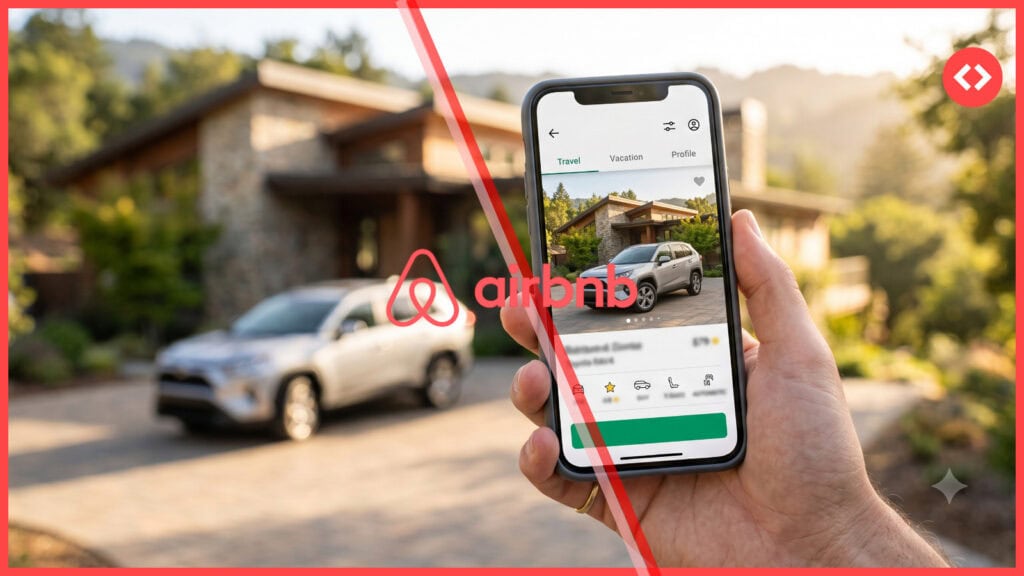
Car rentals through Airbnb, fulfilled by the Ireland-based B2B firm CarTrawler, are now bookable in the US, France, Italy, Spain, and Australia. Guests can add one to an existing stay through Trips, or book standalone through Services.
The basics:

- Major suppliers: Avis, Hertz, Budget, and Enterprise
- First-time bookings earn up to 20% back in Airbnb credit
- Credit is capped at $200, calculated on the subtotal before taxes, fees, insurance, add-ons, and fuel
Airbnb announced the feature on May 20, 2026, at its annual Summer Release event, the same day Expedia confirmed its roughly $350 million acquisition of CarTrawler. That means the infrastructure powering Airbnb’s newest travel category will likely be owned by one of its biggest rivals before the year is out. It’s a real wrinkle, we’ll come back to it, but it’s not the part of this story that matters most to property managers on its own.
The part worth sitting with is buried a layer deeper, in the credit itself, and in what it quietly confirms about a promise Brian Chesky has been making for over a year.
Chesky Says No to Loyalty Points. What Airbnb Ships Looks Like Loyalty Anyway
Airbnb doesn’t have a loyalty program, at least not officially. Chesky has talked about wanting one since before the company went public, and he’s been fairly consistent on one point: whatever Airbnb builds, he doesn’t want it to be a conventional points system.
On an earnings call earlier this year, he told analysts that if Airbnb does loyalty, “we wouldn’t want to do an out-of-the-box points program.” He added that the company was testing “a lot of different tracks,” and that a paid membership in the spirit of Amazon Prime appealed to him more than a mileage-style ladder.
That doesn’t rule out what Airbnb has actually shipped over the past year. It just means nobody’s put a name on it:
- Hotel bookings on Airbnb earn credit back
- HotelTonight, which Airbnb owns, pays credit back on every stay
- Car rentals now pay credit back too
Whether that’s deliberate design or just how the categories happened to roll out, the effect reads the same either way: a currency that accrues on Airbnb bookings and can only be spent on more Airbnb bookings. It walks like a loyalty program and it spends like one. Airbnb just hasn’t called it one.
There’s a reason it might keep showing up this way instead of arriving as one branded launch. Asked about Airbnb’s broader ambitions the same day the car rental feature was announced, Chesky told CNBC’s Andrew Ross Sorkin he could picture the platform eventually running “dozens, possibly even hundreds of categories, just like Amazon.” Add a new category, add a credit mechanic to go with it, repeat. A loyalty-shaped pattern is what that looks like from the outside, regardless of whether anyone at Airbnb is thinking of it in those terms.
Read More: Airbnb tests pay-to-play visibility for “best guests” (LOYALTY PROGRAM TEST?)
Three Airbnb Credit Programs, Three Different Rates: What the Differences Reveal
Line the credit programs up and the differences are more revealing than the similarities:
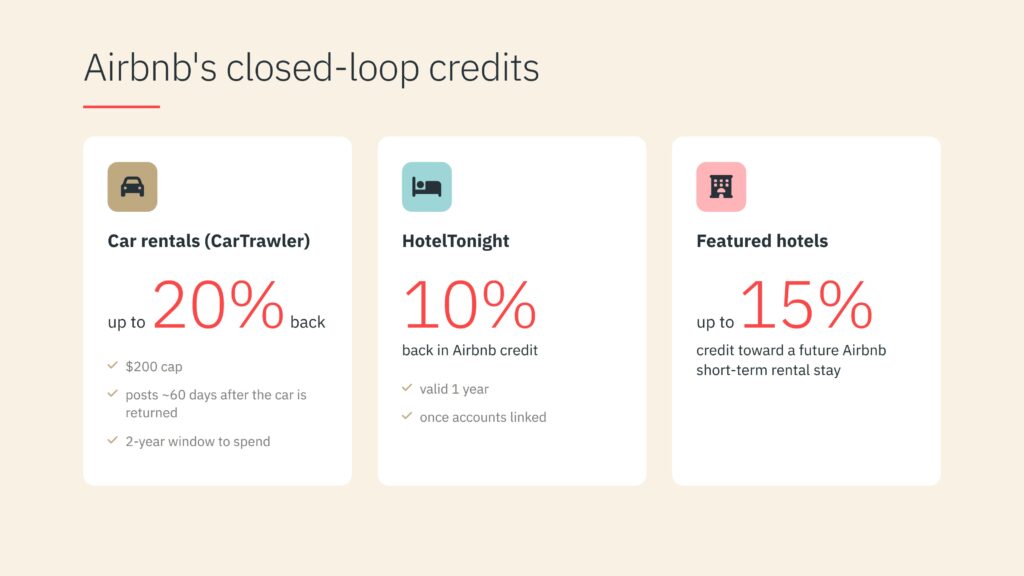
- Hotels: Base 10% back, rising to 15% for badged “featured hotel” listings, capped at $2,000, deposited within a day of checkout, expires after one year
- HotelTonight: Flat 10% back, stacks across every booking once an account is linked, expires after one year
- CarTrawler: Up to 20% back, capped at $200, a 60-day wait before the credit posts, a two-year window to spend it
Every one of those numbers is a lever, and Airbnb is pulling each one differently depending on how established the category already is.
Hotels are familiar territory for Airbnb guests at this point, so the incentive can run modest. Cars are brand new, so the percentage is the highest of the three, engineered to force a habit rather than reward one. The cap stays low because rental transaction values run lower than a hotel folio, so Airbnb doesn’t need to offer much in absolute dollars to hit that 20%. The longer expiration window buys more time for a guest to actually redeem it into another Airbnb booking, which is, after all, the entire point.
Expedia and Booking.com Already Named Theirs. Airbnb Still Hasn’t
Airbnb isn’t operating in a vacuum here, and it’s worth being clear that the other two players in this market solved for loyalty a while ago, in the open, with a name on it.
Expedia Group runs One Key, a single loyalty currency shared across Expedia, Hotels.com, and Vrbo. Members earn OneKeyCash on stays, flights, activities, and car rentals, and can spend it on any of the three brands. Booking.com runs Genius, a tiered program that unlocks automatic discounts, up to 20% on stays and select rental cars, once a guest crosses booking thresholds. Both are named products with public marketing behind them. Both already include car rentals.
Airbnb has neither. What it has instead is the same underlying behavior, credit that accrues on one booking and spends on another, assembled hotel by hotel, app by app, and now car rental by car rental, without ever being introduced as a program.
This is also where the Expedia acquisition of CarTrawler comes back in. Once that deal closes, the car rental booking that earns an Airbnb guest their credit will run on infrastructure owned by the same company that already put a name and a public rewards page on this exact behavior. Airbnb will be renting the pipes from a competitor that isn’t shy about calling this what it is.
Read More: Booking Holdings Is Almost as Big as Airbnb in Homes
What Airbnb Car Rentals Mean for Property Manager Ancillary Revenue
This is where the competition for ancillary revenue actually shows up, and it’s direct.
Operators who currently build extra income around their own transportation arrangements are now up against a subsidized, one-tap option sitting inside the same app the guest already booked their stay through:
- A personal car listed on Turo
- A private airport pickup arrangement
- A relationship with a local rental counter
The comparison isn’t close on convenience, and increasingly it isn’t close on price either.
The upside runs the other way for drive-to and rural inventory. A rental car that’s one tap away inside the same trip lowers the friction that used to keep fly-in guests away from properties without easy public transit. Listings in those markets are likely to see less of a booking penalty for being hard to reach without a car, since Airbnb itself is now the one putting the car in the guest’s hands.
Could Car Rental Bookings Train Airbnb’s Matching for Parking and EV Charging?
Airbnb’s search and matching already personalizes results per guest based on stated intent and behavior. Once mobility data from a car rental booking sits inside that same system, it’s a reasonable next step for Airbnb to start using it:
- A guest books a car rental for their trip
- Airbnb’s matching engine now knows this guest has a vehicle
- When that guest (or a similar one) searches for a stay, listings with parking availability, EV charging, or easy highway access could get weighted higher in results
Nothing here has been confirmed by Airbnb. But it would be a small, logical extension of a system that already personalizes results based on what it knows about a guest’s trip, and it’s worth property managers keeping an eye on whether parking and charging details in a listing start mattering more for visibility, not just guest experience.
The Takeaway: Airbnb’s Loyalty Program Doesn’t Need a Name to Work
If Airbnb keeps adding categories the way Chesky has described, each one paying into the same expiring, closed-loop credit, the practical effect on guest behavior will look identical to a loyalty program whether or not Airbnb ever calls it one.
A guest sitting on unredeemed credit from a car rental has a real incentive to put their next stay on Airbnb rather than book direct or shop a competitor. That incentive compounds every time a new category gets plugged in.
For operators leaning on repeat guests booking direct, that’s the actual thing to watch. Not the car rental feature itself, but the quiet accumulation of reasons for a guest’s next booking to default back to the platform. Airbnb doesn’t need to announce a loyalty program for that dynamic to already be running. It just needs to keep adding categories.

Uvika Wahi is the Editor at RSU by PriceLabs, where she leads news coverage and analysis for professional short-term rental managers. She writes on Airbnb, Booking.com, Vrbo, regulations, and industry trends, helping managers make informed business decisions. Uvika also presents at global industry events such as SCALE, VITUR, and Direct Booking Success Summit.
Related Articles:
 Airbnb Drops Strict Policy—Limited Takes Over: What It Means for Your Vacation Rental Business
 Airbnb and The White Lotus Effect: A 500% Surge That Rewrote the Market
 Airbnb Touts Experiences 2.0, Booking.com Courts NBA Fans, eviivo Streamlines Checkout with PayPal
 Airbnb’s natural language search is already live in the US — five days before the Summer Release