France’s government wants to cap one of the last big tax advantages left to vacation rental owners, and some members of parliament want to go further and remove it entirely for anyone who buys a vacation rental from 2027.
Here’s what is on the table:
- The proposal: owners would be able to deduct depreciation of only 1.5% per year of a vacation rental’s building value, capped at €5,000 per year per household, all properties combined. Long-term furnished rentals would get a softer cap (2.5% and €7,000).
- The harder version: a parliamentary committee voted to ban depreciation entirely for vacation rentals bought from January 1, 2027.
- The money: the government expects to collect €260 million in 2027, rising to €330 million a year over time.
- Who is exposed: the many owners who today pay little or no income tax on their rental income thanks to depreciation. In 2021, 68% of them declared a tax loss.
- The timing: a key vote is set for November 3, but France’s minority government could fall over its budget, which would delay the measure rather than kill it.
France is one of the largest short-term rental markets in the world: Airbnb has long described it as its second-largest market after the US, and it is Europe’s largest by nights booked, according to the Eurostat data we analyzed this month. What happens there tends to inspire regulators elsewhere in Europe. In this article, we’ll see what the measure does, why depreciation matters so much to French vacation rental owners, how it fits into the wave of French rules since 2024, and what it means for property managers who work with these owners.
A quick primer: how France taxes vacation rental owners
For readers outside France, a bit of context is needed, because the French system is unusual.
In France, renting out a furnished property (which includes every vacation rental) is taxed as a commercial activity, not as passive rental income. Most owners fall under a status called LMNP, for loueur en meublé non professionnel, or “non-professional furnished landlord”: an individual who rents out furnished property without it being their main source of income. Owners who earn more than €23,000 a year from furnished rentals, and for whom it represents more than half of their household’s income, are “professional” landlords (LMP) and are not targeted by this measure.
An LMNP owner can choose between two tax regimes:

- The flat-rate regime (“micro-BIC”): the tax office automatically deducts a fixed percentage of revenue to cover expenses, and the owner is taxed on the rest. Since the Le Meur law of 2024, that deduction is 50% for vacation rentals with an official star rating (classés) and only 30% for unrated ones, which are also capped at €15,000 of revenue.
- The actual-expenses regime (“régime réel”): the owner deducts real expenses, including depreciation of the building and furniture.
Depreciation is the key. Because it is a deduction with no cash going out, it often wipes out taxable profit entirely, year after year, and unused depreciation can be carried forward indefinitely. This is why, when the Le Meur law made the flat-rate regime less attractive for vacation rentals, many owners simply switched to the actual-expenses regime, often with the help of specialist accountants.
For American readers, the logic will feel familiar: US owners also depreciate rental property, over 27.5 years for residential rentals, or 39 years when the average stay is seven days or less, which works out to roughly 2.6% per year. The French proposal of 1.5% per year would be considerably stingier than that, and the €5,000 household cap has no US equivalent.
What France’s 2027 budget proposes
The French government presented its 2027 budget bill (projet de loi de finances, or PLF, the annual law that sets taxes and spending) on October 1. Its Article 7, titled “Redirecting public support towards family and long-term housing”, rewrites the depreciation rules for LMNP owners.
According to the text of the bill:
- Most furnished rentals: depreciation capped at 2.5% per year, and €7,000 per year per tax household
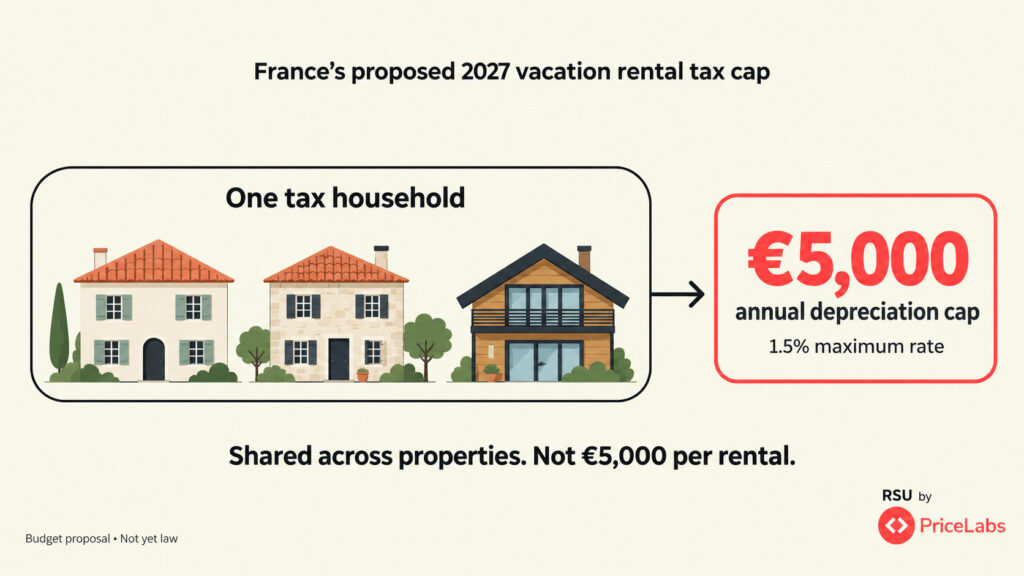
- Vacation rentals (rated or not): depreciation capped at 1.5% per year, and €5,000 per year per tax household
- No more carry-forward: from 2027, depreciation above the cap is lost forever
- The existing stock: depreciation accumulated before 2027 can still be used until the end of 2036, but only against half of each year’s taxable profit
Student residences, senior residences and care homes are exempt, and the flat-rate regime is untouched.
Here’s the thing: the €5,000 cap applies per household, not per property. A couple owning three vacation rentals could deduct no more than €5,000 of depreciation per year across all three, which is why owners with small portfolios are the most exposed.
The government’s stated goal is to make long-term renting more attractive than short-term renting. The bill explicitly links the cap to a 2026 tax break for unfurnished long-term rentals at affordable rents (the “Jeanbrun” scheme, capped at €8,000 a year in most cases and up to €12,000 for the most affordable rents). According to the report of the parliament’s general budget rapporteur, Charles de Courson, a furnished rental under LMNP is today about 41% more profitable than a comparable investment under that long-term scheme. The same report estimates the current cost of the LMNP regime to the state at €353 million a year, and concludes that the reform would lead to the “near-disappearance” of its tax advantage.
What the cap would mean in euros
Let’s look into this with a simple example. Take a vacation rental whose building value (excluding land, which cannot be depreciated) is €200,000 (or $200,000; the mechanics are the same):
- Today: at a typical depreciation rate of about 3.5%, the owner deducts around €7,000 a year
- With the proposed cap: 1.5%, or €3,000 a year
- The difference: about €4,000 of additional taxable profit every year. For a household in the 30% income tax bracket, which also pays 18.6% of social charges on this income, that is close to €2,000 of extra tax per year, by our calculation
And above roughly €333,000 of total building value across the household’s vacation rentals, the €5,000 cap kicks in.
How many owners does this affect? According to a 2024 parliamentary report led by Annaïg Le Meur (the MP behind the Le Meur law), quoted by the budget rapporteur, 68% of furnished rental owners on the actual-expenses regime declared a tax loss on their 2021 income, against only 14% of owners renting unfurnished property. In other words, two out of three paid no income tax on their rental income.
Parliament wants to go further on vacation rentals
On October 8, the finance committee of the National Assembly (France’s lower house) voted two amendments that shift the whole burden onto vacation rentals:
- Long-term rentals spared: an amendment by Guillaume Kasbarian, from President Macron’s party, exempts furnished homes rented as a tenant’s main residence, on short “mobility leases” (for people relocating for work or training), or to students and apprentices. In its own words, the tightening “remains entire for vacation rentals.”
- No depreciation at all for new vacation rentals: an amendment by Socialist MP Iñaki Echaniz, co-author of the Le Meur law, would ban any depreciation deduction for a vacation rental acquired from January 1, 2027. Properties bought before that date would remain under the 1.5% and €5,000 cap.
The Kasbarian amendment also quotes the Prime Minister’s political objective, which it calls “legitimate”: not giving vacation rentals a tax advantage in zones tendues, the French term for cities where housing demand far exceeds supply.
There is a catch, though. The day after these votes, the same committee rejected the whole revenue section of the budget, so the full Assembly is debating the government’s original text, not the committee’s version. Both amendments must be tabled again and voted on in the chamber to survive.
The fourth tax hit in two years
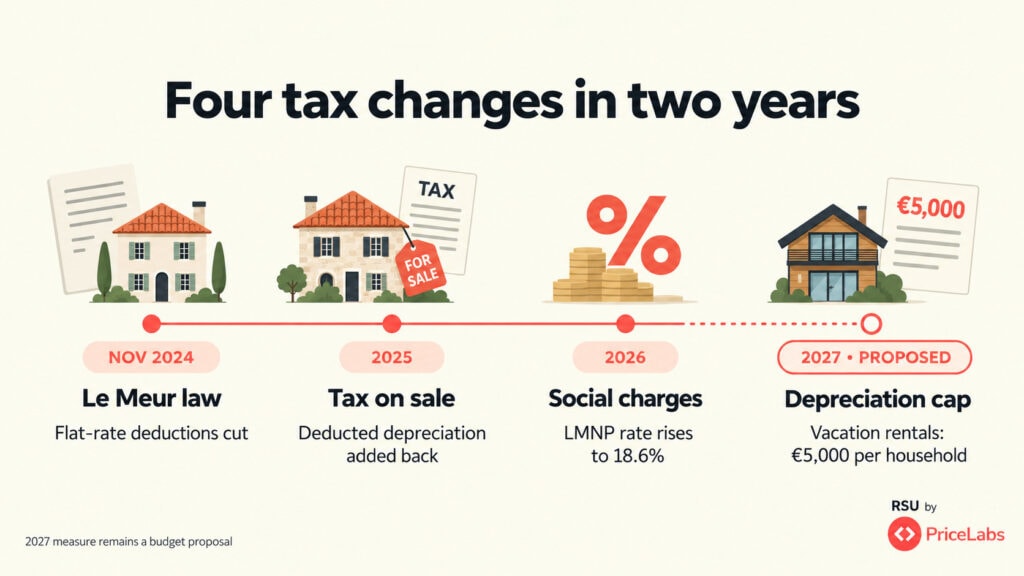
This is not an isolated move. Since late 2024, French vacation rental owners have absorbed a steady series of changes:
- The Le Meur law (November 2024) cut the flat-rate deduction for vacation rentals and gave mayors stronger tools, from lower day caps to quotas (our breakdown of the law and what experts say about its effects). Enforcement has followed: Paris issued nearly €1 million in fines in the first quarter of 2026 alone (our report). France also implemented the EU registration rules on May 20, 2026 (our guide and how to avoid OTA delistings).
- The 2025 budget added the depreciation already deducted back into the taxable capital gain when an owner sells, a bit like depreciation recapture in the US.
- The 2026 social security budget raised social charges on LMNP income to 18.6%, versus 17.2% for unfurnished rentals.
- The 2027 budget now goes after depreciation itself.
So, there you go: the Le Meur law closed the flat-rate escape route, and the 2027 budget is now closing the actual-expenses one. The idea is not new either. The Le Meur mission, conducted with two government inspection bodies, had recommended removing depreciation for furnished rentals, and last year the Assembly had already voted a 2% cap before rejecting the 2026 budget as a whole.
The industry has pushed back. On October 12, the day before the debate opened in the chamber, the UNPLV, the French vacation rental association whose members include Airbnb, Abritel/Vrbo, HomeToGo, Leboncoin and Interhome, issued a press release asking for the provisions that specifically target vacation rentals to be removed. Its main argument is instability: its president, Philippe Bauer, says owners cannot be asked to commit their savings for fifteen or twenty years while the tax rules change “every year”. The UNPLV also warns about mountain resorts, where much of the accommodation consists of homes occupied only part of the year, and which is already under pressure from France’s energy-performance rules ahead of the 2030 Winter Olympics in the French Alps.
Will it pass? France’s political deadlock
This is where French politics matters. Since President Macron dissolved the National Assembly in 2024, no group has held a majority, and France has already burned through two prime ministers. The current one, Sébastien Lecornu, needs votes from either the left or Marine Le Pen’s Rassemblement National to pass his budget. Left-wing parties have said they will likely vote to topple him (Journal du Net), and the RN has not ruled it out. This is also the last budget before the April 2027 presidential election, which makes every party more nervous.
Several paths remain open:
- A normal vote: the Assembly, then the Senate, amend Article 7. The Senate, where the center-right dominates, could soften it, and a joint committee of seven deputies and seven senators then seeks a compromise.
- Article 49.3: this constitutional tool lets the government adopt the budget without a vote, choosing which amendments to keep. Deputies can only stop it by passing a no-confidence motion, which also brings down the government.
- Ordinances: if parliament has not decided within 70 days (around December 17), the constitution allows the government to enact its bill by decree. This has never been done.
Here’s the thing: a government collapse would most likely delay the measure, not kill it. When Michel Barnier’s government fell in December 2024, the 2025 budget was only adopted in February 2025, under a new prime minister, and the capital-gains change for furnished rentals was still in it. The 2026 budget was also late, published on February 20, 2026. In the meantime, a stopgap “special law” only allows the state to keep collecting existing taxes. And because French income tax for a given year is calculated the following spring, a measure voted in early 2027 could still apply to 2027 income.
The calendar, as it stands:
- November 3: vote on the revenue section in the Assembly (official calendar) (postponed from October 20, as more than 2,000 amendments were still pending)
- November 17: first-reading vote on the whole budget
- November–December: Senate, then joint committee
- Late December: final adoption and publication, unless politics intervenes
If adopted, the cap would apply to financial years ending on or after January 1, 2027, which for most owners means 2027 rental income.
What it means for property managers
So, is the French vacation rental investment model over? Not quite, but it is getting a lot less generous, and here is what we at Rental Scale-Up think managers should keep in mind:
- Your owners’ net returns are about to drop. Owners on the actual-expenses regime, especially those with two or three properties, could face a new tax bill of a few thousand euros a year. Some will push for higher revenue to compensate, some will question management fees, and some may consider selling. It is better to have that conversation now than in spring 2028.
- The acquisition date becomes a dividing line. If the Echaniz amendment survives, a vacation rental bought in 2027 would carry no depreciation at all, which could slow the flow of new investor-owned properties, a key source of new contracts for many managers.
- The “flexible” model may look more attractive. With long-term furnished rentals spared, some owners could switch to mobility leases for part of the year and vacation rentals the rest of the time. In France, that mixed model already exists, and managers who can run both may have an edge.
- Star rating could regain value. Rated vacation rentals still benefit from a 50% flat-rate deduction up to €83,600 of revenue. For some owners, the comparison between the two regimes may flip, which makes the classification process a service worth offering (the decision itself belongs to their accountant).
- Outside France, watch the playbook. France is now regulating short-term rentals through tax as much as through zoning, with a clear line between tourist stays and long-term housing, and with grandfathering by purchase date. These are ideas other European governments facing housing pressure could borrow.
Nothing is final yet, and we will update this story after the November 3 vote. But the direction, in France, has not changed since 2024: the tax system is being rebuilt to favor long-term housing over vacation rentals, one budget at a time.
This article is for information only and is not tax advice

Uvika Wahi is the Editor at RSU by PriceLabs, where she leads news coverage and analysis for professional short-term rental managers. She writes on Airbnb, Booking.com, Vrbo, regulations, and industry trends, helping managers make informed business decisions. Uvika also presents at global industry events such as SCALE, VITUR, and Direct Booking Success Summit.
Related Articles:
 Goliday Expands to the UK, Edinburgh’s Temporarily Relaxes Regulations, Booking.com’s Top Welcoming Cities for 2025
 Houston Sets the Clock, DC Opens Hosting, Industry Builds an Advocacy Fund
 EU Short-Term Rental Data Sharing Goes Live, Australia Calls for Sweeping Reforms, US States Preempt Local Rules
 Mexico City Enforces Registration, England Delays Planning Class, Cleveland Caps Density