
On August 12, 2026, northern and eastern Spain will go dark just before sunset. The first total solar eclipse visible from mainland Spain in over 120 years is triggering a monumental astrotourism boom. But while the world looks up, the vacation rental industry is witnessing a powerful economic anomaly on the ground: unprecedented international travel demand caused by Solar Eclipse 2026 colliding head-on with aggressive national housing regulations.
The result is a market where supply is heavily artificially constrained, giving hosts unprecedented pricing power.
Chasing Totality: Flight Surges and the Rise of the Solo Astrotourist
The path of totality sweeps from Galicia in the west to the Balearic Islands in the east, passing directly over major hubs like Bilbao, Zaragoza, and Valencia. Because totality occurs late in the evening, the sun will sit incredibly low on the horizon. This fragile viewability, where a single hill or low cloud bank can obscure the main event, means travelers aren’t just booking a place to sleep; they are paying a heavy premium for unobstructed, west-facing properties.
The influx of these highly motivated travelers is already reshaping the August travel window. According to Amadeus travel intelligence, flight bookings to airports along the eclipse path between August 7 and August 12 have spiked by 25% year-over-year.

The demographics of this surge paint a picture of a hyper-focused, non-traditional guest:
- Unprecedented Regional Spikes: Bilbao is experiencing a massive 366% surge in inbound flight demand, followed closely by Asturias (+292%) and Valencia (+137%).
- The Global Eclipse Chaser: International demand is primarily being driven by long-haul origin markets, specifically the United States, Japan, Argentina, and Canada.
- Surgical Itineraries: These are not casual summer vacationers. Short stays of one to five days have increased by 57%, indicating visitors are building dedicated, high-intensity trips directly around the astronomical window.
- The Independent Traveler: While group and couple travel is up, solo travel has grown by a staggering 48% compared to last year, highlighting the deep, individual dedication of astronomy enthusiasts.
The Regulatory Squeeze: Why Short-Term Rental Supply is Plummeting
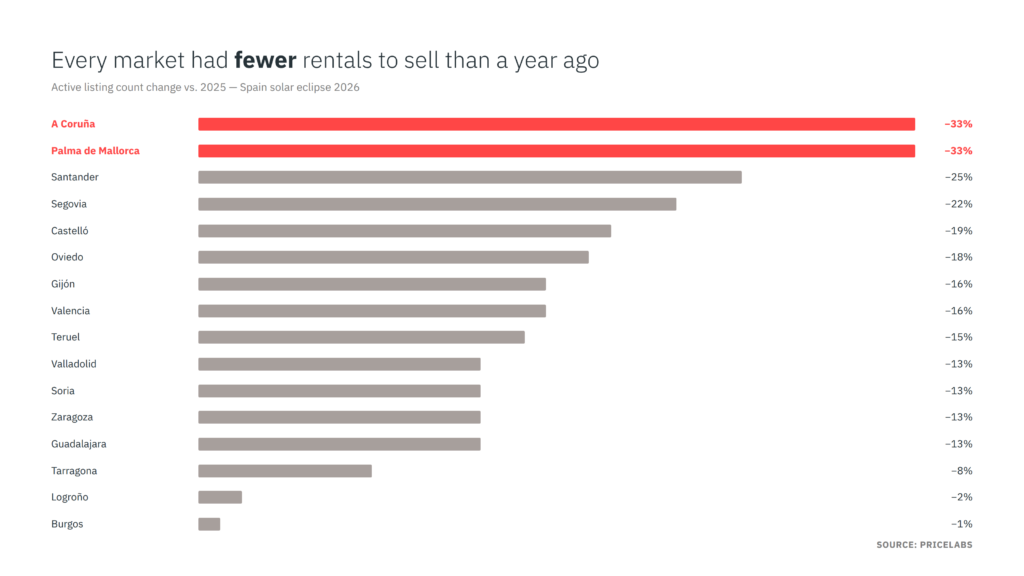
Basic economic theory suggests that a localized demand shock of this magnitude would flood the market with new, opportunistic short-term rental listings. Yet, PriceLabs data reveals a fascinating counter-trend: active listing counts across the eclipse path are actually down by an average of 16% compared to 2025. In cities like A Coruña, the supply of available short-term rentals has plummeted by 33%. This supply crunch is the direct fallout of Spain’s newly enforced Unified Rental Registry (Registro Único de Arrendamientos).
Following the aggressive government purge of tens of thousands of unlicensed apartments in late 2025 to combat overtourism, the baseline of legal inventory is now strictly capped. The casual operator can no longer spin up an Airbnb listing for a weekend to capitalize on an event. When this hard regulatory cap meets savvy professional property managers, who have strategically blocked their August 2026 calendars to wait for late-booking premiums, the market transforms into a high-stakes pressure cooker.
Astronomical Rate Hikes: PriceLabs Data Exposes a 98% ADR Jump
This intense friction between surging global demand and heavily suppressed local supply is yielding massive returns for fully compliant operators.
While hotel rates in the region have increased by a very respectable 36%, short-term rentals are operating in a completely different stratosphere. PriceLabs data shows an average Average Daily Rate (ADR) increase of 98% for the event dates compared to the same time last year.
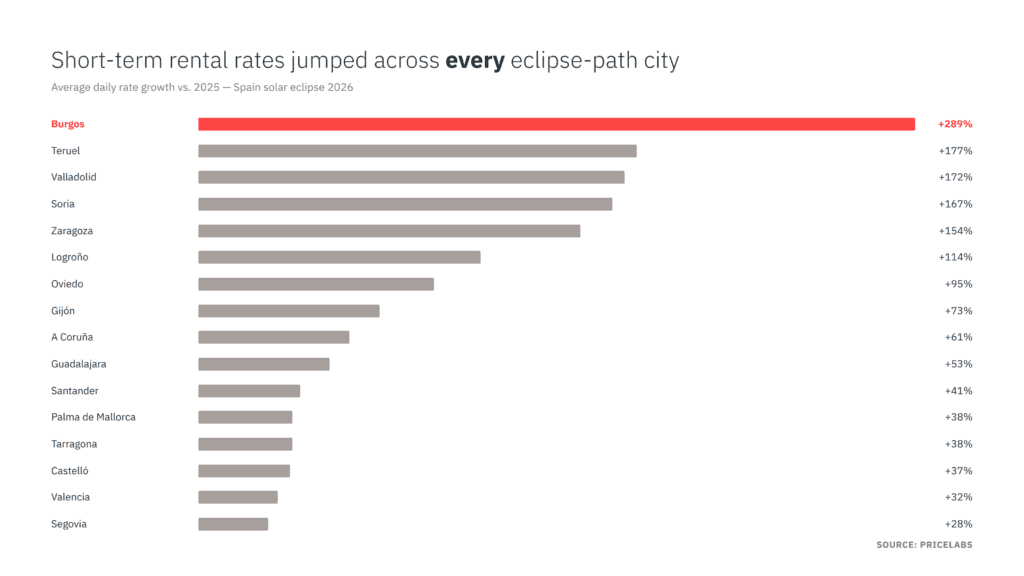
- The Burgos Anomaly: Sitting dead-center in the totality path, Burgos has seen rates explode by 289%. Standard $96 nights have catapulted to an average of $375.
- The Teruel Hub: Home to official space agency broadcast events, Teruel’s ADR has climbed 177% up to $272.
- Secondary Market Surges: Even secondary cities like Valladolid and Soria are punching well above their weight, posting rate increases of 172% and 167% respectively.
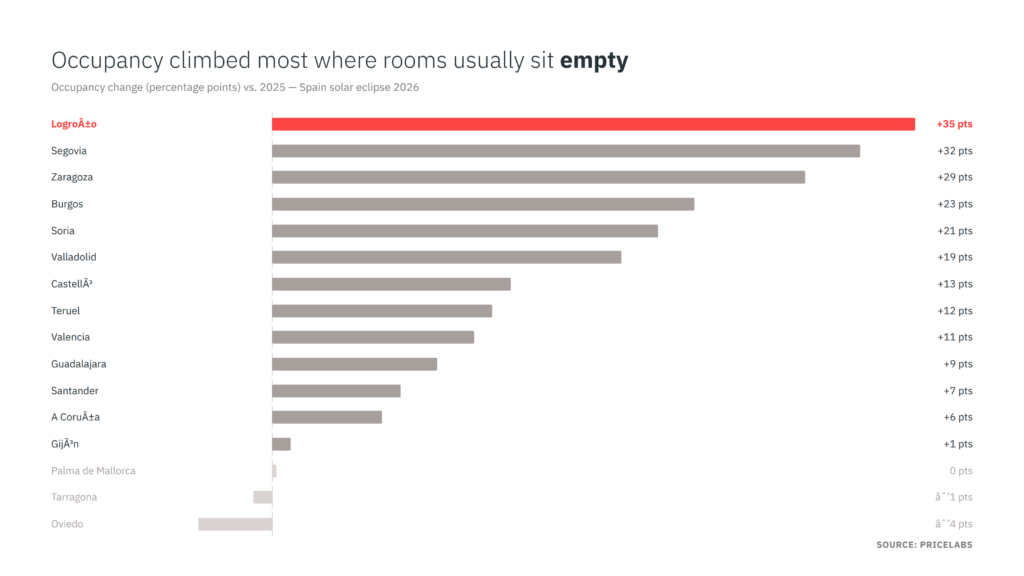
Demand is so acute that occupancy pacing is already averaging 66.4% across the analyzed region. Logroño, for instance, leaped from 40% occupancy last year to a staggering 75% for the 2026 eclipse dates.
The “Trio of Eclipses”: Forecasting Market Dynamics for 2027 and 2028
The August 2026 event is merely the opening act. Spain is entering an unprecedented golden age of astrotourism, serving as the stage for three consecutive solar eclipses in 2026, 2027, and 2028.
On August 2, 2027, a second total solar eclipse will sweep across southern Spain. In stark contrast to the 2026 sunset event, the 2027 eclipse occurs in the morning and boasts a massive duration, plunging cities like Cádiz, Málaga, and Tarifa into darkness for over four and a half minutes. Just six months later, on January 26, 2028, an annular “ring of fire” eclipse will cross the exact same southern Andalusia region right at sunset.
The current data from the 2026 event provides a clear predictive model for these upcoming phenomena. Andalusia is already one of Europe’s heaviest-hitting summer tourism markets. When the 2027 eclipse arrives, it will introduce compound, price-insensitive demand on top of peak baseline seasonality.
However, because Spain’s strict regulatory framework is now permanently in place, the supply elasticity that traditionally accommodated such mega-events is gone. The 2027 and 2028 markets will likely mirror the 2026 reality: a highly constrained, heavily policed legal supply forced to absorb a massive influx of international wealth. For the registered, compliant property manager, localized astronomical events are no longer just dates on a calendar. They are the most lucrative revenue anomalies of the decade.

Uvika Wahi is the Editor at RSU by PriceLabs, where she leads news coverage and analysis for professional short-term rental managers. She writes on Airbnb, Booking.com, Vrbo, regulations, and industry trends, helping managers make informed business decisions. Uvika also presents at global industry events such as SCALE, VITUR, and Direct Booking Success Summit.