
Jet fuel has more than doubled since February. Airlines have cut millions of seats from summer schedules. Spirit Airlines — the largest budget carrier in the US — has shut down entirely. And Europe may have as little as 30 days of jet fuel reserves left.
If you manage holiday rentals in Europe, you’re probably wondering: does this mean more domestic guests this summer? And should I adjust my holiday rental pricing strategy 2026?
The short answer: it depends entirely on where your properties are and who your guests typically are. We don’t yet have confirmed data that a large-scale domestic shift is underway — but the conditions are forming. Here’s how to read the situation, and what to actually do about it.
The fuel crisis is real, but the impact is uneven
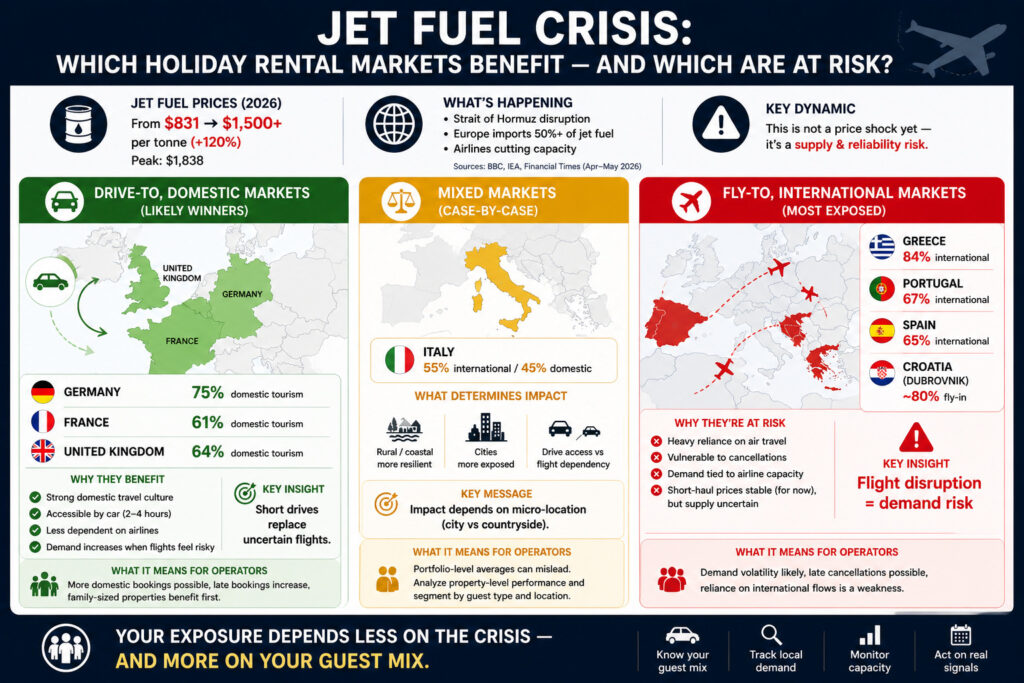
The numbers are stark. Jet fuel has risen from $831 per tonne in late February to over $1,500, peaking at $1,838 — an increase of more than 120%. The Strait of Hormuz, which normally supplies about 20% of the world’s traded jet fuel, has been effectively blocked for eight weeks.

Europe is particularly exposed. The continent imports more than half its jet fuel, much of it normally from the Gulf. The UK is worse — 65% of its jet fuel is imported, and two of its refineries closed in the past two years, leaving just four operational. The IEA has warned that if disruptions continue, physical shortages could emerge at some airports by June.
Airlines are responding. Lufthansa has cut 20,000 flights between May and October. Air France has been told not to add services to Singapore or Tokyo. EasyJet’s unhedged fuel cost it £25 million in March alone. Long-haul fares are up dramatically — London to Melbourne is 76% more expensive than last year.
In the US, Spirit Airlines — once one of the most profitable budget carriers in the country — has wound down operations entirely, citing “sustained rise in fuel prices”. Other US budget carriers are seeking a $2.5 billion government bailout.
But here’s the nuance most people are missing: short-haul European fares haven’t spiked yet. Wizz Air’s CEO says airlines are actually dropping prices on short-haul routes to overcome traveller hesitancy. Well-hedged budget carriers like Ryanair are using their cost advantage to pressure less-hedged rivals. So flying to Spain or Greece hasn’t become dramatically more expensive — yet. The risk is supply disruption and cancellations, not price. For now.
Which markets could win and which are most exposed
Not every European holiday rental market is affected the same way. The key variable is how dependent your market is on international fly-in visitors versus domestic travellers who drive.
Heavily domestic, drive-to markets — positioned to benefit:
Germany is the most domestic tourism market in Europe, with roughly 75% of overnight stays from German residents. The Baltic coast, Bavaria, and the Black Forest are almost entirely car-accessible. When Germans can’t fly cheaply — or don’t trust that their flight will operate — they stay home. Germany is also Europe’s biggest outbound travel market, so even a small percentage staying domestic moves the needle significantly.
France is similar at roughly 61% domestic. French families drive to Brittany, Normandy, the Dordogne, and the south. There’s already a strong domestic holiday culture that doesn’t depend on flights.
The UK sits at about 64% domestic. Cornwall, the Lake District, Devon, and the Welsh coast are almost entirely car markets. For UK families, the decision is straightforward: when a budget flight to Spain becomes uncertain, a 3-hour drive to Devon is the fallback. The RAC reports that the early May bank holiday is set to be the busiest in 10 years, with 19 million leisure car trips planned — despite petrol costing £13 more per fill than last year. Only 6% of drivers cited fuel costs as a reason not to travel. UK families are absorbing higher driving costs.
That said, “positioned to benefit” doesn’t mean every property in these regions will see a wave. The South West’s share of UK overnight trips has been declining — from 20% in 2022 to 16% in 2025— so any fuel-crisis uplift is fighting against a longer-term structural trend. The question is whether your specific properties, in your specific micro-market, are seeing it. More on how to check below.
Read More: Short Stay Pricing: How UK Property Managers CAN Handle Shorter Bookings and Rising Costs
Heavily international, fly-in markets — most exposed:
Greece is the most vulnerable major market in Europe, with 84% of overnight stays from international visitors, almost all arriving by plane. The islands are entirely dependent on flights from the UK, Germany, and France. If European flight capacity shrinks or cancellations mount, Greek tourism suffers disproportionately.
Portugal sits at roughly 67% international. The Algarve depends heavily on British and German flights. Lisbon has diversified somewhat, but the coastal regions are classic fly-to destinations.
Spain is at about 65% international. The Costas, Balearics, and Canary Islands need budget flights from northern Europe to fill. Domestic Spanish tourism exists but the industry’s engine is inbound air travel.
Croatia is also heavily exposed — in Dubrovnik, 80% of visitors arrive by plane. The city’s tourism board has described the situation as “very, very difficult”.
Mixed markets:
Italy splits roughly 55% international, 45% domestic. Italians drive to their own coast and countryside — Puglia, Sardinia, Tuscany. But the headline destinations (Venice, Florence, Amalfi) are heavily international fly-in. The impact depends on which part of Italy you operate in.
Read More: Airbnb Q4 2025: Record Bookings Driven by Simplified Pricing and Checkout
This isn’t Covid — and that matters
During Covid, driving was cheap and flying was banned or terrifying. The result was dramatic: international arrivals in Europe collapsed 65% while domestic demand dropped only 26%. UK “staycation” searches grew 500%. Rural and coastal holiday lets boomed.
This time is different in important ways.
Driving is more expensive too. UK petrol is at 157p per litre (£86 to fill a family car, £13 more than last year). Diesel is 189p (£104, up £27) (RAC, May 2026). For a short domestic drive of 2-4 hours, the extra cost is manageable — maybe £20-30 each way. But for long international drives — the Dutch caravan to Portugal, the German family driving to Croatia — fuel costs have risen substantially. A 2,000-mile round trip that cost £300 in fuel now costs £450-500. The automatic cost advantage of driving over flying is gone for long distances.
Flights exist — they’re just less certain. During Covid, you simply couldn’t fly. Now you can, but some routes have been cut, and there’s genuine uncertainty about whether summer schedules will hold. The UK government (FCDO) says there’s “no current need to change travel plans” — but that headline itself plants doubt.
The real driver isn’t price — it’s uncertainty about flights specifically. Families booking summer holidays right now are reading headlines about fuel shortages, airline collapses, and potential cancellations. Even if their specific flight isn’t affected, the doubt is enough to tip the decision. “Let’s just book something in the UK” doesn’t require a rational cost comparison — it requires enough anxiety about whether the flight will actually operate.
Driving costs, by contrast, don’t seem to be deterring people. The RAC data is clear: 19 million bank holiday trips planned, only 6% put off by fuel prices. Families are absorbing higher petrol costs for short domestic drives without hesitation.
So the realistic picture is:
Short domestic drives (Cornwall, Lake District, Brittany, Bavaria) are positioned to benefit most. The extra fuel cost is small and the alternative — an uncertain flight — is less appealing. These markets should see increased domestic demand, though probably not the dramatic Covid-era surge.
Long international drives (Netherlands to Portugal, Germany to Croatia) don’t automatically benefit. The drive itself is expensive now. These travellers are choosing between two expensive options.
Fly-to international destinations (Greek islands, Algarve, Costa del Sol) are most at risk — but not from price alone. Short-haul budget fares haven’t spiked yet. The risk is cancellations and supply disruption as summer progresses, especially if fuel reserves keep declining.
What should you actually do?
If you manage holiday rental properties in Europe, the question isn’t whether a domestic boom is coming nationally. It’s whether it’s reaching your specific properties, in your specific market, right now.
Here’s how to check — weekly.
1. Where are your guests coming from?
Compare your recent bookings — domestic versus international — to the same period last year. More local postcodes? Fewer foreign addresses? That’s the signal. If you’re in a drive-to destination (Cornwall, Lake District, Brittany, Black Forest), you should see this first. If you’re in a city that depends on international fly-in visitors (London, Barcelona, Lisbon), the story is different — flight disruption could hurt you, not help you.
2. Is your booking pickup accelerating?
How many new bookings came in this week compared to the same week last year? This is the earliest signal of a demand shift. If pickup is rising, demand is growing — even if your calendar looks emptier because bookings arrive later. If pickup is flat or declining, the national headlines aren’t translating into demand for your properties.
3. How does your pacing look by month?
Pull up June, July, and August occupancy compared to the same point last year. Not compared to your target — compared to what actually happened. If June is tracking close and July is building, that’s a late market filling normally. If July is well ahead of where it was at this point last year — that could be the domestic wave arriving early. If it’s behind and the gap is widening, don’t wait to act.
4. Check by property type.
A 4-bed family cottage in Devon benefits directly from “let’s drive instead of fly.” A 1-bed city flat doesn’t. Coastal and rural family-sized properties in drive-to destinations should see the signal first. Your portfolio average may be hiding it.
5. Check the booking window.
Are you seeing more bookings inside 14 days than last year? That’s specifically the late domestic booker who just decided not to fly. That’s the customer you don’t want to have already discounted for.
Connect it to your pricing
If you see the domestic wave in your data — hold your rates. You have more demand coming, possibly at the last minute. Discounting now gives away exactly the upside you should be capturing.
If you don’t see it — don’t assume it’s coming just because the Financial Times says so. A property manager in central London shouldn’t bank on a staycation boom. A property manager in Cornwall shouldn’t assume it’s automatic when the region’s share of UK overnight trips has been declining for three years.
Either way, know it now. Not in July. Make it someone’s job to pull this data weekly and report back: are we seeing more domestic bookings? Is pickup accelerating? Is pacing ahead or behind?
The point isn’t to predict the boom. It’s to see it when it arrives — and not have already given away your rates before it does.

Thibault Masson is a leading expert in vacation rental revenue management and dynamic pricing strategies. As Head of Product Marketing at PriceLabs and founder of Rental Scale-Up, Thibault empowers hosts and property managers with actionable insights and data-driven solutions. With over a decade managing luxury rentals in Bali and St. Barths, he is a sought-after industry speaker and prolific content creator, making complex topics simple for global audiences.