
The most important takeaway from Booking.com’s Q1 2026 results is not that geopolitical conflict slowed travel. It is that travel demand does not often disappear, but reroutes.
The Middle East conflict reduced Booking Holdings’ room-night and gross-bookings growth by about two points, but U.S. room nights still accelerated to low-teens growth, driven primarily by domestic demand. Intra-European travel was up high single digits, and intra-Asian travel was up low double digits.
That matters because the summer question for short-term rental managers is no longer just whether people will travel. It is whether flight disruption, higher airfares, and jet-fuel uncertainty push more of them toward domestic, regional, and drive-to stays — the kind of demand alternative accommodations are well positioned to absorb.
Booking.com Q1 2026 results: Stronger than the headline slowdown suggests
Worth saying: the headline numbers would have been unremarkable in a calmer year, but context matters. In Q1 2026 Booking.com:

- Recorded 338 million room nights (a 6% year‑over‑year increase)
- Gross bookings reached US$53.8 billion, up 15% YoY
- Revenue was US$5.5 billion, up 16%
- Adjusted EBITDA rose 19%, and adjusted EPS grew 14%
The company estimated that the Middle‑East conflict trimmed growth by about two percentage points. Considering that late‑February hostilities disrupted a key transit hub and sent jet‑fuel prices higher, a mid‑single‑digit room‑night gain signals resilience.
Alt accommodations — homes, apartments, vacation rentals — continued to buffer volatility. Their share of Booking.com room nights ticked up to ≈38%, roughly in line with total growth, while listings expanded 9% to 8.8 M. RSU’s Q1 2025 recap noted that alternative bookings grew 12% and represented 37% of room nights; by Q3 2025 this mix held steady around 37% with 8.6 M listings. The steady climb reinforces our earlier thesis: Booking’s hotel backbone allows it to scale vacation rentals without losing pricing discipline.
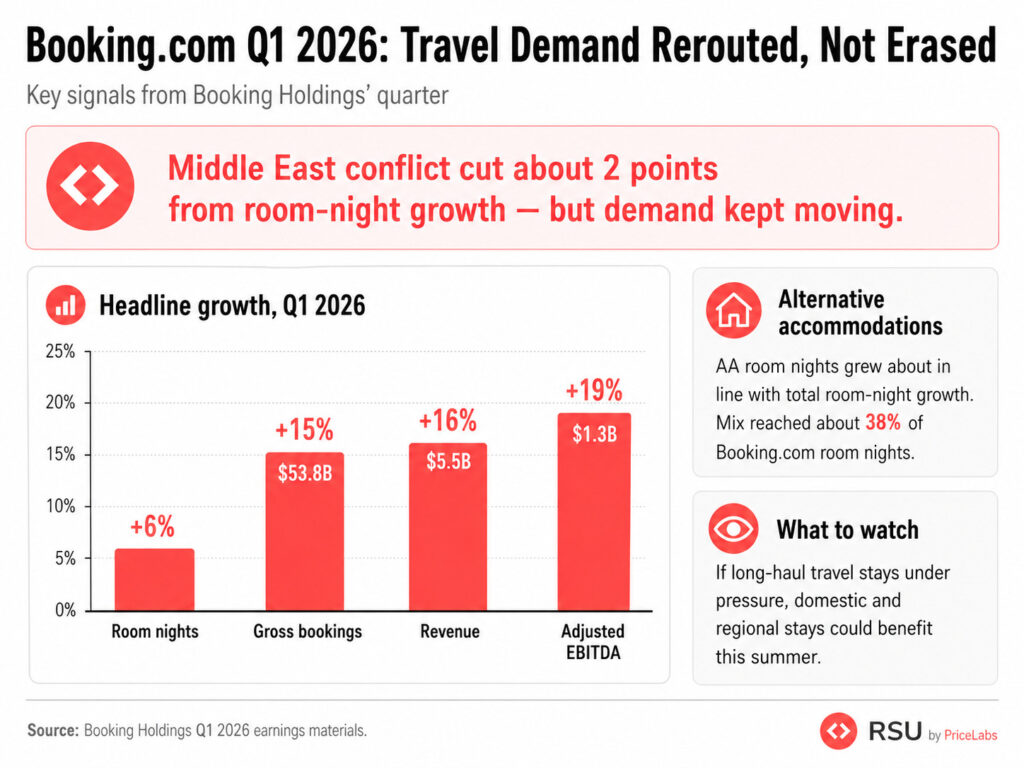
Booking.com’s Q1 2026 results show resilient travel demand despite Middle East disruption, with alternative accommodations reaching about 38% of Booking.com room nights. Source: Booking Holdings Q1 2026 earnings materials.Alternative accommodations remain central to Booking.com’s growth story
Operators know that volatility breeds opportunity. The 9% listing growth suggests supply is still coming online, even as hosts face higher financing and energy costs. Management said AA growth was “roughly similar to overall room‑night growth,” which implies high‑single‑digit gains. On the surface that’s slower than the 12% expansion RSU tracked in Q1 2025, yet the comparison is against a pandemic‑recovery surge; deceleration here looks more like a reversion to trend.
For property managers, the message is clear: alternative accommodations remain a critical channel. Booking’s infrastructure (payment facilitation, fraud prevention, multilingual support) and its giant app (in the high‑50% share of bookings) give it reach that Airbnb or Vrbo cannot match in certain markets. We have previously highlighted how cross‑promotion through hotel traffic and Genius loyalty programs convert casual travellers into rental guests. With domestic travel likely to rise, managers in suburban and rural destinations should anticipate incremental demand and ensure their properties are listed on channels where travellers expect one‑stop shopping.
The domestic travel question is now unavoidable
Another underappreciated story is Booking.com’s direct demand engine. Mobile app bookings accounted for a “high‑50%” share of room nights, and Genius Level 2/3 members likewise delivered a high‑50% share. Merchant gross bookings grew 24%, raising the merchant mix to 72%, showing that guests increasingly pay Booking.com upfront rather than at the property. The company plans to “strengthen Genius” by adding more immediate benefits (free breakfast, room upgrades, tiered discounts). From an operator’s perspective, this implies stronger price competition but also more predictable payouts and fewer cancellations.
What is analytically useful here is the intersection of loyalty and geography. The Middle‑East conflict, now in its third month, has cut cross‑border bookings through hubs like Dubai and raised concerns about fuel availability and airfares. Booking’s guidance assumes these headwinds persist through June. If international trips become costlier, domestic tourism is poised to pick up, echoing the pattern we observed during the U.S. slowdown in 2025.
For U.S. operators, this could mean more weekend bookings within driving distance and a premium on flexible cancellation policies. For European hosts, domestic travellers may fill shoulder seasons, but expect shorter lengths of stay and greater price sensitivity. If you rely heavily on cross‑border guests, now is the time to localise your listings, adjust minimum stays and refresh your domestic marketing.
Genius, merchant payments, and Connected Trip are tightening Booking.com’s platform control
Booking Holdings’ long‑promised Connected Trip — a seamless itinerary from inspiration to lodging to attractions — is showing growing signs of life. Management touted Priceline’s AI assistant “Penny” and natural‑language search with Smart Filters at Booking.com. The tools let users type “a pet‑friendly cottage near Lisbon under €100 per night” and get bookable results, and early data shows higher engagement. CEO Glenn Fogel emphasised partnerships with OpenAI, Google and Anthropic to integrate booking functionality into frontier models.
We view these as incremental enhancements rather than a strategic pivot: they improve user experience but do not yet redefine distribution. Competitors are racing to embed generative AI into search and guest communications; property managers should experiment with these features but not expect immediate changes to demand.
What short-term rental managers should do before summer
RSU’s Q1 2025 coverage noted that Booking’s alternative accommodations grew 12% and captured 37% of room nights, outpacing Airbnb’s 8% nights growth and Expedia/Vrbo’s 6%. In Q3 2025, Booking sounded more confident than Airbnb thanks to its U.S. marketing push and multi‑vertical stack. Without Q1 2026 data from Airbnb and Vrbo yet, we can only infer that Booking’s 6% room‑night growth compares favourably with Airbnb’s mid‑single‑digit nights growth in late 2025. When those figures become available, we will update this comparison.
For operators, the takeaway is strategic diversification: if you rely solely on one platform, you miss out on cross‑platform demand shifts. Booking’s expanding loyalty program and payments capabilities may draw travellers who previously booked on Airbnb; Vrbo’s integration with Expedia’s loyalty programme could be a wild card. You need to monitor conversion rates and guest mix across channels and adjust your pricing to reflect each platform’s fee structure.
In Conclusion
Booking’s integrated travel stack and expanding loyalty ecosystem give it a structural advantage. The company turned in solid growth despite geopolitical headwinds, and its alternative‑accommodation supply continues to rise. Yet the bigger story for property managers is the likely domestic tourism boost as travellers avoid unstable regions and high airfares. Booking.com is positioned to capture that shift, but operators who invest now in local marketing, dynamic pricing and flexible policies will capture it even more. Which one actually moves the occupancy and revenue needle over the next six months will be the industry’s most useful natural experiment.

Uvika Wahi is the Editor at RSU by PriceLabs, where she leads news coverage and analysis for professional short-term rental managers. She writes on Airbnb, Booking.com, Vrbo, regulations, and industry trends, helping managers make informed business decisions. Uvika also presents at global industry events such as SCALE, VITUR, and Direct Booking Success Summit.