

On April 17, the Mayor’s Office of Special Enforcement filed a $5 million lawsuit against a Brooklyn landlord who, according to the complaint, obtained six legitimate STR registrations and ran them as illegal entire-unit Airbnbs. Days later, OSE disclosed that 27% of all approved listings citywide are now operating outside the rules. The two facts are connected, but not in the way the press release frames them. The lawsuit is dramatic. The 27% is more important.
Here is why we think they are connected, and why what is happening in California and the EU this year matters more than the New York headline for your short-term rental compliance strategy.
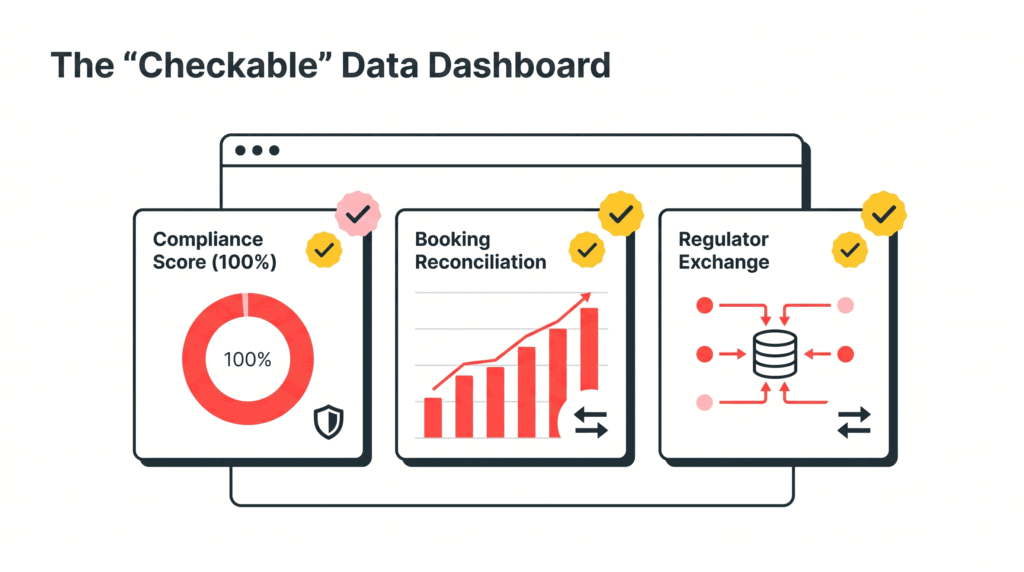
Compliance is investigable in NYC. It is checkable in California and the EU.
Most coverage of STR regulation treats every regime the same way: rules, registration, enforcement. The interesting distinction in 2026 is not how strict the rules are. It is whether compliance is checkable or investigable.
Local Law 18 verifies registration at intake. Platforms confirm the registration number before processing each booking. After that, no party — not the platform, not the operator, not the city — is required to keep reconciling listing activity with registration status on an ongoing basis. A registered listing can drift out of compliance for months without anyone noticing in real time. The first external signal, in the current model, is typically an inspection or a warning letter. NYC’s compliance is investigable: the city has to go look.

California’s SB 346 (live since January 1) and EU Regulation 2024/1028 (live from May 20) are built on the opposite premise. Platforms transmit booking-level activity to the regulator on a continuous or near-continuous schedule, and the regulator reconciles it automatically against the registration record. A drift is detectable on the data layer, not in the field. Compliance is checkable: the city already knows.
If you take that distinction seriously, the 27% is what the investigable model produces over time. It is not, fundamentally, a story about bad actors. It is a story about a feedback loop that was not built into the statute.
Read More: Houston Sets the Clock, DC Opens Hosting, Industry Builds an Advocacy Fund
Enforcement has scaled. The gap has widened anyway.
When we last looked at Local Law 18 in detail, the question was whether the registration regime would hold. The honest answer, ten months on, is partial. OSE has expanded inspections, sent roughly 600 warning emails to registered operators, and in April 2025 launched a Notices of Intent to Revoke pilot — a tier between warning and lawsuit on its enforcement ladder. The enforcement effort has scaled.
The 27% figure was disclosed by OSE Executive Director Christian Klossner to Skift on April 21. It captures approved listings now offering entire-unit stays where the registration is hosted, accepting bookings beyond the two-guest cap, or both. In June 2025, the same figure was estimated at 20%. Despite a more active OSE, the gap is widening — by seven percentage points in ten months. More enforcement is not, on its own, closing it.
Bineth illustrates the failure mode: register first, then alter post-approval.
You do not need the full Bineth narrative to understand the failure mode, but it is a clean illustration. On April 17, OSE filed suit against Chananya Bineth, his wife Gitty, and four associates, seeking up to $5 million. The complaint alleges they obtained six short-term rental registrations across three buildings — two in Brooklyn, one in the Bronx — by submitting documents that falsely identified the co-defendants as full-time tenants. The registrations authorized hosted two-guest stays. The listings were then altered on Airbnb and an in-house booking site to advertise illegal entire-unit stays.
From April 2023 through the end of 2025, the operation processed roughly 1,400 transactions and generated $1.3 million in payouts. OSE inspectors visited multiple times and were turned away. The agency issued 35 summonses, and at least $47,500 in fines were paid. The lawsuit is what the top of the enforcement ladder looks like for an operator who did not respond at the lower rungs.
Bineth was not an unregistered operator. The registrations were obtained, then the listings were altered post-approval. That is precisely the failure mode the 27% is capturing, at scale, in less elaborate form, across thousands of listings.
California’s SB 346 turns the platform’s data into the city’s data.
The California Short-Term Rental Facilitator Act, which establishes a new standard for short-term rental compliance, took effect on January 1, 2026. It authorizes any California city that adopts an enabling ordinance to compel platforms to share host data: physical address, listing URL, registration status, and number of nights booked per year, among other fields. Platform noncompliance can cost up to $10,000 per day. The Los Angeles City Attorney’s office has been actively using it since the start of 2026.
The mechanism is reconciliation. The data the city sees is the data the platform now keeps continuously. Operator records, platform records, and city records align by default rather than by audit.
The EU rolls out the same architecture across 27 countries on May 20.
EU Regulation 2024/1028 takes effect across member states on May 20, 2026, three weeks from now. Platforms will transmit monthly activity data per listing — address, registration number, listing URL, nights booked, guest counts — to a national Single Digital Entry Point in each country. Authorities cross-reference automatically.
For an operator in Paris, Lisbon, Barcelona, or Rome, the structural posture from May 20 is broadly the same as the SB 346 cities in California. The gap between what the operator believes about their compliance and what the regulator can confirm narrows by design.
NYC has the data infrastructure. It has not built the loop.

It is worth saying that NYC is not without data infrastructure. The Booking Service Data Reporting Law predates Local Law 18 and obliges platforms to share transaction data with OSE periodically. LL18 added platform verification at intake. What neither requires is continuous post-approval reconciliation at the booking level, automatically tied to registration status. And nothing feeds back to the operator either.
Klossner was direct on this point with Skift. Airbnb is complying with Local Law 18’s verification requirements, he said, but the platform is not legally required to prevent registered listings from being altered after approval to offer illegal stays. When a regulator publicly identifies the gap in his own statute, you tend to get new rules eventually. For now, the gap remains, and OSE closes it case by case.
Intro 1107 is the political variable to watch in 2026.
The Bineth lawsuit is the first major STR enforcement action publicly attributed to Mayor Zohran Mamdani’s administration, sworn in on January 1, 2026. It lands during a live legislative debate. Intro 1107, introduced in November 2024 and still pending in the City Council, would eliminate the host-presence requirement that the Bineth defendants are alleged to have violated. The bill has eight co-sponsors. How the new administration approaches Intro 1107, given its early enforcement posture, is the variable that will determine whether NYC tightens, loosens, or preserves Local Law 18 as it currently stands.
In 2026, compliance topology varies by market — and that changes how you operate.
If you run a portfolio across multiple markets, the relevant question is no longer whether STR rules are tightening. They are, almost everywhere that matters. The relevant question is which compliance topology each of your markets has chosen.
| Region | Enforcement Model | Verification Method | Property Manager Burden |
| California (SB 346) & EU | Checkable | Automated Data Reconciliation | Low (Structural alignment by default) |
| New York City (Local Law 18) | Investigable | Audits & Field Inspections | High (Manual internal monitoring required) |
In SB 346 cities and across the EU, your compliance is structurally legible.
The platform sees it. The city sees it. You can assume the regulator’s view is close to your own. Drift is detected automatically. The cost of operating compliantly is largely the cost of operating compliantly. There is little upside to internal monitoring beyond what the regime already does for you.
In NYC, you are on your own between intake and enforcement.
The first external signal that a listing has slipped is typically an OSE letter or an inspection. If you are compliant, you have no structural way to know, short of the city telling you, that you have not slipped. Internal monitoring of guest counts, presence, off-platform bookings, and listing configuration becomes the only feedback loop available, because no other party is required to maintain one.
The same regulatory pressure is producing very different daily realities.
NYC’s path is high-touch, high-cost, and high-visibility, and not structurally connected to the 27% the city has now publicly quantified. California’s and the EU’s path is lower-drama and structural. The relevant question is which short-term rental compliance topology each of your markets has chosen. Which one actually moves the compliance number more, over the next twelve months, is the most useful natural experiment this industry has had in some time. I will be watching it closely. You should too.
Stay on top of short-term rental regulation trends and what they mean for your pricing strategy.

Uvika Wahi is the Editor at RSU by PriceLabs, where she leads news coverage and analysis for professional short-term rental managers. She writes on Airbnb, Booking.com, Vrbo, regulations, and industry trends, helping managers make informed business decisions. Uvika also presents at global industry events such as SCALE, VITUR, and Direct Booking Success Summit.
Related Articles:
 Airbnb’s Vision for Fair Regulations in Spain and Elsewhere
 The May 20 EU Data Deadline: Should Property Managers Expect Mass Delistings?
 EU Short-Term Rental Data Sharing Goes Live, Australia Calls for Sweeping Reforms, US States Preempt Local Rules
 French Short-term rentals and the Hoguet Law: What the FNAIM Report from April 2026 Says