
Six weeks from FIFA World Cup 2026 kickoff, the most ambitious World Cup ever staged is showing unmistakable signs of demand strain. While cumulative bookings are tracking solidly above last year, the rate of new bookings has stalled. Booking pace across US host markets has slowed to just 1–2% per week—effectively flat for a global mega-event at this stage of the cycle.
This is not an isolated signal. International travelers are arriving below projected volumes, prices are holding at peak levels even as pickup pace has flattened at exactly the moment it should accelerate, and the operational environment—from flights to transit to border enforcement—is deteriorating rather than improving.
This is not a pricing mistake. The short-term rental industry made rational rate decisions months ago based on the demand projections available at the time. What has changed is the environment those projections were built on.
Why Occupancy Alone Can’t Tell the Story
Because occupancy is a ratio, reading softness as demand weakness requires first ruling out a sudden supply expansion. The PriceLabs data shows US listing count is essentially flat year-over-year (-0.6% aggregate), with active listings actually shrinking in key markets: Hard Rock Stadium (Miami) is down 9%, NRG (Houston) is down 8%, and SoFi (Los Angeles) is down 4%.

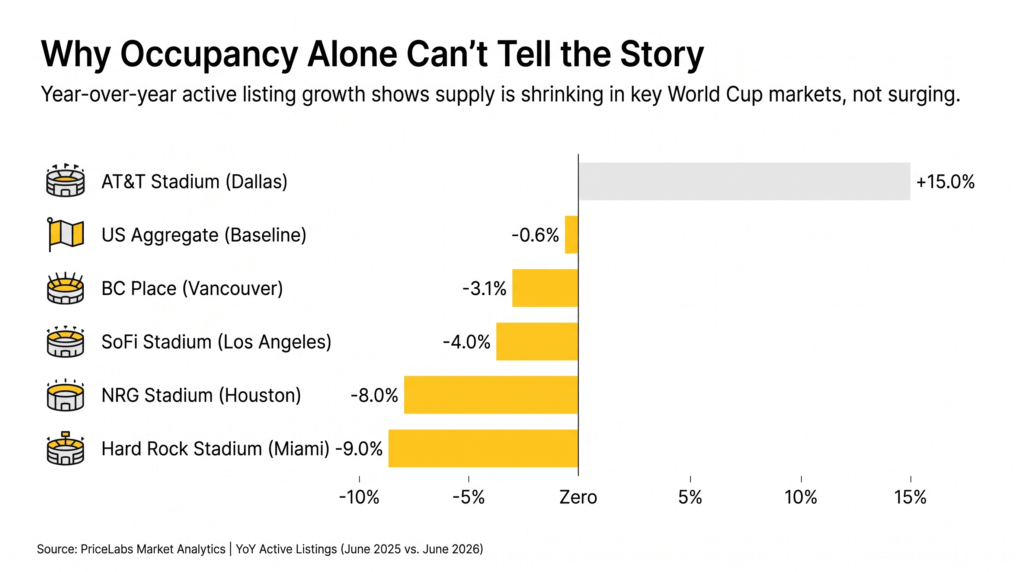
The one meaningful exception is Dallas, where supply has expanded by 15%. But with supply broadly stable across the rest of the dataset, the occupancy and pickup signals are doing real work, not a denominator artifact. With the rate of new bookings stalling against stable supply, the gap between the current trajectory and what current pricing assumes is widening.
The Mess Is the Demand Environment
Over the last two months, a series of operational fractures have emerged. They have been treated as isolated issues. They are not. Each adds friction independently. Together, they raise the total cost and uncertainty of attending to a level where marginal demand simply stops converting.
This is the structural reality suppressing World Cup demand:
- Travel friction: Lufthansa has canceled 20,000 short-haul European flights due to the jet fuel crisis. Norse Atlantic abandoned its London-to-LA route.
- Transit costs: New Jersey Transit is charging $150 for a round-trip train to MetLife Stadium, triggering a $48 million public dispute between the state and FIFA. Boston is charging $80 for what is normally a $20 trip to Gillette Stadium.
- Border barriers: Travel bans block fans of four participating nations entirely. Five more face visa deposit requirements of up to $15,000 in countries where the average annual income is $5,000. Human Rights Watch is actively documenting over 167,000 ICE arrests across the 11 US host city metro areas.
- Pricing fatigue: Official face-value tickets for the final have escalated from $8,680 to $10,990, while premium secondary market listings recently breached $2 million. This extreme dynamic pricing has triggered widespread fan backlash and formal ethics complaints against FIFA.
Read More: Super Bowl LX Flips the Bay Area Script: Santa Clara Beats San Francisco on Price
Three Countries, Three Separate Tournaments
Treating this as a single North American event obscures what the data is actually showing. Each country is operating under a different demand environment—and producing different outcomes as a result.
Mexico: The Control Group
Mexico is not outperforming—it is operating without the structural friction visible in US markets. That distinction matters. Resale tickets are price-capped, and Latin American fans face minimal visa friction. Occupancy is surging, and RevPAR growth runs between 393% and 1,325%. This is what the rest of the dataset would likely look like in the absence of structural friction.
Canada: The Policy Experiment
BC Place (Vancouver) and BMO Field (Toronto) host the same national team and equivalent matches. The only meaningful difference is that Vancouver never lifted its STR restrictions.
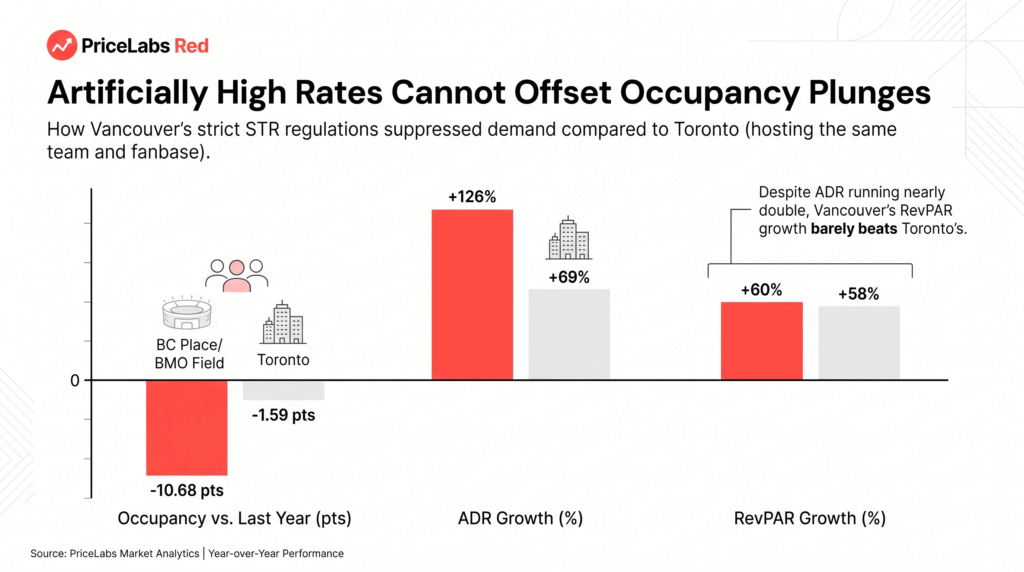
This is a clean natural experiment. The policy environment hasn’t caused a massive year-over-year supply wipeout — active listings are down just 3.1% compared to last year. But ADR has risen 126% and occupancy has plunged nearly 11 points, the worst drop in the dataset. Toronto, operating without equivalent restrictions and hosting the same fanbase, is down just 1.59 points. The result is counterintuitive but clear: in Vancouver, higher rates have not offset the occupancy loss — RevPAR growth of 60% trails Toronto’s 58% despite ADR running nearly double.
Team Allocation Explains the US Strain
The US data shows where the strain is most concentrated. RevPAR growth across US stadiums ranges from 29% in San Francisco to 272% in Dallas. That gap is explained entirely by which fanbases are arriving and how many barriers they face.
| Stadium | Headline Matches | Occ vs LY | RevPAR Growth |
| AT&T (Dallas) | Argentina ×2, QF | +10.73 pts | +272% |
| Gillette (Boston) | Scotland ×2, England, QF | +8.44 pts | +121% |
| SoFi (Los Angeles) | USA ×2, Iran ×2, QF | +4.42 pts | +106% |
| Levi’s (San Fran.) | Qatar vs Switzerland | -1.23 pts | +29% |
Demand Strength Is Uneven
The performance gap across US host cities shows that generalized market size matters far less than specific team allocations and the subsequent structural friction those fans encounter.
Low-Barriers Markets Fill First
Gillette Stadium leads all US markets with 34.71% occupancy. Scotland plays twice here, bringing the “Tartan Army”—one of international football’s most historically committed traveling fanbases. Add the fact that UK nationals face no visa deposits or travel bans, and the result is clear: when the attending fanbase faces minimal friction, the market fills.
Supply Constraints Inflate Prices, Not Demand
AT&T Stadium (Dallas) and Arrowhead (Kansas City) both host Argentina. Yet, Arrowhead’s ADR is $134 higher. Dallas has deep hotel inventory; Kansas City does not. Fans are functionally forced into the STR market, pushing rates higher.
The SoFi Paradox
SoFi Stadium hosts the US and Iran. Despite an Iranian diaspora exceeding one million locally, RevPAR growth is the weakest of any US stadium. While STR data alone cannot definitively prove causation, the pattern is consistent with an environment where widespread immigration enforcement fears functionally act as a barrier to entry, suppressing demand from a local population that already has the means to attend.
Read More: NFL Draft 2025: Green Bay Hits Record Rates, But Where Are the Guests?
Two Industries Reading the Same Broken Environment
Hotels and STR operators are responding to the same weakening demand environment, but on different timelines and with different constraints.
Hotels have already repriced to match current demand. Since peaking in December 2025, average US host city hotel rates have dropped 40%. The STR market is still in the process of doing so.
The cheapest STR inventory sold out months ago; what remains is premium-priced stock that pulls the average up while new bookings stall. But if the late-booking surge does not arrive at the scale current pricing assumes, STR pricing will need to adjust. Capturing existing demand, rather than holding out for a surge that may not arrive, will require active, dynamic revenue management.
The International Shortfall Is Not Resolving
The gap is not in interest—it is in conversion. The missing demand is primarily international travelers who typically book 14 to 30 days out and push ADRs into the high range. The demand that is converting is more domestic, shorter-lead, and lower-spending than the international segment the market was priced for.
While hundreds of millions of ticket requests were submitted to FIFA, actual international conversion is lagging. FIFA projected 40–50% international attendance, but the market is currently delivering just 26–35% in the best-performing US cities.
Furthermore, while FIFA projected roughly 3 million international attendees globally, Tourism Economics estimates just 742,000 net incremental tourists will reach the US.
These figures are not directly comparable—one is gross global attendance, the other net US incremental travel—but directionally, they point to the exact same outcome: significantly fewer international visitors than expected. For cities with weak match allocations and high travel barriers, closing this gap in six weeks will require a late surge of historic proportions.
Knockout Dates: The 48-Hour Window
Automated pricing tools are calibrated for demand that builds gradually. They are not designed for a situation where the most critical demand signal—which two teams are playing—arrives just 48 hours before FIFA World Cup 2026 kickoff. A quarterfinal between Argentina and Portugal commands a fundamentally different premium than one between Morocco and Australia.
Operators in quarterfinal markets must treat these dates as requiring manual review the moment match results are confirmed. An algorithm applying standard last-minute discount logic to a quarterfinal date will slash prices exactly when the market is prepared to pay a massive premium.
The Next Two Weeks Decide the Cycle
The FIFA World Cup 2026 is not underperforming because demand doesn’t exist—FIFA’s official allocation is exhausted. The issue is that the demand converting into bookings is not the demand the market was priced for.
Forty-five days leaves room for a late surge. But the gap is wider than late-booking patterns typically close, and the structural barriers are not improving.
The trajectory is now clearly weakening. The next two weeks of pickup data will determine whether this remains a slow correction—or becomes a sharper reset.
For operators navigating complex, fast-changing demand environments, tools like Revenue Accelerator help professional managers automatically adapt to shifting market conditions and capture existing demand.

Guneet has spent five years working at PriceLabs, developing deep expertise in short-term rental operations and hospitality technology. She brings that practitioner’s lens to her writing at RSU, covering platform updates and making sense of market data for property managers.