Are you the hands-on web or tech person? This article is written for the business owner. We wrote a companion piece for you, with the exact files, markup, and settings to implement: Beyond Scraping: The Technical Checklist for Vacation Rental Websites. Read this one anyway if you want to understand why your boss is about to forward it to you.
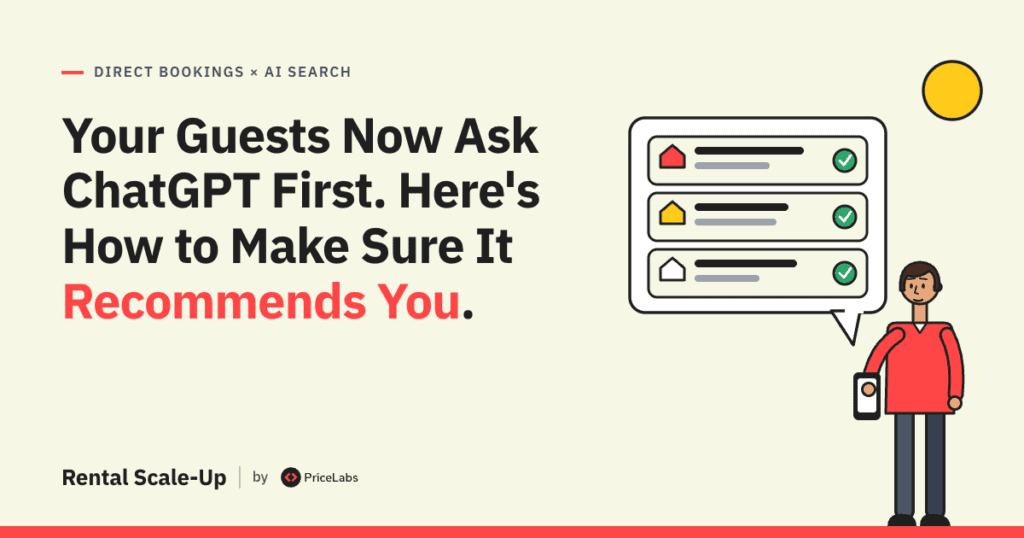
Your next guest may never see your website in a list of search results. She will ask ChatGPT or Gemini for “a 3-bedroom villa in Spain with a pool, under €300 a night in September,” and the assistant will hand her a shortlist of three properties. There is no page two. If your direct booking site is illegible to the machine, the AI does not rank you lower; it simply leaves you out, and the booking goes to a competitor — or back to an OTA, commission included.
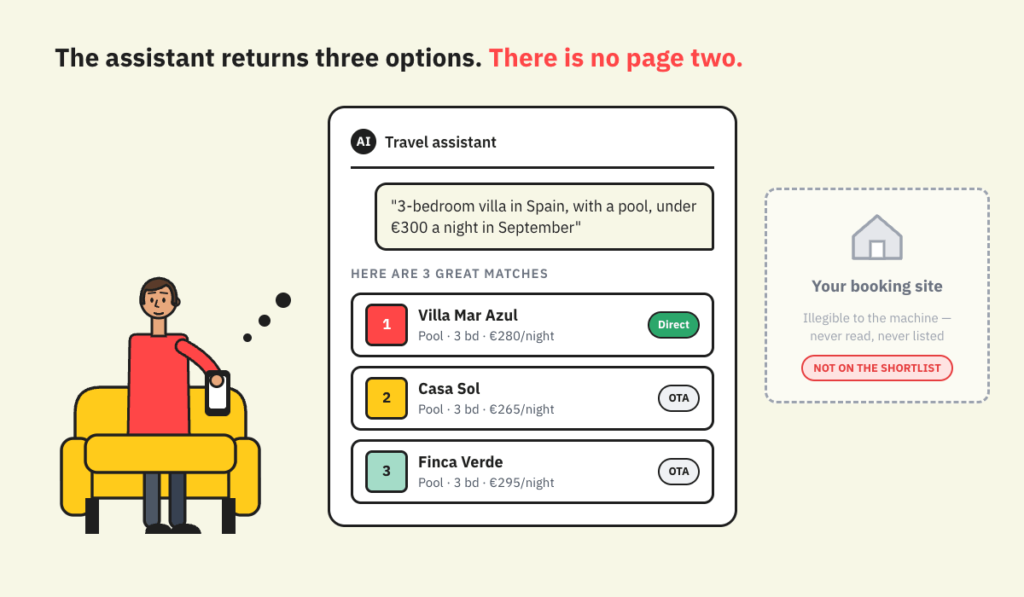
This is not a prediction; it is now measurable in your own reports. On May 13, Google added a new “AI Assistant” channel to Google Analytics 4, so property managers can see for the first time how much traffic ChatGPT, Gemini and Copilot are sending them, with no setup required. Two months earlier, Schema.org — the shared dictionary that websites use to describe their content to machines, backed by Google, Microsoft and others — confirmed “vacation rental” as an official category in that dictionary. In plain terms: there is now a standard way for your website to tell any machine “this page is a 3-bedroom rental with a pool, at this price.” The machines are no longer just crawling your site to rank it. They are reading it to answer travelers’ questions and, increasingly, to book on their behalf.
You will not need to touch a line of code to act on this article. Every fix comes down to a question you can ask, a report you can open, or an instruction you can forward. Your job is to make sure it gets done, not to do it.
Key facts before we start:

- 39% of travelers already use AI somewhere in their booking journey, and 15% use ChatGPT and similar tools specifically to find accommodations, according to industry statistics compiled by Mindful Ecotourism.
- Booking.com and Expedia went live inside ChatGPT in October 2025; Accor, Hyatt and Wyndham followed in early 2026.
- Many sites that blocked “AI bots” in 2023-2024 are now invisible in ChatGPT Search answers, without their owners knowing it.
- GA4’s new AI Assistant channel shows you your own AI traffic, and it likely understates it: one analysis estimates 60-70% of AI-driven visits hide inside your “Direct” numbers.
In this article, we’ll see why AI assistants now decide whether your direct booking site gets seen, the five questions to put to your web person or website provider this week, and how to check your own AI traffic in GA4 this weekend — no technical skills required.
From Search Engines to Search Agents
For twenty years, the game was clear: a traveler typed “villa with pool Costa Brava” into Google, Google showed ten blue links, and your job was to be one of them. In 2026, a growing share of travelers skips that step. They ask an assistant: “Find me a 3-bedroom villa in Spain with a pool and fast Wi-Fi, walkable to a beach, under €300 a night in September.” The assistant then does the searching: it fetches pages, compares options, and comes back with a shortlist of three or four properties.
The big platforms have seen this coming. Booking.com and Expedia were the first OTAs to plug directly into ChatGPT in October 2025, and travel is now the largest B2C category in the ChatGPT app ecosystem, at over 20% of it. Hotel groups like Accor and Hyatt followed with their own ChatGPT apps in early 2026.
Here’s the thing: when an OTA integrates with ChatGPT, it is paying to remain the middleman in an AI-mediated booking. Your direct booking site won’t get a deal like that, but it doesn’t need one. AI assistants also read the open web. When a traveler asks for “a pet-friendly cottage in the Cotswolds from the owner directly,” the assistant can cite and link your site. Whether it does depends on whether your site is legible to a machine reading it in milliseconds. You don’t need to make it legible yourself. You need to know what to ask for, and how to check the answer.
The Five Questions to Ask Your Web Person This Week
Each of these questions exists because of something an AI does, or fails to do, when it reads your site — and each failure has a price in bookings. Forward them as written. Each has a good answer and a bad answer, so you can judge the reply without being technical yourself. The companion technical article gives your web person everything they need to fix a bad answer.
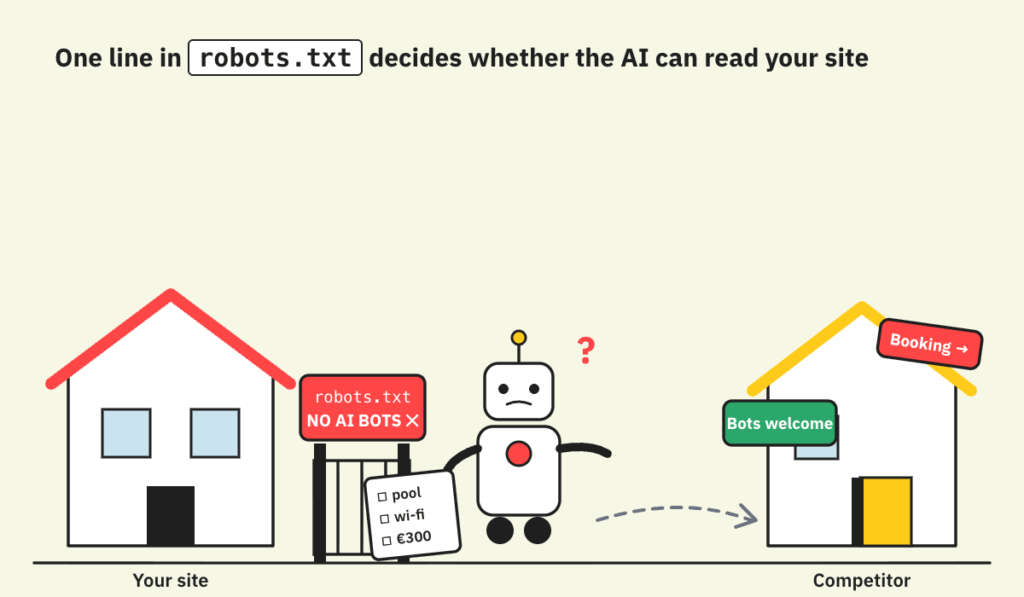
- “Are we blocking OpenAI’s search crawler in our robots.txt?” (Robots.txt is the small file every website has that tells bots which pages they may read.) This is the big one. Many sites blocked all AI bots in 2023-2024, when the debate was about AI training on content. But OpenAI now uses a separate crawler for ChatGPT search results, and sites that block it do not appear in ChatGPT Search answers at all. Good answer: “We allow OAI-SearchBot; we only block the training bots.” Bad answer: “We block all AI bots for safety.” That safety is costing you bookings.
- “Does every property page have VacationRental structured data, with amenities and live prices?” Structured data is the machine-readable label on your pages, and the vacation-rental-specific format is now a stable standard. Amenities matter most: when the traveler’s prompt says “with a pool and high-speed Wi-Fi,” the assistant matches against exactly these labels. Prices matter second-most: assistants are known to quote stale or invented rates when they can’t find a reliable one. Good answer: “Yes, with a full amenity list, synced to the booking engine.” Bad answer: “We have some SEO markup from 2021.”
- “If we use a website provider — what VacationRental markup do they output?” If your site runs on a direct booking platform (Lodgify, Boostly, Hostfully and the like), your provider controls this. Their answer will tell you a lot about how ready they are for 2026. A provider who can’t answer is a provider to reconsider at renewal time.
- “Do we have an llms.txt file — and did anyone charge us real money for it?” This one is a trick question, and it protects your budget. The
llms.txtfile — a plain-text summary of your site written for AI models to read — is heavily promoted as an AI-visibility must-have. The data says otherwise: adoption is around 10%, and server-log studies show major AI crawlers almost never read the file. Our view: worth shipping because it costs half a day and does no harm — but if an agency quotes you four figures for it, you have learned something important about that agency. - “Is our name consistent everywhere?” AI assistants cross-check sources before citing. If your villa is “Villa Azul, Cádiz” on your site and “Casa Azul Beach House” on Airbnb and Google, you make that verification harder than it needs to be. This one your marketing team can fix without a developer.
Check Your Own AI Traffic This Weekend (No Skills Required)
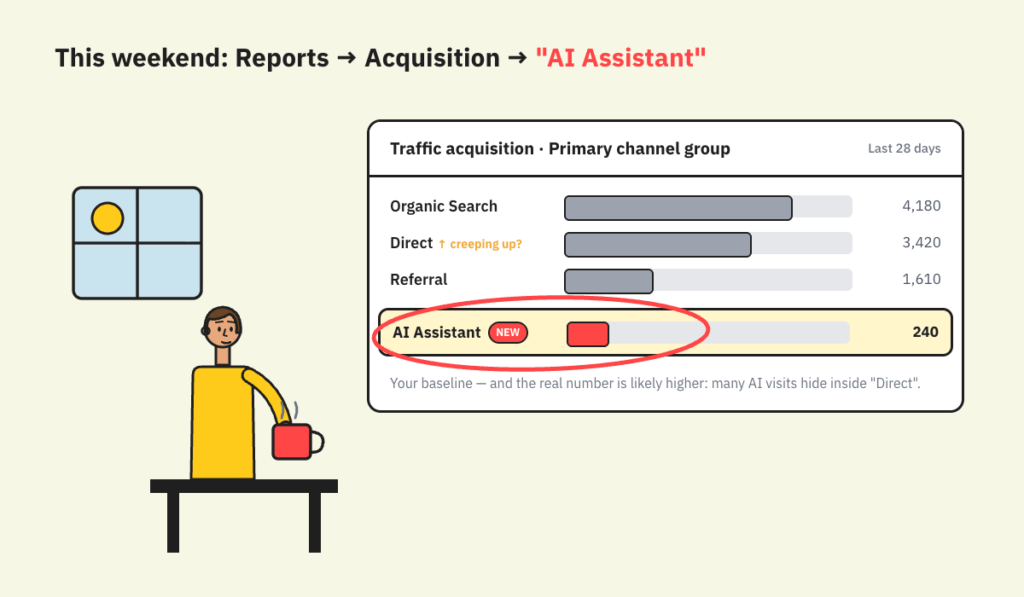
Since May 13, GA4 automatically files visits from ChatGPT, Gemini, DeepSeek, Copilot and Grok under a dedicated “AI Assistant” channel. Open Reports, then Acquisition, then Traffic acquisition, and look for “AI Assistant” in the channel list. That’s it. That number is your baseline.
Two things to know when reading it:
- The real number is higher. One analysis estimates 60-70% of AI-driven sessions arrive with no identifying trace and get filed under “Direct.” That figure is a third-party estimate, not a Google disclosure, so treat it as directional. But if your Direct traffic has been creeping up without explanation, this may be part of the answer. We saw it on our own site: on a recent night, Direct sessions on one section of Rental Scale-Up spiked to roughly 3x normal human volume around midnight. Humans don’t binge-read industry content at midnight in synchronized bursts; AI crawlers running on schedules do.
- Don’t panic at zero-second visits. An AI-attributed session with no engagement time is often not a bored human — it is an agent reading your page to answer a traveler’s question somewhere else. Our interpretation: that session can still end in a booking, made by a guest who never “visited” your site the way GA4 understands a visit. The number to watch instead: whether AI-referred visitors who do stick around convert better than average. Our expectation, and it is only that: they should, since the assistant pre-qualified them before sending them.
The Multilingual Advantage
One more angle, particularly relevant if you operate in Spain, France, Italy or any market where your guests don’t search in English. AI assistants can translate anything on the fly. But when it comes to citing sources, research on generative engine optimization consistently finds that natively written content outperforms translations. Models detect translated text, and they score original writing in the searcher’s language higher. There is also less competition: the pool of high-quality Spanish or French vacation rental content is far smaller than the English one.
So a manager with a genuinely native Spanish site — not a machine-translated mirror — has a citation advantage when a Madrid family asks Gemini for a beach house in Cádiz. If you already invest in multilingual content, you are better positioned for AI search than most of your larger competitors. If you don’t, this is a stronger argument for it than traditional SEO ever was.
What It Means for You
Your to-do list has exactly three items, and none requires a developer:
- This week: send the five questions above to your web person or website provider. Put a deadline on the reply.
- This weekend: open GA4, find the AI Assistant channel, note your baseline, and glance at your Direct channel for unexplained growth.
- When the answers come back: forward the companion technical checklist to whoever is doing the fixing. It contains the exact files, markup and settings — they will not need to interpret anything.
Now, as usual, what matters is your own market: how much of your traffic is already AI-mediated (check your GA4), and are the travelers it sends booking (check your conversion reports)? The platforms are cutting their deals with the assistants. Your direct booking site’s deal is simpler — make it effortless for the machine to read, and let it send you the guest.

Thibault Masson is a leading expert in vacation rental revenue management and dynamic pricing strategies. As Head of Product Marketing at PriceLabs and founder of Rental Scale-Up, Thibault empowers hosts and property managers with actionable insights and data-driven solutions. With over a decade managing luxury rentals in Bali and St. Barths, he is a sought-after industry speaker and prolific content creator, making complex topics simple for global audiences.
Related Articles:
 Beyond Scraping: The Technical Checklist for Vacation Rental Websites (AI Readiness, 2026)
 Arizona Mayors Seek Rental Control, Murcia Partners with Airbnb, and Minut Automates Energy Savings with Ecobee
 Lisbon Imposes Bans and New Limits, Mabrian Launches Rental Monitoring Tool, and Airbnb Reboots Experiences
 PriceLabs’ 2026 Revenue Accelerator, in Context: Why Revenue Is No Longer One Person’s Job — and How AI Is Reshaping That Job in Two Directions at Once