Are you the business owner or CEO? This is the implementation companion to a piece written for you: AI Agents Are Deciding Which Rentals Get Booked. Read that one first for the business case and the five questions to ask. This page is the answer sheet — hand it to your web person, developer, or website provider.
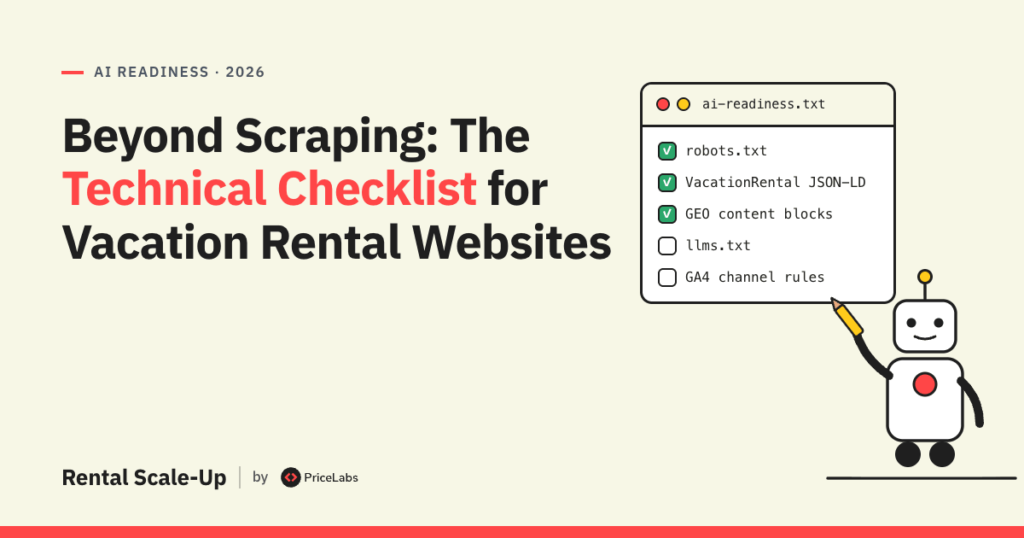
This checklist covers the five technical items that determine whether AI assistants (ChatGPT, Gemini, Copilot, Perplexity) can read, cite, and recommend a vacation rental direct booking site in 2026. Each item states what to do, why, and how to verify it. Ordered by impact per hour of work.
1. robots.txt: Allow the Search Crawlers, Decide Separately on Training
Impact: highest. Effort: 5 minutes.
OpenAI operates separate crawlers for separate purposes, and treats them as independent access decisions. OAI-SearchBot powers ChatGPT Search citations; GPTBot collects training data; ChatGPT-User fetches pages when a user asks about a specific URL. Sites that block OAI-SearchBot are not shown in ChatGPT search answers. Many sites blocked all AI bots wholesale in 2023-2024; if this site did, it is currently invisible in ChatGPT Search.
A sensible configuration for a direct booking site that wants AI-search visibility but opts out of model training:

# Allow AI search / citation crawlers
User-agent: OAI-SearchBot
Allow: /

User-agent: ChatGPT-User
Allow: /

User-agent: PerplexityBot
Allow: /

# Optional: block training-data collection (independent decision)
User-agent: GPTBot
Disallow: /

User-agent: Google-Extended
Disallow: /
Note the trade-off on the training bots: blocking GPTBot and Google-Extended keeps content out of future training runs, but some practitioners argue training presence helps long-term brand recall inside models. That is a business call for the owner, not a technical one — flag it, don’t decide it.
Verify: load yourdomain.com/robots.txt in a browser and confirm the rules. Then watch server logs over the following weeks for OAI-SearchBot hits; OpenAI publishes its crawler IP ranges if you need to confirm a hit is authentic.
2. Structured Data: VacationRental JSON-LD on Every Property Page
Impact: high. Effort: half a day to two days, depending on CMS.
Schema.org version 30.0 (March 2026) confirms VacationRental as a stable type. This is the markup AI systems demonstrably parse. Minimum viable JSON-LD per property page:
json

{
  "@context": "https://schema.org",
  "@type": "VacationRental",
  "name": "Villa Azul",
  "identifier": "villa-azul-cadiz",
  "address": {
    "@type": "PostalAddress",
    "addressLocality": "Cádiz",
    "addressCountry": "ES"
  },
  "containsPlace": {
    "@type": "Accommodation",
    "occupancy": { "@type": "QuantitativeValue", "value": 6 },
    "numberOfBedrooms": 3,
    "amenityFeature": [
      { "@type": "LocationFeatureSpecification", "name": "Pool", "value": true },
      { "@type": "LocationFeatureSpecification", "name": "Wifi", "value": true },
      { "@type": "LocationFeatureSpecification", "name": "Pet-friendly", "value": true },
      { "@type": "LocationFeatureSpecification", "name": "Air conditioning", "value": true }
    ]
  },
  "makesOffer": {
    "@type": "Offer",
    "priceSpecification": {
      "@type": "PriceSpecification",
      "price": 285,
      "priceCurrency": "EUR"
    },
    "availability": "https://schema.org/InStock"
  }
}
Three implementation notes:
amenityFeatureis the highest-value field and the most commonly omitted. Copy the exact amenity name strings from Google’s vacation rental documentation rather than inventing labels — the names in the example above are illustrative, and unrecognized strings match nothing. When a traveler’s prompt says “with a pool and high-speed Wi-Fi,” retrieval systems match against these attributes.Offerpricing must be synced to the booking engine, not hard-coded. AI assistants quote stale or invented rates when no reliable price is machine-readable. A wrong price in markup is worse than no price.- Eligibility caveat: Google’s vacation rental rich results require a connectivity-partner integration with Google. That restriction applies to Google’s display only — the JSON-LD itself is consumed by any AI system reading the page. You are marking up for every machine, not just one.
Verify: run each template through the Schema Markup Validator and Google’s Rich Results Test. Spot-check that rendered prices match the booking engine.
3. Content Structure for Retrieval (GEO Basics)
Impact: medium. Effort: ongoing, content team shares the work.
AI retrieval pipelines extract short, self-contained passages. Two cheap habits:
- Direct-answer blocks. Immediately after each H2 on key pages, place a 40-60 word paragraph that answers the heading’s implicit question in plain language. Easier to lift and cite than an answer scattered across five paragraphs.
- Entity consistency. Property names, business name, and address must be identical across the site, Google Business Profile, and OTA listings. Assistants cross-check sources before citing; naming drift breaks the match.
4. llms.txt: Ship It, But Bill It Honestly
Impact: low (today). Effort: half a day.
The honest status: ~10% adoption, and server-log analyses show major AI crawlers almost never fetch the file — in one 90-day sample of 500M+ AI bot visits, 408 requests hit llms.txt. Google has said it does not support it. Ship one anyway: the cost is trivial, some smaller agents do read it, and it future-proofs against a provider flipping the switch. Do not let anyone bill serious money for this.
Format: plain Markdown at yourdomain.com/llms.txt:
markdown

# [Company Name] — Vacation Rentals in [Region]

> Professional vacation rental management, [N] properties in [locations].
> Direct booking site: no OTA fees. Policies below apply to all properties.

## Properties
- [Villa Azul, Cádiz](https://example.com/villa-azul): 3BR, pool, pet-friendly, sleeps 6
- [Casa Verde, Tarifa](https://example.com/casa-verde): 2BR, sea view, sleeps 4

## Policies
- [Cancellation policy](https://example.com/cancellation): free until 14 days before check-in
- [Pet policy](https://example.com/pets): dogs welcome in listed properties, €25/stay
5. Measurement: GA4 Configuration for AI Traffic
Impact: medium. Effort: one hour.
Since May 13, 2026, GA4 files qualifying sessions under a native AI Assistant channel (ChatGPT, Gemini, DeepSeek, Copilot, Grok recognized at launch). Two gaps to close manually:
- Perplexity lands in Referral. Add a custom channel group rule matching source
perplexity.ai(andwww.perplexity.ai), positioned above the Referral rule in Admin → Data display → Channel groups. - Most AI traffic hides in Direct. An estimated 60-70% of AI sessions carry no referrer (third-party estimate, directional). Useful proxy signal: hourly session patterns in the Direct channel. Synchronized night-time bursts (e.g., 3x normal volume between 11 PM and midnight) indicate scheduled crawler activity from data centers rather than humans. Check server logs against known AI user-agents (
GPTBot,OAI-SearchBot,ClaudeBot,PerplexityBot,Google-Extended) to confirm.
Also brief the owner on interpretation: zero-engagement AI sessions are frequently agents fetching content to answer a traveler elsewhere — a citation opportunity, not a bounce problem. The conversion rate of engaged AI-referred visitors is the metric worth reporting monthly.
Done? Report Back in Business Terms
When the five items are complete, the useful summary for the owner is one paragraph: which bots can now read the site, whether prices and amenities are machine-readable, what the AI-traffic baseline is, and what it costs to keep markup synced. The business-side article tells them what to do with that summary.

Thibault Masson is a leading expert in vacation rental revenue management and dynamic pricing strategies. As Head of Product Marketing at PriceLabs and founder of Rental Scale-Up, Thibault empowers hosts and property managers with actionable insights and data-driven solutions. With over a decade managing luxury rentals in Bali and St. Barths, he is a sought-after industry speaker and prolific content creator, making complex topics simple for global audiences.
Related Articles:
 Your Guests Now Ask ChatGPT AND CLAUDE First. Here’s How to Make Sure THEY Recommend You.
 Arizona Mayors Seek Rental Control, Murcia Partners with Airbnb, and Minut Automates Energy Savings with Ecobee
 Lisbon Imposes Bans and New Limits, Mabrian Launches Rental Monitoring Tool, and Airbnb Reboots Experiences
 PriceLabs’ 2026 Revenue Accelerator, in Context: Why Revenue Is No Longer One Person’s Job — and How AI Is Reshaping That Job in Two Directions at Once