

Short-term rental law updates this week: Ireland, Vienna, and Madison each moved on rules affecting operators — spanning a national registry rollout tied to EU data infrastructure, a margin-impacting European tax hike targeting commercial operators, and a strict local short-term rental permit cap in the US South.
Ireland Short-Term Let Register Launch Date Set for December
- Minister for Enterprise Peter Burke and Minister for Housing James Browne confirmed on May 13 that the national short-term let register will open on December 1, 2026 — a six-month postponement from the original May 20 deadline, following sustained lobbying from the Irish Self-Catering Federation.
- All operators have a legal obligation to register with Fáilte Ireland by December 31, 2026, to receive the unique registration number required for online listings.
- The registry targets hosts offering accommodation for periods of 21 nights or less and is explicitly designed to align with the EU Short-Term Rental Regulation.
- The system will be underpinned by the forthcoming Short Term Letting and Tourism (STLT) Bill, which the Oireachtas Enterprise Committee reviewed in pre-legislative scrutiny in February 2026.
Read More: The May 20 EU Data Deadline: Should Property Managers Expect Mass Delistings?
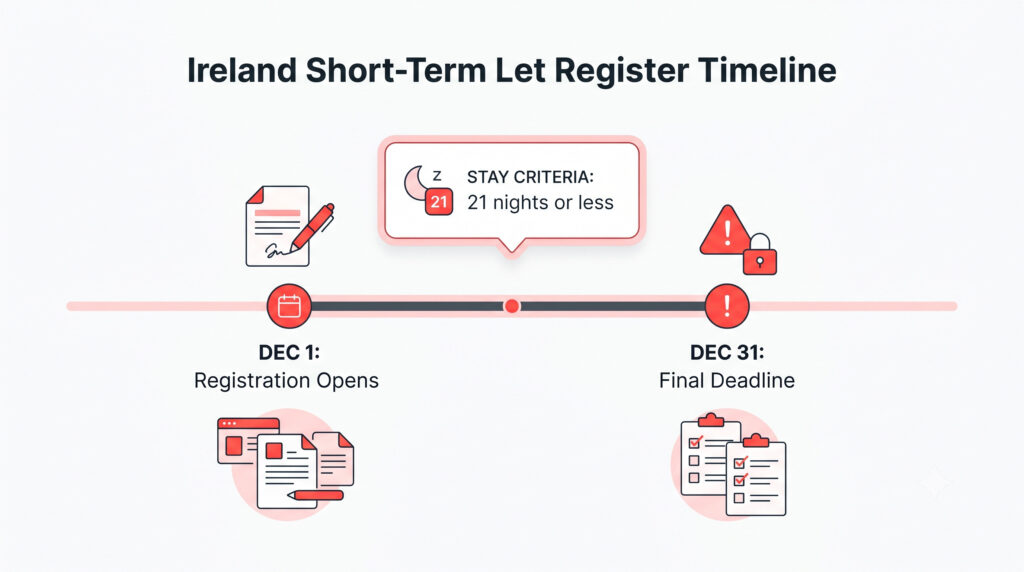
The 31-day short-term rental permit window falls squarely in peak holiday season — operators who wait for December 1 to start preparing will likely miss the deadline.
What This Means For Property Managers
The SDEP Connection. This registry is Ireland’s direct implementation of the EU’s Single Digital Entry Point (SDEP) requirements under Regulation (EU) 2024/1028. Once the December 31 deadline passes, the legal burden shifts to platforms like Airbnb and Booking.com — they will be legally mandated to remove any Irish listing that lacks a verified Fáilte Ireland registration number.
The Operational Window. The December 1 to December 31 window is exceptionally tight for a nationwide rollout. Property managers with Irish portfolios may want to prepare documentation (Eircode, PPSN, unit capacity) well in advance to avoid a scramble during the holiday season. The EU alignment means platform enforcement will likely be automated and swift, leaving little room for grace periods. The industry’s concern is legitimate: the Irish Self-Catering Federation has already warned that planning compliance requirements could force thousands of rural properties off the market permanently.

Vienna Short-Term Rental Cap Enforcement and Tax Hike
- Under the amended Vienna Building Code (Bauordnung), in effect since July 2024, the city enforces a strict 90-day per calendar year cap on short-term rentals in non-residential zones.
- The legislation was explicitly driven by a stated public interest to ensure that residential living space is not permanently taken away from its purpose of satisfying a year-round housing need.
- Operating beyond the 90-day limit requires an exception short-term rental permit (Ausnahmebewilligung) from the MA37 building authority, with violations carrying fines of up to €50,000.
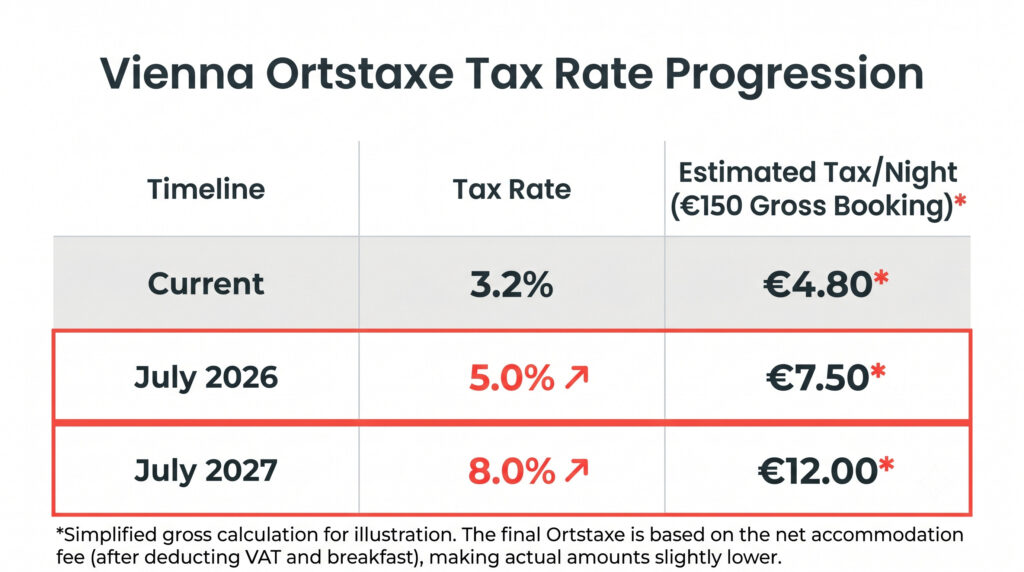
- The City of Vienna confirmed that the local tourist tax (Ortstaxe) — currently 3.2% — will increase to 5% from July 1, 2026, with a further increase to 8% scheduled for July 2027. The legal basis was adopted by the Vienna Provincial Parliament on December 12, 2025.
Read More: Short-Term Rental Regulations 2026: EU Data Deadline, Australia, US States
What This Means For Property Managers
The End of “Buy-to-Airbnb.” Vienna’s regulatory environment has fundamentally shifted investor sentiment. The combination of the strict 90-day cap and the €50,000 fine ceiling signals that the city is aggressively prioritising traditional long-term tenancy over commercial, multi-unit operators. Industry analysts now describe “buy-to-Airbnb” strategies in Vienna as significantly riskier than in most European cities.
Margin Compression. The Ortstaxe increase from 3.2% to 5% in July is a direct hit to operator margins. At €150 per night, the current tax runs to roughly €4.80; at the July 2026 rate, that rises to approximately €7.50. Hosts operating legally within the 90-day limit need to adjust summer pricing models before July 1. The staged path to 8% by 2027 means this is a multi-year compression, not a one-time adjustment.
Madison, Alabama Short-Term Rental Ordinance Proposes 190-Permit Cap
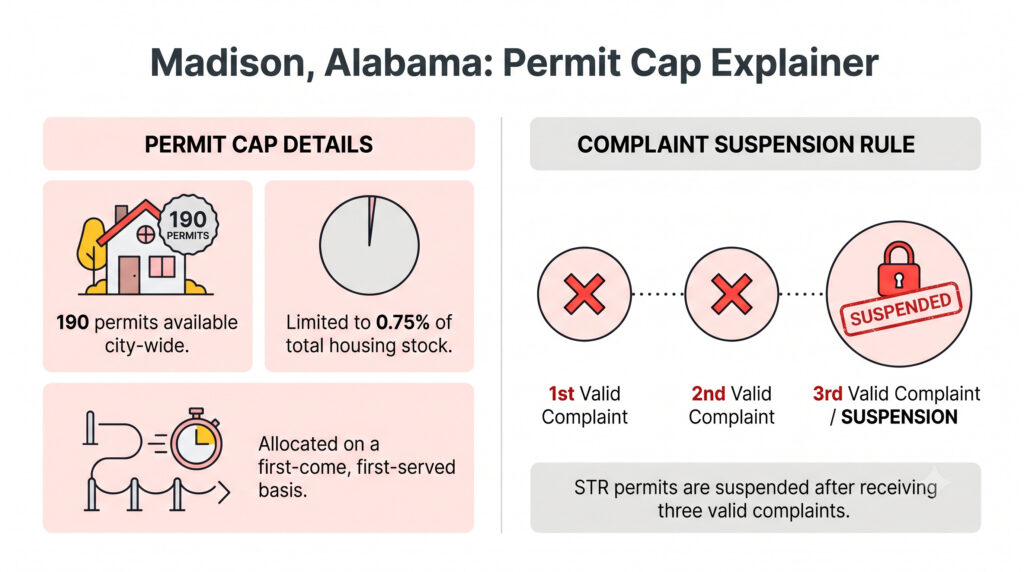
- The Madison, Alabama City Council scheduled a public hearing for June 22, 2026, to discuss a proposed ordinance capping short-term rentals at 190 permitted units citywide.
- Short-term rentals currently have no legal framework in Madison — no approved use type exists in the Zoning Ordinance or City Code, though many operate through Airbnb and VRBO without regulation. The city estimates between 60 and 150 STRs are currently active. This ordinance creates a legal pathway in response to a resident feedback survey the city ran in March 2026.
- The proposed 190-permit cap represents approximately 0.75% of Madison’s total housing supply. Short-term rental permits will be issued on a first-come, first-served basis.
- STRs would only be permitted in certain zones, with HOAs holding final authority over whether they are allowed in their communities.
- The ordinance outlines a strict enforcement process where three substantiated complaints within a 12-month period result in a six-month short-term rental permit suspension. A second suspension within two years means a one-year suspension; a third within three years means permanent revocation.
Read More: New Short-Term Rental Laws 2026: Missouri, Sacramento & Alabama
What This Means For Property Managers
From No Framework to Highly Regulated. The missing context behind this strict cap is that Madison is currently a market where STRs are unregulated, not formally banned. The city is creating a legal framework — but a very narrow one. This mirrors a regional trend: nearby Decatur, Alabama launched its own mandatory registration system in April 2026, backed by $500-per-day fines that kick in July 1. Alabama cities are rapidly adopting the strict regulatory playbooks that larger US metros have spent years refining.
The Operational Reality. A cap of 190 units against an estimated 60 to 150 active operators creates an immediate bottleneck once the ordinance passes — the first-come, first-served structure rewards operators who move fast. The three-complaint suspension rule creates very low tolerance for noise or parking violations. Securing the short-term rental permit is only the first step; keeping it requires robust guest vetting and a local response contact reachable around the clock.
Stay on top of short-term rental regulation trends and what they mean for your operating environment.

Uvika Wahi is the Editor at RSU by PriceLabs, where she leads news coverage and analysis for professional short-term rental managers. She writes on Airbnb, Booking.com, Vrbo, regulations, and industry trends, helping managers make informed business decisions. Uvika also presents at global industry events such as SCALE, VITUR, and Direct Booking Success Summit.
Related Articles:
 Airbnb’s Vision for Fair Regulations in Spain and Elsewhere
 The May 20 EU Data Deadline: Should Property Managers Expect Mass Delistings?
 French Short-term rentals and the Hoguet Law: What the FNAIM Report from April 2026 Says
 Mexico City Enforces Registration, England Delays Planning Class, Cleveland Caps Density