

Short-term rental policies updates this week: Atlanta, Spain, and Maui each moved on strategies affecting operators. The landscape shows a distinct shift in regulatory tactics globally, from removing legally vulnerable ownership caps to make enforcement possible, to taxing tourist rentals through VAT and property-tax surcharges, to narrowing the exemptions that would have softened a zoning phaseout.
Atlanta Removes Its Residency Cap to Unlock Enforcement
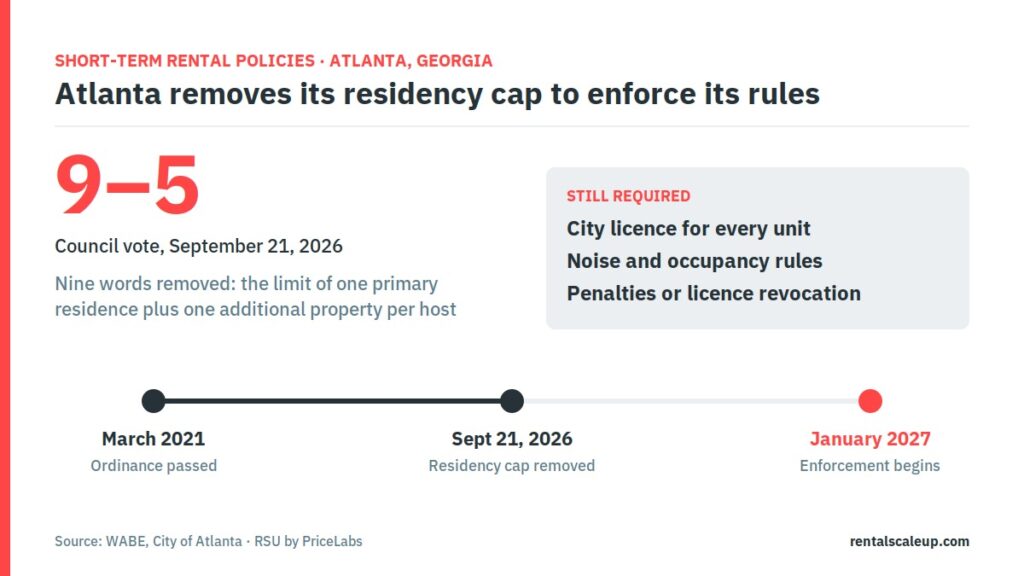
- At its Monday, September 21 meeting, the Atlanta City Council voted 9-5 to amend the short-term rental ordinance it passed in March 2021. Council member Matt Westmoreland’s amendment removed nine words that had limited hosts to their primary residence plus one additional property. The change is on the city’s legislative record.
- District 2 council member Kelsea Bond proposed a two-unit cap per host, and the council rejected it. Bond and District 5 council member Liliana Bakhtiari voted against the amendment. Bakhtiari said colleagues should pass further restrictions.
- The rest of the 2021 framework stays in place. Hosts must hold a city licence and follow noise and occupancy rules, and violations can lead to penalties or licence revocation.
- Neighbourhood-level rules also continue, including the short-term rental ban the council passed for Home Park in August 2025.
- The “Why” / The Timeline: Officials had held back on enforcing the 2021 law because of court rulings on residency requirements. In 2022, the 5th U.S. Circuit Court of Appeals ruled in Hignell-Stark v. City of New Orleans that a residency requirement discriminated against out-of-state owners under the dormant Commerce Clause. That ruling sits alongside the later court decisions on New Orleans’ one-per-block limits. With the residency language gone, the City Planning Department can enforce the ordinance when it takes effect in January 2027.
Uvika’s Views
- The licence becomes the compliance unit, not the host: Removing the residency cap shifts Atlanta’s question from how many units a host owns to whether each unit is licensed and run within the rules.
- Portfolio size is no longer the legal constraint. The enforcement exposure now sits at the level of each individual address.
- What professional managers can do is audit every Atlanta unit before January 2027, confirming a current city licence for each one and making sure the licence details match the listing on every channel.
- Revocation is tied to conduct, so operating records carry weight: Westmoreland described enforcement as action against hosts who neglect properties or create a nuisance, with licence revocation available for repeated violations.
- Noise, occupancy and upkeep complaints become the routes by which a licence can be lost. One poorly run unit can now cost a licence outright.
- What professional managers can do is install noise monitoring, state occupancy limits in house rules and booking confirmations, and keep a dated log of complaint responses as evidence for any enforcement hearing.
- The cap debate has paused, not ended: The vote was 9-5, the council rejected a two-unit cap only this week, and the council has used neighbourhood-level bans before.
- Growth plans that assume unlimited units per host carry policy risk. Residents at buildings such as the Landmark high-rise are already asking for caps and lawsuits.
- What professional managers can do is model the Atlanta portfolio under a two-unit-per-owner scenario, spread acquisitions across neighbourhoods, and track council agendas for any companion legislation.
Read more: Austin Enforces Platform Verification, BC Touts Rent Drops, Scottsdale Bans Event Centers
Spain Adds VAT and Property-Tax Surcharges on Tourist Rentals by Decree
- On Tuesday, September 29, Spain’s Council of Ministers approved two housing decree-laws. The first, Royal Decree-law 26/2026, was published in the Boletín Oficial del Estado on September 30. It carries the tourist-rental measures. The second decree, covering automatic renewal of habitual-residence leases, is due in the BOE on October 1.
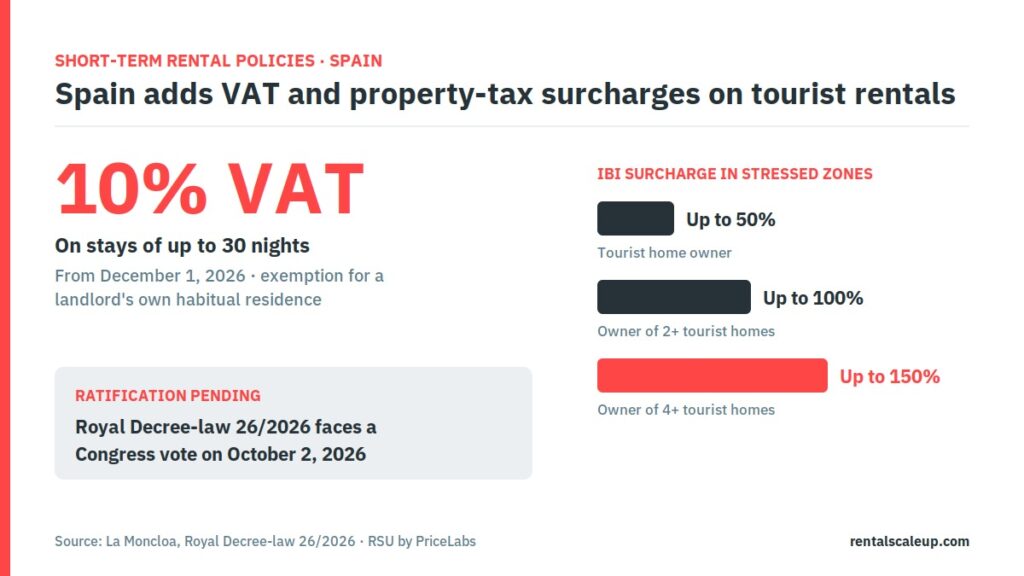
- VAT: From December 1, 2026, rentals of furnished homes for up to 30 nights generally become subject to VAT. The exception is a landlord renting out their own habitual residence. The rate is 10%, applied to tourist rentals that are currently exempt. That is below the 21% VAT the government had proposed earlier.
- Property tax (IBI): In areas declared stressed residential markets, councils may add an IBI surcharge of up to 50% on homes used for tourist rentals. The ceiling rises with the owner’s portfolio:
- up to 100% for owners with two or more tourist properties;
- up to 150% for owners with four or more.
- Seasonal and room rentals: A seasonal lease must now rest on a real, documentable reason. It must last more than 31 days and generally no more than 12 months. A lease that runs past that limit without justification, or more than two chained contracts between the same parties for the same home, becomes a habitual-residence lease from the first contract. For room rentals, the combined rent paid by all tenants cannot exceed the rent for the whole home.
- Ratification caveat (October 2): A royal decree-law takes effect on publication, but Congress must ratify it to keep it in force. Congress has called an extraordinary plenary for Friday, October 2, and neither decree’s passage is assured. PP, Vox and UPN oppose the measures, so the government’s parliamentary partners will decide the outcome. Junts has already said it will vote against the second decree. If Congress does not ratify Royal Decree-law 26/2026, the VAT, IBI and seasonal-lease provisions lapse. Spain has seen this before: an earlier housing decree lapsed in April after its initial approval.
- The “Why” / The Timeline: The government presents the package as a response to housing access and links it to the eviction of 87-year-old Madrid resident Maricarmen Abascal. The decree adds national tax measures on top of regional and city rules, such as Barcelona’s licence phaseout by 2028. It comes months after Spain’s Supreme Court voided the national short-term rental registry, and while Brussels negotiates the EU Affordable Housing Act framework for housing-stressed areas. If ratified, the VAT applies to stays from December 1, 2026. Each council decides whether to adopt the IBI surcharge.
Uvika’s Views
- VAT changes the price stack for every stay of 30 nights or fewer: Stays that are now exempt will carry 10% VAT from December 1. Each operator has to decide whether to absorb it in margin or pass it to guests.
- Reservations already on the books for December onward were priced without VAT. Rates quoted today may be wrong by the time the guest arrives.
- What professional managers can do is pull every confirmed booking with a stay date on or after December 1 and decide how VAT will be handled for those guests. They can also set up VAT invoicing with a tax adviser before the ratification vote is known, and check how registration interacts with the VAT already charged on Airbnb’s host service fee.
- The IBI surcharge scales with ownership and depends on local adoption: The 50%, 100% and 150% ceilings depend on how many tourist homes the owner holds. They apply only in declared stressed zones and only where a council chooses to adopt them.
- Two managers with identical portfolios can face different costs depending on how many homes each underlying owner holds and which municipalities have stressed-zone declarations.
- What professional managers can do is map each property against current stressed-zone declarations, record how many tourist homes each owner client holds, and give owners a 2027 IBI estimate under each surcharge tier.
- The mid-term rental route narrows: Seasonal leases now need a documented cause and cannot be chained beyond two contracts. Units shifted out of tourist use into 31-day-plus lets therefore carry reclassification risk.
- A seasonal contract that fails the test becomes a habitual-residence lease, which brings longer tenancy rights and less control over the unit.
- What professional managers can do is keep written evidence of the reason for every seasonal let, cap contract chains at two per tenant and home, and hold off on conversions until Congress votes on October 2.
Read more: Spain to Remove 86,000 Listings Under Its National Short-Term Rental Registry
Maui Planning Commission Rejects Most Exemptions From Its Vacation Rental Phaseout
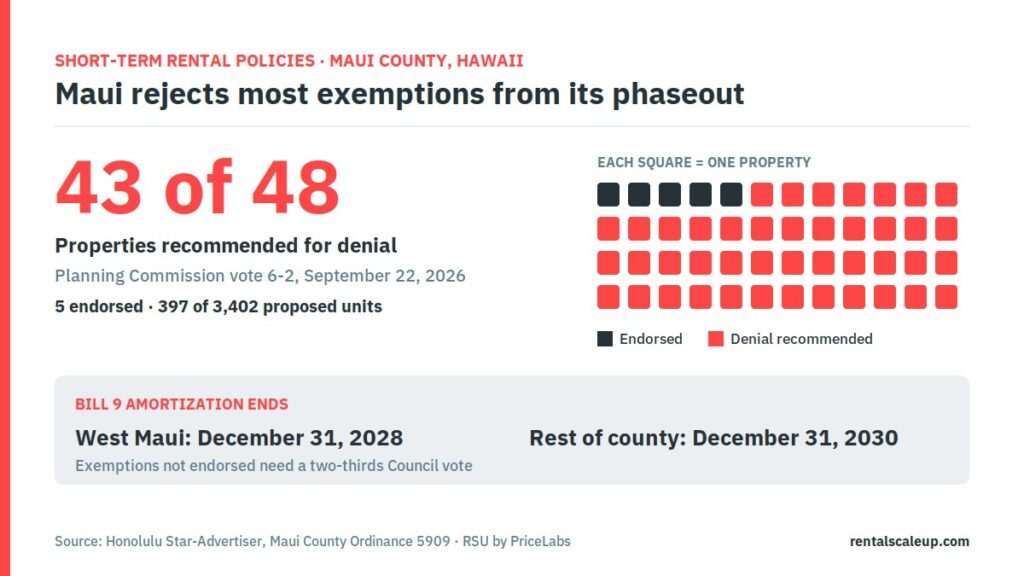
- On Tuesday, September 22, after about five hours of public testimony, the Maui Planning Commission voted 6-2 to recommend denying hotel-zoning exemptions for all but five of the 48 properties under review. Commissioners Keaka Kamai and Josh Circle-Woodburn dissented.
- The five endorsed properties total 397 units: Hale Kaanapali (262 units), Kuau Plaza (30), Maui Schooner (58), Hono Koa (28) and Hana Kai. The County Council’s pending resolutions had proposed rezoning 48 properties covering 3,402 units.
- The commission approved only two categories: properties that are entirely timeshares and properties with existing variances allowing vacation rental use. It recommended denial for hotel-like properties such as the 440-unit Kama’ole Sands, the 364-unit Resort at Papakea and the 205-unit Maui Eldorado. It also recommended denial for leasehold properties and those mixing timeshare with transient vacation rentals.
- The “Why” / The Timeline: The exemptions would carve properties out of Ordinance 5909 (Bill 9). The ordinance was adopted in December 2025, after Mayor Richard Bissen proposed the phaseout, to return roughly 6,100 apartment-zoned units to the housing supply after the 2023 Lahaina wildfire. Under the ordinance, the amortization period ends on December 31, 2028 in West Maui and December 31, 2030 in all remaining areas. Vacation rental use must cease from January 1, 2029 and January 1, 2031 respectively.
- The exemption route depends on the hotel zoning categories the Council created under Bill 88 in June. The CShort-term rental policies updates this week: Atlanta, Spain, and Maui each moved on strategies affecting operators. The landscape shows a distinct shift in regulatory tactics globally, from removing legally vulnerable ownership caps to make enforcement possible, to taxing tourist rentals through VAT and property-tax surcharges, to narrowing the exemptions that would have softened a zoning phaseout.ouncil can still approve exemptions the commission did not endorse, but only with a two-thirds vote. For the ordinance itself, see RSU’s breakdown of what Bill 9 actually does, and the state law behind it in our coverage of Hawaii’s county phaseout authority.
Uvika’s Views
- The commission is drawing the line on legal status, not on how a property operates: Only fully timeshare properties and those with existing variances won endorsement. Properties argued to function as hotels did not.
- An exemption case built on operating model (front desk, daily housekeeping, hotel-style management) carried little weight at this stage.
- What professional managers can do is help owner associations assemble the documentary record the commission favoured: recorded variances, timeshare declarations and original zoning approvals. That record should be ready before the Council takes up the resolutions.
- A Council supermajority is now the remaining exemption path: Exemptions the commission did not endorse need a two-thirds Council vote. That is a higher bar than the simple majority the Council relied on to create the hotel zoning categories.
- Owners of the 43 properties recommended for denial face a binary outcome, with timing set by the Council calendar rather than by owners or managers.
- What professional managers can do is plan for both results for each affected complex: a continue-operating plan and a conversion plan. Brief owners on each, including the 20% to 40% condo price decline scenarios UHERO has modelled for the phaseout.
- The amortization clock keeps running during the exemption process: The West Maui period ends on December 31, 2028, and the exemption process has no effect on that date.
- Forward bookings, management contracts and owner revenue projections that extend past the deadline carry legal and refund risk for units without an approved exemption.
- What professional managers can do is close the booking calendar after December 31, 2028 for West Maui apartment-zoned units without an exemption, add phaseout clauses to management agreements, and identify hotel- or resort-zoned inventory to replace units that may leave the programme.
Read more: Maui Planning Commission Rejects Rezoning Lifeline for 7,000 Short-Term Rentals

Stay on top of short-term rental regulation trends and what they mean for your operating environment.

Uvika Wahi is the Editor at RSU by PriceLabs, where she leads news coverage and analysis for professional short-term rental managers. She writes on Airbnb, Booking.com, Vrbo, regulations, and industry trends, helping managers make informed business decisions. Uvika also presents at global industry events such as SCALE, VITUR, and Direct Booking Success Summit.
Related Articles:
 Lisbon Imposes Bans and New Limits, Mabrian Launches Rental Monitoring Tool, and Airbnb Reboots Experiences
 Italy Moves to Scrap Tax Break on Short-Term Rentals, Prompting Fierce Debate
 Survive the EU Short-Term Rental registration Deadline: What Managers Must Do Next
 French Short-term rentals and the Hoguet Law: What the FNAIM Report from April 2026 Says