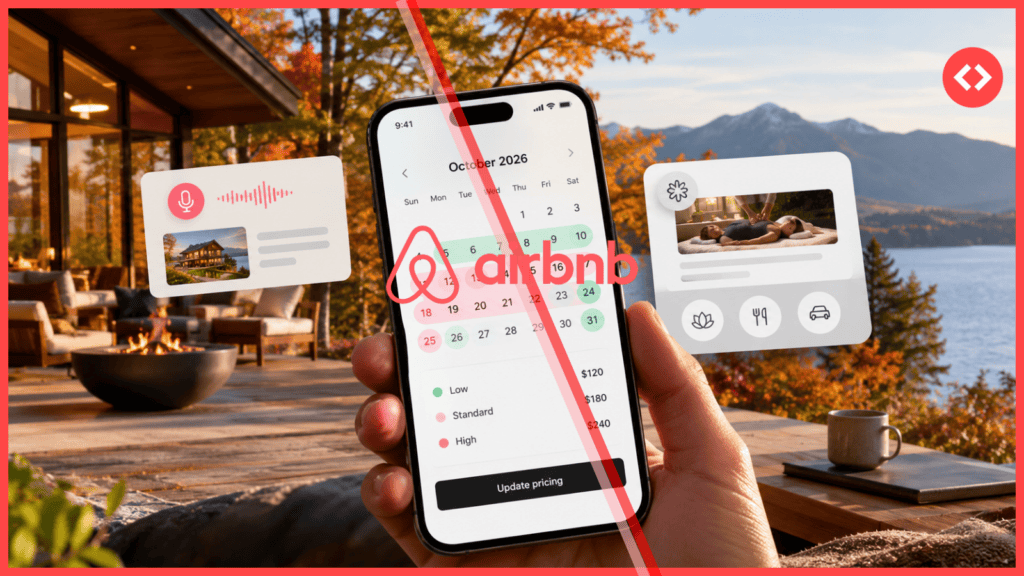
Airbnb, the short-term rental and experiences marketplace, appears to be using the words “dynamic pricing” for its own host pricing tool for the first time. That change in language sits at the centre of the Airbnb 2026 fall update, which also splits host tools by portfolio size and brings more in-stay add-on services into the Airbnb app.
Here is what’s new for hosts and professional managers, who gets it, and when.
Airbnb 2026 Fall Update: New Host Tools and Rollout Dates
Host details come from Airbnb’s host resource page, which goes further than the press release published on September 30, 2026.
| Host feature | Who it’s for | Rollout |
|---|---|---|
| Dynamic pricing | Hosts who opt in | October 2026 |
| Top-rated guest discount (15%) | Hosts who opt in | Available to select hosts (piloted earlier in 2026) |
| AI earnings dashboard | Hosts with 5 or fewer listings | Available now |
| Multi-listing calendar | Default for hosts with 6 or more listings | Rolling out |
| 3D floor plans | Hosts with an iPhone Pro or iPad with a LiDAR camera | Now, all hosts in the coming weeks |
| Smart Setup | Hosts creating new listings | US since the summer 2026 release, outside the US early 2027 |
The quickened pace of releases is likely tied to AI. In a September 23 announcement on its expanded use of models from OpenAI, the AI company behind ChatGPT, Airbnb CTO Ahmad Al-Dahle said development teams are “shipping roughly 80% more features than a year ago.”

Airbnb Dynamic Pricing: A Recommended Price Range That Adjusts Daily
Airbnb’s new dynamic pricing tool works in three steps, according to its host resource page:
- Airbnb recommends a price range meant to help hosts “earn more when demand is high, and stay booked when it’s not”
- Nightly prices adjust automatically within that range, based on daily demand and supply
- Hosts can change prices any time and check how competitive they are against similar listings in the calendar
The term itself is the news. Airbnb’s long-running Smart Pricing tool is described in its help centre as prices that “automatically go up or down based on demand,” without the phrase “dynamic pricing.” It appears this is the first time Airbnb has used the industry’s own term for one of its products.
What Airbnb hasn’t said yet
The announcement leaves some questions open for professional managers:
- Smart Pricing: whether dynamic pricing replaces it or runs alongside it
- Multi-listing calendar: how price ranges apply when editing several listings at once
- Connected software: how the tool interacts with a PMS (property management system) or third-party pricing tools
- Other channels: Airbnb’s tool prices Airbnb listings only, so rates on Vrbo, Booking.com or direct sites are managed elsewhere
Top-rated guest discount: 15% off for guests rated 4.8 or higher
Hosts can now offer 15% off to guests rated 4.8 stars or higher with at least three reviews. Airbnb says hosts who offered similar discounts “earned 11% more and had 14% more nights booked on average,” and that the discount helps listings “show up in more searches.”
Airbnb tested a version of this earlier in the year. In February, RSU’s Thibault Masson reported on a pilot inviting hosts to offer 20% off to the same guest group in exchange for higher search ranking, a badge and strikethrough pricing. The launched version is a smaller discount, and Airbnb hasn’t detailed how much search visibility it adds.
Airbnb Splits Host Tools by Portfolio Size
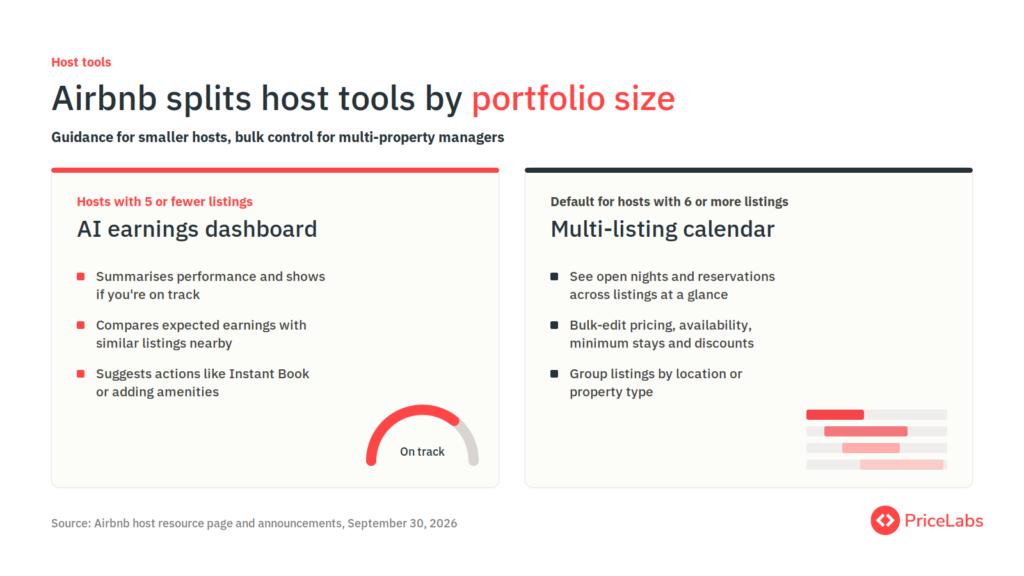
Two of the new tools are aimed at different segments: an AI earnings dashboard for hosts with five or fewer listings, and a multi-listing calendar that becomes the default for hosts with six or more.
Multi-listing calendar: built for multi-property managers
The multi-listing calendar is the one tool in this update designed specifically for managers with several properties. According to Airbnb, hosts can:
- See open nights and reservations across listings at a glance
- Update pricing, availability, cancellation policies and discounts across all listings or a selection
- Adjust minimum stays and apply last-minute discounts in bulk
- Group listings by location or property type and update each group together
This stands out because Airbnb’s marketing still centres on individual hosts and home sharing. The calendar shows Airbnb building for professional portfolios, even if its messaging doesn’t name them.
AI earnings dashboard: guidance for smaller hosts
The AI earnings dashboard, available now for hosts with five or fewer listings, uses AI to “summarize your performance and show if you’re on track.” It compares expected earnings with similar listings nearby and suggests actions such as turning on Instant Book or adding amenities.
I think the split shows what Airbnb believes each segment needs. Smaller hosts appear to get help making pricing and listing decisions, perhaps because they may not know the full range of options available to them. Larger portfolios get control and speed for changes they already know they want to make.
Airbnb AI Search Adds Voice, Raising the Value of Detailed Listings
AI search is now official in the US. Guests can search homes, experiences and services “using your own words or voice,” according to Airbnb.
Airbnb briefly tested natural language search with US users in May, as RSU reported five days before the summer release, then quickly removed it. It wasn’t part of the summer 2026 release announcements. What’s new now is the official launch, and voice.
Why voice search matters for listings
Spoken searches tend to be longer and more specific than typed ones. The more detail a guest gives, the more a listing has to match on.
That puts more weight on specific, informative listing details: amenities, layout, what’s nearby, who the property suits. Detail that adds information helps the match. Filler that adds none doesn’t.
Other AI changes to how listings are shown
- AI filters: typing a keyword surfaces related filters. Airbnb’s example is “baby,” which brings up cribs, playgrounds and children’s books and toys. Those filters draw on the amenities hosts tick on their listing.
- AI listing descriptions: Airbnb now writes its own short summaries of a home’s key features in search results.
- 3D floor plans: hosts scan rooms with a LiDAR camera (a depth-sensing camera on recent iPhone Pro and iPad models) to create an interactive floor plan. The tool also detects basic amenities automatically.
- Smart Setup: announced in the summer release, this creates a listing from the property’s address. It has been available in the US since then and reaches hosts outside the US in early 2027.
As we noted after the summer release, how readable a listing is to AI increasingly shapes whether it is found, surfaced and chosen. The fall update extends that from listing creation to how guests search.
More Airbnb Add-On Services Move Inside the App
Airbnb is expanding the services guests can book alongside a stay, delivered by partners and rolling out through the end of 2026.
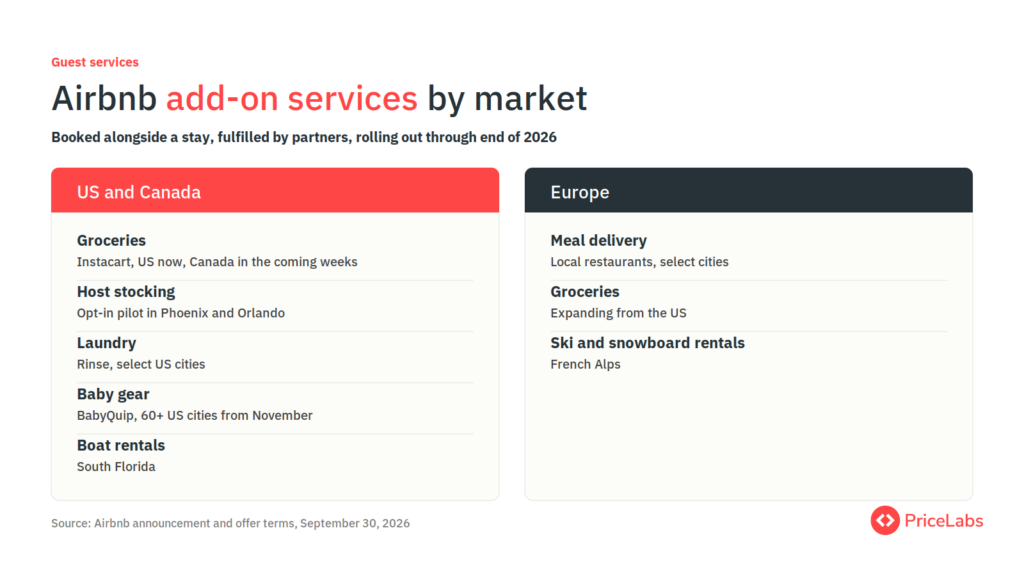
Add-on services by market
US and Canada
- Groceries via Instacart, the grocery delivery platform: already available broadly across the US, with Canada in the coming weeks. Guests can order up to three weeks before check-in, with $0 delivery on orders of $10 or more, according to Airbnb
- Host stocking: in Phoenix and Orlando, hosts can opt in to receive a guest’s grocery order and stock the property before arrival. RSU covered this pilot when it was announced, with a $25 payout per order at launch
- Laundry via Rinse, a laundry pickup and delivery service: free pickup, delivery and next-day rush service in select US cities
- Baby gear via BabyQuip, a baby equipment rental marketplace: cribs, strollers, high chairs and toys in 60+ US cities from November, with 10% off through Airbnb
- Boat rentals in South Florida
Europe
- Meal delivery from local restaurants in select European cities
- Groceries, expanding from the US
- Ski and snowboard rentals in the French Alps
Partner offers in Airbnb’s terms
Airbnb’s offer terms page lists the discounts guests get through Airbnb’s links. All run until December 31, 2026.
| Partner | What it is | Offer through Airbnb |
|---|---|---|
| Instacart | Grocery delivery | No delivery fee on $10+ orders; $10 off $50+ orders in selected US destinations |
| CarTrawler | Car rental booking platform | Up to 20% off, plus up to $200 Airbnb Credit on a first rental |
| ResortPass | Hotel and resort day passes | 20% off |
| Welcome Pickups | Private airport transfers | 20% off in Spain, Italy, France, Portugal, Germany and Greece |
| Bounce | Luggage storage | 15% off |
| Blacklane | Chauffeured rides | 10% off |
Meal delivery partner: Deliveroo appeared in Airbnb’s terms
Airbnb hasn’t named its meal delivery partner. However, on September 30, Airbnb’s offer terms page listed Deliveroo, the UK-based food and grocery delivery platform, offering free delivery on orders placed through Airbnb in London, Manchester, Edinburgh, Milan and Dubai.
That section had been removed by October 1. It is possible that Deliveroo is the partner, and the list suggests the service may reach beyond Europe, since Dubai was included.
What this means for managers who sell add-ons
Many property managers already offer laundry, baby gear, ski rentals or kitchen stocking, often for a small margin. These services now sit inside the Airbnb app, usually with a discount attached.
For a guest already booking on Airbnb, the case is convenience: one app, one record of what was spent, and a lower price. Airbnb’s terms state that it is “not the provider” and partners handle fulfilment, so outside the Phoenix and Orlando stocking option, hosts aren’t part of these transactions.
Connect and Travel Map Bring Airbnb’s Real-Life Social Network to Stays
Airbnb’s social features now cover stays, not just experiences. Guests can invite people they know to Connect, then see each other’s trips and recommendations on a Travel Map, read reviews, save favourites and message directly.
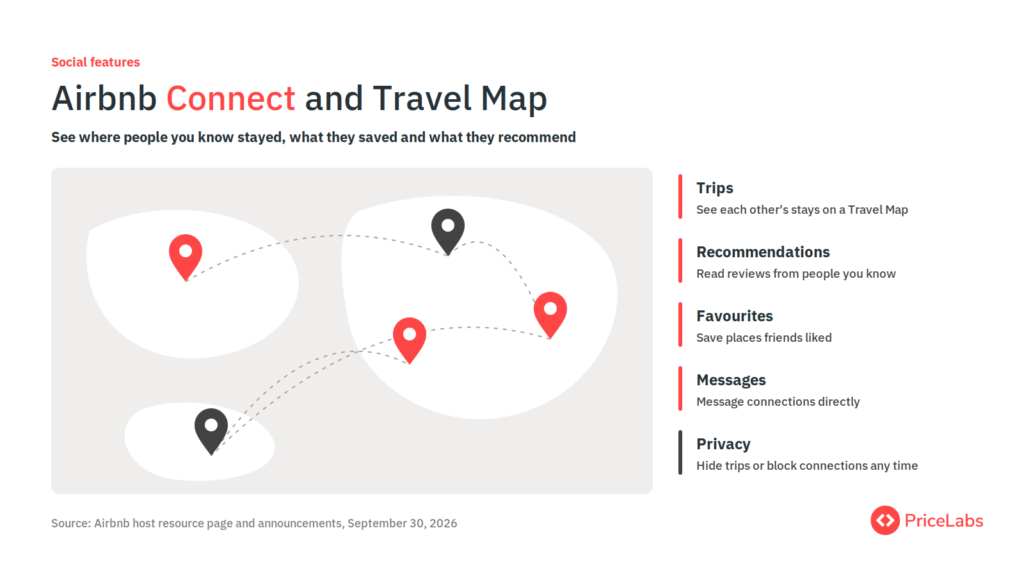
RSU has tracked this for a while. Airbnb first let guests connect with people from shared experiences, part of what RSU has called Airbnb’s real-life social network: people meet offline first, then connect on the platform.
Word of mouth, built into the product
Word of mouth is one of Airbnb’s biggest strengths. In Airbnb’s Q2 2025 earnings call, CEO Brian Chesky said “90% of our traffic coming from direct and unpaid sources continues to be the state of the business.” Recommendations from friends extend that.
Connect also gives Airbnb a lot more guest intent data: where people’s friends stayed, what they saved and what they liked. That data can likely help Airbnb match guests to the right properties.
On privacy, Airbnb says users can hide or remove trips and block connections at any time.
What Airbnb’s Fall Update Tells Hosts About Its Direction
Taken together, the update shows Airbnb building across the whole trip, from how guests find a stay to what they order during it. It also builds for hosts at every scale.
- Airbnb now speaks the industry’s pricing language. “Dynamic pricing” puts Airbnb’s own tool in the same conversation as the pricing software professional managers already use.
- Host tools are segmented by portfolio size. Guidance for hosts with five or fewer listings, bulk control for six or more.
- Listing data drives discovery. AI search, voice, AI filters and AI-written summaries all draw on what hosts put into their listings.
- In-stay services are becoming a platform category. Add-ons that managers have sold on their own now also come through Airbnb’s partners, often discounted.
Most host tools are still rolling out, and how they behave on live listings will matter more than the announcement. RSU will keep reporting on what changes as they arrive.

Uvika Wahi is the Editor at RSU by PriceLabs, where she leads news coverage and analysis for professional short-term rental managers. She writes on Airbnb, Booking.com, Vrbo, regulations, and industry trends, helping managers make informed business decisions. Uvika also presents at global industry events such as SCALE, VITUR, and Direct Booking Success Summit.
Related Articles:
 Barcelona’s Short-Term Rental Ban Faces Legal Challenges: What Managers Need to Know
 Will Airbnb Abandon Its Values of Inclusivity and Diversity Under Trump’s Second Presidency?
 Lisbon Imposes Bans and New Limits, Mabrian Launches Rental Monitoring Tool, and Airbnb Reboots Experiences
 Airbnb’s Q4 2025 Earnings Call: Top 10 Things FOR Vacation Rental Managers