
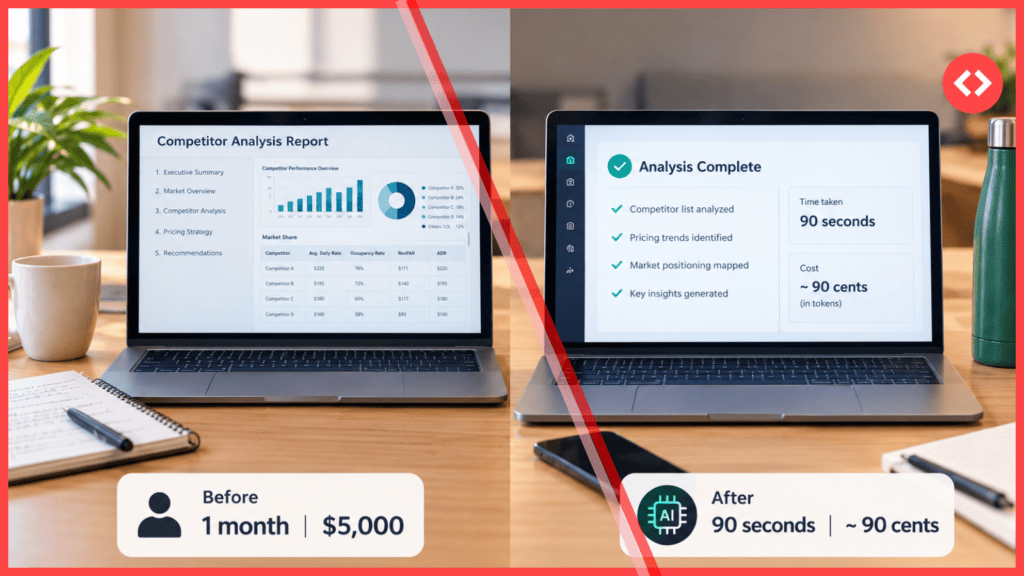
What impact does AI have today on the owner acquisition process in the business of short-term rentals? Industry expert Brooke Pfautz used to pay an analyst about $5,000 and wait a month for a comprehensive competitor report for property management companies. On a live RSU by PriceLabs session on September 30, he produced the same report for Big Bear Vacations, a Casago franchisee in California. This time it took him 90 seconds to build, and cost about 90 cents.
It is clear that AI use today can concretely make finding, contacting and signing a new owner faster and more effective than two years ago.
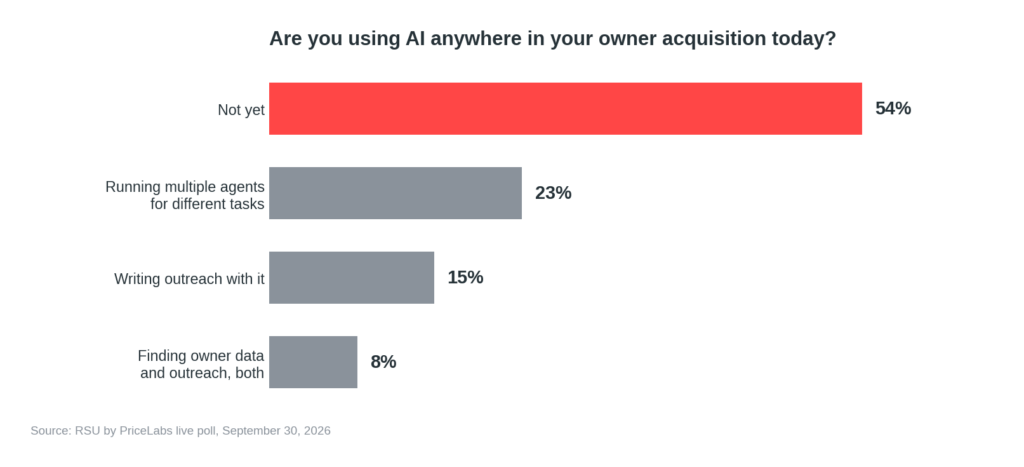
This article is for property managers who want to grow their portfolio but are not sure which parts of that work AI can take over. Many have already tried ChatGPT or Claude, got back something they could not use, and quietly stopped. A live poll found 54% of the room is not using AI anywhere in owner acquisition yet. Pfautz, founder of Vintory, and Thibault Masson, founder of RSU by PriceLabs, spent the hour on what the managers getting good results do differently.
Three Owner Acquisition Strategies You Can Deploy This Week
Before the AI work makes sense, it helps to see where new owners come from today.

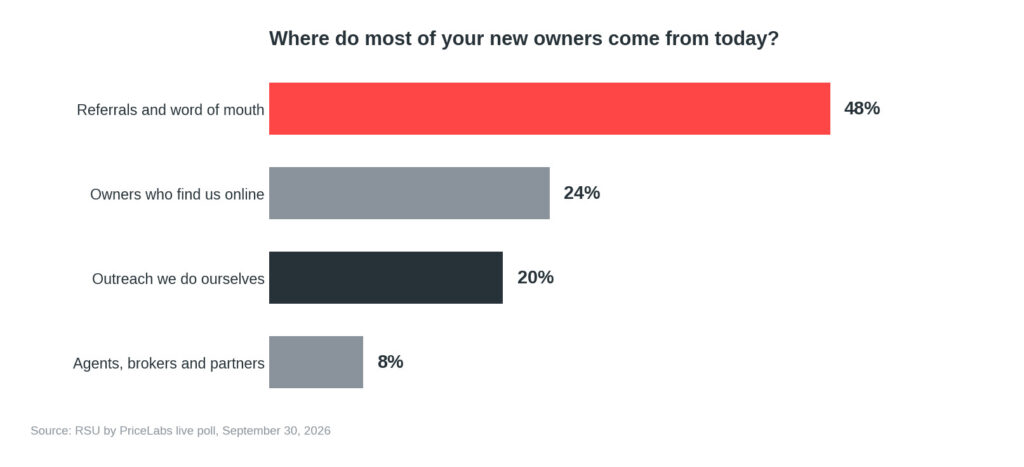
Nearly three quarters of new owners arrive through channels the manager does not control. Changing that starts with a list, meaning a set of named property owners you have good reason to contact. Pfautz said more than 50% of what a campaign produces comes down to that list, because the best email in the world sent to the wrong people does nothing.
Here are three ways to build one, all of which work in any country.
1. Study the Owners You Already Have
Export your current owner list with all their corresponding data, including their home address, property type and performance, then give that file to ChatGPT or Claude and ask what your best properties have in common. AI is good at finding patterns across hundreds of records that a person reading the same spreadsheet would miss.
A property manager in Hilton Head did this by hand and noticed that several of his owners lived in one small town in Ohio, far from the coast. He booked a hotel conference room there, ran a short seminar on owning property in Hilton Head, and signed two or three owners who went on to buy houses.
2. Pick a Narrow Target and Stay on It
When Pfautz started in Ocean City, a ten-mile strip of land with roughly 20,000 condos on it, he chased every property he could find. He soon cut back to five buildings and marketed to them constantly, because they were newer, larger, and had the potential to earn significantly more.
Most managers already sense which properties suit them. What AI adds is a way past that feeling, because you can filter a whole market by how properties are performing or by their guest ratings.
3. Build the List From Public Records
Where a city or county requires a short-term rental permit, that permit list can usually be requested through a public records request. Property records, deed registries and assessor files carry owner names and mailing addresses.
Masson tried the European version over a weekend. He filtered a market dashboard for listings on a French island that were struggling on revenue or ratings, then matched them against property transaction records, which are public in France. He got closer to a usable list than ever before, then met the wall: the records show the address and the sale price but not the owner’s name.
In the United States, Vintory sells this step already assembled. It scrapes listing sites and property manager websites, collects permit lists and public records, and holds over 1.5 million records, using photo and description matching to work out which listing belongs to which address.
What makes AI for Owner Acquisition tick? Context, Rules, Skills, and Connectors.
A list only pays off if somebody follows up on it. Pfautz remembered a customer who cancelled while 34 leads sat untouched in their system, and another manager who told him more than half his closed deals come from a long follow-up sequence rather than a first call. So the real work sits in what comes after the list: emails that go out on a schedule, a page that catches the replies, a number to send, and a presentation to walk through.
That is exactly the work people hand to AI, and where most of them give up. Pfautz hears the same complaint constantly: someone tried ChatGPT, the result was poor, they stopped. The reason is that a general AI model knows nothing about your company. These four files are that briefing. Write them once, attach them to every request after that.
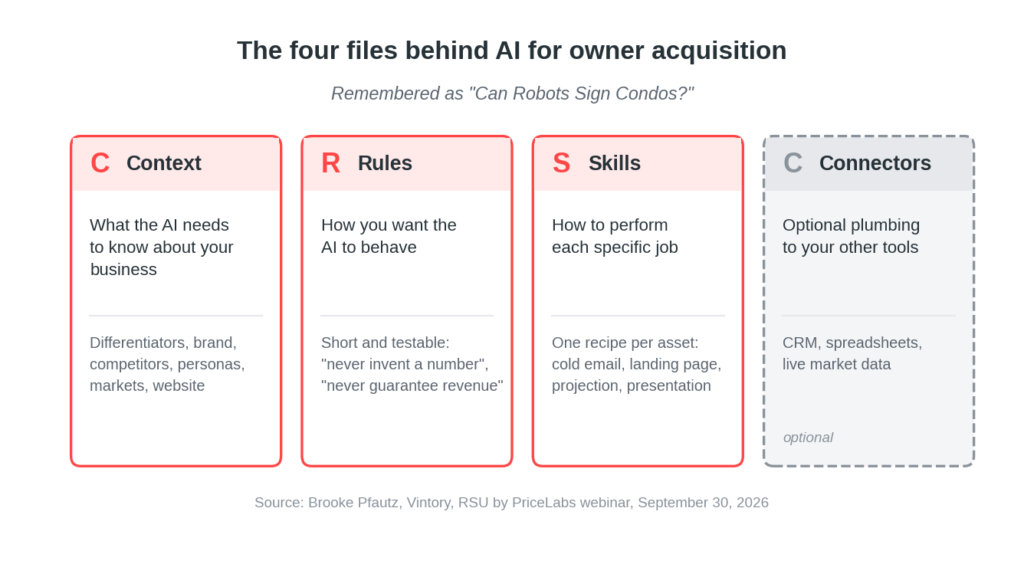
- Context is everything about your business: what makes you different, your brand voice and colours, your competitors, your owner types, your markets. Your website supplies most of it.
- Rules are the things the AI must never do, written so you can check them. “Be professional” is not a rule. “Never use exclamation points” is. For owner marketing: never invent a number, never promise revenue, never name a competitor to an owner.
- Skills are one short recipe per asset. The cold email recipe says 140 characters or fewer, no filler, and a subject line of one to three words.
- Connectors are optional links to your CRM, a spreadsheet or live market data.
A Word file or Google Doc is enough for each, and the quickest way to write them is to ask the AI to draft them and then fix what it gets wrong. It is the same approach behind a saved brand system your AI follows every time and the same path described in building your own AI agents in five levels.
How Brooke Pfautz Used AI to Build Five Owner Acquisition Assets
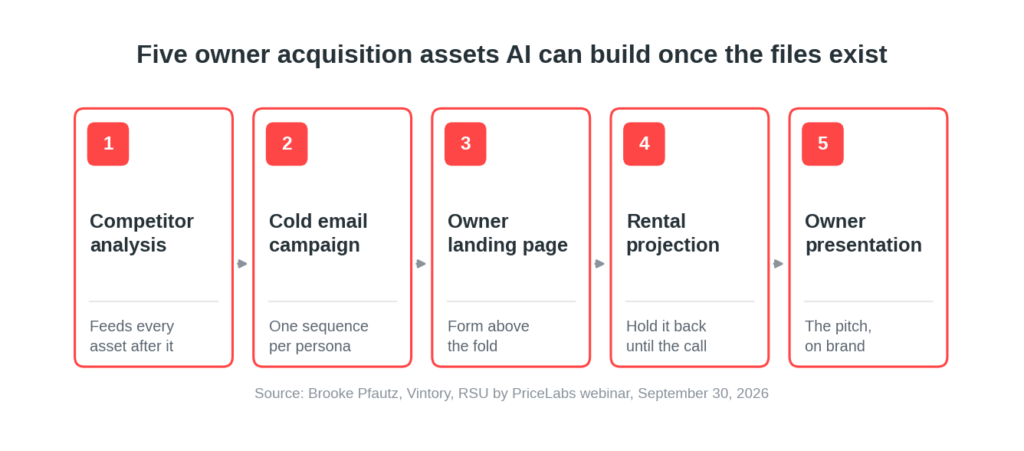
Once the files exist, Pfautz used them to build five things in the session. First the competitor report, which compares your company against every competitor it can find online and which every later asset then draws on. Then a cold email sequence for each type of owner, one for the owner managing the home himself, one for the owner already with another company, and one for the first-timer. Then an owner landing page, which is the most common failure he sees after working with a thousand companies, because so many have no form on them and no clear next step. Then the revenue projection, the thing owners actually ask for, built as a web page rather than a PDF so you can make it specific to one address and see when the owner opens it. And finally the owner presentation, a slide deck on brand in under two minutes.
To produce your own, ask the AI to write the prompt for the asset you want rather than writing it yourself, then attach the context file, the rules file, the recipe for that asset and the competitor report. Read the first result against your rules file, correct what is wrong once, and save those corrections back into the recipe so the next one comes out right without the same fix. That is the whole loop, and it is what makes the second landing page faster than the first.
AI Can Make Revenue Projections More Dynamic and Accurate
The revenue projection is the asset most likely to lose you the deal, and the reason is usually the properties it was built from. Those properties have to be a fair match for the home in front of you. Get it wrong and it costs you twice: a prospective owner sees a number lower than what they already earn and walks away, and an existing owner compares your figures to homes that were never like theirs.
Most tools open on the whole market, which can be 300 or 400 listings, most of them nothing like the property you are discussing. Masson narrowed that view inside PriceLabs’ Revenue Estimator Pro by how many guests a home sleeps, minimum stay, features such as a pool, and a guest rating of at least 4.8 on Airbnb. That last filter does the most work, because comparing a well-run home against listings with poor reviews makes good management look worthless. Fees are not included in that view either, so say plainly whether your figure is before or after commission.
Two Owner Retention Mistakes Property Managers May Make
The same care decides whether owners stay, and two habits cost more owners than poor performance does.
Showing an owner their numbers on their own. Managers tell Pfautz their owners left after a bad year. A property down 5% in a market that fell 20% actually did well, and an owner shown only the first figure cannot know that. Send the market alongside the property every time. Owner Analytics reports and the PriceLabs connector that pulls your data into Claude or ChatGPT both produce that comparison without a manual export.
Changing where the numbers come from. Quote one revenue figure while courting an owner and a different basis three months later, and the inconsistency says something about you that no landing page will repair. Choose your sources once, keep a record of what you sent and to whom, and use the same basis across owners and months.
Masson’s take on building all of this yourself is worth keeping in mind: the 90% you can produce is real, and the missing 10% is the tracking, the scheduling and knowing when to stop emailing someone who already replied. RSU has argued both sides in build your own AI or wait for your PMS, and has a full breakdown of how to execute a homeowner acquisition campaign if you are starting from nothing.

Guneet has spent five years working at PriceLabs, developing deep expertise in short-term rental operations and hospitality technology. She brings that practitioner’s lens to her writing at RSU, covering platform updates and making sense of market data for property managers.