There are no seats at the Tour de France 2026. No tickets, no gates, no barriers along most of the route. If you want to watch the world’s best cyclists fight for the yellow jersey, you walk up a mountain, find a patch of tarmac, and stand there — close enough, on the right day, to hear a rider breathe.
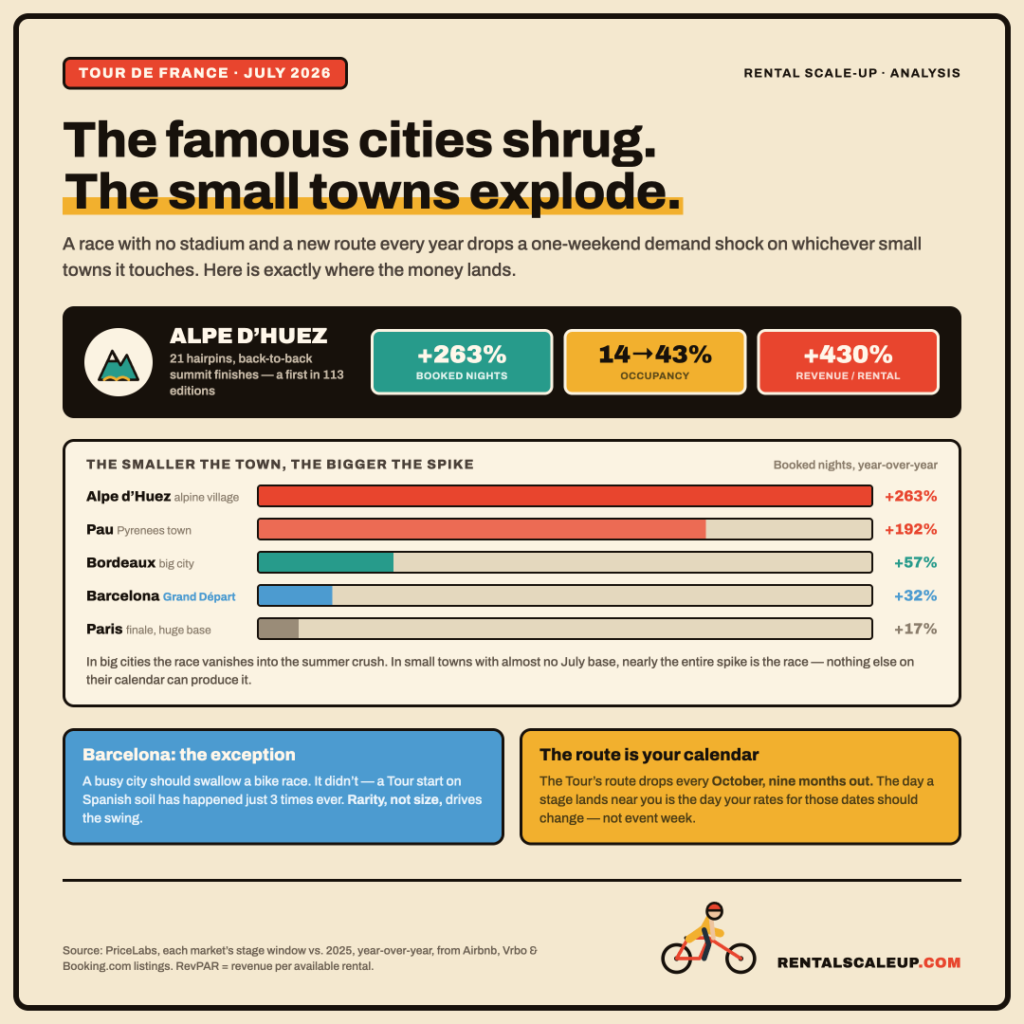
This July, that right place is a French ski station called Alpe d’Huez, and the short-term rentals on and below that mountain are posting the most dramatic numbers we have seen in Europe this summer: revenue per available rental up 430%.
You do not need to care about cycling — or France — for this to matter. Whether your properties are in Tennessee, Yorkshire, or on the Algarve, your country almost certainly has an event like this one: a race, rally, marathon, or touring festival that changes its route every year, is announced months in advance, and drops a one-weekend demand shock on whichever small towns it happens to touch. The Tour de France 2026 is simply the biggest, cleanest example — and this year’s numbers show exactly where the money lands, and where it doesn’t. In this article, we’ll look at both, and at what they mean for how you price.
Key takeaways

- Alpe d’Huez, hosting the race’s finish two days in a row, shows booked nights up 263% and revenue per available rental up 430%. Pau, in the Pyrenees, is close behind.
- Big cities on the route barely register: Paris booked nights are up just 17%, Bordeaux 57% — real, but modest against their busy summer baselines.
- Barcelona, hosting the start, is the exception that proves the rule: +32% booked nights in a city that busy is a real signal — because Tour de France 2026 start on Spanish soil is a rarity, even in a country with its own grand tour.
- Towns pay ASO, the race organizer, €90,000–€130,000 to host a stage — and 250–300 candidates compete for roughly 30 slots. They know what the data shows.
- The route is announced every October, nine months ahead. If a moving event passes near you, the announcement day is the start of your pricing calendar.
Tour De France 2026: A race with no stadium, watched far beyond France
For readers who have never followed it: the Tour de France 2026 is one of the most-watched annual sporting events on Earth, broadcast to well over 100 countries across three weeks every July. What makes it unusual is that it has no stadium, no home city, not even a fixed country. The race finishes on the Champs-Élysées in Paris almost every year (2026 will be the 51st Paris finish; in 2024, the Olympics pushed the finale to Nice) — but everything else is redrawn from scratch, every year.
The 2026 edition — the 113th — runs July 4 to 26: 21 stages, 3,333 kilometers, 54,450 meters of climbing. The Grand Départ — the race’s ceremonial opening weekend, a hosting prize in itself — is in Barcelona, only the third time the race has started on Spanish soil, with the opening two stages on Catalan roads before the race crosses into France. From there: the Pyrenees around Pau, a finish in Bordeaux, the Massif Central, the eastern borders, and a closing week in the Alps that ends with two straight days on Alpe d’Huez before the final ride into Paris.
And the crowd on the roadside is as international as the TV audience. Because the race is free to watch, fans plan entire vacations around standing on a specific mountain on a specific day: Belgians, Dutch, Germans, Britons, Danes, Colombians, and a growing contingent of Americans. This matters for rental demand: a Tour stage does not just move French visitors around France. It imports international, multi-night guests into whatever towns the route touches that year.
Alpe d’Huez: mythical to cycling fans
If you follow cycling, Alpe d’Huez needs no introduction. If you don’t, here is the two-minute version — because the mountain’s special status is exactly what is driving the numbers below.
Alpe d’Huez is a ski station above the Oisans valley in the French Alps, reached by a 13.8-kilometer climb at an average gradient of around 8%, with 21 numbered hairpin bends. Among cycling fans worldwide, those 21 bends are sacred ground — the sport’s most famous climb, its history recited the way football fans recite World Cup finals. Outside that world, most people could not place it on a map. Both things are true at once, and that split is the story.
On race day, the climb turns into something closer to a pilgrimage than a spectator event. Fans camp on the mountainside for days to claim a spot; entire bends are occupied by national fan clubs — one hairpin is so reliably packed with orange-clad Dutch fans it is simply called Dutch Corner. There are no barriers on most of the ascent, so spectators stand an arm’s length from the riders as they grind past. No other global sport offers that proximity — which is why so many people fly across the world to stand on a road for one afternoon.
In 2026, the pull is stronger than it has ever been: Alpe d’Huez hosts the finish of Stage 19 and then again of Stage 20, back-to-back summit finishes on consecutive days — a first in the race’s 113 editions. The Tour de France 2026 will, in all likelihood, be decided on that mountain. And this is why the data from Le Bourg-d’Oisans matters so much: it is the small town at the base of the climb, in the valley every fan must pass through, and the official start of Stage 20. When the mountain fills up, the valley catches the overflow.
What the numbers for Tour De France 2026 show: the famous cities shrug, the small towns explode
Here is the July booking picture along the route, from PriceLabs data, each market measured over its own stage window against the same window last year:
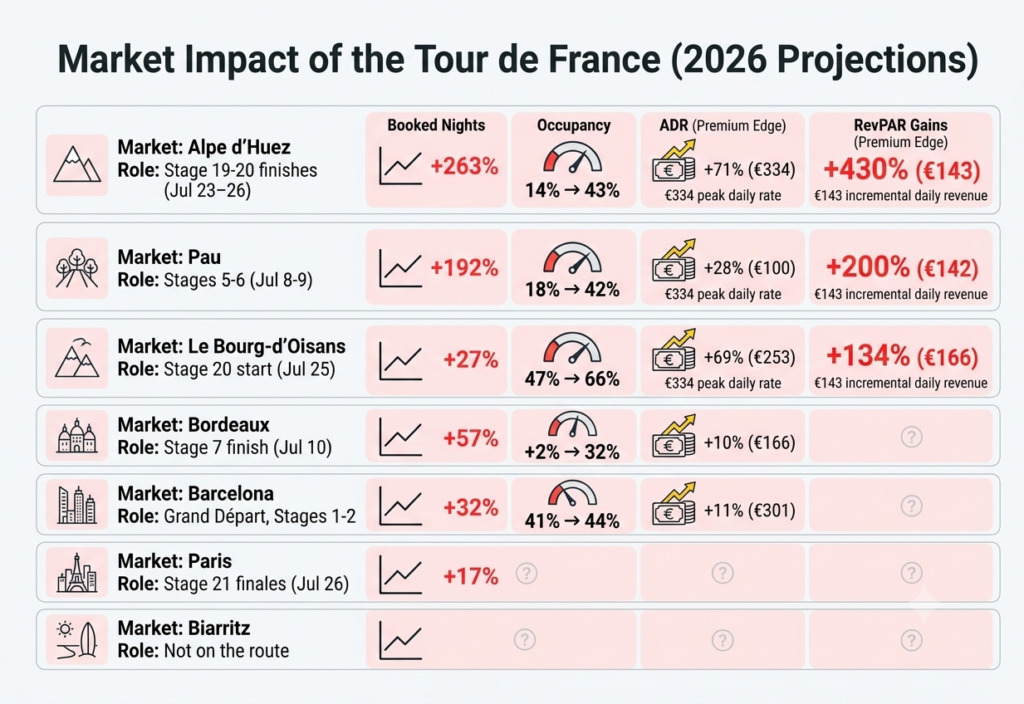
Source: PriceLabs, year-over-year change for each market’s stage window, based on public listing data from Airbnb, Vrbo, and Booking.com. Biarritz shown as a no-event benchmark (August window). ADR = average daily rate; RevPAR = revenue per available rental.
Read the table bottom-up. Biarritz — a popular beach town nowhere near this year’s route — posts +23% booked nights, which is what a normal, healthy European summer peak looks like. Paris, hosting the finale it hosts nearly every year, manages +17%: the race is statistically invisible inside the ordinary crush of late-July tourism. Bordeaux, a Tour regular, gets a real but moderate bump. In big cities, so much else is happening that even one of the world’s biggest sporting events disappears into the baseline.
Now the top of the table. Alpe d’Huez triples its occupancy and more than quintuples its revenue per rental. Pau’s occupancy jumps from 18% to 42%. Bourg-d’Oisans, the valley town, fills from 47% to 66% at rates up 69%. These are places with a small base of listings and, in a normal July, not much reason for international visitors to stay the night. When the Tour lands on them, nearly the entire spike is attributable to the race — nothing else in their calendar can produce it.
So, is this just about town size? Mostly, but not only — Barcelona is the interesting exception. A city that busy should swallow a bike race the way Paris does. Instead it posts +32% booked nights at €301 a night. Our reading: rarity. Spain has its own grand tour, La Vuelta, every year — but a Tour de France 2026 start on Spanish soil has happened only three times ever.
For Catalan and Spanish cycling fans, this is a once-in-a-generation home fixture, and it registers even against Barcelona’s enormous baseline. Novelty, not just size, drives the swing. (A supply footnote: Barcelona’s rate growth is also happening in a market where the city plans to revoke all tourist-apartment licenses by 2028, a ban Spain’s top court has upheld — capped supply amplifies every demand event.)
PriceLabs co-founder Richie Khandelwal’s summary of the pattern: the smaller a town’s usual footprint, the more a single event can distort it. A village that fills up for one race weekend produces far bigger percentage swings than a city that is already busy year-round.
Why small towns fight — and pay — to host
None of this is lost on the towns themselves. Hosting the Tour is not a lottery; it is a competitive bid. Towns pay ASO, the race organizer, a hosting fee — around €90,000 for a stage start and €130,000 for a finish, per ASO’s own 2023 figures — and foreign cities have paid in the region of €5–6 million for a Grand Départ, as Brussels reportedly did in 2019. Roughly 250 to 300 candidate towns compete for about 30 hosting slots each year, and the real cost, once road works and crowd infrastructure are added, typically more than doubles the fee.
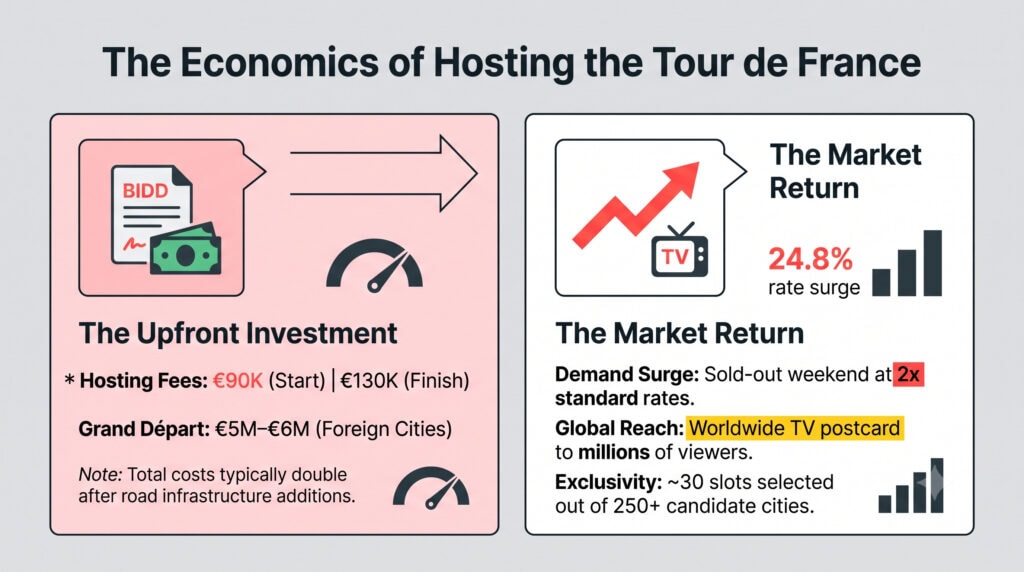
Why do they queue up anyway? Because of exactly what the table above shows. For a small town, one stage means a sold-out weekend at double rates, a worldwide television postcard, and a wave of international guests who would otherwise never come. The mayors have, in effect, already done the revenue management math. Hosts near the route should do the same — while keeping in mind that France’s own regulatory backdrop is tightening for short-term rentals generally.
What this means for property managers — far beyond France
As we said at the top, the Tour is only the biggest example. The Giro d’Italia and La Vuelta redraw their routes every year. So do major rallies, point-to-point races, and touring festivals on every continent. The same playbook applies — much of it borrowed from what we laid out for the 2024 Paris Olympics:
- The route announcement is your pricing calendar. The Tour’s route comes out every October, nine months ahead. If a stage lands within driving distance of your properties, that day — not the event week — is when your rates for those dates should change. The demand shock is predictable long before it arrives.
- The opportunity concentrates where baseline demand is lowest. Do not look at the famous city on the poster; look at the small towns on the route map, and at the valley towns and villages within reach of the key stages — the Bourg-d’Oisans effect. That is where occupancy can triple.
- Event guests are last-minute guests — price and gate accordingly. Race followers book short stays, late, and pay for position. Keep inventory back, adjust minimum-stay rules as the date approaches, and apply the last-minute booking playbook.
- Check your market’s supply before trusting percentages. A 263% jump in a market with 80 listings is a different story from 263% in a market with 8,000 — the supply-side caution we keep returning to applies to event spikes too.
The Tour de France 2026 needs no stadium and no fixed address — just a mountain, 21 hairpin bends, and no barrier between the fans and the road. That is precisely what makes it such a clean demand experiment, run on a different set of towns every summer. Now, as usual, what matters is your own market: is a moving event coming anywhere near you in the next twelve months, and what did its last visit do to occupancy and rates in towns like yours? PriceLabs’ Market Dashboards will show you the history; the route announcement will tell you the date. The rest is discipline.

Thibault Masson is a leading expert in vacation rental revenue management and dynamic pricing strategies. As Head of Product Marketing at PriceLabs and founder of Rental Scale-Up, Thibault empowers hosts and property managers with actionable insights and data-driven solutions. With over a decade managing luxury rentals in Bali and St. Barths, he is a sought-after industry speaker and prolific content creator, making complex topics simple for global audiences.