
When short-term rental bookings soften after summer, the reflex is to drop rates. Jay Whiteley, VP of Revenue and Commercial at VueStay Vacations by Casago, thinks that reflex has the sequence backward. Price, in his framing, is an output rather than an input. Distribution, listing content, length-of-stay rules, fees, and review scores all feed into the number a guest eventually sees, which means a rate cut responds to the last thing in the chain rather than the first.
RSU by PriceLabs and RevLabs by PriceLabs hosted “Shoulder Season Is Coming: Getting Your Teams Aligned Before It Costs You More” on August 20, 2026. PriceLabs’ Kyle Driskell hosted Whiteley, who spent eight years helping Evolve grow from 2,000 to 35,000 properties before joining VueStay, alongside Uvika Wahi, Rental Scale-Up’s editor and short-term rental industry analyst.
Who books shoulder season now: the guest mix beyond deal seekers
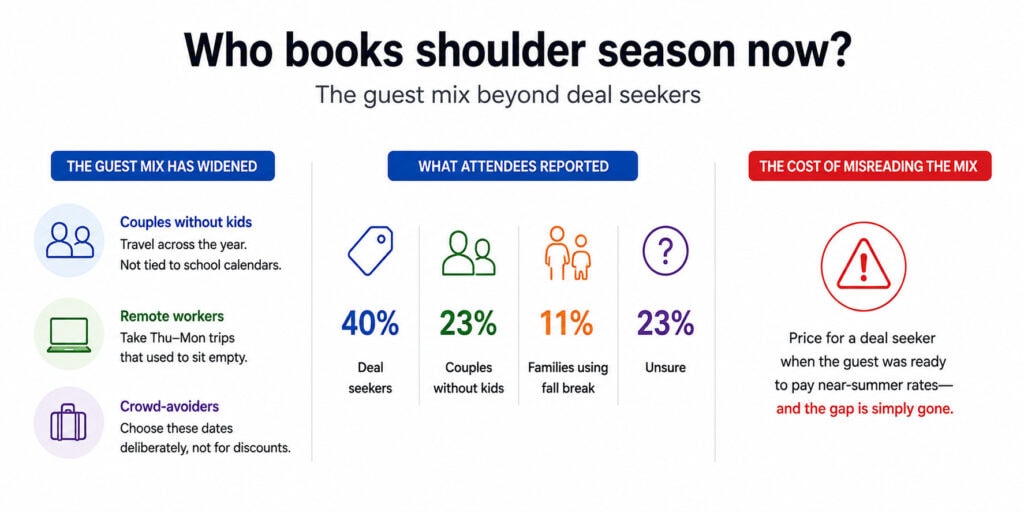
Deal seekers were once the whole story for shoulder season, which is part of why the reflex to discount persists. The mix has widened since:
- Dual-income couples without children are spreading trips across the year rather than saving for one summer break. School calendars are what make September and October slow, and this group is unaffected by them.
- Remote workers with flexible schedules are taking Thursday-to-Monday stretches that used to sit empty.
- Travelers avoiding crowds are choosing these dates deliberately. They are not waiting for a discount, and many were prepared to pay closer to summer rates.
Attendees on the call reported something consistent with this. Deal seekers still led at 40%, with couples without kids at 23%, families using fall break at 11%, and 23% unsure.

The cost of misreading the mix is not theoretical. Price for a deal seeker when the guest was ready to pay near-summer rates and the gap is simply gone.
How to run a post-season “retro” before changing your rates
Price is an output, not an input, Whiteley asserts. A booking slump might require better listing photos or a shorter minimum-stay requirement, not a lower rate. Before changing prices, run a retrospective on last season:
- Pull guest reviews and support tickets to find where money actually leaked.
- Understand that a review score dropping from 4.8 to 4.6 could be a cleaning or maintenance issue, which a pricing engine will miss entirely.
- Use AI tools to analyze data; for example, PriceLabs allows users to ask plain-language pricing questions in Claude, ChatGPT, or n8n.
- Test new pricing moves during peak season instead, as it brings in 70% to 80% of annual revenue.
Two things make this easier than it used to be:
- The analysis no longer needs a data team. A manager running a handful of properties can now pull the same depth from their PMS and pricing data. For instance, revenue management PriceLabs offers users the ability to ask questions in plain language through their MCP connector in Claude, ChatGPT, or n8n.
- Peak season is the safer time to test. Since it carries most of a portfolio’s annual revenue, there is more room to learn from a change without the result being noise.
Why available nights matter more than occupancy or rates
Once the retro is done, the next question is what you are budgeting against, and September is when most teams start. Whiteley’s answer is available nights.
Revenue is three numbers multiplied together:
- The nights you can sell. Every date genuinely open for booking.
- The share you actually sell. Occupancy.
- What you sell them for. ADR.
Most teams spend their attention on the second and third. The first moves without anyone announcing it. An owner blocks three weeks for family. A listing sits paused after a maintenance issue and nobody unpauses it. A new property joins the portfolio with a 30-day availability cap nobody flagged.
None of those register as decisions. All of them show up in the forecast. And unlike a rate, a night that was never bookable cannot be won back later.
It also reframes churn. Losing a property whose calendar was mostly blocked costs less than it appears to. Keeping one whose owner has quietly started blocking it costs more.
What to tell owners during a slow season
Slow months make owners uneasy. If nobody separates normal seasonality from actual performance, an owner is left to draw their own conclusion, and a quiet comparison to another manager is an easy one to reach. Blocked dates often follow.
Whiteley’s argument is that this makes shoulder season the best window of the year to market your work to owners rather than a season to get through. Most managers undersell themselves here. A monthly report is a number. An owner update is a story with four parts:
- How the property performed against the market
- How it performed against the same month last year
- What the team did to produce that result
- What is planned for the next quarter
Outperformance an owner never hears about does nothing for retention.
PriceLabs’ owner analytics tool, demonstrated live on the call, generates these updates on a schedule rather than leaving them to whoever has time.
How to run a team hackathon to fix one shoulder season problem
Knowing what to fix is a different problem from getting three departments to fix it together. Pricing, marketing, and operations each carry their own KPI, so the same slow month reads as a rate problem, a visibility problem, and a staffing problem depending on who is looking. Everyone acts, nobody coordinates, and the fixes work against each other.
Wahi’s answer is a hackathon: a short, time-boxed session where a cross-functional group works on one named problem and has to produce something usable by the end. The format comes from software teams, but nothing about it is technical.
The structure:
- One problem, stated with a number. Not “improve guest experience.” A 0.2-point drop in review scores since June, or a rise in owner-blocked nights.
- Anyone can work on it. The problem does not belong to the department it technically sits under. A housekeeping lead and someone from IT can reach a fix neither would have found alone, which Wahi compares to outsider art, where people without formal training in a field often produce its strongest work.
- 24 to 48 hours, fixed. Short enough that people commit, short enough that nobody builds something elaborate.
- A working prototype, not a slide. The output has to be something that can be tried, whether that’s a revised checklist, a message template, or a changed process.
What the format solves is the silo. A shared problem with a deadline forces the conversation that the org chart usually prevents, and it produces one agreed answer rather than three departmental ones.
Why the order of these steps matters
Each of these habits fails without the one before it.
Run the retro and you know why last season went the way it did, which is usually not the rate. Count your available nights and you know the size of the calendar you are actually budgeting against. Tell the owner the story and the property stays in the portfolio with its calendar open. Solve the problem as one team and the fix holds, instead of three departments quietly working against each other.
Skip a step and the next one is built on a guess. That is the failure this session opened with, and it is the one that shows up in October, priced into a quarter nobody meant to price that way.

Related Articles:
 New PriceLabs–Booking.com Integration Helps Hosts Gain Back Pricing Control
 From Empty Gaps to Extra Bookings: PriceLabs’ Dynamic Min Stay Tackles Lost Revenue
 PriceLabs Hits 161 Integrations, HomeToGo Snaps Interhome, Booking.com Debuts Rewards Card
 PriceLabs’ 2026 Revenue Accelerator, in Context: Why Revenue Is No Longer One Person’s Job — and How AI Is Reshaping That Job in Two Directions at Once