If you spent the first half of the year grinding to meet Vrbo’s punishingly strict Premier Host requirements, the rules of the game just changed again.
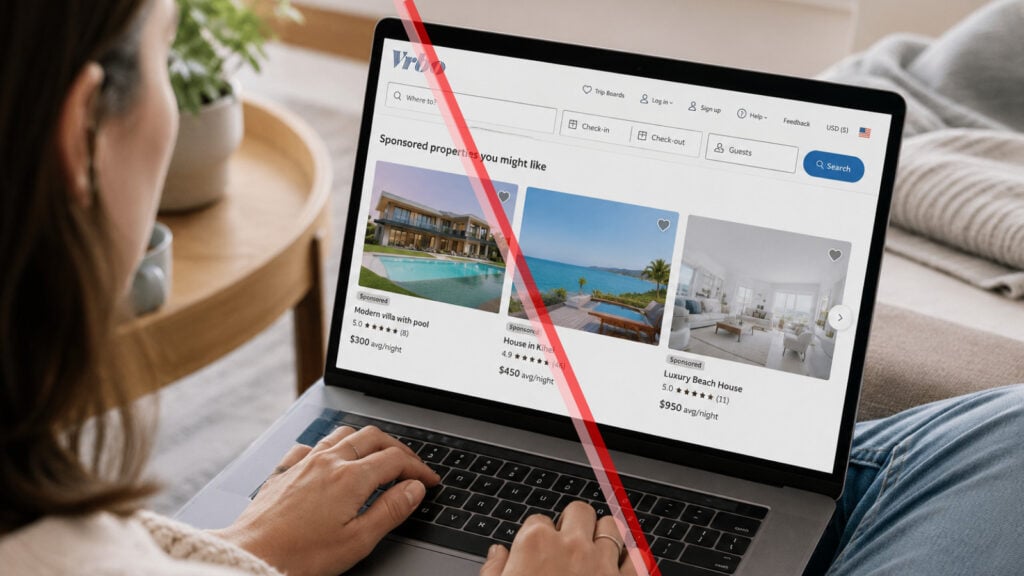
Vrbo Sponsored Listings are officially live. Unlike traditional ad networks that charge you per click regardless of whether a traveler books, Vrbo’s model is tied directly to performance: hosts pay on a per-booking basis. You only pay the ad fee if the sponsored placement actually results in a confirmed reservation.
While we previously reported on the implications of Vrbo’s sponsored listings pilot, the full public rollout brings the core conflict into sharp focus: How does a platform balance operators who earn their visibility with those who simply buy it?
Here is what the official launch means for your portfolio, your margins, and the actual value of your Premier Host status.

How Vrbo Sponsored Listings Work (And How to Set Up a Campaign)
Before diving into the strategy, it is important to understand the mechanics. Because Vrbo uses a “pay-per-booked-night” model, the financial risk of a traveler browsing but not booking stays with the platform, not the property manager. You are essentially bidding a flat dollar amount to bump your property into a premium slot when a traveler’s search criteria matches your listing.
Setting up a campaign is done entirely through the Expedia Group Advertising portal, and the process is straightforward:
- Access the Portal: Log into your Expedia Group Advertising platform. This is where all ad campaigns across Expedia’s ecosystem (including Vrbo) are managed.
- Set Your Bid Amount:Minimum bid is $5 per booked night. Choose the amount you are willing to pay for a completed booking. While $5 is the baseline, the system functions as an auction. Higher bids increase your “ad score,” which dictates whether you win the premium search placement over competitors.
- Configure Targeting and Modifiers: Apply bid modifiers to target specific dates or traveler types. This allows you to aggressively push for visibility during shoulder seasons while keeping your ad spend low during naturally high-occupancy months.
- Launch and Monitor: Set the campaign live. Unlike static promotions, you can start, pause, or adjust your bids in real time. The portal provides live feedback on impressions, clicks, and bookings so you can calculate your exact Return on Ad Spend (ROAS).
The “Fee Stack” – The Hidden Cost of Paid Placement
Because Vrbo charges you when a booking completes, this functions less like traditional advertising and more like a second commission layer, except you set the rate yourself by bidding.
To work out what a sponsored booking actually costs you, you must divide the bid by the total value of the booking, and add that percentage to your base commission. But there is a third layer to watch out for: promotions.
As we covered in our breakdown of Vrbo’s Q2 2026 earnings, over 40% of Vrbo bookings now run on supplier-funded promotions. Those discounts come straight out of your nightly rate.
If you put a 15% promotion on a listing and then run a Sponsored Ad on it, you are doing three things at once:
- Cutting your own rate.
- Paying base commission on the smaller total.
- Paying the ad bid on top.
One booking, three costs, all of them yours. Any single fee is manageable, but the stack is what will surprise unprepared property managers.
The Premier Host Dilemma: Are You Buying New Bookings or Paying Twice?
Historically, Vrbo told professional managers a simple story: deliver operational perfection, and the algorithm will reward you. Your Premier Host status still guarantees you the best organic placement.
However, because paid ads now carve out the absolute top slots, a competitor with a lower rating and a willingness to pay can theoretically land a spot above your flawless 5-star Premier listing.
Expedia calls its pay-per-booking model “risk-free” because you do not pay for empty clicks. But for strong listings, there is a different problem: incrementality.
Vrbo bills you when a booking completes, and the bookings most likely to complete are the ones a strong listing was already going to win. If you are a Premier Host sitting third in the organic results, and you buy an ad to move to the top, did the ad actually win you a new booking? Or did you just pay an ad fee for a guest who was already going to book your property anyway?
Vrbo’s reporting will credit the ad, but no platform can tell you what would have happened if you hadn’t advertised. If your listing converts poorly, you are buying real exposure. If your listing already ranks well, you may be cannibalizing your own organic bookings.
A 4-Step Playbook for Testing Sponsored Listings
Before you roll this out across your entire portfolio, implement a strict testing framework:
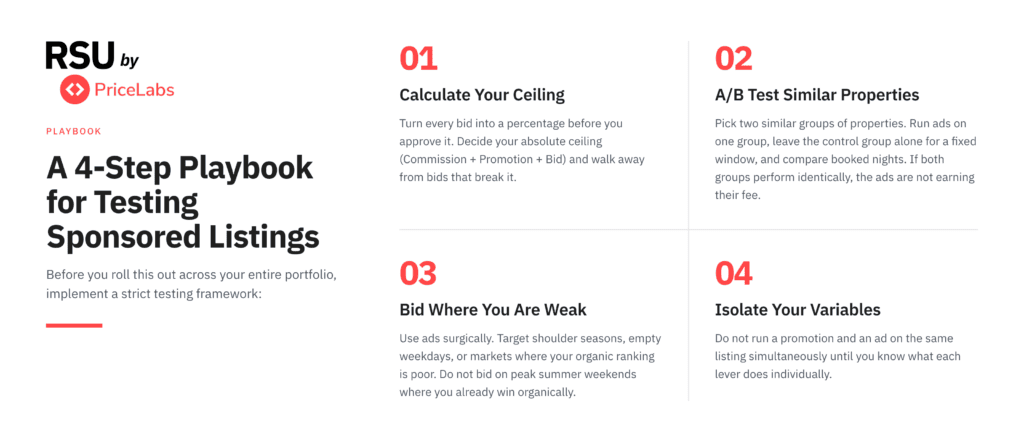
- Calculate Your Ceiling: Turn every bid into a percentage before you approve it. Decide your absolute ceiling (Commission + Promotion + Bid) and walk away from bids that break it.
- A/B Test Similar Properties: Pick two similar groups of properties. Run ads on one group, leave the control group alone for a fixed window, and compare booked nights. If both groups perform identically, the ads are not earning their fee.
- Bid Where You Are Weak: Use ads surgically. Target shoulder seasons, empty weekdays, or markets where your organic ranking is poor. Do not bid on peak summer weekends where you already win organically.
- Isolate Your Variables: Do not run a promotion and an ad on the same listing simultaneously until you know what each lever does individually.
What We Still Do Not Know
While the product is live, several critical factors will only become clear as the market matures:
- Bid Formats: Whether standard bids will settle into fixed dollar amounts or percentages, and what a “normal” bid looks like in highly competitive markets.
- Performance Gating: Whether Vrbo will restrict ad eligibility to high-performing listings. If they do, the Premier Host badge stops being a reward for operational excellence and simply becomes the prerequisite to buy ads.
- Expedia.com Cross-Listing: Whether these sponsored listings might eventually surface across Expedia’s broader OTA network.
The era of pure organic visibility on Vrbo is officially over. The top of the page is no longer something you earn purely through performance. Success now requires tracking exactly what each booking costs you, rather than just watching your base commission rate.

Uvika Wahi is the Editor at RSU by PriceLabs, where she leads news coverage and analysis for professional short-term rental managers. She writes on Airbnb, Booking.com, Vrbo, regulations, and industry trends, helping managers make informed business decisions. Uvika also presents at global industry events such as SCALE, VITUR, and Direct Booking Success Summit.
Related Articles:
 New Vrbo Updates Show It’s Making Reliability Its Core Identity
 Lisbon Tests Softer Rules, New Vrbo API, Investors Prioritize Stability Over Scale
 Vrbo Introduces Buy Now, Pay Later for Vacation Rentals
 Airbnb, Booking.com, and Vrbo Are Changing How Listing Visibility Works, and It’s Going to Cost You