

Vacation rental regulations updates this week: Vancouver, Mexico City, and Valencia each saw governments either reject, rethink, or be ordered to reverse short-term rental restrictions.
Vancouver Rejects Airbnb’s FIFA World Cup Loosening Pitch
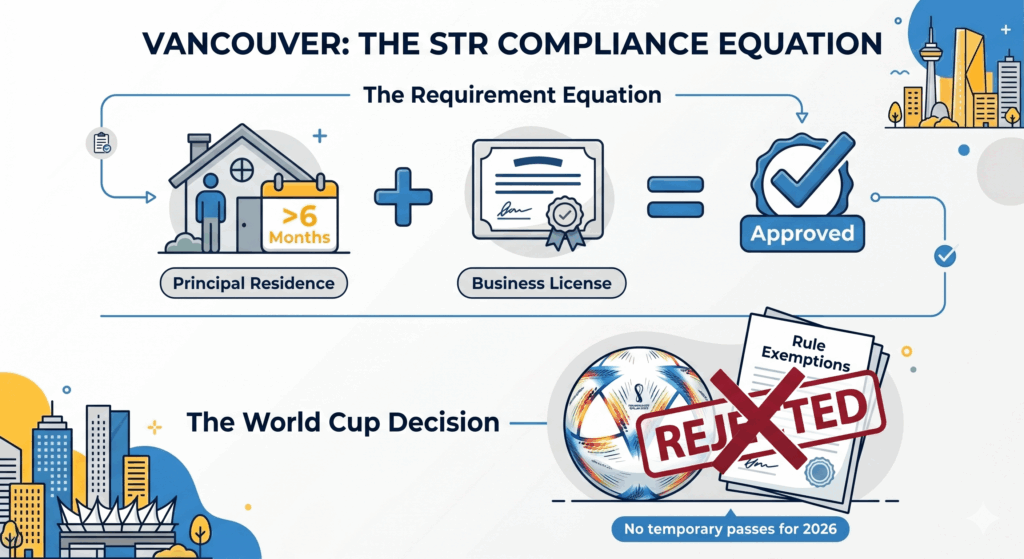
- Airbnb commissioned Deloitte to produce a report projecting a 70,000-night accommodation shortfall during the nine most critical days of the FIFA World Cup in Vancouver — leaving up to 15,000 fans per day without rooms at peak demand — and used it to ask the BC government for an “event exemption” loosening the province’s principal-residence requirement.
- BC Premier David Eby publicly rejected the proposal, telling reporters the province would not loosen short-term rental rules to suit the platform’s projections. Vancouver city staff confirmed separately that they are not considering changes to the city’s existing short-term rental rules.
- BC’s existing rules — in effect since the provincial registry launched in May 2025 — require short-term rentals in most communities to be the host’s principal residence (the home where they live the majority of the year), with a business licence on file. Separately, Airbnb is offering hosts an additional ~$1,000 CAD bonus for rentals during the World Cup window, independent of the regulatory ask.
Uvika’s Views
- This is the same Airbnb playbook that reached the LA Mayor’s budget proposal three weeks ago — a shortfall report, an event-exemption ask, a pre-tournament timeline. The two governments have responded in opposite directions. LA’s planning department reversed an initial rejection and put a temporary loosening in the mayor’s budget; BC’s premier said no in public. The contrast is the story.
- For property managers holding non-primary inventory in BC, the public rejection means there is no realistic exemption window opening before kickoff. Operators in this position may want to plan around the existing principal-residence rule rather than wait for a policy change.
- The signal travels. The 2026 FIFA World Cup has 16 host cities across the US, Canada, and Mexico. Several of those cities have STR rules that Airbnb has been pressing to loosen. Vancouver’s “no” is the first clear data point on whether the event-pressure argument lands politically — and it didn’t, in BC.
- For PMs operating in other Canadian World Cup host cities (Toronto), the BC posture suggests the federal-housing-pressure climate in Canada is structurally different from the US. The Department of Finance’s $50M Short-Term Rental Enforcement Fund (announced December 2024) sits behind the provincial-level rules and signals that the federal tilt is toward enforcement, not flexibility.
Entities
BC Short-Term Rental Registry — The provincial registry that launched May 1, 2025. All STR hosts and platforms must register; platforms must remove unregistered listings. The registry is the structural mechanism that gives the principal-residence requirement enforcement teeth.
Mexico City Rethinks Its Airbnb Law as World Cup Approaches
- Mexico City government officials have publicly confirmed they are reviewing the city’s short-term rental regulations — informally known as the “Airbnb Law” — amid concerns the framework will deter hosts ahead of the FIFA World Cup. The mayor’s office has stated it does not want to generate “tourismophobia.”
- The current framework includes a 50% night cap on a single property’s annual short-term use, a mandatory host registry, and an exclusion of social-housing units from short-term rental eligibility. The regulation has been in legal limbo since 2024 — multiple amparos (Mexican constitutional injunctions) have blocked enforcement against various property classes and operators.
- Mexico City is one of three Mexican host cities for the 2026 FIFA World Cup. Roughly 44,000 visitors are projected to use short-term rental housing during the tournament, with Airbnb and Deloitte estimating the platform alone could generate $345M in economic impact across Mexico City over the full tournament window. Hotel infrastructure on its own is widely seen as insufficient to meet World Cup demand, with hoteliers planning roughly 3,300 new CDMX rooms before kickoff but city tourism officials acknowledging the gap.
Uvika’s Views
- The legal-limbo is operationally consequential for property managers. Different rules effectively apply to different properties depending on which amparos cover them — meaning the formal regulation and the rules a specific operator is actually subject to can diverge. PMs in CDMX may want a property-by-property compliance read rather than a citywide one.
- The Mexico City review sits between the LA position (open to loosening) and the Vancouver position (firm rejection). The framing here is different — CDMX officials are signalling concern about hosts withdrawing from the market, not about under-supply for fans. That language matters: it suggests any review is more likely to soften enforcement than to formally relax rules.
- For PMs considering whether to onboard new CDMX inventory ahead of the tournament, the timing is delicate. A formal regulatory loosening before June would be unusual; an informal enforcement pause through the tournament is more plausible based on the “tourismophobia” framing. Operators in this position are weighing real risk against a substantial demand window.
- The contrast across the three FIFA World Cup host countries is now visible in the data points. Each country is making different choices on the same underlying tension — and PMs operating cross-border need to read each market separately.
Entities
Amparo (Mexican constitutional injunction) — A judicial mechanism in Mexican law that allows individuals or companies to challenge the application of a law on constitutional grounds. An amparo typically suspends the law’s application to the complainant while the court reviews; it does not strike down the law itself. Multiple amparos against the CDMX Airbnb Law have left enforcement uneven across operators.
Valencia Court Voids Tourist Housing Moratorium; City Studies Supreme Court Appeal
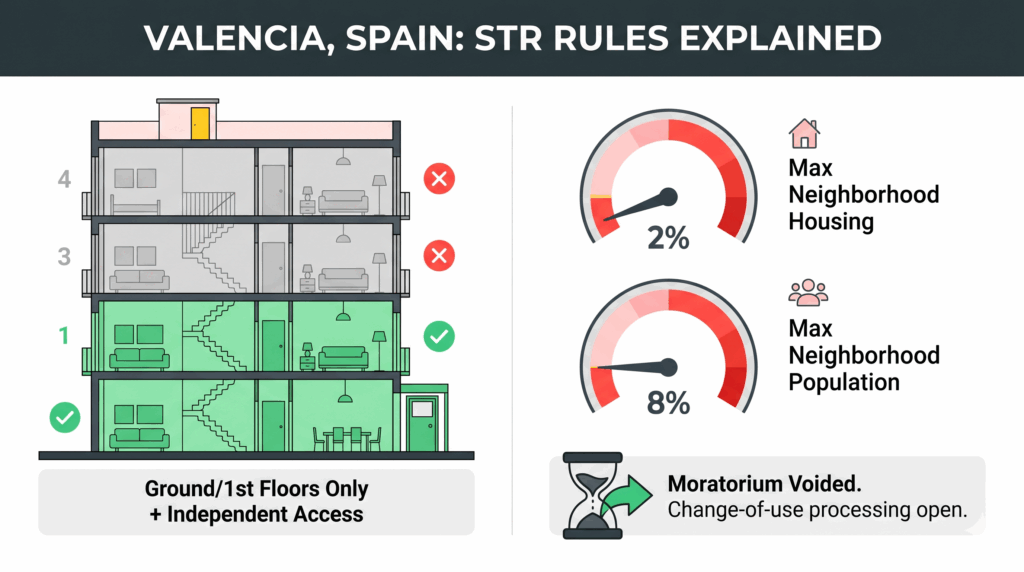
- The Tribunal Superior de Justicia de la Comunitat Valenciana (TSJCV) ruled on April 14, 2026 to invalidate the City of Valencia’s tourist housing moratorium, which had paused new short-term rental licenses since May 28, 2024. The ruling found that the City Council’s May 2024 moratorium was based on a legal provision that did not authorise the suspension of license processing for change-of-use and responsible declarations. The ruling is partial: the court declined to strike down the suspension of building permits for new hotel uses, leaving that piece of the moratorium intact.
- The Valencia City Council is studying an appeal to the Tribunal Supremo (Spain’s Supreme Court, which can hear cassation appeals on questions of national legal interest). Separately, on March 31, 2026 — two weeks before the court ruling — Valencia City Council had approved a permanent new regulation for tourist housing: a 2% cap on tourist apartments per neighbourhood housing stock, an 8% cap on tourist places per neighbourhood population, and a requirement that new units sit only on ground or first floors with independent street access. How Valencia’s neighbourhood movement responds to the ruling — and whether it mounts its own legal challenge in defence of the moratorium — remains a variable to watch as both the Supreme Court appeal and the new permanent ordinance take shape.
Uvika’s Views
- The court ruling and the new permanent regulation are now operating in parallel — the moratorium is voided, but the March 31 ordinance with its 2% and 8% caps is in force going forward. For property managers, the practical question is whether change-of-use applications filed during the moratorium (May 2024 – April 2026) can now be processed retroactively, or whether they have to be re-filed under the new regime. That detail is unresolved and worth tracking.
- The legal grounds the TSJCV used — that the City Council relied on a provision that did not authorise the suspension — sit in the same family as procedural-shortcut rulings against STR restrictions seen in California (Santa Ana CEQA) and Nevada (Clark County). The legal theories are different across jurisdictions, but the pattern of courts pushing back on cities adopting STR restrictions without the right procedural footing is showing up in more places. Whether this becomes a defining trend depends on the next several rulings.
- For Valencia hosts who had applications stuck in the moratorium queue, the ruling creates a window of opportunity that may close depending on how the City Council handles its Supreme Court appeal and how quickly the new March 31 regulation is operationalised. Operators in this position face a genuine timing decision.
- Spain’s housing-cost politics give resident groups significant standing in tourist-housing litigation. If neighbourhood associations do file a counter-challenge, a successful appeal could put the moratorium back in place even before the Supreme Court rules — making this the variable most worth tracking in the weeks ahead.
Entities
Tribunal Superior de Justicia de la Comunitat Valenciana (TSJCV) — The highest regional court in the Valencian Community. The TSJCV hears administrative challenges to municipal and regional government actions. Its April 14, 2026 ruling on the Valencia moratorium is binding on the City Council unless overturned on appeal to Spain’s Supreme Court (Tribunal Supremo).


Uvika Wahi is the Editor at RSU by PriceLabs, where she leads news coverage and analysis for professional short-term rental managers. She writes on Airbnb, Booking.com, Vrbo, regulations, and industry trends, helping managers make informed business decisions. Uvika also presents at global industry events such as SCALE, VITUR, and Direct Booking Success Summit.
Related Articles:
 Airbnb’s Vision for Fair Regulations in Spain and Elsewhere
 The May 20 EU Data Deadline: Should Property Managers Expect Mass Delistings?
 EU Short-Term Rental Data Sharing Goes Live, Australia Calls for Sweeping Reforms, US States Preempt Local Rules
 French Short-term rentals and the Hoguet Law: What the FNAIM Report from April 2026 Says