
On April 22, I was on stage at Old Billingsgate in London for the Short Stay Summit 2026, organised by the Short Term Accommodation Association (STAA). The panel — “Making Sense of Data and Decoding the Guest” — brought together Maria Flores Portillo (Beyond), Vered Raviv-Schwarz (Guesty), Rohit Bezewada (AirDNA), and me, hosted by Sally Henry from Key Data.
With 800+ UK property managers in the room and data presentations from both AirDNA and Key Data setting the scene, the questions we tackled are the ones I hear from operators every day: should I hold my rates or cut them? Are promotions worth it? How do I deal with shorter stays eating my margins?
Here’s a breakdown of what I shared, question by question.
1. What is the secret to balancing demand and rates?
Focus on revenue per available night, not occupancy. A full calendar at low rates is not a win. Sally’s data showed hot tub properties where early bookers paid £402 per night versus £252 for last-minute guests. Filling too early at the wrong price is one of the most expensive mistakes you can make.

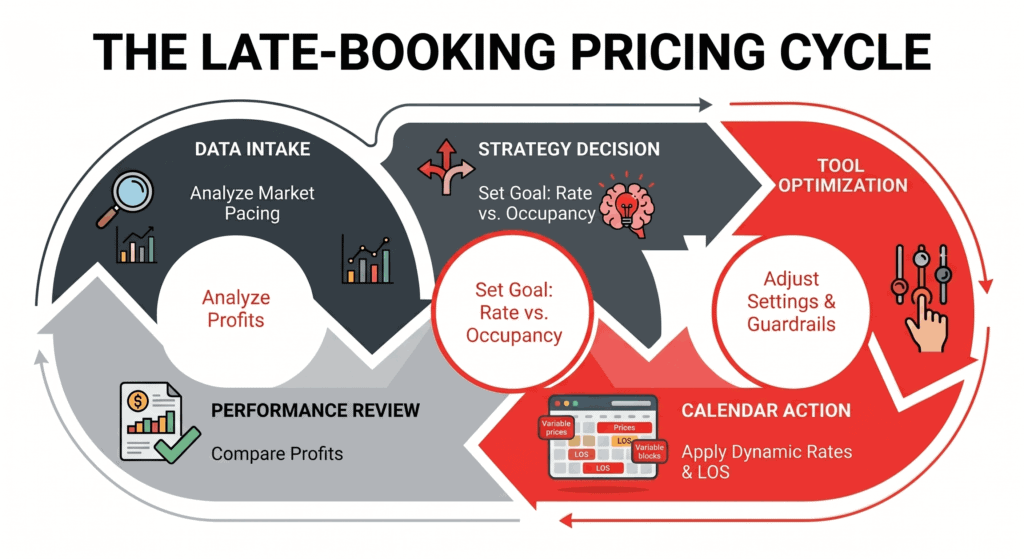
The secret isn’t the pricing tool — it’s the settings. Most property managers in the room were already using dynamic pricing. The question is: when did you last review your guardrails? Base prices, minimum stays, last-minute discount triggers. If you set those a year ago, they’re probably kicking in too early for a market that now books later.
You can’t balance demand and rates if you don’t know what’s happening in your specific market. National averages are misleading. Sally’s data showed London tracking +24% year-on-year while Kent was -6%. The tool that tells you whether to hold or adjust isn’t a headline — it’s pacing (how full are you compared to last year at this point) and pickup (how many new bookings came in this week). Check both weekly.
And investigate whether a domestic mini-boom is reaching your properties. There’s noise in the press about staycations — Sykes and Cottages.com reported strong Easter numbers, and fuel costs, EU border friction, and inflation all give UK travellers reasons to stay domestic. But it’s not uniform. Did you see it at Easter? Is May tracking that way? Make it someone’s job to check this weekly, by region and by property type. Don’t assume the headlines apply to your portfolio.
2. How do property managers hold their nerve in a late-booking market?
This was my main theme on the panel, shared with Maria. The host framed it as: booking windows are shrinking, rates appear to contract — how do you encourage rate discipline?
The calendar is supposed to look emptier right now. Sally’s data showed Q2 pacing -5% and Q3 -2%, but 23% of bookings now arrive within 7 days of check-in. Rohit’s AirDNA data showed UK summer pacing up 15-16% in demand. The biggest mistake you can make right now is discounting in April for demand that’s coming in June.
The booking window is polarising, not just shrinking. Planners still book far out and pay premium rates. A growing spontaneous segment books inside two weeks. The dangerous zone is 15 to 29 days before arrival — that’s where operators panic-discount, sometimes dropping below even their last-minute rates. Sally showed hot tub properties where prices hit their lowest point in this exact window, then bounced back when late bookers arrived and needed a place.
Rate discipline only works if your listing earns it. Rohit’s data showed a clear K-shape in the market: quality properties hold rates, while weaker listings lose occupancy four times faster. Rate discipline without listing quality is just stubbornness.
Should property managers engage in promotions?
Some properties will need them — but most operators are reaching for promotions too early.
Before you panic, read your calendar right. Two things are happening simultaneously: bookings are arriving later and stays are getting shorter. Both make your calendar look worse than it is. Three 2-night bookings leave holes that a single week-long booking didn’t. Check your pacing against last year — if you’re tracking within a few points, you don’t have a demand problem. You have a different-shaped calendar.
For the gaps that shorter stays create, reach for your minimum stay rules before your rate. Most dynamic pricing tools have minimum stay settings that can flex seasonally: allow 2-night bookings in April when you need the fill, hold 3 nights in July when demand is strong. As arrival approaches, let those rules relax automatically. That fills the fragmented calendar without touching your nightly rate.
OTAs are the late-booking channel — Sally’s data showed direct bookings dropping to around 25% of volume inside two weeks, with Airbnb and Booking.com carrying the rest. So yes, you need to be visible there. But visibility and discounting are different things. Richie Khandelwal’s data showed 70% of listings have weak photos and 40% have incomplete descriptions. Fix that first — it’s free visibility that compounds.
And don’t panic-discount in the middle window. If your last-minute rates end up higher than your 3-week-out rates, you’ve been giving away margin at exactly the wrong time.
When a promotion does make sense, it should be a targeted decision about a specific underperforming property — not a blanket portfolio discount. And on Booking.com, always check what’s stacking. Genius plus a mobile deal plus an early booker promo can quietly add up to 30% off before you’ve noticed.
How should property managers price for shorter lengths of stay?
This is where costs and pricing collide, and a lot of operators are getting squeezed without realising it.
Short stays are 22% of bookings but only 13% of revenue. Every one costs a turnover. And everything costs more this year — cleaning, energy, laundry, supplies. If your costs went up and your pricing didn’t move, you’re losing money on short stays.
Most property managers already charge differently for short stays through a cleaning fee or weekly discounts. The question is whether those numbers still reflect today’s costs.
Here’s how to check. Pull up a property you know well. What does it actually cost to turn? Not just the cleaner — laundry, supplies, energy, your team’s time. If that number is £100 and your cleaning fee is £80, you’re paying £20 out of pocket on every turnover. Multiply that by your short stays last month.
Now look at your nightly rate for a 2-night stay versus a 7-night. A £100 turnover on a 7-night at £150/night is £14 per night for the turn. On a 2-night at the same rate, it’s £50 per night. You need that 2-night rate closer to £185-200 to hold a similar margin. Most pricing tools let you set length-of-stay adjustments — including PriceLabs, depending on your PMS.
If your PMS supports variable cleaning fees by stay length, set it up. A 1-night guest doesn’t leave the place like a 10-day family. Rental Scale-Up’s analysis of dynamic cleaning fees showed that moving from flat to variable cleaning fees nearly doubled margins on the same properties.
But don’t adjust in a vacuum. Check what your comp set is doing. If similar properties haven’t raised prices and you jump, you won’t just be more expensive — on Airbnb you’ll drop in search results and fewer guests even see your listing. Look at the market before you move. At PriceLabs, the Compare Competitor Calendar shows not just competitors’ nightly rates but their cleaning fees too, so you can see the full picture.
Related Read: You’re Probably Comparing Your Performance to the Wrong Market
3. How do property managers stand out on the OTAs?
Use OTAs tactically, especially in a late market. Direct bookings dominate the far-out booking window at 60%+ — but inside two weeks, direct drops to around 25% and OTAs carry the volume. In a market that books later, your OTA presence matters more than it did a year ago.
Stop the obvious mistakes before spending on promotions. 70% of listings have weak photos. 40% have incomplete descriptions. Start with your 10 worst-performing listings. That’s free visibility that compounds every day it’s live.
Then decide which specific properties need paid visibility. Not every listing needs a promo — and if you’re on Booking.com, check what discounts are stacking before you add another one.
4. Closing: one piece of advice
Pull up your June and July occupancy right now. How full are you compared to this point last year?
If you’re tracking similar but lagging a bit — hold. That’s a late-booking market working as expected. If the gap is widening week on week — act. And it will be different across your portfolio. Your coastal cottages might be fine while your city apartments need attention.
The point is: know it now, not in July. Make it someone’s job to check weekly and report back whether the domestic mini-boom everyone’s reading about in the press is actually reaching your properties — by region, by property type.
The big takeaway
The UK holiday let market in summer 2026 is full of contradictions. Demand indicators point one way, booking pace points another. Headlines say “staycation boom” while some regions are quietly down year-on-year.
The biggest risk isn’t a weak summer. It’s property managers making pricing decisions in April based on what the calendar looks like today — in a market where the calendar fills later than it used to.
The operators who do well this summer won’t be the ones with the fullest calendars right now. They’ll be the ones who understood that a late-booking market isn’t a problem to solve — it’s the market they’re in. And priced accordingly.

Thibault Masson is a leading expert in vacation rental revenue management and dynamic pricing strategies. As Head of Product Marketing at PriceLabs and founder of Rental Scale-Up, Thibault empowers hosts and property managers with actionable insights and data-driven solutions. With over a decade managing luxury rentals in Bali and St. Barths, he is a sought-after industry speaker and prolific content creator, making complex topics simple for global audiences.