HomeToGo’s CEO has spent six years trying to get Google’s vacation rentals box, the block of listings with prices that Google showed at the top of its search results, off the page in Europe, and this week he finally got what he asked for. What he may not have expected is that the first person to push back under his celebratory post would be a host, which is to say one of the businesses he argues will benefit from all this in the end.
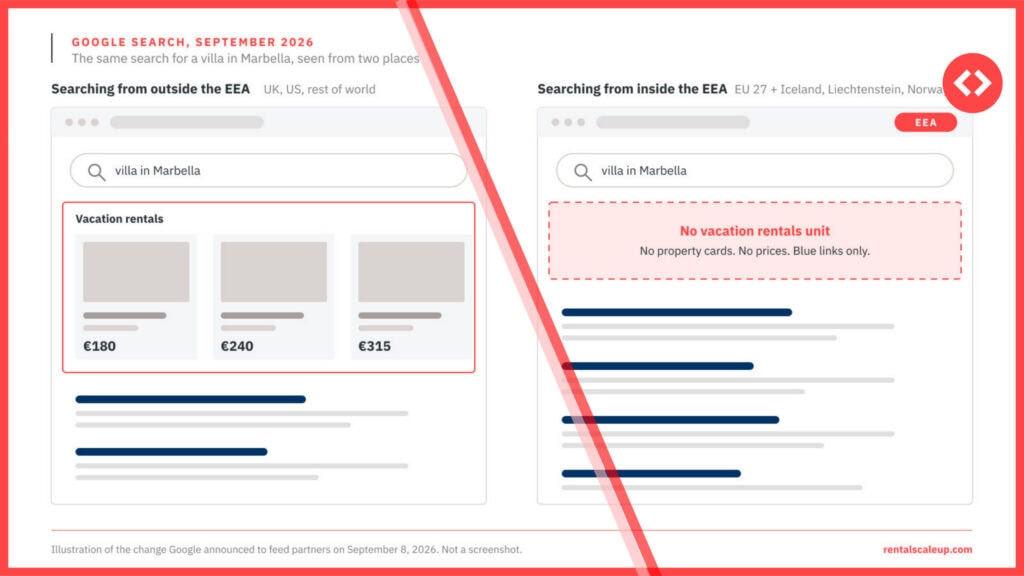
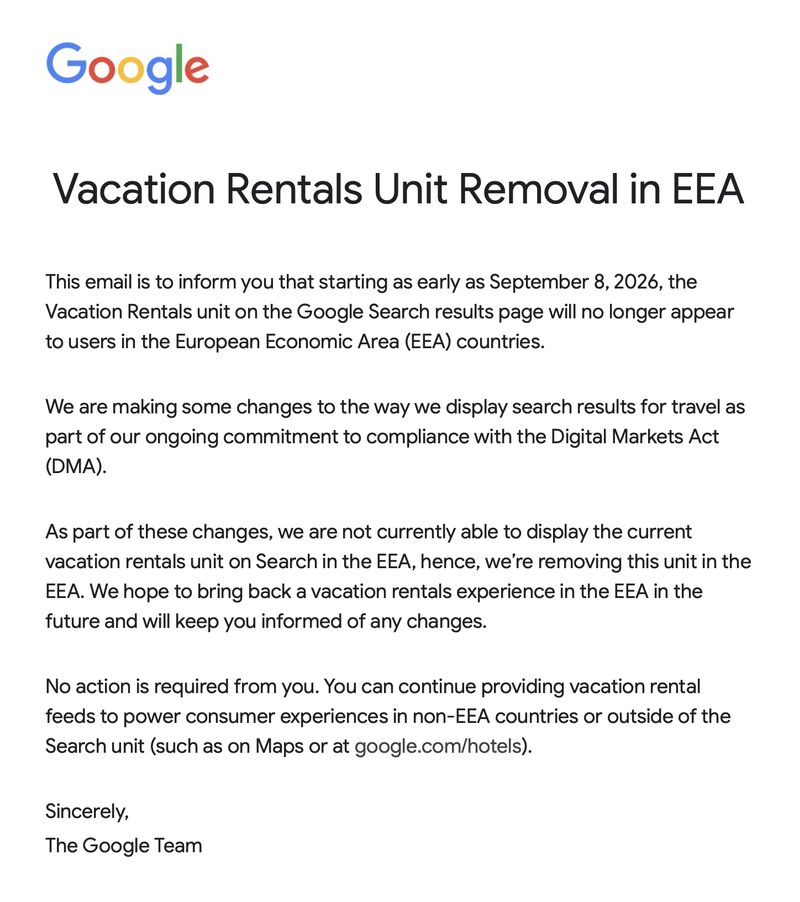
On September 8, 2026, Google emailed its vacation rental feed partners to say that the Vacation Rentals unit on Google Search “will no longer appear to users in the European Economic Area (EEA) countries,” starting “as early as September 8.” The EEA is the 27 EU countries plus Iceland, Liechtenstein and Norway; the UK and Switzerland are not in it. No action is required, the email says, and feeds can still power Maps, google.com/hotels and searchers everywhere else, the UK and the US included. Within hours, HomeToGo co-founder and CEO Patrick Andrae posted the email on LinkedIn with the caption “After all the years a silver lining for fair competition.” In the comments, a German host asked what, exactly, hosts like him had won.
Key takeaways:
- The removal is Google’s response to the €890 million Digital Markets Act (DMA) fine of July 23, 2026, of which €460 million was for self-preferencing, that is, giving its own services a better spot in Search than rivals get. Google had 60 days to comply.
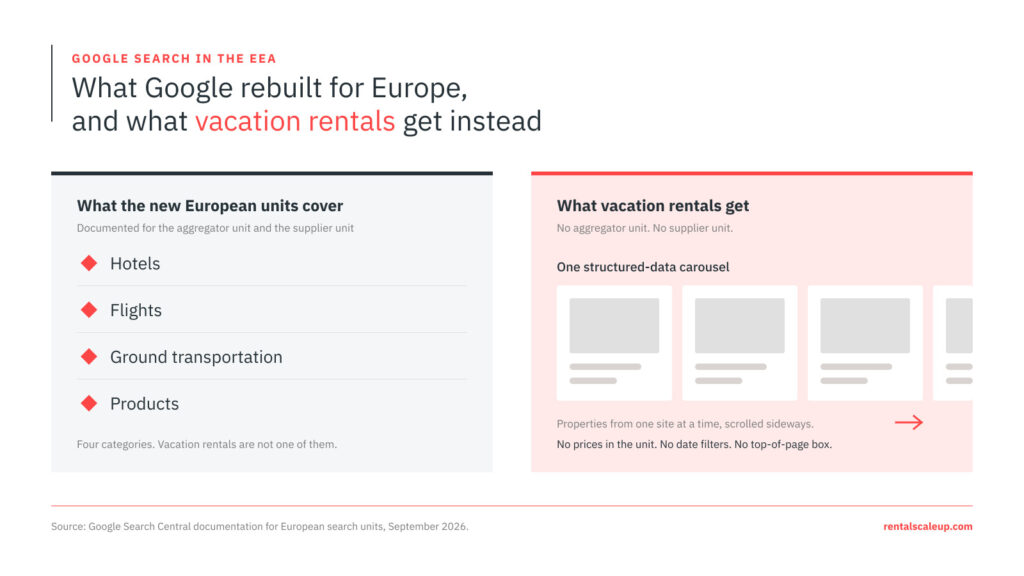
- Google’s replacement formats for Europe are documented for hotels, flights, ground transportation and products. Vacation rentals are not on that list.
- When Google tested a “blue links only” format for hotels in three EU countries in late 2024, it reported that traffic to hotels fell more than 10% while traffic to comparison sites “largely stayed flat.”
- HomeToGo, which filed an antitrust complaint against Google in 2020, now makes about 66% of its revenue from B2B, not from its marketplace.
- What decides whether you lose the channel is where your guest searches from, not where your property is. A British or American guest still sees the box; a French or German one does not.
In this article, we’ll see what Google actually changed, why HomeToGo’s CEO is so pleased, what the comment thread under his post tells us, and which managers are exposed.

What Google removed, and why
Google has been a “gatekeeper” under the DMA, the label the law gives the biggest platforms, since July 2023. Since then it has been arguing with the Commission, and with a coalition of comparison sites that includes HomeToGo, about its travel units: the boxes at the top of the results page that show hotels, flights or vacation rentals with prices and filters.
The comparison sites’ complaint is that Google’s own box always sits above theirs. On July 23, the Commission agreed. In its decision, it found that Google displays its own shopping, hotel and transport results “more prominently in search results, including at the top”, with visuals and filters that competitors are denied, and gave Google 60 days to fix it, which put the deadline around September 21. Google shipped on September 8, two weeks early.
Rather than open the units to rivals, Google chose to strip them down or remove them. Its own documentation for European searchers now describes two new formats: an “aggregator unit” for approved comparison services and a “supplier unit” for the businesses themselves, both covering “hotels, flights, ground transportation, and products.”
Vacation rentals appear only in the structured-data carousels, a scrollable strip that shows properties from one site at a time. In plain terms, Google rebuilt a compliant hotel box, stripped of prices and date filters (Hospitality Today sums up what a European hotel gets now: “A name. A link to your website. The address and phone number.”), and did not rebuild a vacation rentals box at all.
Google has not explained why one category was worth the engineering and the other was not. What we can observe, without claiming to know the reasoning, is that hotel search sits next to Hotel Ads, a business Google earns from, and vacation rentals did not earn Google anything.
Here’s what Google itself says about it. Nick Fox, its SVP of knowledge and information, told PhocusWire the changes “degrade the user experience for Europeans, boosting online intermediaries at the expense of local businesses.” To Reuters, Google called them “the largest reduction in quality of service” in its 29-year history and repeated its claim that earlier DMA changes cut free direct-booking traffic to European businesses by 30%, a figure it attributes to those businesses and has not documented.
So, Google is telling everyone, loudly, that Brussels made it do this. Tech analyst Philipp Klöckner has a shorter word for it in the LinkedIn thread: #MaliciousCompliance. His charge, not ours: that Google is following the letter of the rule in a way that hurts the people the rule was meant to help.
Why HomeToGo’s CEO is happy
To understand the celebration, you need the back story. In February 2020, we reported that Google had started pushing its vacation rentals meta-search (its own comparison box) above the organic results, and that 34 travel companies, HomeToGo among them, had complained to the EU. In August 2020, HomeToGo filed its own antitrust complaint. Andrae’s words at the time: Google “can just snap its fingers and say, basically, tomorrow I want to have a product.” Six years later, the unit he complained about is gone, so “after all the years” is not a figure of speech.
Vindication, six years in the making
The first reason is the one his caption points to: vindication. A Berlin company with a quarter of a billion euros of annual revenue complained about Google, kept complaining while Google shipped upgrade after upgrade, and has now watched Google withdraw the product from an entire continent, which is something that almost never happens to anyone who takes on Google. European travel companies have been losing to Google’s search position for two decades, and most of them decided long ago that fighting was pointless. Andrae’s LinkedIn title reads “Made in 🇪🇺,” and the post ends with a flexing-arm emoji. We have not asked him, but it reads to us as a European founder marking the rare day when Brussels worked in his favour against an American platform, and he is entitled to enjoy it.
It is not about Google ads
The second reason is the one people get wrong. You might assume HomeToGo is celebrating because it buys a lot of Google ads and a competitor for the top of the page just disappeared. That reading is, in our view, wrong, and the reason matters for our readers.
HomeToGo is no longer mainly a marketplace living on paid search traffic. In H1 2026, its B2B arm, HomeToGo_PRO (software and services sold to property managers, plus the rental businesses it owns, Interhome and Kraushaar), brought in €105.2 million, about 66% of group revenue, and now covers its operating costs. The marketplace, the consumer site you know, is the smaller business: €58.8 million, down 10.2% year on year, still losing money. Its pay-per-click advertising revenue fell 26%. And HomeToGo is deliberately spending less to buy customers: marketing and sales costs went from 85% of revenue in H1 2025 to 54% in H1 2026. All disclosed figures.
So, why does a company that is cutting its ad budget care so much about Google’s free box? Because it is cutting its ad budget. Our interpretation, and it is only that: a marketplace that has decided not to fight Booking and Airbnb on ad spend is betting on its organic ranking, and Google’s box sat right on top of that ranking, doing the comparison job for free.
HomeToGo is a channel too
The third reason matters most for property managers. HomeToGo is a real distribution channel in Europe, especially in the German-speaking markets. Its onsite booking model lets a manager take the booking on HomeToGo under its own company name, cancellation policy and terms, and receive the guest’s details, which is why we called it a “direct-like” booking on someone else’s platform. The onsite take rate (the share of the booking value HomeToGo keeps) was 13.5% in Q3 2025. For some European managers, HomeToGo can be the third channel after Airbnb and Booking.
Why hosts liked Google Vacation Rentals in the first place
Because it was free. Google’s free booking links carried no commission or referral fee; the “Book” button sent the traveler to the manager’s own landing page, where payment and confirmation happened. The only cost was the connectivity partner (the software company that sends your listings to Google) or the PMS that pushed the feed. We made the case ourselves in Part 2, updated as recently as July 2026: no bidding for traffic, your brand in the results, and “the customer data is yours.” Full disclosure, then: we have been telling you to list there for five years. That guide now needs a rewrite for European readers.
And Google courted this industry, in Europe especially. In April 2021, when the product was young, we reported that some property managers were already getting more than 10% of their bookings from it.
In May 2023, Google Travel’s David Robles came to the VITUR Summit in Málaga to walk managers through the three ways their rentals could show up on Google, Search, Maps and Google Travel. In November 2023 he was at VRWS in Barcelona presenting vacation rentals side by side with hotels in Google’s hotel search, with a price comparison across online travel agencies and direct sites, under the line “Google is where your future guests go to discover, research, and plan their travel.” Connectivity partners built integrations, PMS vendors added it to their feature lists, and a lot of European managers did the work to get listed. Three years later, those same managers are the ones losing the box.
Was it a big channel? Probably not for most, and nobody publishes reliable share-of-bookings numbers for it. But it may well have been the only zero-commission channel with Google-scale reach, and that is exactly why it was appreciated.
The comment thread is where the real debate happens
Andrae’s post drew a handful of replies, and two of them, together with his answers, carry the whole debate.
Will the giants benefit most?
One commenter, Nikolaus Haufler, asks the question everyone should ask: “Will the giants benefit most?” Andrae’s answer: “No, I believe everyone will benefit, as everyone’s visibility is affected by this.”
So, who’s right? Well, the only data we have points to the giants. When Google ran its hotel test in Germany, Belgium and Estonia, it reported that hotels lost more than 10% of their traffic, that traffic to intermediary sites (booking and comparison sites) “largely stayed flat”, and that users were less satisfied and more often gave up. Google is an interested party, of course, but nobody has published numbers that contradict it.
Booking and Airbnb have deeper SEO and far bigger budgets than HomeToGo, and HomeToGo has far more of both than any independent manager, so the reclaimed clicks would likely follow that order. To be fair to Andrae, that test covered hotels, not vacation rentals, and nobody has published data on what happens when the vacation rentals box goes. “Everyone benefits” may turn out to be right, but so far nothing in the public record supports it.
The host’s objection, and the CEO’s answer
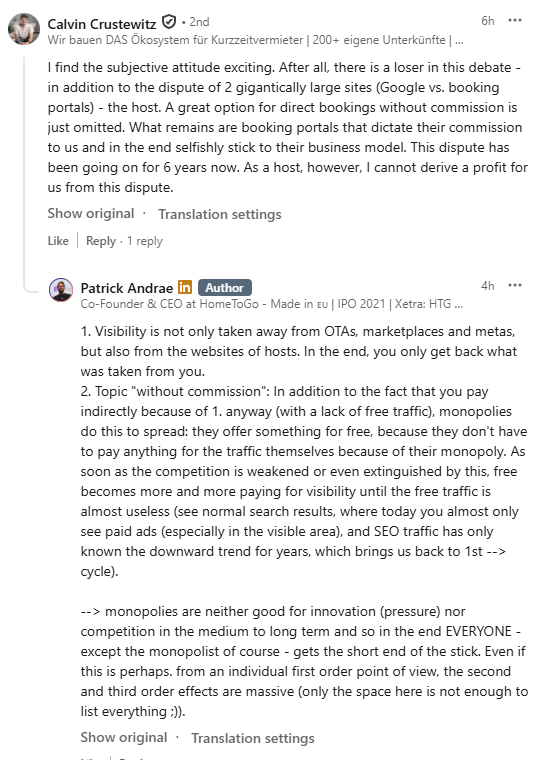
Calvin Crustewitz, a German operator who says he runs some 200 units of his own and a training academy for hosts, makes the host’s side of the argument, and it is the strongest comment in the thread. A great option for direct bookings without commission is gone, he writes; what remains are portals that dictate their commission. The dispute has run six years, and, in LinkedIn’s translation of his German, “as a host, however, I cannot derive a profit for us from this dispute.”
Andrae’s reply is the most interesting exchange of the whole thread, so here it is in substance. First, Google’s unit was not only taking visibility from online travel agencies and comparison sites but also from hosts’ own websites, so “in the end, you only get back what was taken from you.” Second, “free” is what monopolies offer while they weaken the competition; once the alternatives are gone, free turns into paying for visibility, as happened with normal search results where the visible area is now mostly ads.
That argument is coherent, and it is more or less the argument the Commission accepted. Credit where it is due: Andrae answered a critical host publicly and at length, which is more than most CEOs do, and his own rental brands, Interhome and Kraushaar, sell through their own websites too, so they lost the same Google box as everyone else.
Still, HomeToGo and a host do not weigh this trade the same way. HomeToGo’s marketplace charges 13.5% on onsite bookings and, per its own accounts, is still losing money; it cannot give traffic away the way Google could.
A European manager this week lost a channel that charged 0% and kept one that charges 13.5%. That does not make Andrae’s argument wrong. It does mean that, in effect, he is asking Calvin to accept a certain loss today against a longer-term harm that is harder to see. That may well be the right trade for the industry as a whole, but it is not an obvious one for Calvin, and I can see why he is not cheering. So, there you go.
Who actually loses the channel
Google’s notice says the unit no longer appears to users in the EEA, so the EU plus Norway, Iceland and Liechtenstein, but not the UK or Switzerland. The trigger is where the traveler searches from, not where the property is. A traveler in Chicago, London or Tokyo looking for a villa in Marbella or a flat in Florence still sees the box. A traveler in Madrid or Paris looking for the same villa does not, once the rollout reaches their market. So a manager whose demand is mostly North American or British should keep most of the channel, while a manager who lives on domestic and intra-European travel stands to lose their share of it. Your reservations report, filtered by guest country and by source, is what turns this headline into a number for your own business.
Google’s timing language, “as early as September 8,” describes a rollout rather than a switch, so do not be surprised if the box is still visible in some countries for a while. And a returned box, which Google says it hopes to bring back one day, would have to pass the same equal-treatment test that removed this one, and neither Google nor the Commission has said what such a box would need to look like.
What it means for property managers
The fact: with Google’s free booking links gone from Search, every remaining vacation rental distribution channel of any scale in the EU now takes a commission or a click fee. Our interpretation: Andrae won a case he was right to bring, and the Commission’s own findings say so. The outcome looks good for HomeToGo’s marketplace and for the organic ranking of its own rental brands, and it is unlikely to be good for the independent European manager in the short run, whatever it does for competition in the long run.
The timing makes it sharper, because it is the fourth change to how European travelers find a rental in as many months. Booking Holdings launched BKNG Ads on May 21, one advertising system across Booking, Priceline and Agoda. Vrbo took Sponsored Listings global on September 1, a pay-per-booked-night fee to sit at the top of results (our explainer).
And Airbnb’s “Direct Booking Links” pilot, which we covered on August 31, cuts the host fee to 6% or 10% for bookings through your own tracked link, with the caveat that “the guest stays Airbnb’s guest. The data stays Airbnb’s data.” A week later, Google removed the one Google-scale channel where the guest actually landed on your site. So, since May, Booking and Vrbo have both launched new ways to pay for the top of their own search results, Airbnb has put a price on the word “direct”, and Google has taken away the one place where a listing could reach the top of a results page without paying anyone.
| Channel | What you pay | Who owns the guest |
|---|---|---|
| Google Vacation Rentals free booking links | 0% (now gone from Search in the EEA) | You |
| Your own website via Google Hotel Ads / Performance Max | Ad spend, per click or per booking | You |
| Airbnb Direct Booking Links (pilot) | 6% or 10% host fee | Airbnb |
| Airbnb standard | 15.5% host-only fee | Airbnb |
| Booking | around 15%, plus BKNG Ads if you bid | Booking |
| Vrbo | around 8% commission, plus Sponsored Listings per booked night if you bid | Vrbo |
| HomeToGo onsite booking | 13.5% take rate (Q3 2025) | Shared: you get guest details, booking happens on HomeToGo |
Fees are disclosed figures or our earlier reporting; they vary by market and contract, so check your own.
Read that table once and one thing stands out: the only line with a zero in it has just been removed for Europeans, and the two “direct” alternatives that remain either cost you ad money or keep the guest on someone else’s platform.
Here is what I’d do about it:
- Segment your bookings by guest origin this week. Pull last year’s Google-referred bookings and split them by the guest’s country. Guests searching from outside the EEA (Americans, Britons, Swiss) are untouched; guests searching from inside the EEA are what you stand to lose. That number, not the headline, tells you how much this matters to you.
- Keep your feed running. It still powers Maps, google.com/hotels and every searcher outside the EU, Britons included, and Google’s email explicitly asks you to keep sending it.
- Know where the visibility went. The paid side of Google’s hotel unit in Europe is untouched; hotels have until September 30 to feed rates for Hotel Ads and Performance Max, Google’s paid hotel listings and automated ad campaigns. Whether or not that is Google’s intention, paid placement is now the only way back to the top of a European results page for a direct site. Decide now whether that is a channel you want.
- Watch your OTA mix over the next quarter. If Google’s test data holds, the reclaimed clicks would land mostly on Booking and Airbnb, not on your own site. Check your direct share month by month rather than trusting anyone’s “everyone benefits”.
- Reassess HomeToGo on its merits, not on the celebration. Its onsite model hands you the guest’s details, which Airbnb’s “direct” links do not, and it may just have become relatively more important because a free competitor disappeared. That is a reason to look at the numbers, one way or the other.
Now, as usual, what matters is what your own bookings say. If direct bookings from Google referrals were 2% of your business, you have lost 2%. If they were 10%, you may have a problem, and the people telling you the DMA is good news are unlikely to be the ones who will fix it.

Guneet has spent five years working at PriceLabs, developing deep expertise in short-term rental operations and hospitality technology. She brings that practitioner’s lens to her writing at RSU, covering platform updates and making sense of market data for property managers.