
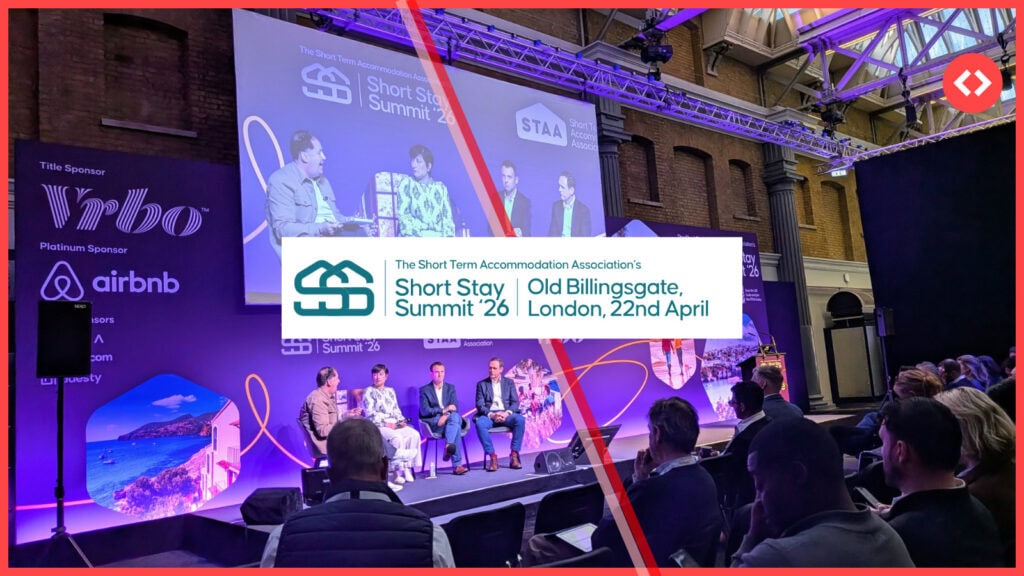
But three pieces of information got through worth a property manager’s attention: a new Foundations Score from Booking that flags per-property revenue leaks; Vrbo’s AI Q&A answered 1.3 million traveler questions in a few weeks; and Airbnb saw January 18 as a huge summer-booking day.
This is the second of two write-ups from Short Stay Summit 2026. The first covered the earlier AI session with Casago/Vacasa’s Steve Schwab and Sykes Cottages’ Graham Donoghue, hosted by Guesty’s Kate Cox.
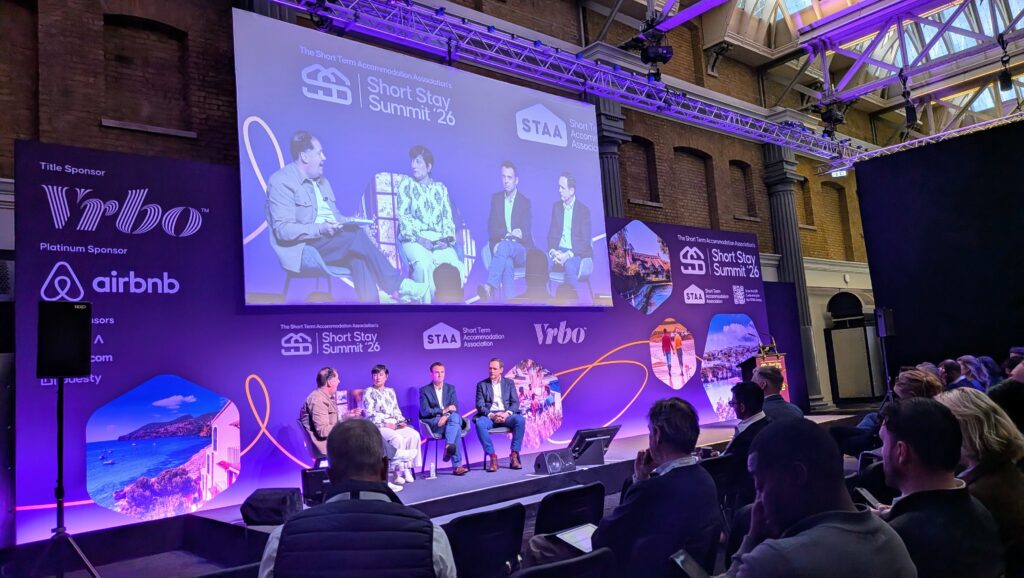
Booking.com: A Foundations Score That Points to the Specific Listing Fixes You Are Missing
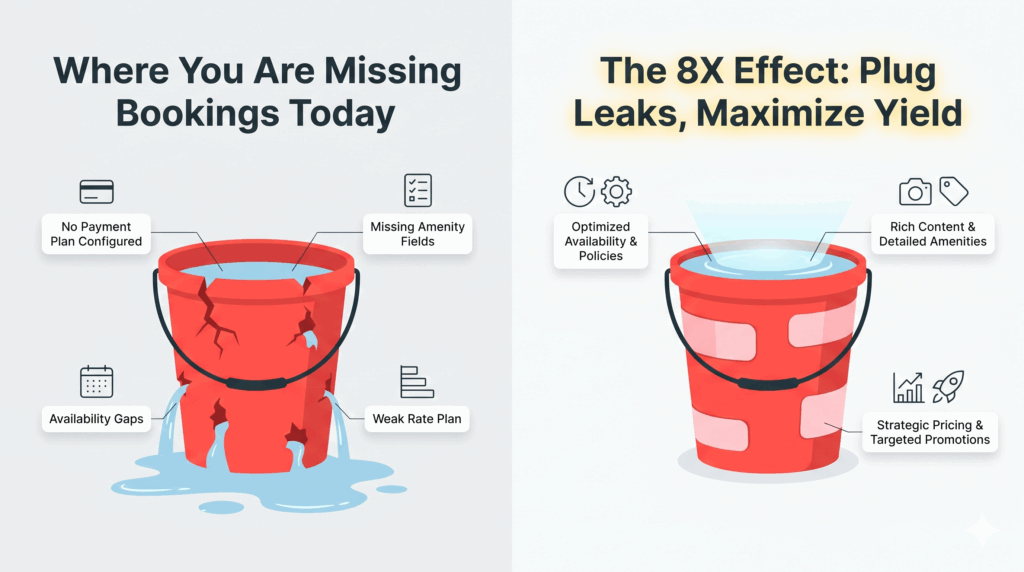
Matina walked through Booking’s Foundations framework — the five fundamentals every listing needs in place (Availability, Policies & Payments, Content, Pricing, Promotion).
Her line:

“When you look at each and every one of them, they may look small. When you put them together, the effect is an eight times lower productivity.”
A partial cancellation policy, a few missing amenity fields, a payment method not configured, a rate plan never promoted — each looks harmless. That is exactly why operators never get around to fixing them. The score’s job is to assign a per-property revenue cost to the combination, so the work becomes ranked and obvious rather than vague.
For a smaller PM without a dedicated revenue team, that is a diagnostic worth taking seriously when your PMS or channel manager exposes it.
Vrbo: A Useful AI Chatbot on the Listing Page — 1.3 Million Answers in Weeks
Vrbo’s property Q&A answered 1.3 million traveler questions in its first few weeks. The system reads the listing, amenities, reviews, and property data, and answers the traveler in-page. The host is never pinged.
The industry conversation about AI on a booking site has been about the full-stack booking agent — a chatbot that handles availability, pricing, and checkout. That project is expensive, risky, and the kind of thing that strands at 80% (see Lesson 4 in my write-up of the earlier AI session). Vrbo deliberately built the narrow version: a Q&A chatbot that removes pre-booking friction, then hands the traveler off to a normal booking flow. No agentic checkout. No payment-step liability.
That narrow version can be within reach of a smaller PM on their own direct-booking site. Point an LLM at your listing content, amenities, house rules, and reviews. Expose it as a chat widget. Let it answer questions, build confidence, and hand the traveler back to your existing booking engine when they are ready. It is the cheapest AI experiment you can run this year and the one most likely to show up in your direct-booking conversion rate.
Airbnb: January 18 Was a Huge Summer Booking Day — Which Means You Are Running Two Peaks, Not One
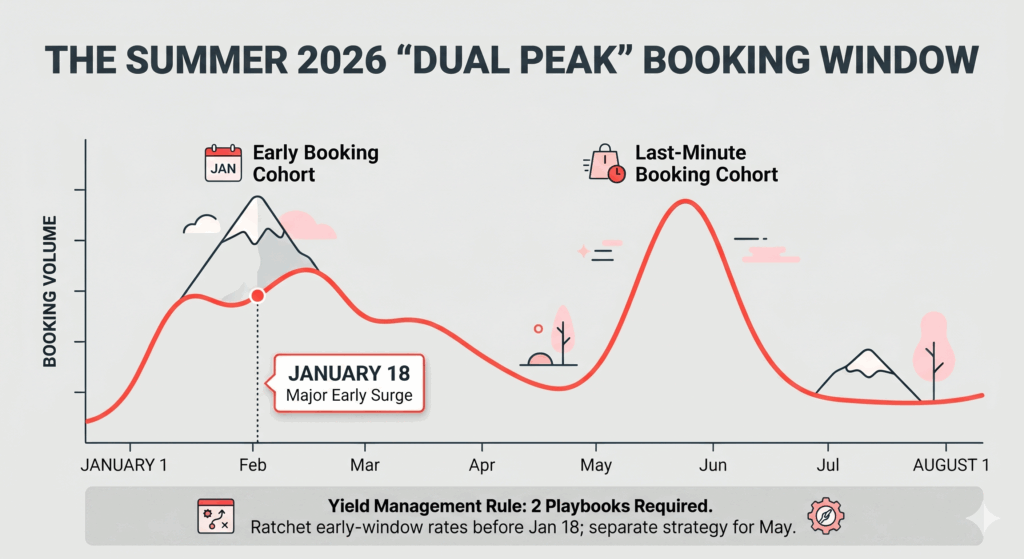
Jordi contributed the panel’s most specific forward-looking data point: for summer 2026, Airbnb saw January 18 as a very big booking date. He framed lead times as one of the most underused benchmarks in the PM toolkit, and he is right about that.
We already knew in this industry that you had to be ready in January for summer bookings. That is not new.
What January 18 actually tells you is that the market now has a real early-booking cohort and a real late-booking cohort — not one or the other. Your 2026 pricing plan needs two playbooks: an early-window strategy that is already ratcheting rates before January 18, and a last-minute strategy for the travelers who will still be booking in May. Treating summer as a single peak is how you lose yield to whoever is treating it as two.

Thibault Masson is a leading expert in vacation rental revenue management and dynamic pricing strategies. As Head of Product Marketing at PriceLabs and founder of Rental Scale-Up, Thibault empowers hosts and property managers with actionable insights and data-driven solutions. With over a decade managing luxury rentals in Bali and St. Barths, he is a sought-after industry speaker and prolific content creator, making complex topics simple for global audiences.