

Short-term rental policies developments this week: New Orleans, Bali, and New York City each carry consequences for operators. The landscape shows a distinct global shift in regulatory tactics: from federal courts upholding strict block-level density caps in Louisiana, to sustained restrictions on foreign investment in Indonesia, to new non-primary residence surcharges in major US markets.
Federal court upholds New Orleans short-term rental ordinance
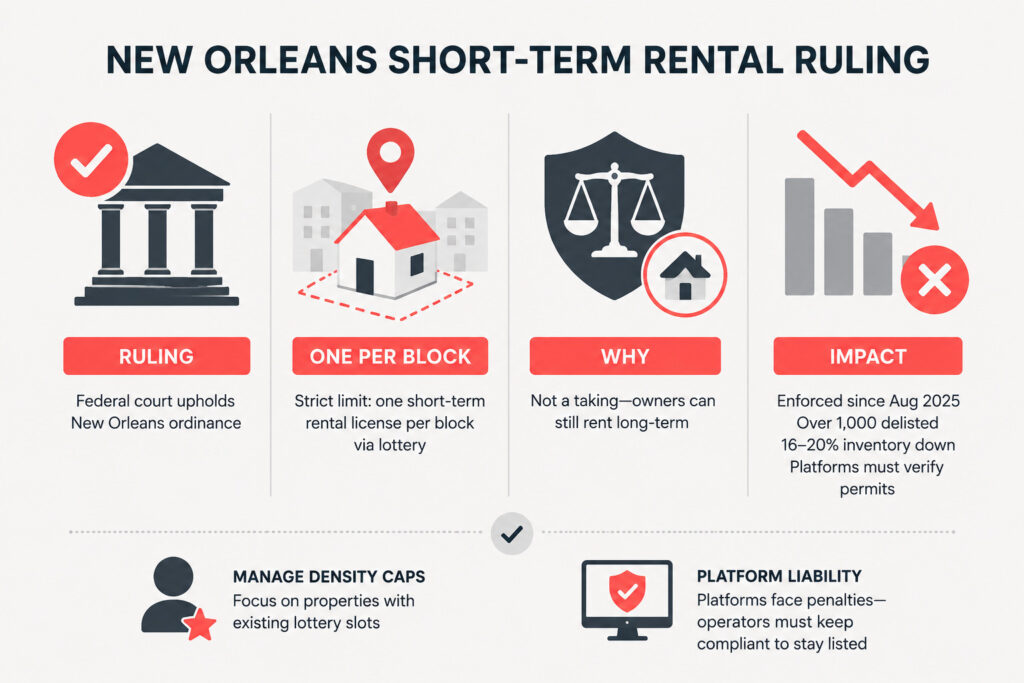
- On August 5, 2026, the US Fifth Circuit Court of Appeals upheld New Orleans’ short-term rental ordinances, affirming the dismissal of Airbnb’s lawsuit against the city’s restrictions.
- The ruling preserves the city’s strict density limit, which restricts short-term rental licenses to just one per city block, awarded through a lottery system.
- The “why”: The court rejected the argument that the one-rental-per-block rule amounted to an unconstitutional taking of private property. The panel found that because owners retain the ability to lease their properties for long-term use, the regulation does not violate the Fifth Amendment.
- The timeline: Enforcement of these rules has been underway since August 2025. Since that deadline, Airbnb has delisted more than 1,000 New Orleans properties, and citywide short-term rental inventory across all platforms is down an estimated 16 to 20 percent. Booking platforms remain legally required to verify a listing’s city permit before processing any transactions.
Uvika’s views
- Managing density caps: The New Orleans ruling sets a strong legal precedent for other major US cities looking to implement strict density quotas.
- When cities limit inventory on a per-block basis, localized supply becomes artificially constrained.
- What professional managers can do is prioritize acquiring long-term management contracts for properties that have already secured these grandfathered lottery slots.
- Platform liability as the standard: As we saw with the enforcement of Local Law 18 in New York City, shifting verification liability to the platforms is highly effective at enforcing local rules.
- Because platforms face direct financial penalties for listing unverified properties, they will automatically delist non-compliant units.
- Professional operators must maintain impeccable digital compliance records to avoid automated removal from major booking channels.
Bali’s block on new foreign investment licenses holds firm
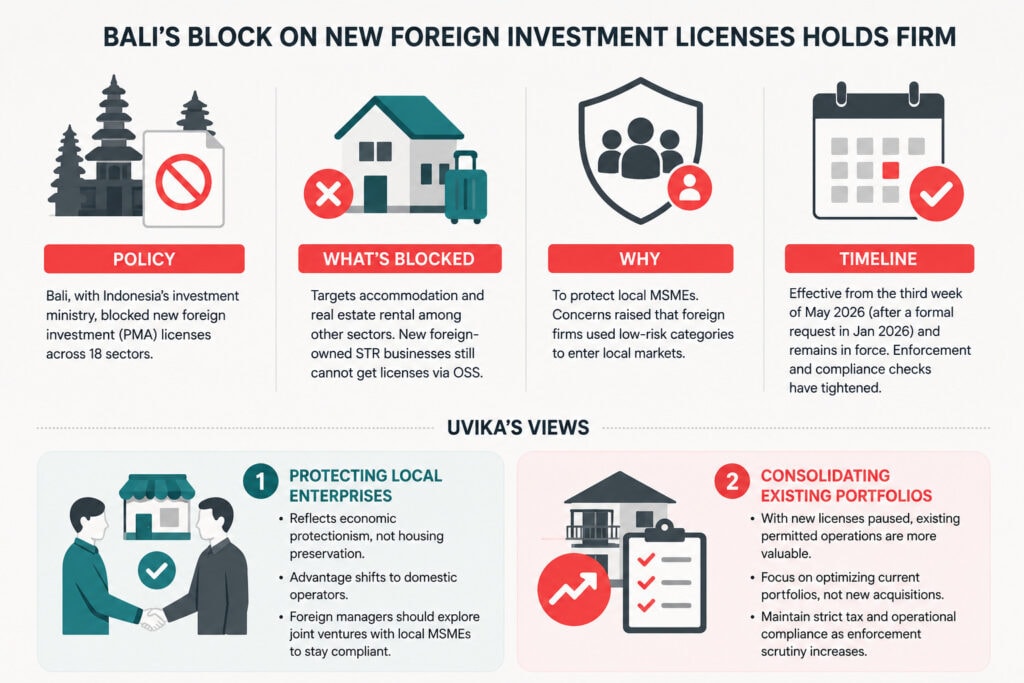
- The Provincial Government of Bali, in coordination with Indonesia’s investment ministry, restricted new foreign direct investment (PMA) licenses across 18 business sectors, and the block remains active.
- The policy targets accommodation and real estate rental activities among other sectors, meaning new foreign-owned short-term rental businesses still cannot obtain licenses via the Online Single Submission (OSS) system for these lower-risk classifications.
- The “why”: The government enacted this policy to protect local micro, small, and medium enterprises (MSMEs), after Bali’s governor raised concerns that foreign-owned companies were using low-risk business categories to enter sectors traditionally occupied by local operators.
- The timeline: The restriction took effect from the third week of May 2026, following a formal request from Bali’s governor to Indonesia’s Minister of Investment in late January 2026. It remains in force today, and enforcement has since tightened, with authorities applying substance-based compliance checks to existing operators as well.
Uvika’s views
- Protecting local enterprises: Bali’s approach reflects economic protectionism rather than housing preservation, and it has held steady for months now rather than easing.
- This shifts the competitive advantage directly to domestic operators.
- What professional foreign managers can do is explore joint venture structures with local MSMEs to remain compliant with investment laws.
- Consolidating existing portfolios: With new foreign licenses still paused, existing permitted operations become more valuable.
- Operators who already hold valid PMA licenses can focus on optimizing their current portfolios rather than expanding through new acquisitions.
- Ensuring ongoing compliance with local tax and operational requirements is essential to maintaining these licenses, especially as enforcement scrutiny increases.
New York City prepares August rollout for non-primary residence surcharge
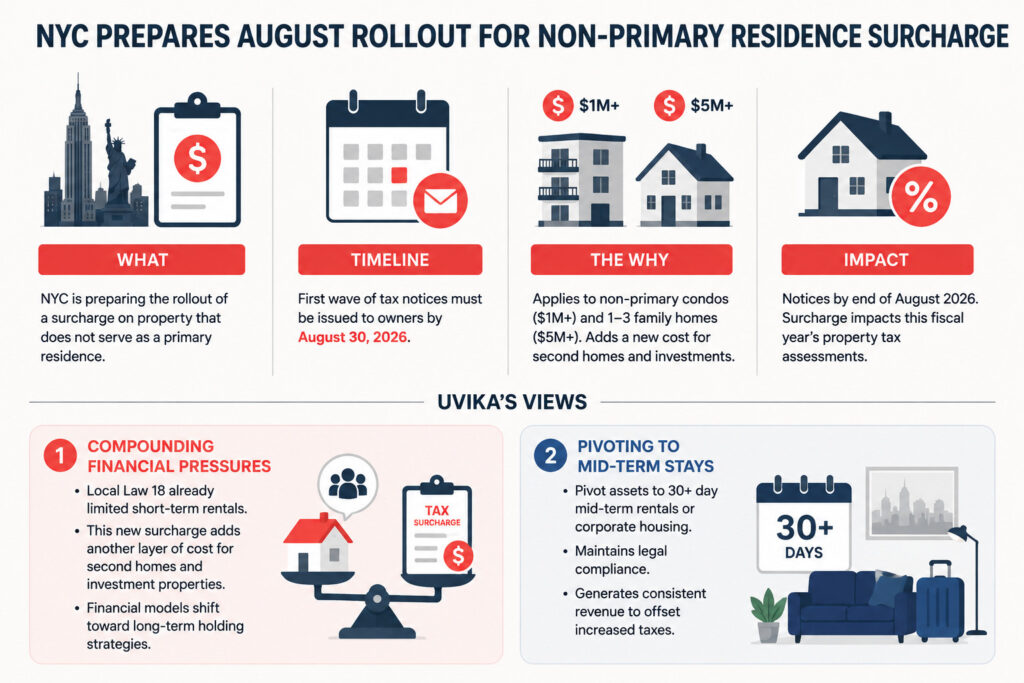
- New York City is preparing the rollout of a “City Surcharge on Property That Does Not Serve as a Primary Residence,” a provision enacted in the recent New York State Budget Bill.
- By law, the first wave of tax notices for this fiscal year must be issued to owners by August 30, 2026.
- The “why”: The surcharge applies to non-primary condominium and cooperative units valued at $1 million or more, and to non-primary one-, two-, and three-family homes valued at $5 million or more. It introduces a new financial consideration for real estate investors who maintain second homes or investment properties in the city, across both the condo and single-family segments.
- The timeline: Notices are scheduled to be sent by the end of August 2026, with the surcharge impacting the current fiscal year’s property tax assessments.
Uvika’s views
- Compounding financial pressures: We previously covered how Local Law 18 reshaped the New York City market by limiting short-term rentals to two guests and requiring host presence.
- For investors who relied on short-term rentals to offset the costs of a second home, whether a condo or a single-family property, this new surcharge adds another layer of operational cost.
- The financial model for non-primary properties in the city continues to shift toward long-term holding strategies.
- Pivoting to mid-term stays: To navigate the combination of Local Law 18 and the new property surcharge, operators must adjust their leasing models.
- What professional property managers can do is pivot these assets exclusively to 30+ day mid-term rentals or corporate housing.
- This approach maintains legal compliance while generating consistent revenue to offset the increased tax obligations.
Stay on top of short-term rental regulation trends and what they mean for your operating environment.

Uvika Wahi is the Editor at RSU by PriceLabs, where she leads news coverage and analysis for professional short-term rental managers. She writes on Airbnb, Booking.com, Vrbo, regulations, and industry trends, helping managers make informed business decisions. Uvika also presents at global industry events such as SCALE, VITUR, and Direct Booking Success Summit.
Related Articles:
 Marseille Imposes 90-Day Cap, Airbnb To Collect Taxes in Italy, Vermont Bill Targets Short-Term Rentals
 Guesty Powers Casago, UK Advocacy Strengthens, Comparent Debuts Software Marketplace
 Maui Inches Toward Rental Ban, Bali Targets Unlicensed Villas, and PriceLabs gets Recognition
 Spain Penalizes Airbnb Over Non-Compliance, Milan To Ban Key Boxes from 2026, Forge Tests AI Assistant