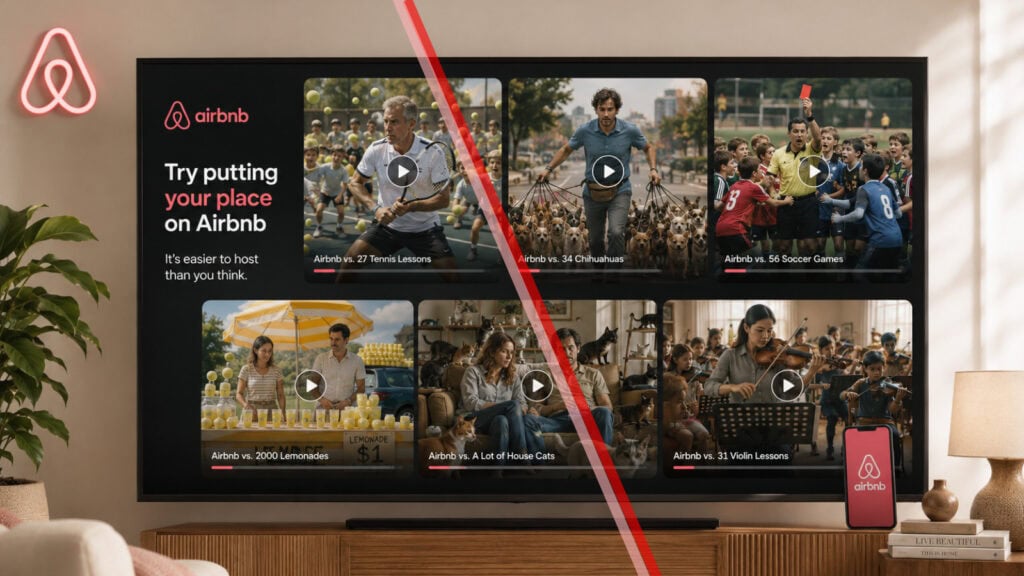
In Airbnb’s latest ads, released July 2026, a tennis instructor is being pelted with balls by 27 pupils at once. A dog walker is drowning in Chihuahua leads. A referee, surrounded by furious preteens, gives up and runs. In each case a narrator offers the same way out: or you could try putting your place on Airbnb.
It is a well-made joke, and it is not where the information is. The information is in the disclaimer, in type small enough that nobody is meant to read it, which specifies that the earnings estimate applies to hosts with two bedroom entire home listings. This piece takes each advert in turn, then sets the small print against what Airbnb has been telling its own investors about the homes it is trying to acquire.
Five New Airbnb Ads Compare Hosting to Gig Work
Five videos are live on Airbnb’s YouTube channel, each running about 16 seconds, shot horizontally, which suggests broadcast or paid video rather than anything native to social feeds. All are live action rather than the animation style of recent campaigns. All five close on the same card: try putting your place on Airbnb.
The structure never changes. A narrator names a dollar figure, names a quantity of work, and then offers the alternative. To make around $2,000 in a week, this woman could give 27 tennis lessons. Or she could try putting her place on Airbnb.

The spots have been directed by Pablo Rochat with production by Iconoclast. Rochat works in an absurdist register, which is the right hire for a campaign whose whole job is making the alternative look ridiculous.
Every YouTube description carries the same boilerplate about people listing their homes and offering unique stays and one of a kind activities that let guests experience the world in a more authentic, connected way. Each also links to Airbnb’s host sign-up page.
Each Ad Turns a Sequence of Work Into a Single Pile-Up
The numbers are not meant literally. Nobody referees 56 consecutive games. Instead, each ad compresses the whole quantity into one absurd frame: one court, one street, one field, one lawn, one living room.
The effect is less arithmetic than nightmare. That is the point.
“Airbnb Vs. 27 Tennis Lessons”
An older man performs warm-up stretches, racket in hand. The camera pulls back to reveal a court packed with pupils doing the same, every one of them firing balls at a lone instructor on the far side, who is attempting to serve through the barrage.
“Airbnb Vs. 34 Chihuahuas”
A man in a blue shirt, cargo trousers and a fanny pack walks an implausible number of Chihuahuas along a street, leads hopelessly tangled, perspiring. Passers-by stop to coo and take photographs. He is not enjoying himself. The narration says he could walk 34 Chihuahuas every day.
“Airbnb Vs. 56 Soccer Games”
A referee blows his whistle, alone on the turf. The reveal is a pitch swarming with preteens. He produces a red card, is immediately mobbed by the aggrieved, and flees.
“Airbnb Vs. 2000 Lemonades”
A couple work a lemonade stand beneath a yellow striped umbrella, hand-lettered signs advertising lemonade at $1. Cups cover the table, the ground four rows deep, and the entire roof of a blue sedan. As the man stacks another, several topple. The narration supplies a resigned “whoops.”
“Airbnb Vs. A Lot of House Cats”
A couple sits on a grey couch exchanging harried looks while the camera pushes past them and finds cats everywhere: on the stairs, the bookshelves, the kitchen counter, the aquarium, a glass table shot from underneath.
This one names no number and no dollar figure. It says the couple could make extra money this weekend by cat sitting for a whole lot of cats.
“Airbnb Vs. 31 Violin Lessons”
A sixth ad in the same series does not appear on Airbnb’s YouTube channel. It surfaced on the website of Jo Ryan, a stylist and costume designer based in Spain. A woman plays violin in front of a music stand, surrounded by children also playing, badly, with a range of expressions from engaged to entirely checked out.
The existence of a sixth spot off-channel suggests the set is larger than what Airbnb published, likely with variants running elsewhere.
The Small Print Names the Properties Airbnb Is After
Five of the six films carry an identical line at the edge of the frame: estimated earnings for active hosts with two bedroom entire home listings, earnings varying with availability, pricing, demand and local laws, and excluding taxes and hosting costs.
Consider what that sentence rules out. Not a spare room. Not a shared home. Not the flat you vacate for a fortnight each August. A whole two bedroom property, actively let.
Airbnb has named its target in the one part of the advert designed to be ignored.
The Cat Ad Drops the Disclaimer Because It Drops the Number
The house cats spot is the only one without a dollar figure, and it is also the only one that swaps the long disclaimer for a plain “earnings may vary,” same size, bottom of screen.
That is a small thing that proves a bigger one. The two-bedroom language is not boilerplate legal text Airbnb attaches to everything. It is tied specifically to the $2,000 claim. Where there is no claim, there is no listing-type disclosure.
Airbnb’s Own Figures Point the Same Way
The disclaimer is not plucked from the air. In its second quarter shareholder letter, Airbnb reported that entire homes, and particularly listings with four or more bedrooms, continued to grow fastest. In North America, entire homes and short stays kept outpacing both long stays and private rooms, a mix shift the company says has now run for over a year. (Q2 2026 results, p12)
The letter also discloses a measure Airbnb rarely leads with. Nights and Seats Booked rose 10 per cent year on year; Bedroom Nights Booked, which is nights multiplied by bedroom count, rose more than 12 per cent. Over the preceding twelve months guests booked upwards of a billion bedroom nights, a record.
There is a gap worth noting. Airbnb’s fastest growth is in homes of four bedrooms or more, while the adverts quote earnings on two. Two bedrooms is simply a likelier thing for the sort of person watching to already own.
Airbnb Has Already Explained How It Picks the Homes It Wants
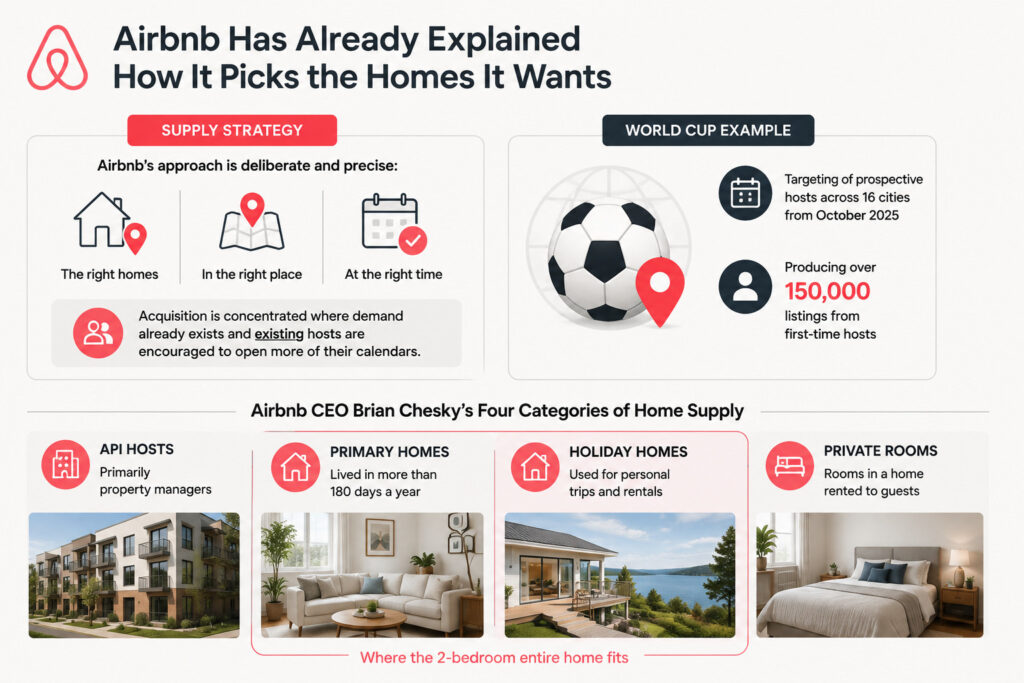
The same letter contains a passage on supply that reads uncannily like the brief for this campaign. Airbnb calls its supply strategy deliberate and precise, says it is seeking “the right homes, in the right place, at the right time,” and confirms that acquisition is concentrated where demand already exists. It adds that it is pressing existing hosts to open up more of their calendars. (Q2 2026 results, p12)
The World Cup is offered as the worked example: targeting of prospective hosts across 16 cities from October 2025, producing over 150,000 listings from first-time hosts.
Brian Chesky, Airbnb’s co-founder and chief executive, went further on the first quarter call, dividing home supply into four categories for analysts. There are API hosts, whom he described as primarily property managers; primary homes, lived in more than 180 days a year; holiday homes; and private rooms. The two bedroom entire home of the disclaimer sits squarely in the middle pair.
Advertising Is Only Needed Where the Listing Is Not Already a Business
Which raises the obvious question of why Airbnb’s ad spend is going towards this segment of folks, instead of professional managers that list thousands of properties without being asked twice.
The answer is that they do not need persuading, and Airbnb treats them accordingly. Professional supply is managed through fee structures and tooling. It arrives because listing is somebody’s job.
Individual supply arrives only if somebody decides to bother, and Chesky has said as much. Listing a property, he told the first quarter call, is very difficult for an ordinary person and no trouble at all for a business, because a business employs someone to do it. Airbnb is attacking that friction with AI listing tools. These adverts attack the other half of the problem, which is motivation. Hence the money, the mockery of gig work, and the absence of anything resembling a product demonstration.
He has also given a commercial reason for preferring the amateur. On the same call he noted that the more properties a host manages on Airbnb, the lower the rating, and put it plainly: “our customers have higher satisfaction with individual hosts over property managers.” That inventory, he added, is more unique and exclusive to Airbnb.
$2,000 a Week Is a Good Week, Not a Typical One
Annualised, the figure comes to roughly $104,000, which is a great deal more than most hosts see. Airbnb’s own historic reporting put the median American host nearer $14,000 a year.
This does not make the claim untrue. A two bedroom whole home in a strong market during a good week will produce it, which is exactly what the disclaimer’s references to availability, demand and local laws are there to accommodate. Advertising has always occupied the flattering end of a real range, and this is an unremarkable example of the practice. The point is not that the number is generous. The point is that it comes attached to a property type.
Nobody in These Adverts Owns a Visible Home
Across six films, the following do not appear:
- The home itself. No rooms, no furnishings, no exterior. The only interior in the set belongs to the cat film, and it is overrun.
- Any Airbnb product. No AirCover, no Setup, no pricing tools, no earnings dashboard, despite all of them shipping in the second quarter.
- Any guest. Nobody stays anywhere.
- Any neighbourhood, community or local business.
- Any country. The sum is in dollars and nothing else localises the films.
What remains is labour, and the proposition that labour is undignified. The instructor is pelted. The dog walker sweats while strangers photograph his charges. The referee is routed by children. Airbnb is not competing with hotels in these films. It is competing with the side hustle, and the argument is that an hour of your time is worth less than a square foot of your house.
Airbnb Is Spending Well Ahead of Its Revenue Growth
The money behind this is visible in the filings. Sales and marketing came to $875 million in Q2 2026 against $691 million a year earlier, an increase of about 27 percent while revenue grew 17 percent. Across the first half, the figure was $1.63 billion against $1.25 billion. (Q2 2026 shareholder letter, p23)
Airbnb never reports host count growth or net listings added. Its Q2 letter gives nights, GBV, ADR and bedroom nights, plus over 5.5 million hosts as a lifetime figure, and Airbnb’s newsroom fast facts page listed more than 9 million active listings worldwide as of May 2026. The only supply numbers Airbnb volunteers are event-linked.
That absence is why a campaign like this is worth reading closely. The ads disclose a target that the financial reporting does not.
In the Same Window, a Different Pitch in Canada
Airbnb also released four ads this month fronted by Canadian hosts in Picton, Dunham, Kelowna and Halifax, escorting viewers around local businesses under the line “with Airbnb, you book the neighborhood.” Those films mention no price, no earnings and no product whatsoever.
This is not inconsistency so much as division of labour, and Chesky has described the logic without prompting. Asked on the second quarter call about the company’s ambitions, he observed that policy is a risk, though not an existential one, and a risk Airbnb expects to manage indefinitely.
Managing it looks like this. Where short-term lets are politically contested, Airbnb advertises the neighbour. Where they are not, it advertises the yield.
What It Amounts To
The joke in these ads is about tennis balls and Chihuahuas. The information is in the disclaimer.
Airbnb has publicly named the listing it wants more of, in the same quarter its own data showed entire homes and multi-bedroom homes growing faster than the platform overall, and while it raised marketing spend well ahead of revenue. It is recruiting whole units, in dollars, from people who currently earn money by selling their time.
For anyone tracking where competition for supply is heading, that is the signal. Not what the ads say out loud, but the category the fine print quotes.

Uvika Wahi is the Editor at RSU by PriceLabs, where she leads news coverage and analysis for professional short-term rental managers. She writes on Airbnb, Booking.com, Vrbo, regulations, and industry trends, helping managers make informed business decisions. Uvika also presents at global industry events such as SCALE, VITUR, and Direct Booking Success Summit.
Related Articles:
 Airbnb Is Still Bashing Hotels in Its Ads, While Adding Them to Its Platform
 Airbnb’s Winter Olympics 2026 Strategy: Gen Z, Global Events, and the Long Game Beyond Bookings
 Airbnb, Booking.com, and Vrbo Are Changing How Listing Visibility Works, and It’s Going to Cost You
 What Airbnb’s New Ads Reveal About Its Next Move in Canada