
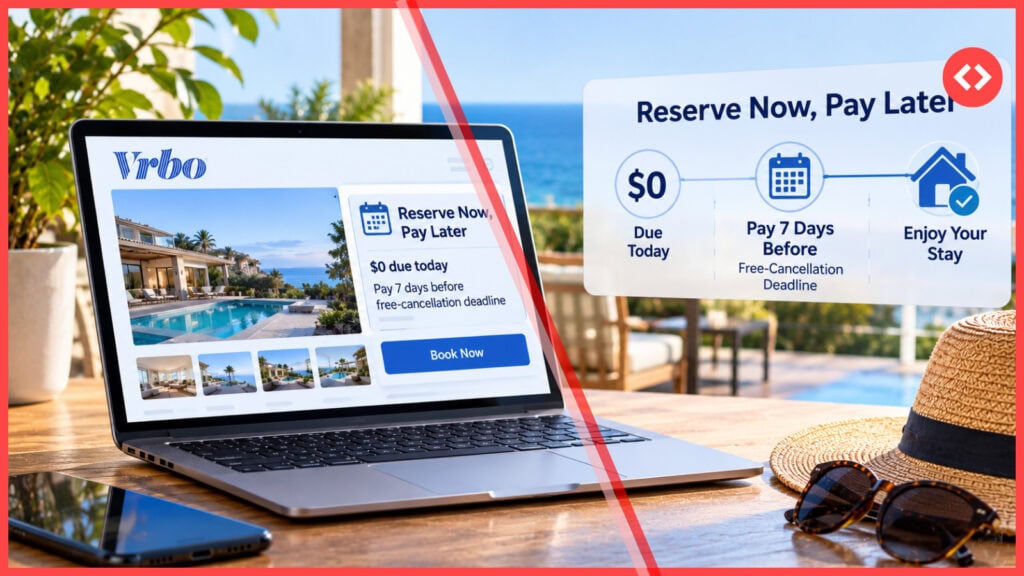
On Vrbo, guests can now book a home with nothing due at checkout, as they already can on Airbnb, and on Booking.com when hosts allow it.
- What changed: Vrbo launched Reserve Now, Pay Later in the US. Eligible guests pay $0 at booking and are only charged seven days before the free-cancellation deadline.
- Who it impacts: US hosts and managers on Vrbo whose listings offer a full refund up to 60 days before check-in. Hosts cannot opt out, except by switching a listing to No Refund.
- What to watch: Whether the conversion lift Airbnb saw carries over to Vrbo, and how many $0 bookings cancel for non-payment. On Airbnb, cancellations rose by about one point.
Vrbo has added a payment option built to win more bookings: letting guests reserve with $0 down. On Airbnb, bookings made this way already account for about 20% of global gross booking value, the total value of all bookings.
Vrbo’s version comes with a difference hosts will notice. Instead of charging guests close to arrival, it ties the charge to each listing’s own free-cancellation deadline, which can sit as far as 60 days out. On most policies, that means hosts know a booking is paid earlier than they would on Airbnb.
Below, we break down how the option works, how it compares with Airbnb and Booking.com, how it differs from the Affirm payment plans Vrbo already offers, and what it changes for your calendar.
How Does Vrbo’s Reserve Now, Pay Later Work?
Expedia Group, Vrbo’s parent company, announced the option on October 28 in its fall 2026 product release, and Vrbo shared the full details on November 2. It is available on Vrbo.com and the Vrbo app.

What the guest sees
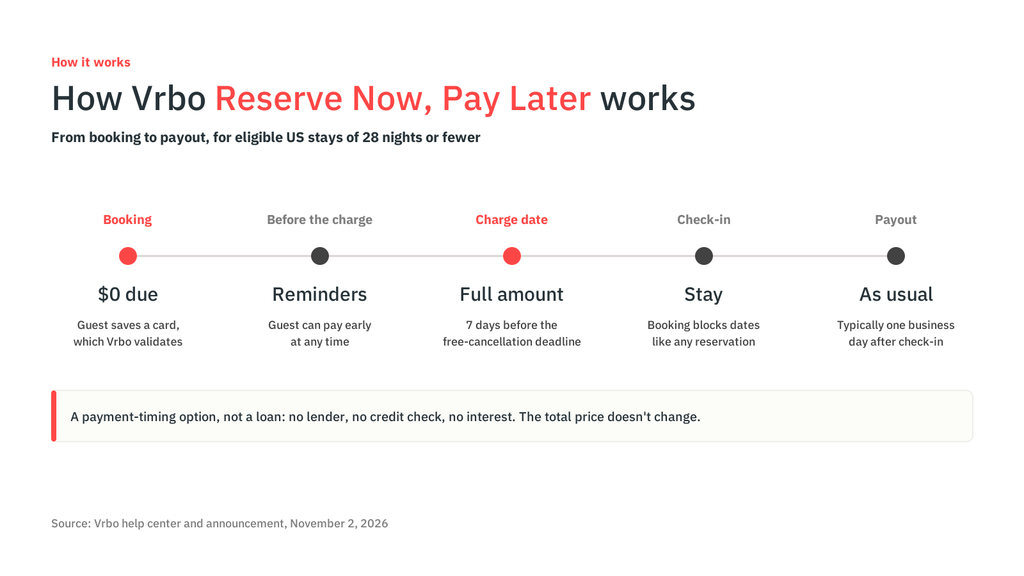
Guests find eligible homes with a “Pay $0 today” filter or at checkout. The steps are simple:
- At booking: the guest pays nothing but must save a credit or debit card, which Vrbo validates.
- Before the charge: Vrbo sends reminders, and the guest can pay early.
- On the charge date: the full amount is charged automatically, seven days before the property’s free-cancellation deadline.
The total price does not change. Vrbo is clear that this is a payment-timing option, not a loan: there is no lender, no credit check and no interest.
When a payment fails
If the card is declined, Vrbo retries for two days, then gives the guest up to four more days to update their details. If the money still has not arrived 12 hours before the free-cancellation deadline, Vrbo cancels the reservation and the dates reopen.
Who can use it
The option is US-only, for stays of 28 nights or fewer, on listings whose cancellation policy offers a full refund up to 60 days before check-in. According to Vrbo’s help center, that covers the Day Before, Lenient, Relaxed, Moderate, Strict and Firm policies. Only No Refund listings are excluded.
That wide eligibility is where Vrbo’s version starts to look different from Airbnb’s.
Vrbo vs. Airbnb vs. Booking.com: Who Charges Guests When?
Vrbo collects earlier than Airbnb on most policies, while Booking.com leaves the timing to each property. Here is how the three compare.
| Vrbo | Airbnb | Booking.com | |
|---|---|---|---|
| Option | Reserve Now, Pay Later | Reserve Now, Pay Later | No branded equivalent |
| Due at booking | $0 | $0 | $0 on rates labeled “No prepayment needed”; set by the property’s prepayment policy |
| When the guest pays | 7 days before the free-cancellation deadline | On a scheduled date before check-in | Set by the property’s policy |
| Eligible policies | Any with a full refund up to 60 days out | Flexible and Moderate | Not applicable |
| Can hosts opt out? | Only by switching to No Refund | No; Airbnb decides eligibility | Hosts set prepayment themselves |
| Markets | US | Global since February 2026 | Global |
Airbnb charges closer to arrival
Airbnb launched its version for US guests on US listings in August 2025 and took it global in February 2026. It only applies to Flexible and Moderate policies, whose free-cancellation deadlines fall 24 hours and five days before check-in. Payment is due shortly before that deadline, so the charge lands days, not weeks, before arrival.
Airbnb also requires check-in to be at least 14 days away and the total to be at least $50, according to its help center.
On Vrbo, your policy sets the date
On Vrbo, a listing with a full refund up to 60 days out gets paid roughly 67 days before arrival. A listing on the Day Before policy gets paid about eight days before arrival.
So the same feature can mean money in hand two months out, or barely a week out, depending on the policy you chose.
Booking.com has no branded version
Booking.com has no feature by this name. Instead, each property decides: hosts can add prepayment to their policies in the Extranet, Booking.com’s partner dashboard. With Payments by Booking.com, guests are charged according to those policies and must pay in full before they arrive.
Guests see the result on each rate. The same room can carry a non-refundable “Pay online” rate next to a free-cancellation rate labeled “No prepayment needed, pay at the property.”
So on Booking.com, a $0-at-booking reservation is the host’s choice, made rate by rate, not the platform’s.
Is Reserve Now, Pay Later the Same as Vrbo’s Affirm Option?
No. If you remember Vrbo expanding buy now, pay later with Affirm earlier this year, the two are easy to mix up. One lets guests spread the cost; the other lets them delay it.
| Buy now, pay later (Affirm) | Reserve now, pay later | |
|---|---|---|
| What it is | A loan from Affirm, a consumer lending company | A delay in when the guest’s card is charged |
| How the guest pays | In installments over 3 to 24 months, sometimes with interest | In full, later, with no interest or credit check |
| Who pays Vrbo upfront | Affirm | Nobody until the charge date |
| If the guest doesn’t pay | Affirm absorbs it; your payout is unaffected | The booking is canceled and the dates reopen |
| Markets | US and Canada, typically on stays of $250 or more | US |
For hosts, the key line is the fourth one. With Affirm, the money for the booking is secured from day one. With Reserve Now, Pay Later, it is not secured until the charge date.
What Changes for Vrbo Hosts: No Opt-Out, but Payouts Stay the Same
Vrbo says hosts don’t need to do anything, and payouts don’t change. Its help center adds a few details worth knowing.
What stays the same
- Payouts: still on the normal schedule, typically one business day after check-in.
- Your cancellation terms: the policy in place when the guest booked still applies.
- Your calendar: these bookings block dates like any confirmed reservation. In Reservation Manager, they show the payment status and the charge date.
What changes
- You can’t opt out. The only way to keep a listing out is to switch it to No Refund, which applies to every new booking on that listing, not just this option.
- Your own payment schedule is set aside. If you split payments (for example, 50% at booking and the rest later), that schedule no longer applies to these bookings, because Vrbo handles the charge.
- Unpaid cancellations don’t count against you. When Vrbo cancels a booking for non-payment, it doesn’t affect your performance metrics.
That last point matters because Vrbo’s Premier Host standards now expect zero host-initiated cancellations. A guest’s failed card won’t put that status at risk.
Will Reserve Now, Pay Later Increase Cancellations on Vrbo?
Possibly, by a little. Airbnb’s experience points to a small rise in cancellations, alongside guests booking further ahead and choosing bigger homes.
What Airbnb’s numbers suggest
Airbnb’s experience is the best guide so far. Its overall cancellation rate rose from about 16% to 17% in Q4 2025, as we reported in our Airbnb Q4 2025 analysis, with the rate higher among guests who used the option.
A quarter later, Airbnb said the net impact on bookings was positive across all regions, and that Reserve Now, Pay Later bookings made up about 20% of global gross booking value, as we covered in our Q1 2026 earnings call takeaways.
Airbnb also saw two effects managers may welcome:
- Longer booking windows: guests booked further ahead.
- Bigger homes: demand shifted toward homes with four or more bedrooms, which lifted average nightly rates.
It is possible Vrbo will see similar patterns, given its focus on larger family homes, but it has not shared any early data.
Your free-cancellation deadline decides how much time you get to rebook
If a guest never pays, Vrbo cancels the booking up to 12 hours before your free-cancellation deadline. So the date your dates reopen depends on your policy:
- A 60-day policy: the dates come back about two months before arrival, with plenty of time to resell them.
- A Day Before policy: the dates can come back roughly a day before arrival, when rebooking is much harder.
The tighter your free-cancellation window, the later you find out whether a $0 booking will be paid.
Your Cancellation Policy Is Now Your Main Lever on Vrbo
Since you can’t switch the option off, your cancellation policy now sets three things at once: how attractive your listing looks, when guests pay, and how late an unpaid booking can fall through.
Questions worth asking per listing
- Which listings book furthest ahead? For homes that book months out, such as large family homes in peak season, a longer free-cancellation window means payment arrives early and failed bookings reopen with time to resell.
- Where does a tight policy cost you? Flexible policies help conversion, but on a Day Before policy, an unpaid booking can reopen your dates about a day before arrival.
- Is No Refund worth it anywhere? It keeps a listing out of the option entirely, but it applies to all new bookings and is likely to reduce conversion. It may make sense only for a handful of high-demand dates or properties.
What to watch on your calendar
It would make sense to track $0 bookings separately in your reports for the first few months, along with how many cancel for non-payment and how close to arrival. That data will show whether your current policies fit, listing by listing.
If cancellations rise, it may also be worth checking how your pricing reacts to dates that reopen late. Last-minute availability usually needs a different price than the one set months ago.
Why Payment Timing Is Becoming a Host Decision
With this launch, guests can book vacation rentals with nothing down on all three big platforms. The difference is who decides: on Airbnb and Vrbo, the platform sets which listings qualify, while on Booking.com, hosts decide through their prepayment policy. Expedia Group CEO Ariane Gorin said on the company’s Q3 2026 earnings call that the option is now live across all its brands.
A few lessons carry over beyond Vrbo:
- The platforms are competing on how easy it is to book. $0 checkout is likely to become an expected feature, not a perk.
- Your cancellation policy is now a payments decision. On Vrbo, it sets when you get paid. On Airbnb, it decides whether the option applies at all.
- A booking isn’t secured until it’s paid. Treating $0 bookings as a separate category in your reports is the simplest way to see their real effect.
Vrbo’s design also gives hosts a practical advantage: on most policies, guests are charged further from arrival than on Airbnb, so there is more time to rebook if a payment fails.
FAQs
What is Vrbo Reserve Now, Pay Later?
It is a US payment option that lets guests book eligible Vrbo homes with $0 due at booking. The full amount is charged automatically seven days before the property’s free-cancellation deadline.
Can Vrbo hosts opt out of Reserve Now, Pay Later?
Not directly. The only way to keep a listing out is to switch it to the No Refund cancellation policy, which applies to all new bookings on that listing.
When do Vrbo hosts get paid for a Reserve Now, Pay Later booking?
On the usual schedule, typically one business day after check-in. The option changes when the guest pays Vrbo, not when Vrbo pays the host.
What happens if the guest’s payment fails?
Vrbo retries the card, then gives the guest a few days to update it. If the booking is still unpaid 12 hours before the free-cancellation deadline, Vrbo cancels it, the dates reopen, and the cancellation does not count against the host’s metrics.
Is Vrbo Reserve Now, Pay Later the same as Airbnb’s?
The idea is the same, but the timing differs. Airbnb’s version only covers Flexible and Moderate policies, so guests pay days before arrival. Vrbo’s covers policies with deadlines up to 60 days out, so guests often pay weeks before arrival.

Uvika Wahi is the Editor at RSU by PriceLabs, where she leads news coverage and analysis for professional short-term rental managers. She writes on Airbnb, Booking.com, Vrbo, regulations, and industry trends, helping managers make informed business decisions. Uvika also presents at global industry events such as SCALE, VITUR, and Direct Booking Success Summit.
Related Articles:
 Airbnb Launches Co-Host Marketplace in Japan, Vrbo to Delist Poor Listings, Booking.com Bets Big on India and AI
 Vrbo’s Rolls Out New Promotions Suite: What Managers Should Know
 Vrbo’s Host-Initiated Cancellation Policy: Why Property Managers Are Worried
 Vrbo Members Only Deals Shift to Auto-Enrollment: What Hosts Need to Know by September 10