

Short-term rental policies and rules that existed on paper are moving into enforcement this week, and each place now has a date hosts can plan around.
- What changed:
- Las Vegas area: Clark County ended its license lottery, and owners can book application appointments from December 15.
- Ireland: new planning permissions for short-term lets will generally be refused in the 25 largest towns.
- Medellín: the council approved a plan to enforce its ban on tourist rentals in mainly residential zones.
- Who it impacts:
- Las Vegas-area owners within 1,000 feet of another rental or applicant.
- Irish hosts without planning permission in towns of more than 20,000 people.
- Medellín hosts renting in mainly residential zones.
- What to watch: Appointment booking in Clark County on December 15, the Seanad vote on Ireland’s registration bill, and the Medellín mayor’s signature.
Short-term rental policies that already existed on paper are getting enforced: through a federal court ruling near Las Vegas, a national register in Ireland and a new city plan in Medellín.
Las Vegas Area Ends Its License Lottery and Reopens Applications
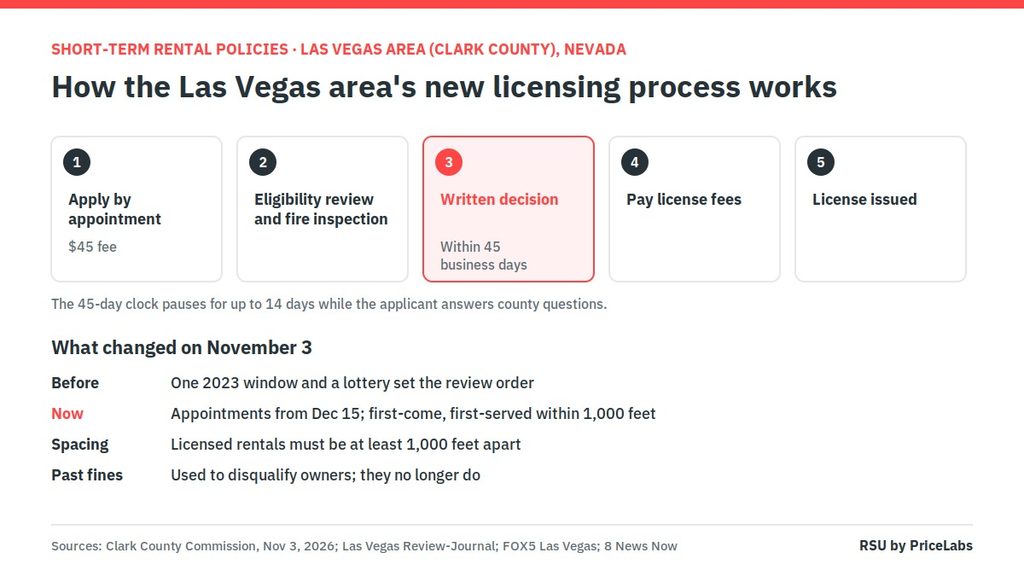
- On November 3, 2026, Clark County, which governs the Las Vegas area outside city limits, unanimously approved new licensing rules for short-term rentals.
- The change follows a Ninth Circuit ruling in October that largely upheld an injunction against the county’s licensing system.
- Before, the county took applications in one 2023 window and used a lottery to set the review order, and it has approved 242 of 830 complete applications since.
- Owners can now book application appointments from December 15, and the county must decide each one within 45 business days.
- Licensed rentals must be at least 1,000 feet apart, so when two neighbors apply, only the first complete application can get a license.
- Owners with past county fines used to be barred from getting a license, and they can now qualify.
- What hosts need to do now: Owners who want a license could be ready to book on December 15, with the $45 application fee ready and the home prepared for the county’s fire inspection. Nearby applications are decided in the order they arrive.
Guneet’s Views
- Owners near another rental could lose a license to whoever books first: With 1,000-foot spacing, the first complete application in each cluster wins. Owners told local TV the lottery has simply become a race.
- It could make sense for managers with Las Vegas-area owners to check which homes sit within 1,000 feet of a licensed rental or another likely applicant. Those are the homes where the booking date decides the outcome.
- Owners who were fined now have a way back to a license: Past fines no longer count against them, after the federal courts raised concerns about the old process.
- Managers could check which owners paid county fines since 2023 and might now qualify.
- Courts are setting the pace of short-term rental rules in more than one US market. In Dallas, a court order has kept the city’s single-family ban from taking effect since 2023. For managers in both markets, the court calendar now matters as much as the council’s.
Read more: Clark County’s platform liability
Ireland Curbs New Short-Term Lets in Its 25 Largest Towns
- Since 2019, owners in rent pressure zones have needed planning permission (a council’s approval to change how a home is used) to let a property that is not their main home short term, but few applied.
- Rent pressure zones were extended nationwide in 2025, so that rule now applies across the country.
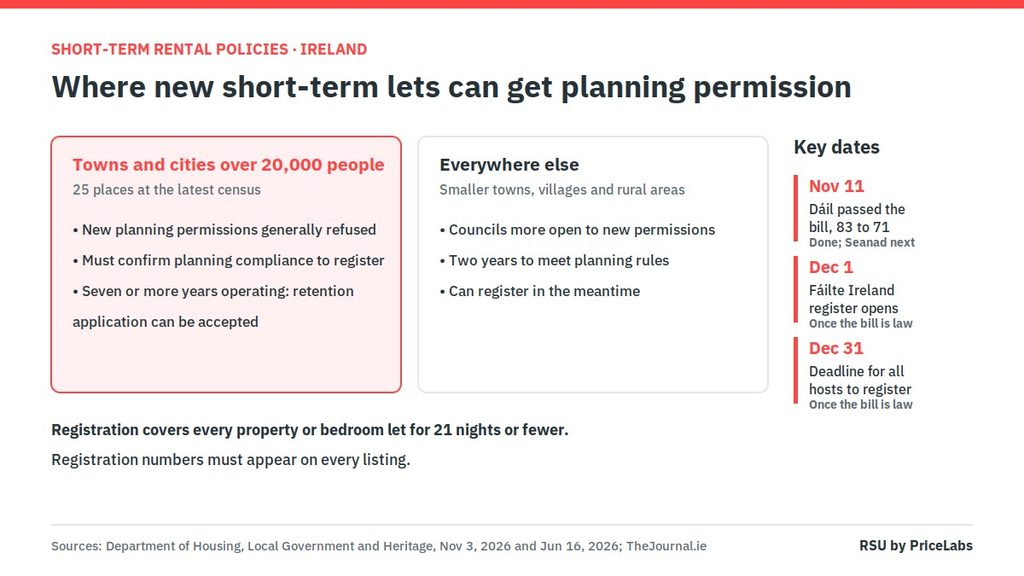
- On November 3, 2026, the government approved a National Planning Statement telling councils to generally refuse new permissions for short-term lets in the 25 towns and cities with more than 20,000 people.
- Elsewhere, hosts get two years to obtain permission, and hosts who have operated for seven years or more without enforcement can apply to keep their use.
- Separately, a registration bill would require every host to register with Fáilte Ireland, the national tourism authority, and confirm planning permission to do so.
- The Dáil, Ireland’s lower house, passed the bill 83 to 71 on November 11, and the Seanad, the upper house, must now approve it before it becomes law.
- What hosts need to do now: Confirm each property’s planning status before the register is due to open on December 1. The registration deadline would be December 31, 2026.
Guneet’s Views
- Hosts in the 25 largest towns without planning permission could lose the right to let: The 2019 rule was rarely enforced because there was no register to find unpermitted lets. Registration would require confirming permission, and new permissions in those towns will generally be refused.
- Managers could check which units sit in towns of more than 20,000 people, and whether each has permission or seven years of operation to support an application to keep its use.
- Hosts in smaller places get two years, not an exemption: They can register now, but each property must have permission within two years.
- Managers with rural or coastal Irish units could check which properties would need a planning application before that window closes.
- Ireland is acting before the EU sets its own test. The Commission’s proposed Affordable Housing Act would make cities show housing harm before restricting short-term rentals, but restrictions adopted before it takes effect would escape its tests. Ireland’s 20,000-person threshold is likely to stand even if the EU law passes.
Read more: Ireland’s platform rules
Medellín Moves to Enforce Its Ban on Tourist Rentals in Residential Zones
- On November 5, 2026, Medellín’s city council approved its revised land-use plan (Plan de Ordenamiento Territorial, or POT), which sets what can operate in each neighborhood for the next 12 years.
- The 2014 plan already barred tourist rentals in mainly residential zones, and the city says it will now enforce that rule.
- Registered tourist-rental hosts grew from 521 in 2019 to 8,322 in 2026, and city inspectors suspended 105 rentals between 2024 and 2026.
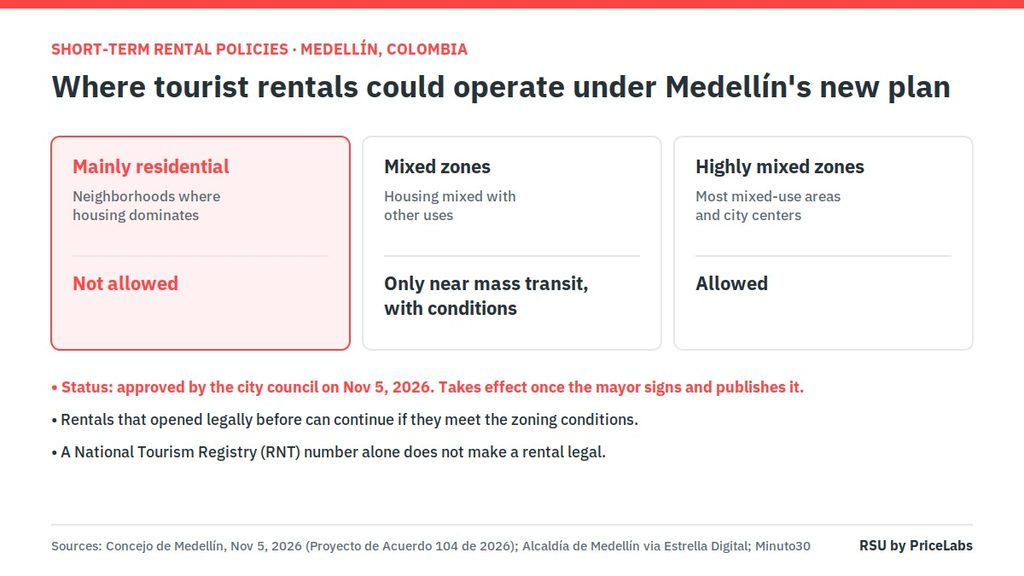
- Under the new plan, tourist rentals stay banned in mainly residential zones, are allowed near the metro with conditions in mixed zones, and are allowed in highly mixed zones, which include parts of El Poblado, Laureles and Belén.
- Rentals that opened legally under earlier rules can continue if they meet the zoning conditions, but a National Tourism Registry (RNT) number alone does not prove that.
- The plan takes effect only once Mayor Federico Gutiérrez signs and publishes it, and as of November 12 it was still awaiting his signature.
- What hosts need to do now: Nothing changes until the plan is signed. Hosts in mainly residential zones could start gathering proof of when each unit began operating.
Guneet’s Views
- Hosts in mainly residential zones could lose their listings: The ban existed on paper for 12 years. Enforcement is the change, and the city has already shown it will suspend rentals.
- Managers could check which Medellín units sit in mainly residential zones once the zoning maps are published.
- Proof of earlier legal operation becomes the key document: Rentals that opened legally can continue, but the host association Asohost worries that protection will not reach hosts already renting in residential areas.
- Managers could gather records showing when each unit started operating and under which rules, since an RNT number alone will not prove it.
- Medellín is using the same tool Spanish cities chose. Málaga froze new permits on residential land through its city plan, and a regional court upheld its neighborhood caps in February. Spain’s experience suggests zoning rules hold up in court better than outright bans, so Medellín’s residential ban is likely to stick once signed.
Read more: Rome’s urban plan limits

Stay on top of short-term rental regulation trends and what they mean for your listings.

Guneet has spent five years working at PriceLabs, developing deep expertise in short-term rental operations and hospitality technology. She brings that practitioner’s lens to her writing at RSU, covering platform updates and making sense of market data for property managers.
Related Articles:
 Short-Term Rental Regulations Update Roundup: Athens, Alicante, and Egypt
 Cape Town To Impose Rental Tax, Booking.com Partners with Maldives, HomeToGo Launches 5 Localized Platforms
 Montreal Limits Rentals to 3 Months, Landfolk Expands in France, Vrbo’s Top Vacation Rentals of 2025
 Mountainside NJ Pre-empts FIFA STR Surge, Sydney Eyes Suburb-Level Airbnb Ban, France Counts Down to Declaloc Deadline