For most of the last decade, the relationship between property managers and the major booking platforms was built on a legible exchange. You provided the inventory. They provided the travelers. If a booking happened, they took their cut, typically around 15%, and everyone moved on.
Visibility, in that model, was something you earned. Strong reviews, competitive pricing, high acceptance rates. The algorithm rewarded operators who performed. No ad budget or OTA advertising required.
That model is changing across all three major platforms simultaneously. Pay-to-play visibility is taking its place. Not in the same way, and not at the same pace, but in the same direction.
What Booking Holdings and Expedia Group Are Building
Both companies launched major advertising infrastructure in 2026
In May 2026, Booking Holdings launched BKNG Ads: a unified advertising platform consolidating ad inventory across Booking.com, Priceline, and Agoda into a single cost-per-click system. Property managers and travel brands can now set a budget, define a target audience, and bid for sponsored placement across all three platforms through one interface.

Expedia Group is building toward the same destination. Its ongoing migration of all brands onto a unified technology platform has been underway for some time, and Vrbo’s sponsored listings pilot, covered in detail in our companion piece, is one of the first visible outputs of that infrastructure reaching vacation rentals specifically.
There is a name for what both companies are building
It comes from outside the travel industry. Retailers like Amazon and Walmart figured out years ago that the high-intent traffic flowing through their platforms was itself an enormously valuable asset, in some ways more valuable than the transactions it produced. They started selling access to that attention: sponsored product placements, display ads, audience targeting based on purchase behavior. The category that emerged from this is called a Retail Media Network.
Booking Holdings and Expedia Group are applying the same logic to travel. Their most valuable asset was never the properties they listed. It was the hundreds of millions of travelers moving through their platforms every year, already decided on traveling and actively looking for somewhere to stay. That attention, it turns out, is worth more when auctioned than when given away as an organic ranking.
The shift from commission to cost-per-click moves the financial risk onto operators
Under the legacy model, the platform only earned its premium if the operator earned a booking. Visibility tools like Booking.com’s Visibility Booster or Vrbo’s Host Accelerator were commission-based, the host paid more only when a stay materialized. The platform shared the downside.
Under a cost-per-click model, the operator pays for the click. Whether the traveler who clicked goes on to book, browses three other listings, or closes the tab, the cost is the same. The financial risk of conversion moves off the platform’s books and onto the operator’s. That is not a small change. It is a fundamental restructuring of who bears the cost when a traveler doesn’t convert.
What Airbnb Is Doing and Why It Belongs in This Conversation
Airbnb has resisted advertising. But it has been quietly expanding a different kind of pay-to-play.
Airbnb does not sell cost-per-click ads. Brian Chesky has been consistently resistant to the idea of formal advertising on the platform, and shareholders have noticed: questions about Airbnb’s advertising ambitions have become a recurring feature of its quarterly earnings calls. Chesky’s position, broadly, has been that Airbnb’s brand is the product, and cluttering the platform with ads risks that.
But Airbnb has been running its own version of the visibility-for-margin trade for years, just through a different mechanism.
Airbnb’s model: offer a discount, get a ranking boost
Rather than selling ad placements, Airbnb periodically prompts hosts to opt into discount programs, offering a flat percentage reduction in nightly rate for a set period in exchange for an algorithmic visibility boost, a strikethrough price, and a promotional badge. The host funds the discount entirely. The platform benefits from increased conversion, which in turn improves the listing’s organic standing.

In February 2026, RSU reported on a new variation of this model being tested with a select group of hosts. Airbnb began asking some hosts to offer a 20% discount in exchange for higher search ranking, with the promotion specifically targeting guests rated 4.8 or above with at least three reviews. The host funds the discount fully. Airbnb provides the visibility boost, a badge, and strikethrough pricing.
The structure closely resembles Booking.com’s Genius program: a discount-for-visibility system that over time became a structural part of Booking’s marketplace, reshaping pricing expectations across many markets. It is not identical. Genius involves formal enrollment, ongoing commitment, and tiered guest segmentation based on booking frequency rather than ratings. Airbnb’s test was campaign-based and limited. But the underlying economic lever is the same: margin in exchange for visibility.
The shareholder pressure on Airbnb is real
What makes Airbnb’s position interesting is the gap between its public stance and the direction its investors keep pushing toward. Advertising is a high-margin revenue stream, and Airbnb controls an enormous amount of high-intent travel traffic. The question of why that traffic isn’t being monetized through ads comes up repeatedly from analysts on earnings calls, and Chesky’s resistance, while genuine, is not guaranteed to hold indefinitely as growth pressures mount.
Airbnb is not building a Retail Media Network today. But it is running discount-for-visibility experiments that compress host margins in exchange for algorithmic preference. The mechanism is different. The destination is not entirely dissimilar.
Why All Three Platforms Are Moving in This Direction Now
The booking platforms are losing the top of the travel funnel to AI
To understand why this shift is happening simultaneously across all three platforms, it helps to look at where travel discovery is heading.
For years, the booking platform search page was where travel decisions happened. A traveler typed in their destination, scrolled through results, compared options, and booked. The platform sat at the center of that process and captured significant value by doing so.
That funnel is being disrupted. AI tools – ChatGPT, Google’s Gemini, and others – are increasingly handling the discovery and inspiration phases of travel planning. A traveler asking an AI to find a three-bedroom cabin in the mountains for a long weekend doesn’t scroll through fifty results. They get two or three curated recommendations, and they likely book one of them.
The booking platform search page has less primacy than it did two years ago. The companies that built their businesses on it are aware of that.
Building ad networks is partly how booking platforms fund their presence in AI search
Here is where the picture gets interesting, and where we want to be clear this is our read of the shape rather than confirmed strategy from any of these companies.
In late May 2026, OpenAI began rolling out cost-per-click advertising within ChatGPT. Early reports indicated travel was among the dominant categories in those initial ad placements, with Expedia and Booking.com among the buyers. Both companies are, by any reasonable inference, spending significantly to maintain visibility in AI-driven search environments.
That spend has to be funded somewhere. When a property manager buys a sponsored placement on BKNG Ads or Vrbo’s ad system, they are contributing to the revenue pool that allows the platform to compete for traveler attention at the AI layer. The operator funds the platform’s visibility, and the platform’s visibility is what routes travelers back to it in the first place.
Whether that is an intentional architecture or simply the economic logic of the situation playing out, the effect is the same either way.
AI shrinks the available real estate, which makes each slot more valuable
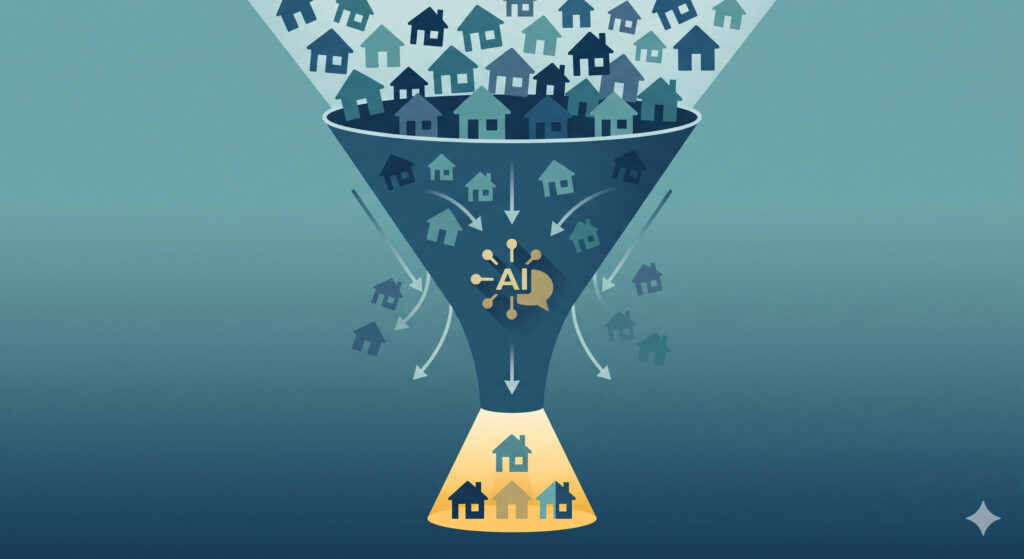
There is a compounding dynamic here. As AI search handles more of the discovery phase, the number of properties a traveler meaningfully considers before booking gets smaller. If the consideration set for any given trip is moving from fifty options toward three or four, competition for those positions becomes significantly more intense. Building an advertising auction around that scarcity is, from the platform’s perspective, the rational response to a shrinking organic funnel.
The Longer Arc
The booking platforms spent a decade building the roads. Now they’re building the toll booths.

It is worth stepping back to appreciate how complete this transformation is. The major booking platforms spent years aggregating supply, building traveler trust, and establishing themselves as the default starting point for accommodation search. That investment created something enormously valuable: a captive, high-intent audience.
Having built the audience, Booking Holdings and Expedia Group are now monetizing access to it in a fundamentally different way than before. The commission model said: bring us good inventory, and we will connect you with travelers for a fee tied to outcomes. The media network model says: the audience is the product, and access to it is auctioned.
Airbnb is running a parallel experiment. Not an auction, but a system where visibility increasingly depends on how much margin you are willing to trade. Different road, recognizably similar direction.
What this means for vacation rentals specifically
Hotels have been navigating booking platform advertising tools for years. Large hotel groups have revenue managers, marketing teams, and agency relationships built specifically around managing platform ad spend. The vacation rental sector largely grew up in an era where organic ranking was the primary lever. Reviews, acceptance rates, response times were the currency of visibility.
That is the context in which BKNG Ads, Vrbo’s sponsored listings pilot, and Airbnb’s discount-for-visibility experiments all land. Not as incremental updates, but as the arrival of a distribution paradigm that hotels adapted to years ago, now reaching vacation rentals at scale.
The operators who understand that shift earliest, and start thinking about distribution in terms of total acquisition cost rather than commission percentage alone, are the ones best positioned for what comes next.
Read More: For a closer look at what Vrbo’s sponsored listings pilot means specifically for Premier Hosts, see our companion piece: The Premier Host Paradox: Will Vrbo’s Sponsored Listings Dilute Your Hard-Earned Visibility?

Uvika Wahi is the Editor at RSU by PriceLabs, where she leads news coverage and analysis for professional short-term rental managers. She writes on Airbnb, Booking.com, Vrbo, regulations, and industry trends, helping managers make informed business decisions. Uvika also presents at global industry events such as SCALE, VITUR, and Direct Booking Success Summit.