Airbnb has added flexible workspace bookings to Airbnb Services, starting with coworking locations operated by Oneder and Work.Life in London.
On the surface, this is a small local pilot. Strategically, it is more revealing. Airbnb is testing whether Services can capture another part of the guest journey, and whether it can expand to a full-scale lifestyle platform in the near future – an app that a user interacts with every day.
Airbnb has experimented with work-related travel before. But this version is narrower, integrated directly into the app, and no longer dependent on an accommodation reservation or an external booking system.
Two London coworking operators are now bookable through Airbnb
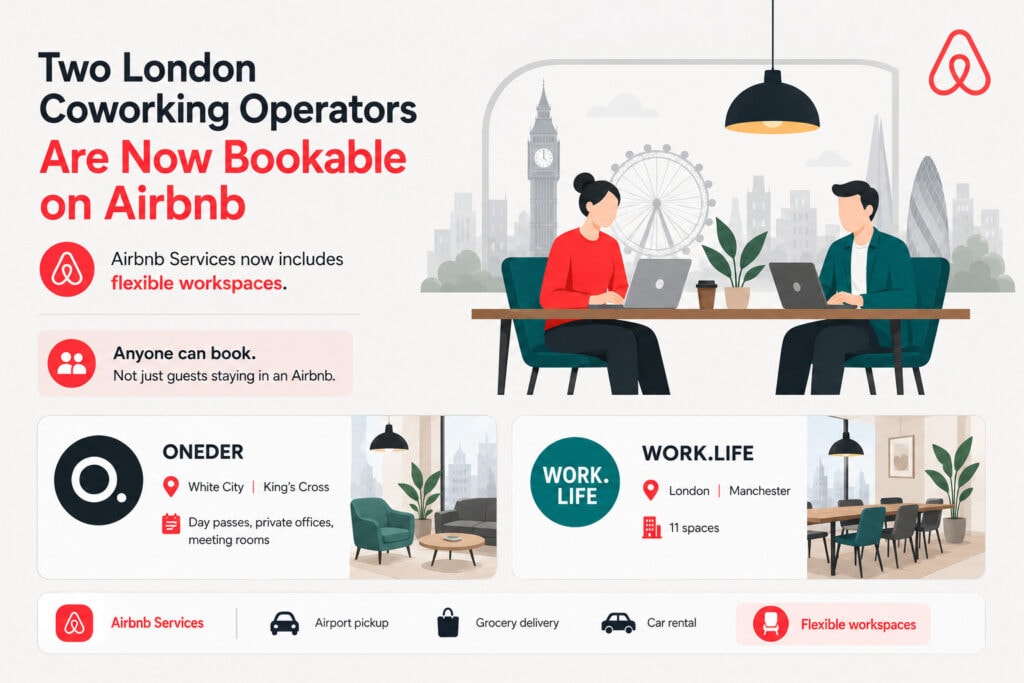
Airbnb Services expanded this summer to include flexible workspaces, alongside its existing airport pickup, grocery delivery, and car rental categories.

Oneder’s CEO previously ran real estate at WeWork; Work.Life brings 11 existing UK spaces to the deal
Oneder and Work.Life are the first two coworking operators inside it, and anyone can book, not just guests staying in an Airbnb.
Oneder was founded in 2023 by David Kaiser, WeWork’s former head of real estate, and Dan Cohen, who had previously founded flexible workspace operator Purpose Group. Its listings cover day passes, private day offices, and meeting rooms at its two current sites, Kindling in White City and Channel in King’s Cross. “Work has stopped being a place people go and become something people do.” says David Kaiser, Oneder co-founder and CEO
Work.Life, founded in 2015 and running 11 spaces across London and Manchester, joined the same pilot with its St Cross Street, Borough, and Holborn locations. The company positioned the deal as a new way for travelers, remote workers, and digital nomads to discover its spaces.
For hosts and property managers, the pilot’s size matters less than what the operator-partnership model signals about Airbnb’s appetite: rather than building or leasing workspace itself, Airbnb is testing demand through partners first.
Hosts near Kindling, Channel, or the three Work.Life sites can mention walking distance to coworking space in their listing description today, since Airbnb is actively marketing exactly that audience to these locations.
A WeWork partnership let guests book a nearby desk, until WeWork’s bankruptcy ended it
Airbnb has experimented with work-focused travel before, from Airbnb for Business (2014) to Airbnb for Work (2018), but eventually scaled those efforts back to a single Laptop-friendly workspace amenity by 2020. Earlier growth was driven primarily by team offsites, not solo business travelers, making today’s pilot a return to a familiar idea.
The WeWork partnership was launched in October 2017 across six cities: New York, Chicago, Los Angeles, Washington DC, London, and Sydney. A guest would provisionally book a WeWork office alongside an Airbnb stay, then get handed off entirely to WeWork’s own system to register and manage that booking. The partnership had no room to survive its mounting financial distress.
This time, booking and managing a desk both happen natively inside Airbnb
It’s tempting to describe the coworking pilot as Airbnb simply repeating the WeWork idea. The mechanics say otherwise.
The 2017 WeWork deal required a guest to already have an Airbnb stay booked, then leave Airbnb’s own app entirely to finish booking and managing the office on WeWork’s system. It ran in six cities globally under the Airbnb for Business banner, and it depended on WeWork building new infrastructure it had never needed before.
The 2026 version smoothes many of those wrinkles: Oneder and Work.Life listings are booked and managed natively inside Airbnb, open to anyone whether or not they have a stay booked, and built inside Airbnb Services rather than a separate business-travel product.
It’s also far narrower in footprint, one city instead of six, which tracks with the pattern from the Experiences relaunch: rebuild quietly, test small, then decide whether to scale.
Workspace sits inside Airbnb Services, letting Airbnb test the category incrementally
Rather than reviving a separate corporate-travel program, Airbnb has placed coworking inside Services. This connects workspace to the company’s broader effort to sell products beyond accommodation.
Customers no longer need to leave Airbnb to register with an external provider or manage the reservation through another system. Airbnb controls more of the discovery, booking, payment, and post-booking experience.
Airbnb can add operators and cities gradually rather than launching a large global workspace program. That reduces the cost and operational risk of testing whether meaningful demand exists.
The pilot follows Airbnb’s more cautious approach to expansion
Airbnb’s handling of Experiences offers a useful comparison. After concluding that the category had become inconsistent and difficult to differentiate, the company reduced supply, paused new applications, and later relaunched Experiences with tighter positioning.
Services emerged from the same broader strategy: Airbnb still wants to expand beyond accommodation, but it is approaching new categories more selectively.
The coworking pilot follows that pattern. Airbnb is starting with a small number of established operators in one market, integrating the transaction into its platform, and leaving room to expand only if the model proves useful.
The limited London launch does not yet show whether Airbnb can generate incremental demand for operators, whether users will return for repeat bookings, or whether the economics justify expansion.
The most important early signals will be the addition of new operators, expansion into new cities, repeat usage, and any connection Airbnb creates between workspace and accommodation bookings.
What Airbnb could gain from coworking
The commercial value of the pilot may extend beyond the commission Airbnb earns from an individual workspace booking.
First, coworking gives users another reason to open Airbnb without planning an overnight trip. Services that can be booked independently could help Airbnb increase transaction frequency beyond the relatively occasional accommodation-booking cycle.
Second, workspace bookings could give Airbnb additional information about travel intent. A meeting-room booking may indicate an upcoming team gathering, while a day-office reservation could reveal demand from remote workers or business travelers.
Third, and most relevant for hosts, workspace could create real cross-selling into the stay side of the business. Airbnb could recommend meeting rooms to groups already booking larger properties, suggest nearby desks to business travelers browsing listings, or surface accommodation suited to team offsites to a host whose property already fits. If that pairing goes live, the listings positioned to benefit first are the ones already matching demand Airbnb can already see: groups of three or more (the segment that already drove nearly 60% of Airbnb for Work’s multi-guest trips back in 2018) and properties near a participating coworking site.
None of these outcomes has been confirmed by Airbnb. But they explain why a small coworking pilot may be strategically relevant even if workspace never becomes one of the platform’s largest categories.