
Vrbo’s parent company Expedia has now beaten its own guidance for five quarters running. In this second quarter of 2026 specifically, that meant bookings grew 12% and revenue grew 14%. That’s the headline number, and it’s a good one. But for anyone actually listing a property on Vrbo, a smaller number buried a few paragraphs into the earnings call matters more: supplier-funded promotions, meaning discounts that come out of the host’s own rate, now account for over 40% of Vrbo’s bookings.
A quarter ago, that figure was about a third. It’s climbing, and the second quarter of 2026 gave several reasons to think it keeps climbing from here.
Expedia Q2 2026 highlights:
- Expedia’s total bookings grew 12%, revenue grew 14%, profit (adjusted EBITDA) grew 23%
- Consumer bookings, the segment that includes Vrbo, grew 8%, the fastest US growth Expedia has posted in 15 quarters
- Supplier-funded promotions covered over 40% of Vrbo bookings, up from roughly a third in Q1 2026
- Expedia’s May sale campaign crossed $1 billion in bookings for participating properties, a first
- The World Cup gave demand a bump this quarter
- Answer engine optimization (getting found inside tools like ChatGPT and Claude) is Expedia’s fastest-growing channel for the second quarter running, still small in absolute terms
US Demand Boosted Expedia, and Vrbo’s Home Turf Is the US
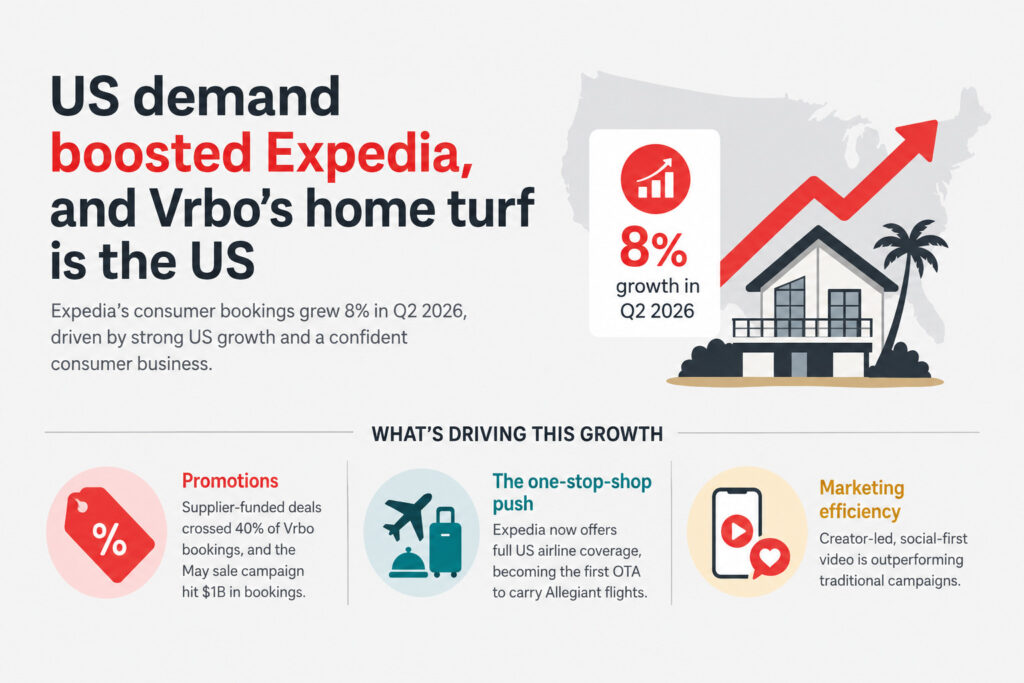
Consumer bookings, the combined figure covering Vrbo, Expedia.com, and Hotels.com, grew 8% in Q2 2026, and Expedia credited the fastest US growth it’s seen in 15 quarters. Expedia didn’t break Vrbo out by name this quarter the way it did in Q1, when Ariane Gorin specifically said Vrbo’s performance stood out.

Read more: Vrbo vs. Airbnb Is the Wrong Frame for 2026. It’s Expedia’s Grid vs. Airbnb’s Walls
Yet, given that the US is Vrbo’s strongest market to begin with, and the consumer segment as a whole had a genuinely strong quarter, it’s a reasonable assumption that Vrbo did well too. The general tone toward the consumer business on the call, new product launches, expanding promotions, record numbers on the merchandising side, reads like a company happy with how that side of things is going.
What Expedia Says Is Actually Driving This
A few things showed up repeatedly on the call as the engine behind this quarter’s growth:
- Promotions. Supplier-funded deals crossed 40% of Vrbo bookings, and the May sale campaign topped $1 billion in bookings for participating properties for the first time.
- The one-stop-shop push. Expedia keeps expanding how much of a traveler’s whole trip it sells beyond just the stay. This quarter, that included becoming the first OTA to carry Allegiant flights, rounding out full coverage of US commercial airlines.
- Marketing efficiency. Expedia has said for two quarters running that a shift toward creator-led, social-first video is outperforming traditional campaigns.
Booking Had a Good Quarter Too, Just for a Different Reason
Booking Holdings also grew across the board in Q2 2026, but the shape of its quarter was different. Booking’s core strength is Europe, and Europe is exactly where this summer’s pricier, thinner flight capacity hit hardest. Vrbo and Expedia didn’t feel that same pressure in the same way, because their strongest market, the US, was also the market with the strongest demand this quarter. Same disruption, landing on two companies with different centers of gravity.
Expedia’s B2B Business Is Facing New Competition
Two separate analysts pressed Expedia on new competition entering its B2B business this quarter, the side that sells Expedia’s travel inventory to airlines, banks, and corporate travel platforms. Neither named a specific rival, but the timing makes things plenty clear: Booking Holdings’ own Q2 2026 call, held the same week, confirmed it’s merging the separate B2B operations of Booking.com, Agoda, and Priceline into a single unit under one leader, the same kind of B2B muscle Expedia already uses to plug Vrbo inventory into partners like Uber, airlines, and corporate travel programs.
If Booking builds comparable B2B distribution reach, that advantage stops being something either platform can lean on to stand apart. What’s left to compete on is how well each platform actually treats the people listing on it, worth watching as both companies keep talking about becoming a “one-stop shop.”
The World Cup Gave Demand a Bump
Expedia said the World Cup added a bump to the quarter, landing late as bookings picked up once the tournament actually began, and the effect showed up more in what travelers paid per stay than in how many trips got booked, guests who came paid more, rather than dramatically more guests showing up. That timing matches what we expected covering the tournament ourselves: fans wait until they know their team is still in it before booking, which pushes decisions into the knockout rounds rather than the group stage.
We know Booking was likely less positioned to capture this specific demand. Its own CEO admitted on the same earnings cycle that he wants the company’s US vacation rental presence “a lot higher,” which lines up with a company not built for a US-anchored demand event the way Vrbo is.
The Promotions Number Will Keep Climbing, and It’s Host Money Paying for It
Supplier-funded promotions means a discount, typically hosts cutting their own rate by 10 to 30%, in exchange for better visibility and a deal badge. Expedia isn’t spending its own money to make Vrbo look like better value to travelers. Hosts are.
There are three reasons to expect this keeps rising rather than leveling off:
- The pattern itself. A third of bookings in Q1 2026, over 40% in Q2, with more already lined up to expand it further, including a sponsored listings pilot Vrbo has been running, a pay-to-play placement model that sells search visibility directly rather than through a rate discount.
- The incentive. This is a real source of profitability for Expedia, and companies tend to keep doing what’s working.
- The research. Vrbo’s own new Built to Stay report (worth a grain of salt, since Vrbo commissioned it) found that 91% of travelers say promotions influence their booking decision, and Vrbo’s own travelers over-index on nearly every measure of that compared to travelers generally.
This pressure isn’t unique to Vrbo. Booking has run supplier promotions for years, and Airbnb keeps rolling out more of its own mechanisms for the same thing. The competition increasingly isn’t about who has the better listings. It’s about which platform makes participating the most worthwhile for the people who actually own the properties (and those who book them.)
Trust Is the Other Half of the Strategy, and It Will Continue to Be
The promotions push isn’t the only throughline. Since late 2025, Vrbo has built a strategy around being provably reliable rather than the loudest option on the market, Affirm-backed payment protection, the WeatherPromise guarantee, and Premier Host standards that demand near-perfect acceptance and cancellation rates. The current ad campaign, tagged “If you know, you Vrbo,” speaks to travelers who already know what they’re looking for rather than trying to win over the undecided, and the ads themselves promote specific features rather than vague claims, Verified Reviews in one spot, the Loved by Guests badge in another.
The Built to Stay report backs this up with real numbers: 81% of travelers say they’d pay more for stronger trust signals, and reviews, specifically recent, verified ones, sit at the center of that. It’s a company publishing the data behind standards it already enforces.
AI Search: Vrbo’s Parent Company Sounds More Open to It Than Booking Does
Neither Booking nor Expedia gets meaningful bookings from AI tools yet, both describe it as small. But the tone is different. Expedia keeps calling answer engine optimization its fastest-growing channel, two quarters running, and treats it as a long-term bet worth building toward. Booking’s public position has leaned more toward downplaying the shift, even while acknowledging traditional Google search traffic is under pressure.
One concrete sign of that gap: running Google’s own rich results checker against a real listing on each platform, Vrbo came back far more decorated than either Airbnb or Booking.com. For more on what that actually means and how we tested it, see our takeaways from the AI visibility webinar.
Put together, the second quarter of 2026 tells a fairly simple story for anyone listing on Vrbo: demand is genuinely there, largely because Vrbo’s strongest market just had its best run in years, but a growing share of what you’re paying to win that demand is coming directly out of your own rate, not Expedia’s marketing budget. That’s not likely to reverse. It’s the strategy.

Uvika Wahi is the Editor at RSU by PriceLabs, where she leads news coverage and analysis for professional short-term rental managers. She writes on Airbnb, Booking.com, Vrbo, regulations, and industry trends, helping managers make informed business decisions. Uvika also presents at global industry events such as SCALE, VITUR, and Direct Booking Success Summit.