
Less than 1% of Booking Holdings’ room nights can be traced back to AI tools like ChatGPT, and that share has barely moved in months. On the Q2 2026 earnings call, that’s the number Booking pointed to as proof AI isn’t disrupting how people book travel, at least not yet.
It’s a fair number, and worth taking seriously. But it only counts people who used an AI tool and then came straight to Booking. It says nothing about the traveler who used AI to make up their mind, then booked directly with the hotel or rental itself. Asked about exactly that scenario, CEO Glenn Fogel gave about as honest an answer as a CEO can give: “I don’t know, they don’t tell me.”
Here is what that means for short-term rental managers trying to work out whether AI is already changing where bookings land, or whether that’s still mostly a story people are telling each other.
Booking’s Own Number Puts AI Bookings Under 1%
What Booking said, in their own words
CFO Ewout Steenbergen’s exact phrasing is worth sitting with: traffic from large language models, both paid and unpaid, is “still significantly below 1% of our room nights,” and that share “hasn’t moved so much recently.” Notice the yardstick. He’s measuring this against room nights, meaning actual completed bookings, not against clicks or visits that never converted.

Fogel added the other half of the picture. Third-party data tells Booking it shows up constantly when people ask AI tools about travel. But showing up isn’t the same as sending someone through the door. “They also mentioned we’re showing up a lot, but the referrals aren’t showing much,” he said. His theory is that even when an AI chat doesn’t send someone directly to Booking, being visible there might still plant the idea, so when the person is ready to actually book, they think of Booking anyway.
Why this number is genuinely useful
If you’ve been wondering whether ChatGPT is already quietly eating Booking’s lunch, this is the clearest public evidence we have that, at least by Booking’s own measurement, it mostly isn’t yet. That’s a real answer, not a dodge, and it’s worth taking at face value.
We Still Don’t Know How Many Travelers Research on AI and Book Directly Instead
The gap in what Booking can measure
Here’s the limit of the under-1% number. It only counts people who used an AI tool and then clicked through to Booking. It says nothing about someone who used AI, got a good recommendation, and then booked somewhere else entirely, a hotel’s own site, a property manager’s direct booking page, a rival platform. That traveler exists somewhere in the world. Booking simply has no way to see them.
Fogel said as much when pressed. He doesn’t know if AI users are booking direct with hotels instead of through Booking. He guessed that he doubts anyone is getting “a huge amount of business” that way, but he was clear that’s a guess, not something he could point to a number for. This isn’t Booking being evasive, it’s an honest admission that we’re early enough in this shift that almost nobody in the industry has solid measurement here yet, Booking included.
It’s also not just Fogel’s hunch. Much of the current conversation across travel, and well beyond it, is some version of the same idea: people are increasingly using AI tools to research and narrow down a decision, then completing that decision somewhere else, often directly with the brand or property they’ve settled on. Booking’s transcript is one data point inside a much bigger, still-unsettled discussion.
My Take: This Is an Old Traveler Habit, Just Running Without Friction Now
The savvy traveler behavior isn’t new, it’s just easier now
There has always been a small slice of travelers who browsed an OTA, found a place they liked, then reached out to the property directly hoping for a better rate or a more personal answer. It took real effort: comparing listings across tabs, cross-checking reviews, emailing a manager and waiting to hear back. Because it took effort, it stayed a habit for a motivated minority, the travelers savvy enough to bother.
AI tools remove most of that effort. Ask a question, get a shortlist, ask a follow-up, get a specific recommendation. You no longer need to be the type of person who opens fifty tabs to behave like one. If that’s true, the pool of people capable of researching on AI and booking direct doesn’t stay a small, savvy niche. It grows toward everyone, because the AI tool does the tab-opening for you.
But trust is still the reason most people don’t do this, and Booking is counting on that
Digger deeper, it is also true that research effort was never the only thing keeping people on a platform. Payment protection, verified reviews, and somewhere to complain if a stay goes wrong are real reasons people book through Booking instead of direct, and an AI recommendation doesn’t replace any of that on its own. The traveler most likely to act on an AI suggestion and book direct is one who already trusts that specific property, or trusts their own judgment enough to skip the safety net.
That’s exactly the bet Booking itself is making. Its whole pitch, on this call and generally, is that trust, reviews, and Genius loyalty status are why people come back to book even after doing their looking around somewhere else. Fogel’s framing was almost exactly this: people research wherever’s convenient, then get serious with a brand they already trust. If that holds, the under-1% number isn’t proof AI doesn’t matter. It’s evidence that trust is still doing the job Booking needs it to do, for now.
Booking Is Advertising Inside Other Companies’ AI Tools While Building Its Own
Paying to be recommended by someone else’s AI
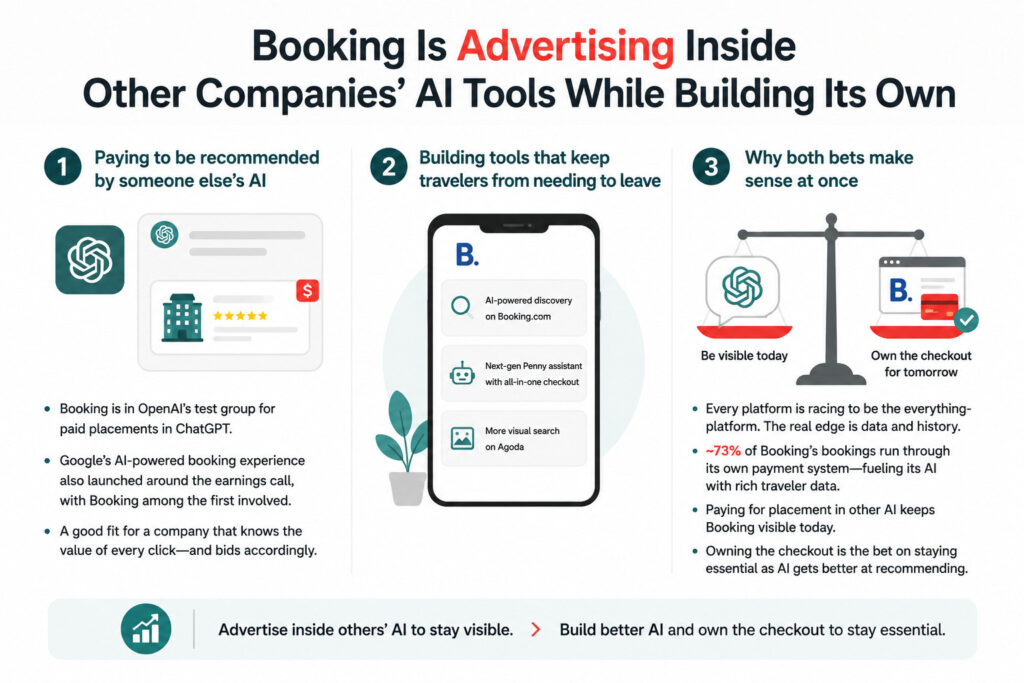
Booking is part of the test group for OpenAI’s new paid placements, meaning it can pay to be recommended inside a ChatGPT conversation. Steenbergen called it a good fit for a company that has spent two decades figuring out exactly what a click on Google is worth and bidding accordingly. Fogel also referenced Google’s own AI-powered booking experience as something that had reportedly launched around the same time as the earnings call, with Booking among the first travel companies involved.
Building tools that keep travelers from needing to leave
At the same time, Booking is investing in its own AI: a new AI-powered discovery experience on Booking.com, a next-generation version of Priceline’s assistant Penny with an all-in-one checkout, and a more visual search experience on Agoda.
Why both bets make sense at once
This isn’t Booking hedging out of indecision. Every major travel platform is racing to become the place that can book everything, stays, flights, cars, tickets, and once every platform can do that, being an everything-platform stops being a real advantage. What’s left to compete on is who has the richest history with each traveler, since that history is what makes a recommendation feel personal, and a better fit. About 73% of Booking’s bookings already run through its own payment system, and that’s the data feeding its own AI tools. Paying for placement inside someone else’s AI keeps Booking visible today. Owning the checkout is the bet on staying essential once AI tools get better at recommending.
Search Traffic Is Slipping, and Booking Says the Direct Relationship Is Holding
The admission
For the second quarter in a row, Booking acknowledged pressure on traffic from traditional Google search, pointing to Google’s AI-generated answer summaries as the likely cause. That’s a real shift for a company that spent years dominating exactly that channel.
The counter-evidence
Booking’s answer is that its direct relationship with travelers hasn’t moved. Roughly two-thirds of bookings still come through channels Booking doesn’t pay for, and the share of bookings happening through its app keeps climbing, now in the high 50%. Fogel’s framing again: people do their looking around wherever’s easiest, but they get serious with brands they already trust.
For Property Managers, This Is a Rare Window Worth Using Now
Why it’s a window
If AI answers are still mostly unpaid and still mostly trusted the way early search results once were, an independent manager’s listing has a real shot at showing up next to Booking’s or Airbnb’s in the same AI answer, something that paid search, where budget decided almost everything, never really allowed. That’s the entire premise behind our guide to getting found by AI: being AI-readable is a rare kind of visibility that isn’t for sale yet.
Why the window probably won’t stay open
The same OpenAI test Booking just joined is an early sign of where this goes. Once AI answers start filling with paid placements the way Google search results did, big platforms with big budgets get louder there too, the same way they always have in paid search. And the sense that AI answers are neutral, which is a real part of why people trust them right now, gets harder to hold onto once more of what you see there is paid for.
If AI search follows the same arc search itself did, ads arrive, people grumble, most stay anyway, then the operators who build visibility before that shift happens are the ones likely to keep the advantage once it does. Whether that window closes, and how fast, is a question Booking just started helping answer, by signing up for the paid test itself.

Uvika Wahi is the Editor at RSU by PriceLabs, where she leads news coverage and analysis for professional short-term rental managers. She writes on Airbnb, Booking.com, Vrbo, regulations, and industry trends, helping managers make informed business decisions. Uvika also presents at global industry events such as SCALE, VITUR, and Direct Booking Success Summit.