
Airbnb and Vrbo do not collect hotel tax in Rowlett, Texas, and the city has hired a vendor to check whether operators are following short term rental regulations and file it themselves. The Dallas suburb moved permitting and quarterly Hotel Occupancy Tax onto a third-party compliance platform in July. In Europe, Poland’s Council of Ministers approved a bill on September 2 that would let homeowner associations vote short-term rentals out of their buildings. In Australia, Consumer Protection Western Australia issued the first infringement under the state’s Short-Term Rental Accommodation Act 2024.
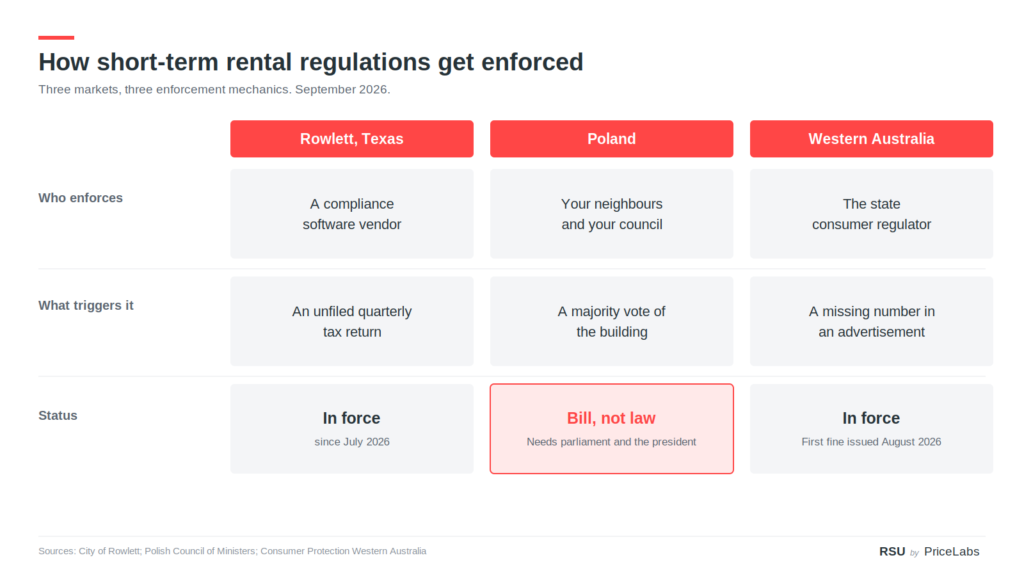
Three moves, three different enforcement mechanics: a purchased monitoring tool, a neighbour vote, and a single line of listing copy. Here is what each changes for professional managers.
Rowlett Buys Enforcement Capability Instead of Building It
- The City of Rowlett, Texas, has partnered with Neumo, a cloud-based compliance platform built for local governments to monitor listings on Airbnb, Vrbo and similar sites, to run its permitting and Hotel Occupancy Tax program.
- From July 1, 2026, owners apply for permits and file tax returns through the Neumo portal. Neumo also runs a 24/7 resident complaint hotline.
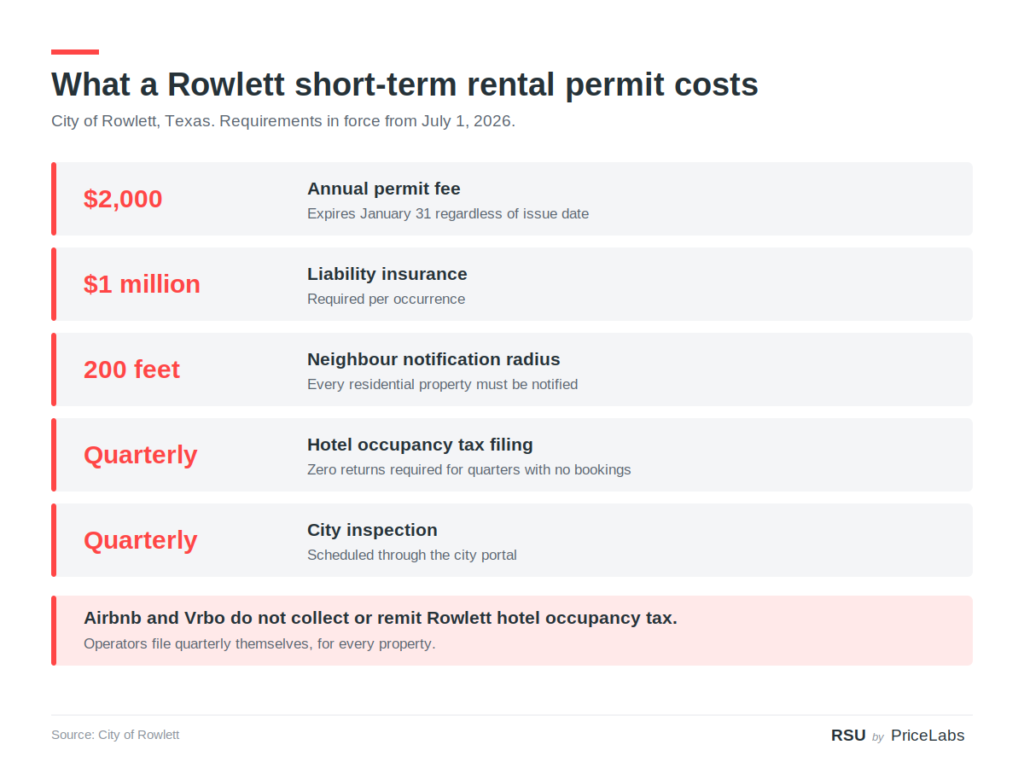
- The city states that marketplaces including Airbnb and Vrbo do not collect or remit Hotel Occupancy Tax for Rowlett. Operators file quarterly themselves, per property, and must file zero returns for quarters with no bookings.
- The annual permit costs $2,000 and expires on January 31 regardless of issue date. Applicants need a 24-hour local contact, $1 million per-occurrence insurance, notification to every residential property within 200 feet, and a site, floor, parking and evacuation plan. Permits do not transfer with a sale, and inspections are quarterly.
Uvika’s Views
- Platform Tax Collection Is Not a Portfolio-Wide Assumption: Texas platforms collect the 6% state Hotel Occupancy Tax, which leads operators to assume local tax is handled too. In Rowlett it is not.
- A manager running units across several Texas cities can be fully compliant in Houston and quietly delinquent in Rowlett on the same booking calendar, because the difference sits in a line on a city FAQ page rather than in anything the channel manager surfaces.
- The zero-return rule is the trap inside the trap. A property that sat empty for a quarter still owes a filing, and the vendor now holds the records to see the gap.
- Enforcement Is a Procurement Decision: Small municipalities do not build listing-scraping tools. They buy them.
- Rowlett has roughly 65,000 residents and a modest permitted inventory, yet it now has the platform-monitoring capability of a large city, because that capability is sold as a subscription.
- Managers holding inventory in small suburban jurisdictions are finding that a quiet ordinance from three years ago goes live the month a vendor contract is signed.
- One open item: council discussed a distance-separation rule between short-term rentals on May 5, 2026, but no separation distance appears in the city’s current permit requirements, and the 2026 ordinance list does not describe one. Confirm the text of ORD-26-05-12 with the city before underwriting on density assumptions.
Poland’s Cabinet Restores Building-Level Bans, But This Is Still a Bill
- On September 2, 2026, Poland’s Council of Ministers adopted a self-amendment to its draft amendment of the Act on Hotel Services, restoring powers cut from the version approved on July 14.
- Homeowner associations (wspólnoty mieszkaniowe) and housing cooperatives (spółdzielnie mieszkaniowe) could prohibit short-term rentals in their buildings by majority vote. Operators would then have six months to end operations.
- Municipal councils (rady gmin), at the request of the mayor, could designate areas where short-term rentals are banned or capped at a set number of days.
- Residents and housing groups gain stronger powers to trigger inspections. Three violations of public safety and order rules within six months would bar a property from operating for a year.
- The underlying bill creates a national accommodation register with a unique number that must appear in every listing, backed by penalties reaching 50,000 złoty.
- Nothing is in force. The bill must pass the Sejm and Senate and be signed by President Karol Nawrocki, who has vetoed a record number of government bills and has stated no position on short-term rentals. Prime Minister Donald Tusk said the rules would not fully take effect until 2028.
Read More: Chicago Weighs Ban Renewal, Croatia Rolls Out Registry, Florence Expands Short-Term Rental Ban

Uvika’s Views
- The Reversal Matters More Than the Text: The zone-designation power was cut in July, then restored at the end of August after two junior coalition partners objected.
- That is a six-week round trip driven by coalition arithmetic rather than new housing evidence, and a competing bill from Poland 2050 containing the stripped provisions is moving through the Sejm in parallel.
- Operators reading regulatory risk as a slow one-way ratchet are mispricing it. The version that binds anyone is the one the president signs, and Poland has a government and a head of state from opposing camps.
- The Unit of Regulation Is Shifting From the City to the Stairwell: Croatia already requires consent from two-thirds of a building’s co-owners before letting short-term. Poland would let a simple majority withdraw that permission after the fact.
- Managers building multi-family portfolios in Kraków, Warsaw and Gdańsk are treating neighbour relations as a licensing condition rather than a courtesy, and some are shifting acquisition toward single-family stock and commercially zoned aparthotels that sit outside association votes.
- The six-month wind-down would run from the date a building votes, not from any national commencement date. Under this text an operator could lose a unit’s income without a line of national law changing that year.
Western Australia’s First Fine Lands on the Advertisement, Not the Property
- On August 26, 2026, Consumer Protection Western Australia confirmed the first enforcement action under the Short-Term Rental Accommodation Act 2024: a $2,000 infringement against the provider of a Perth property whose advertisement did not display a registration number.
- Registration has been mandatory since January 1, 2025, and the number must appear in every advertisement. Commissioner for Consumer Protection Trish Blake said displaying it “is not optional,” framing it as levelling the field for operators who comply.
- Penalties under the Act reach $20,000 for an individual and $100,000 for a corporation. Advertising publishers and booking platforms are separately barred from carrying advertisements for unregistered properties or ones with missing or false numbers.
- The state also added an interactive reporting tool to the register page in August, filterable by region and local government area, accommodation type, hosted or un-hosted status, and whether an owner or tenant registered. It updates monthly and identifies no individual properties.
- It sits alongside the address-level search and heatmap live since July 2025, when the register held 11,556 properties, 46% of them in metropolitan Perth and 27% in the South West.
Uvika’s Views
- The Amount Is Small. The Precedent Is Not: $2,000 against a ceiling of $20,000 reads as a warning shot rather than a crackdown.
- What it establishes is where enforcement happens. Nobody inspected the property or interviewed a guest. Someone read the advertisement.
- That puts compliance risk in listing copy and channel manager field mapping. A registration number that populates on a direct site and drops out of a distribution feed is an offence in Western Australia, and the platform carrying it is exposed alongside the operator.
- Read the New Report as Supply Data, Not Surveillance: The neighbour-versus-operator dynamic the tool is described as enabling already existed through the 2025 address search, which has let anyone check a specific property for over a year.
- What is new is compositional: how much of a council area is hosted versus un-hosted, and how much is registered by tenants rather than owners. That is a read on how professionalised a submarket is before entering it.
- Consumer Protection cautions the data is self-reported and that anomalous records can skew summary figures. It is directionally useful for concentration and mix, and it is not a substitute for verified performance data when sizing a market.
Stay on top of short-term rental regulation trends and what they mean for your operating environment.

Uvika Wahi is the Editor at RSU by PriceLabs, where she leads news coverage and analysis for professional short-term rental managers. She writes on Airbnb, Booking.com, Vrbo, regulations, and industry trends, helping managers make informed business decisions. Uvika also presents at global industry events such as SCALE, VITUR, and Direct Booking Success Summit.
Related Articles:
 Lisbon Imposes Bans and New Limits, Mabrian Launches Rental Monitoring Tool, and Airbnb Reboots Experiences
 Survive the EU Short-Term Rental registration Deadline: What Managers Must Do Next
 Los Angeles Eyes Olympics Airbnb Deal, Santa Ana Court Voids Ban, Saratoga County Imposes Registry and Tax
 French Short-term rentals and the Hoguet Law: What the FNAIM Report from April 2026 Says