Booking.com’s new commercials open on people stuck somewhere grim: a woman on a packed subway train with her hand on the pole and her eyes going nowhere, a woman with wet hair in a grey record store, an office worker penned into a blue cubicle. In each case, she finds a picture of somewhere better and steps directly into it.
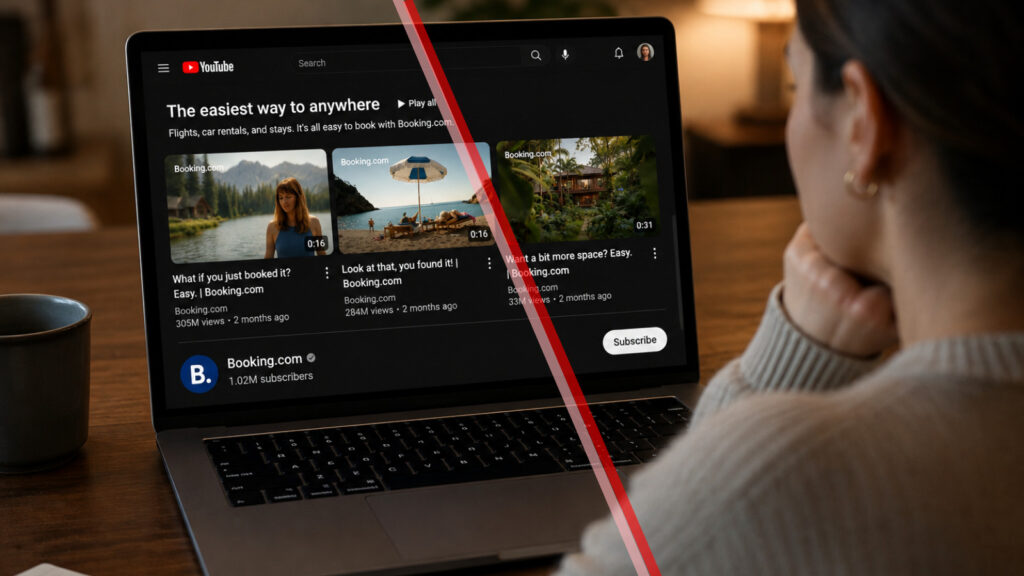
The campaign is called “The Easiest Way to Anywhere,” it launched on 8 June 2026, and Booking.com clearly disclosed that it used AI for these commercials. However, that transparency failed to shield them from a harsh consumer backlash.
That disclosure is also no longer optional everywhere. Since 2 August 2026, EU law has required certain AI-generated images, audio and video to be clearly labelled and to carry machine-readable marks, with penalties reaching €15 million or 3% of global annual turnover. In Booking.com’s home market, labelling AI content has moved from a best-practice debate to a compliance requirement.
For an industry leader attempting to set a benchmark for responsible AI marketing, the experiment is proving an uncomfortable truth: consumers aren’t just looking for disclosure about AI; many actively reject visual AI when it replaces real human craft.

Below is what happened, how consumers reacted, and what it could mean for travel marketers.
Booking.com’s New Commercials Put a Portal in a Miserable Place
The creative came from Zulu Alpha Kilo’s New York office, which has now handled four consecutive Booking.com campaigns, with Fiona McGee directing and production by Arts & Sciences.
Three fifteen-second commercials are currently live on Booking.com’s YouTube channel, all using the same device. Somebody is stuck somewhere drab, sees an image of somewhere better, and passes into it.
In one, a woman zoning out on a crowded subway sees a tropical resort advertisement transform into a villa porch.
In another, a woman in a grey record store passes through a beach pictured on an album sleeve and lands beneath an umbrella beside a friend.
The third puts an office worker in a blue cubicle, staring at her boss’s screensaver of a mountain lake. A beat later, she is jumping from its swimming barge while her children cheer. A phone interface then scrolls stays, flights, and car rentals above a Book Now button.
All three resolve on Booking.yeah, the company’s longstanding sign-off.
Which Song Is Used in Booking.com’s “The Easiest Way to Anywhere” Commercials?
The track is “Juicy Fruit,” originally recorded by the American group Mtume in 1983 and probably best known today as the sample sitting underneath The Notorious B.I.G.’s “Juicy.” The version running across this campaign is the steel pan cover by Bacao Rhythm & Steel Band, the Berlin group signed to Big Crown Records, whose covers have become something of a fixture in advertising sync.
What Changed From the Last Three Campaigns
Melissa McCarthy fronted Booking.com’s 2023 campaign. Tina Fey followed in 2024, then The Muppets in 2025. All three essentially made the same argument: whatever kind of traveler you are, Booking.com has the property that fits you.
“The Easiest Way to Anywhere” has no celebrity and, more tellingly, shows no property.
Two things follow:
- Accommodation is no longer the product being advertised. The phone interface shows flights and car rentals alongside the stay. Accommodation is one component of a trip.
- The campaign targets people who have not yet decided to travel. Previous campaigns assumed you were already choosing a trip. These begin with somewhere unpleasant the viewer might be sitting right now and offer an escape. That is demand creation rather than demand capture.
Read more: Travelers Are Drowning in Options: How AI is Helping Booking Platforms Address Choice Fatigue
Booking.com Disclosed Its AI Use, and EU Law Now Requires It
Since 2 August 2026, the EU AI Act requires AI-generated images, audio and video that resemble existing persons, objects, places or events to be clearly labelled and to carry machine-readable marks. Fines reach €15 million or 3% of global annual turnover. The Commission has issued a standard icon set for the purpose.
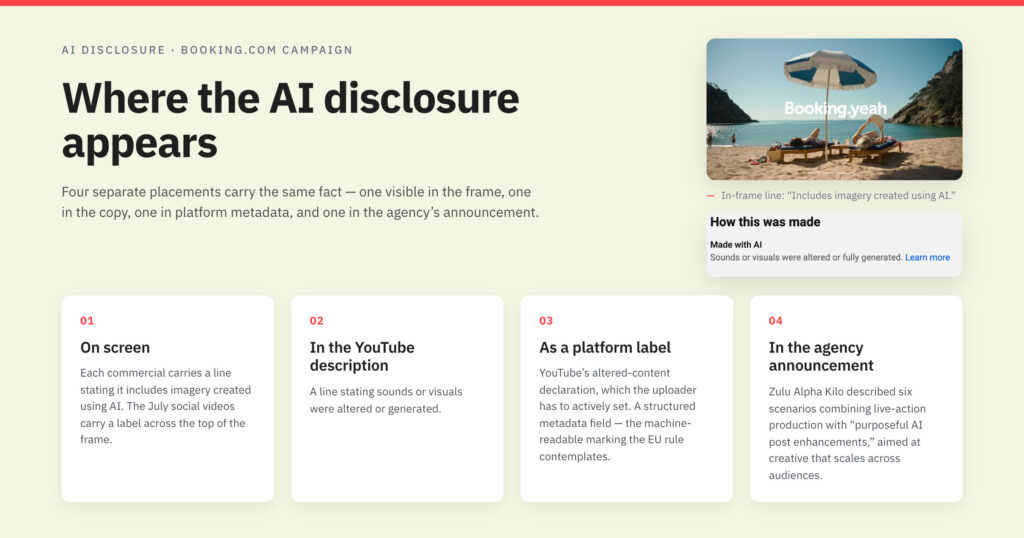
Booking.com was already doing it. The campaign launched 8 June, the social videos 16 July, both ahead of the deadline, which is unsurprising for an Amsterdam-headquartered company working from a staging schedule published in 2024.
Where the disclosure appears:
- On screen. Each commercial carries a line stating it includes imagery created using AI. The July social videos carry a label across the top of the frame.
- In the YouTube description. A line stating sounds or visuals were altered or generated.
- As a platform label. YouTube’s altered-content declaration, which the uploader has to actively set. It is a structured metadata field, which is the machine-readable marking the EU rule contemplates.
- In the agency announcement. Zulu Alpha Kilo described six scenarios combining live-action production with “purposeful AI post enhancements,” aimed at creative that scales across audiences.
Nobody caught Booking.com doing anything. It disclosed on every surface where the work appeared.
This is not only a European problem. IAB research already recommended labelling AI advertising, and the Harris Poll found the measures most likely to reassure consumers reduce to transparency and control. Total price display became EU law first and is now close to a global norm in travel distribution. AI disclosure looks like the same trajectory, which makes the question for marketers outside Europe when rather than whether.
Then, in July, Booking.com went considerably further. On 16 July it published two fully AI-generated vertical videos to Instagram and TikTok. One stars an animated kettle that finally goes on holiday after years of watching its owners travel without it. The other follows a cat abandoned while its family vacations, which responds by booking itself into a cat-only hotel.
Those drew a much louder response.
Booking.com Is Taking Criticism for AI Content on Every Platform
The cat video accumulated 8.7 million views and 2,230 comments on Instagram, alongside 2.9 million views and 575 comments on TikTok. The kettle reached 1.8 million views and 682 comments on Instagram and 1.7 million views and 403 comments on TikTok.
On TikTok, the most-liked comment on the cat video, with 2,181 likes, reads simply: “could have been made without AI.” The second, at 1,159 likes, is an image expressing a preference for AI-free media made by people.
On Instagram, the most-liked comment addressing AI directly, at 460 likes, calls the video “gross” because no human touched it.
The YouTube commercials attracted the same objection at considerably lower volume. One commenter called businesses using AI for advertising “lazy and cheap.” Another pointed specifically to distorted benches and an unnatural-looking background.
These comments are not a representative survey of everyone who watched. Commenters inherently skew toward people motivated enough to respond. But when the most-liked comments across all four social posts independently run against the AI, it is a consistent signal.
Visible AI in Advertising Reduces Trust
The response also aligns closely with consumer research published this year.
| Research (2026) | Finding |
| Harris Poll / 4As / Infillion | 73% are less likely to trust an ad they suspect was AI-made; 63% are less likely to purchase; 78% say AI makes ads feel less authentic. |
| Bentley-Gallup | 49% view businesses using AI in advertising negatively versus 19% positively; 73% of 18-to-29-year-olds call AI-created people or voices unacceptable. |
| Canva / Harris Poll | Seven in ten say AI ads feel like they are missing something; 87% say the best advertising still requires a human touch. |
| IAB | 82% of ad executives think Gen Z and Millennials feel positive about AI ads, versus 45% who actually do. |
| Booking.com | One in four consumers identify as AI Detractors. |
Booking.com’s own finding is particularly relevant.
In July 2025, the company published its Global AI Sentiment Report, based on 37,325 consumers across 33 markets. While 91% expressed excitement about AI and 89% wanted to use it in future travel planning, 91% also held at least one concern.
One in four respondents were classified as “AI Detractors,” a group Booking.com described as resistant to adoption. North America and Europe were among the most skeptical regions.
A quarter of the audience, measured and named by Booking.com, a full year before it made the kettle.
Craft, Cost, and the Limits of Transparency
The likeliest explanation is that the complaint was never purely about undisclosed AI.
Look at the language. The commenter calling the work “lazy and cheap” put lazy first. Others objected to the devaluation of animators and photographers. The most-liked comment across everything reviewed simply argued that the video could have been made without AI.
That is less a complaint about money saved than about a choice not to use human craft when doing so was clearly possible.
My read is that audiences may extend more latitude to a small operator using AI because the realistic alternative could be no creative at all. At Booking.com’s scale, the assumption reverses: resources are presumed to exist, so generated creative can read as a decision not to deploy them.
For fairness, Zulu Alpha Kilo says its rationale was scaling creative across markets, not cutting costs. Commenters describing the work as cheap may therefore be misreading the motive entirely. It has not made them less annoyed.
The narrower lesson is not that brands should or should not use AI. It is that unremarkable AI-generated work appears capable of attracting sharper criticism than equally unremarkable conventional work.
Two Complaints, Only One of Which Has a Fix
The comments ultimately fall into two groups.
Some object to execution: distorted details, strange backgrounds, work that looks obviously generated. Better tools and more careful post-production can address those problems.
Others object categorically to AI replacing human creative work. No improvement in output resolves that objection. Arguably, better AI could make the problem more complicated by removing the visible tell without removing the practice.
Booking.com’s own 25% detractor figure and Gallup’s 49% negative response are, in different ways, measuring that second group.
What This Means for Property Managers
The operational AI this industry runs on, dynamic pricing, guest messaging, review analysis, sits behind the scenes and draws no complaints. Booking.com’s experience speaks to guest-facing marketing, where audiences can tell.
Disclosure did not soften the criticism, so no label will do that work by itself. Also, withholding it now carries a regulatory risk on top of a trust one.
Some of the current reaction is novelty. Labelled AI is unusual enough that the label reads as an admission. As EU rules take hold and platforms add declaration tools, labels stop functioning as signals. That changes the shape of the criticism rather than ending it, shifting the emphasis from using AI to using it badly.
What it costs commercially, nobody knows. Booking.com has reported no booking impact, and loud comment sections do not reliably become lost revenue. What the research establishes is a measurable segment, roughly a quarter of consumers by Booking.com’s own count, who say AI affects how they view a brand. Whether that reaches a booking decision is unproven.

Uvika Wahi is the Editor at RSU by PriceLabs, where she leads news coverage and analysis for professional short-term rental managers. She writes on Airbnb, Booking.com, Vrbo, regulations, and industry trends, helping managers make informed business decisions. Uvika also presents at global industry events such as SCALE, VITUR, and Direct Booking Success Summit.
Related Articles:
 Booking.com Goes Nostalgia, Airbnb Goes Lifestyle: What Their Latest Ads Reveal About the Future of Travel Platforms
 Airbnb Is Borrowing from Booking.com’s Playbook, but Only Where It Fits
 Alternative Accommodations Powered Booking.com’s Q3 2025, And the Trend Isn’t Cooling
 Booking.com Q1 2026: resilience under fire, and why domestic travel may be this summer’s wildcard