
In 2022, Booking.com rented advertising space around Expedia’s own partner conference in Las Vegas. The trolling was part of a larger US campaign called “Think Bigger, Think Booking.com.”
We wrote at the time that if you have to spend that much money announcing your relevance, relevance is probably what you lack. And it was true: Booking.com was still trying to gain a foothold in US vacation rentals. That foothold has grown considerably since. But it is still not where the company wants to be, by its own CEO’s admission on the Q2 2026 earnings call.
Read more: Domestic Demand Did the Heavy Lifting in Booking’s Q2 2026. And Booking Expects More of the Same
So let’s take a look at Booking.com’s strategy and focus in the United States, and what it means for short-term rental managers in the US and beyond.

In 2022, Booking Had to Prove It Belonged in US Vacation Rentals
The gatekeeper with an underdog problem
In Europe, Booking.com is the gatekeeper of online travel. Property managers there do not ask whether to list on it; they ask how to rank on it. In the US vacation rental market, the same company was an afterthought, and it knew it.
When RSU by PriceLabs’ founder Thibault Masson sat through Booking.com’s presentation at VRMA in 2022, the room was not crowded. But what Booking presented signaled a real shift: the company had finally fixed some of the worst flaws in what it offered US vacation rental managers.
What was actually broken
The list was not subtle. Payments were the big one. Booking.com had long left payment collection to the property, an approach built for hotels with front desks and card terminals, not for a manager handing over keys to a home. The result was failed payments and cancellation rates that managers described as hair-raising. By late 2022, Booking was rolling out a payment solution that actually worked, and introducing its first-ever request-to-book option, aimed at reassuring individual US hosts who were not comfortable with instant booking from strangers.
The ad spend that same year was the loud half of the strategy. The quiet half was plumbing.
By 2025, the Quiet Half Was Winning
The numbers stopped being a rounding error
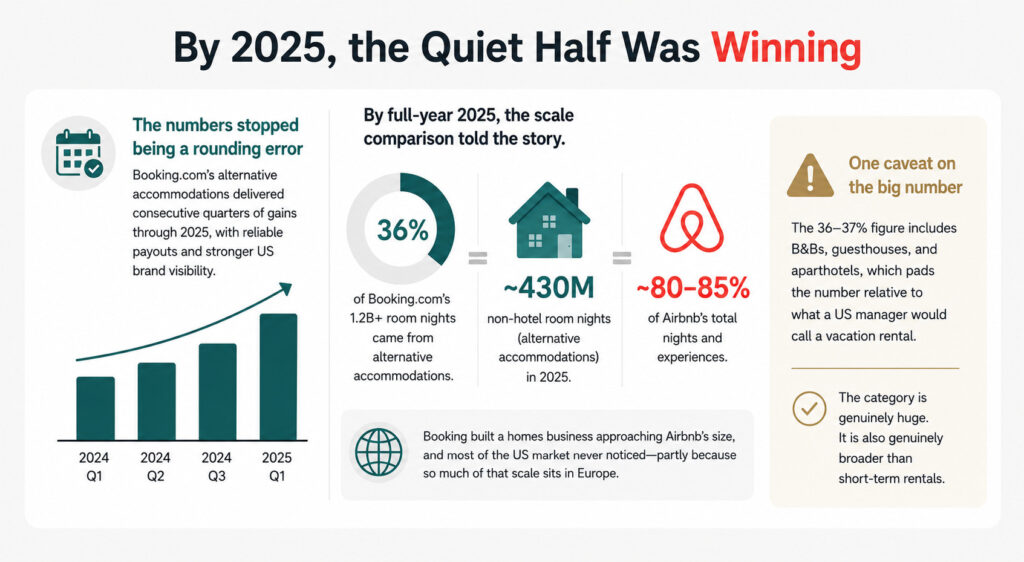
Skip ahead three years, and the picture looks different. Booking.com’s alternative accommodations, its umbrella term for vacation rentals, apartments, villas, guesthouses, B&Bs, and aparthotels, strung together consecutive quarters of gains through 2025, with reliable payouts and noticeably stronger US brand visibility along the way.
By the full-year 2025 results, the scale comparison had become the story. As we broke down earlier this year, roughly 36% of Booking’s 1.2 billion-plus room nights came from alternative accommodations.
That works out to around 430 million non-hotel room nights, or roughly 80 to 85% of Airbnb’s total nights and experiences. Booking built a homes business approaching Airbnb’s size, and most of the US market never noticed, partly because so much of that scale sits in Europe.
One caveat on the big number
That 36 to 37% figure is worth handling with care, and it’s a point we’ve made on RSU before. Booking’s alternative accommodations category includes B&Bs, guesthouses, and aparthotels, which pads the number relative to what a US manager would call a vacation rental. The category is genuinely huge. It is also genuinely broader than short-term rentals.
In Q2 2026, the US Is Growing. The Vacation Rental Piece Still Lags
What the quarter showed
The Q2 2026 results gave Booking real US progress to point to. US room nights grew high single digits, driven by domestic demand, and the company logged another quarter of direct channel growth in the US, meaning more American travelers coming straight to Booking rather than through paid links. Management credited years of what it called disciplined investments across product, supply, brand, marketing, and technology.
But alternative accommodations grew 4% globally against 5% for room nights overall, and management’s own explanation points at the US: growth this quarter skewed toward Agoda, Priceline, and the US market, where, in the company’s own words, its alternative accommodation offering is “relatively smaller.” Translation: Booking grew fastest in exactly the places where its vacation rental shelf is thinnest.
The broken record, verbatim
Glenn Fogel did not spin it. “I’d like that to be a lot higher. Specifically, I want to be a lot higher in the U.S. and boy, this sounds like a broken record,” he said, before listing the same three items he has listed for years: getting the right inventory, making US customers aware of it, and making sure partners like working with Booking.
Inventory, awareness, partner satisfaction. Supply, demand, and the relationship in between. It is the whole underdog problem, restated quarterly.
Booking’s US Playbook Is Grinding, Not Glamour
The playbook in the CEO’s own words
Asked about the US roadmap, Fogel described it as “grind it out”: improve the product, improve the service, get more inventory, make the marketing better, fix the localized things a global player tends to miss. No moonshot, no rebrand, no acquisition rumor. Just process, repeated until the numbers move.
My take
That grinding style is also why Booking can feel invisible in the US compared to its rivals. Over the past year, Airbnb poured money into brand marketing while Expedia and Vrbo built the flashy partnerships, including ones that let travelers book through social media platforms. Booking sat all of it out, and I do not think that is an accident or a failure of imagination. This is a performance marketing company to its bones (it dominated Google’s paid results for a decade while Airbnb bragged about direct traffic), and it invests where spend can be measured, optimized, and defended in a spreadsheet.
The catch is that the US problem Fogel keeps naming has an awareness component, and awareness is the one item on his list that does not respond well to grinding. You can fix payments with engineering and inventory with sales teams. Making American travelers think of Booking.com when they picture a lake house is brand work, the exact kind of unmeasurable spending this company is culturally allergic to. Four years of progress on the measurable items and a broken-record speech about the rest is, I would argue, the predictable result.
What Four Years of Courtship Means for US Property Managers
The pattern across 2022 to 2026 is consistent enough to treat as a condition rather than a campaign. Booking wants US vacation rental supply, has wanted it for years, has fixed the operational reasons managers used to avoid it, and is still not where it wants to be. Its CEO says so, on the record, quarterly.
Historically, that kind of sustained appetite has shown up in partner-facing improvements: the payments overhaul, request-to-book, better visibility tools. The observable trajectory suggests more of the same, because Booking’s stated gaps, inventory and partner satisfaction, are gaps only managers can close for it.
The underdog label has not fully come off. Booking’s US vacation rental business is bigger, more functional, and more visible than it was when the company was buying billboards outside Expedia’s conference. It is still not what its own CEO wants it to be. The difference between 2022 and 2026 is that back then, Booking was asking the US market to take it seriously. Now the market mostly does. The remaining question is whether the inventory follows, and that answer belongs, too, to property managers, not only to Booking.

Uvika Wahi is the Editor at RSU by PriceLabs, where she leads news coverage and analysis for professional short-term rental managers. She writes on Airbnb, Booking.com, Vrbo, regulations, and industry trends, helping managers make informed business decisions. Uvika also presents at global industry events such as SCALE, VITUR, and Direct Booking Success Summit.
Related Articles:
 Bali Targets Illegal Tourist Villas, Booking.com Partners with Antom, British Columbia mandates rental registry
 Booking.com’s Super Bowl LIX Ads Feature The Muppets, Promise Easy Travel for Everyone
 2026 Travel Trends: Intentional, Emotional, Experience-Led
 Airbnb Names New CTO, Booking.com’s Japan Play, Morocco Signals Regulations