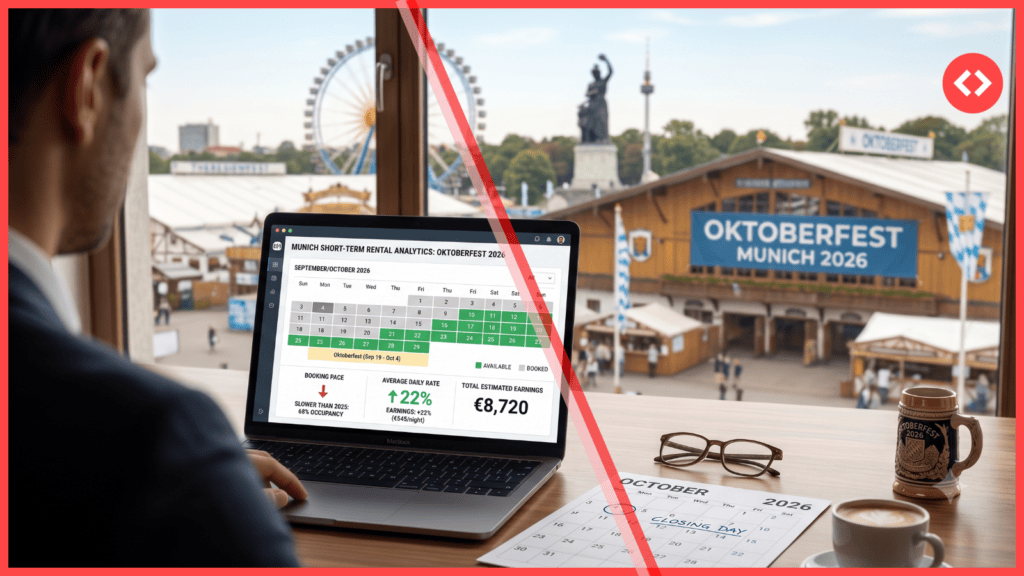
Munich goes into its biggest event of the year with fewer rentals than it had two years ago, booking slower than last year, and charging more than ever. Only one of those three is a problem.
For short-term rental managers, Oktoberfest is one of Europe’s most dependable demand spikes, and the patterns it shows apply to any recurring event. PriceLabs data on Munich’s Airbnb market, as of September 23, shows how it is performing this year.
Before getting to the numbers, it helps to understand what kind of event Oktoberfest is, and who it draws.
Oktoberfest 2026 is a 16-day festival spread across three weekends
The 191st Oktoberfest takes place from September 19 to October 4, 2026, on the Theresienwiese, a festival ground a 15-minute walk from Munich’s main station. It is a huge 16-day event, though very few visitors attend all 16 days.

Even so, it does not behave like a weekend festival. Demand holds up through the week, because much of it comes from businesses as well as tourists.
What the festival grounds look like
- 17 large beer tents and 21 small ones, plus more than 100 rides and stalls
- Free entry to the grounds and tents, except the Oide Wiesn, a historic section with vintage rides and traditional music, which charges €4
- Three weekends, with quieter weekdays in between
A business event as much as a tourist one
Bavarian companies bring clients and staff to the tents, and tables are reserved months ahead, much like corporate boxes at a stadium. That keeps weekday demand steadier than at a typical festival.
Attendance is back to normal after a post-pandemic spike
Attendance jumped to 7.2 million in 2023, the highest since 1980, as crowds returned after COVID. It settled at 6.7 million in 2024 and 6.5 million in 2025, according to the City of Munich.
That is close to the festival’s usual size. Earlier editions drew similar crowds, around 6.5 million in 1999 and 6.4 million in 2013.
What is different this year
The average price of a Maß, the one-liter stein that is Oktoberfest’s standard serving, rose about 2% to €15.61, according to EU Today. Some tents, including the Schichtl and the Schützenlisl, did not raise their prices at all, according to Wiesnkini.
The calendar also shifted. German Unity Day, a national holiday on October 3, fell on a Friday in 2025 and created a three-day closing weekend, but in 2026 it falls on a Saturday.
Most Oktoberfest visitors are local, and Italy leads the foreign crowd
Most visitors come from Munich and the surrounding region, around 206,000 people a day in 2025, according to Vodafone’s analysis of mobile network data. Outside Bavaria the numbers collapse, with Berlin, Stuttgart and Frankfurt the next-largest domestic sources.
Two-thirds of visitors arrive by road and a third by train. That matters for the travel-cost story later in this piece.
About 21% to 27% of visitors are foreign, led by Italy and France
Foreign visitors make up roughly a fifth to a quarter of attendance. The largest groups in 2025, by average daily visitors, according to Vodafone:
| Country | Visitors per day |
|---|---|
| Italy | 8,034 |
| France | 5,223 |
| Netherlands | 5,122 |
| Switzerland | 4,944 |
| Austria | 4,508 |
| United States | ~3,700 |
Five of the top six are within driving distance of Munich. The US contingent, which dominates Oktoberfest’s global image, is smaller than the Dutch one.
Bookings from India and Japan surged in 2026, while the US and UK fell
According to Amadeus air booking data for the festival period, year over year:
- India up 60% and Japan up 31%
- United States down 10%, though still 37% of international bookings
- United Kingdom down 16%
- Spain up 8%, Canada up 9%, Italy up 7%, Australia up 6%
Amadeus also found that solo travelers now make up 47% of bookings, up 2.2 points, while pairs fell 4.6 points to 33%. Bookings of 14 nights or longer rose 13% and now exceed 6% of the total.
Group demand likely comes from visitors who drive in
Groups of six or more make up only 7% of air bookings, according to Amadeus. Yet on the PriceLabs dashboard, listings that sleep five or more guests are 13.3% of Munich supply and take 18.6% of bookings.
The dashboard figure covers the full year rather than the festival alone, but it suggests larger groups are arriving by car or train rather than by air. The festival’s audience is shifting, and so is the rental market that serves it.
Munich short-term rental supply is shrinking
The Munich rental market that Oktoberfest arrived in is smaller than it used to be. According to PriceLabs, Munich’s active listings were down year over year every month from January to July 2026, and up just 3.2% in August.
Germany grew every month over the same period. By August it had about 39,000 more listings than a year earlier, up 10.9%, while Munich had 170 more.
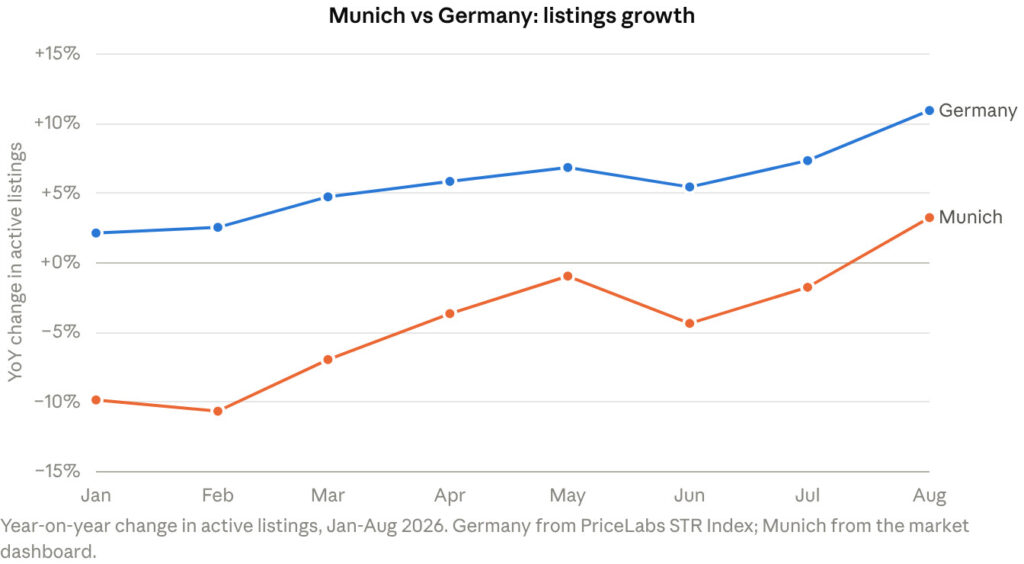
The German figures come from the PriceLabs STR Index and the Munich figures from a PriceLabs dashboard covering 15 km around the city center. The two measure different areas, so the comparison uses growth rates rather than totals.
Munich’s decline started well before 2026
Between September 2024 and September 2025, Munich’s active listings fell 13.2% while Germany’s rose 0.7%. Whatever is shrinking Munich’s supply was already at work before this year’s travel disruptions.
Munich’s rules squeeze out casual hosts
Since 2017, Munich has restricted short-term rentals under Bavaria’s housing misuse law, the Zweckentfremdungsgesetz. According to the city’s landlord guidance, hosts can rent out their whole primary home for a maximum of eight weeks a year, and pure tourist use is effectively barred.
Munich is also Germany’s most expensive property market, which discourages casual hosting on its own. The eight-week cap is likely the main driver, though the data cannot separate it from housing costs.
Read More: EU Affordable Housing Act: What Changed in the Official Text
Oktoberfest 2026 occupancy is behind last year on 14 of 16 nights
That is the market Oktoberfest 2026 arrived in, and so far it is booking slower. As of September 23, 65.8% of available festival nights were booked, against 71.6% at the same point last year, according to PriceLabs.
Occupancy here is the share of available nights that are booked, leaving out nights hosts have blocked off. Because the festival started a day earlier this year, the table compares each night with the same weekday last year, so Saturday sits against Saturday.
| Night (2026) | Booked now | Booked at this point last year | Difference (points) |
|---|---|---|---|
| Sat, Sep 19 | 82.1% | 87.1% | -5.0 |
| Sun, Sep 20 | 73.6% | 77.8% | -4.2 |
| Mon, Sep 21 | 73.5% | 81.5% | -8.0 |
| Tue, Sep 22 | 68.3% | 79.9% | -11.6 |
| Wed, Sep 23 | 65.8% | 79.5% | -13.7 |
| Thu, Sep 24 | 72.2% | 82.2% | -10.0 |
| Fri, Sep 25 | 82.2% | 89.1% | -6.9 |
| Sat, Sep 26 | 80.8% | 85.9% | -5.1 |
| Sun, Sep 27 | 53.3% | 62.1% | -8.8 |
| Mon, Sep 28 | 57.9% | 60.1% | -2.2 |
| Tue, Sep 29 | 57.9% | 54.5% | +3.4 |
| Wed, Sep 30 | 55.7% | 51.1% | +4.6 |
| Thu, Oct 1 | 57.5% | 59.3% | -1.8 |
| Fri, Oct 2 | 65.3% | 70.9% | -5.6 |
| Sat, Oct 3 | 62.2% | 70.1% | -7.9 |
| Sun, Oct 4 | 45.0% | 54.5% | -9.5 |
The festival is likely to finish around 73% occupancy
Last year’s festival finished at 79.0% occupancy. If late bookings arrive at the same pace as last year, this year’s would finish around 73.3%, about six points lower.
That gap is smaller than today’s numbers suggest, because many bookings are made in the final days before a stay.
The closing weekend comparison is not like for like
The closing weekend is 5.6 to 9.5 points behind, but last year’s comparison Friday was the German Unity Day holiday. Some of that shortfall is likely the calendar rather than weaker demand.
Munich hotels are behind too
According to Amadeus, Munich hotels were 70.9% booked for September 13 to 27 as of August 20, against 76.2% at the same point in 2025. Hotels and short-term rentals are showing the same slowdown.
Oktoberfest nightly rates rose 9.2% while normal Munich rates stayed flat
Fewer nights booked would normally mean less money for hosts. But the median nightly rate guests paid during the festival rose 9.2% this year to $283.90, according to PriceLabs.
Outside the festival, Munich rates did not move. The median rate guests paid for September 1 to 15 was $145.20, the same as in 2024 and slightly below 2025.
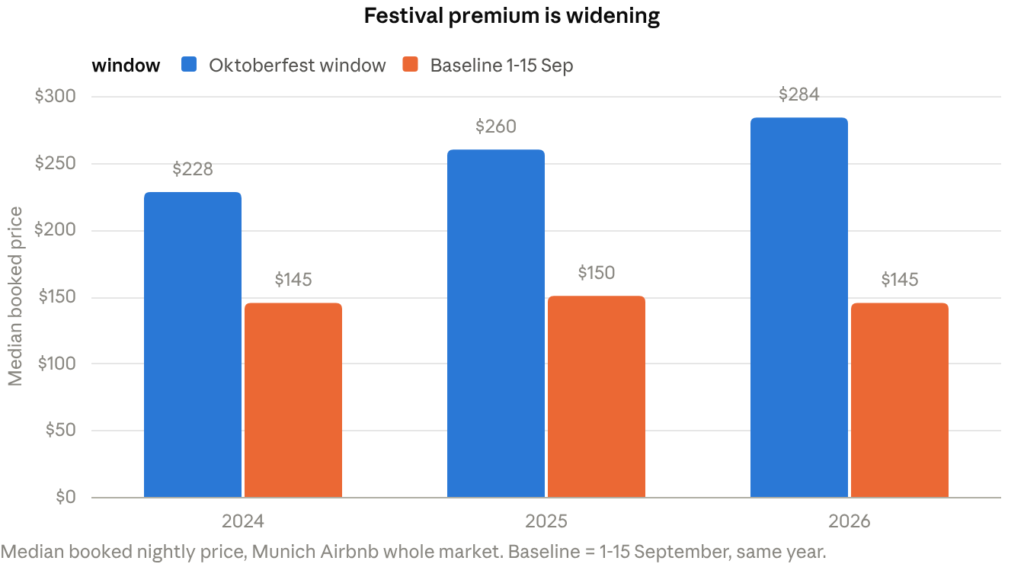
The Oktoberfest premium has widened every year
Compared with each year’s normal September rates, the festival premium has grown:
- 2024: 1.57 times normal rates
- 2025: 1.73 times
- 2026: 1.96 times
Hosts now charge close to double their usual rate during Oktoberfest. The tents, by comparison, raised the price of a Maß by about 2%.
So occupancy is down and rates are up. The question is which effect is bigger.
Oktoberfest RevPAR is slightly ahead of last year despite lower occupancy
RevPAR, or revenue per available rental, is what a host earns per property per night, whether it is booked or not. It combines occupancy and rate into one number.
| Year | Occupancy | Median rate paid | RevPAR |
|---|---|---|---|
| 2024 | 78.0% | $228.20 | $177.90 |
| 2025 | 79.0% | $259.90 | $205.40 |
| 2026 (projected) | 73.3% | $283.90 | $208.10 |
Calculated from PriceLabs data, Oktoberfest 2026 RevPAR comes to about $208, 1.3% ahead of last year and 17% ahead of 2024. PriceLabs’ own September booking curves show the same pattern.
Higher rates only just covered the lost occupancy
For a typical host, six points less occupancy and 9.2% more per night left them 1.3% ahead of last year. That is a thin cushion.
If occupancy falls again next year, rates would need to rise further just to stand still. Where the festival loses bookings, and where it holds them, is where the pricing story gets more useful.
Oktoberfest weekends book far better than weekdays, but are priced only slightly higher
Friday and Saturday nights during the festival are 74.5% booked on average, against 61.9% for Sunday to Thursday. Yet the median listed price for weekend nights is only about 10% higher, $367 against $332.
In other words, weekend demand is much stronger than weekend pricing suggests.
The closing weekend is priced like the peaks but booking well below them
The peak nights of the first two weekends are about 81% to 82% booked. The closing weekend, October 2 and 3, is 62% to 65% booked, yet priced within about 3% of them.
Part of that gap is the missing holiday. Pricing on those nights has not adjusted for it.
Listed prices overstate what is selling
Across the festival, the median price of booked nights was 17.2% below the median listed price. That is likely because cheaper listings fill first, so the listings still showing prices are mostly the expensive ones.
The high asking prices in market tools, such as $786 a night at the top end on the peak Friday, show what is still unsold rather than what guests are paying.
Guests who booked early paid the most
Average nightly rates paid, by how far ahead guests booked:
| Booked | Whole festival | Quieter midweek, Sep 28 to 30 |
|---|---|---|
| More than 30 days ahead | $313 | $317 |
| 8 to 30 days ahead | $294 | $283 |
| In the final 7 days | $304 | $286 |
On quieter nights, late bookers paid about 10% less than guests who committed early. The guests who booked earliest appear to be the least sensitive to price.
Long-haul Oktoberfest bookings fell as jet fuel prices spiked
The clearest clue to who stopped booking is where guests are coming from. Higher airfares likely explain most of the drop.
Jet fuel prices doubled after the Strait of Hormuz closed on February 28, and IATA expects them to average 69% higher in 2026, pushing return fares up 7.7%. Europe is especially exposed, importing about 80% of its jet fuel from the Gulf.
Oktoberfest bookings shifted toward nearby markets
IATA expected travelers to switch from long-haul trips to trips closer to home. The Oktoberfest booking data matches that:
- Long-haul markets fell: US air bookings down 10%, UK down 16%
- Nearby markets held or grew: Italy up 7%, Spain up 8%
Oktoberfest’s core audience is local and arrives by road, so higher airfares thin out the edges of the crowd rather than its center. India and Japan are the exception, both long-haul and both sharply up, and the data offers no clear explanation for them.
Event demand under pressure: fewer guests, but less price-sensitive ones
Airfares explain why fewer nights were booked, but not why rates rose at the same time. The likely answer is that demand did not shrink evenly: the travelers who dropped out were the ones least willing to pay.
The guests who still came, and especially those who booked early, appear to be less sensitive to price. That is how occupancy can fall while rates, and revenue per rental, go up.
Read More: FIFA World Cup 2026: Why STR Bookings Are Stalling
The World Cup showed the same demand pattern, with one difference
RSU saw a similar pattern during the FIFA World Cup 2026, where many US host cities had much higher rates, flat or lower occupancy, and higher RevPAR.
The difference is supply. Rental listings grew in World Cup host cities, while Munich is serving its biggest event with fewer rentals than it had two years ago.
What Oktoberfest 2026 shows short-term rental managers about recurring events
Oktoberfest is long, annual and shifts by a day or two each year, which makes it a useful test case. Several patterns in this data are likely to hold for other recurring events.
- Early bookers paid the most. Guests who committed more than a month ahead paid more than those who booked late, especially on quieter nights.
- Weekends outperformed their pricing. Peak nights booked about 13 points better than weekdays at only about 10% higher prices.
- Holidays can distort a year-over-year comparison. A holiday moving from a Friday to a Saturday changed the closing weekend.
- Comparisons only work weekday to weekday. When an event shifts by a day, the same calendar dates fall on different days of the week.
- National trends provide context. Munich’s supply only looked like a local story once it was set against Germany’s growth.

Uvika Wahi is the Editor at RSU by PriceLabs, where she leads news coverage and analysis for professional short-term rental managers. She writes on Airbnb, Booking.com, Vrbo, regulations, and industry trends, helping managers make informed business decisions. Uvika also presents at global industry events such as SCALE, VITUR, and Direct Booking Success Summit.
Related Articles:
 Super Bowl LIX New Orleans 2025: The Tightrope of Regulations and Heavy Demand
 Illegal Price Gouging During LA Fires: Airbnb Implements Host Pricing Restrictions
 Vrbo Q2 2025 Results Show Clear Shift Toward Promotions, Shorter Stays, and Bundled Value
 FIFA World Cup 2026: Six Weeks Out, the Demand Environment Is Showing Serious Strain