

Updates in short-term rental policies this week. Pittsburgh headed toward a fall zoning fight over unhosted investor units, Rome’s city council rewrote its urban master plan to choke off short-term conversions in specific districts, and Baguio City moved to require registration through a digital tourism portal built to catch scammers rather than protect housing supply. The common thread: cities are reaching for zoning codes and digital registries instead of, or ahead of, dedicated short-term rental licensing fights.
Pittsburgh prepares for a fall zoning vote
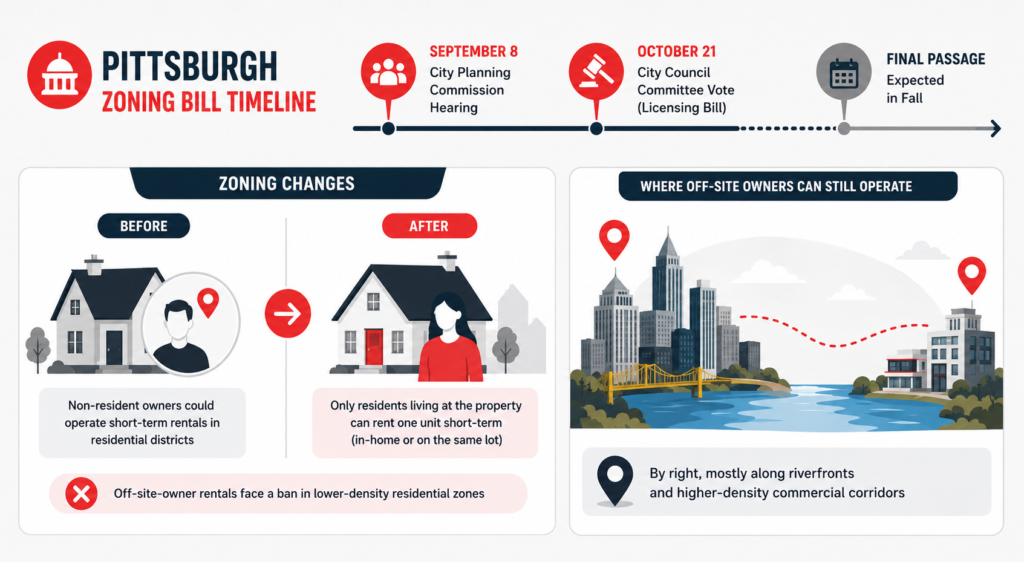
Pittsburgh’s City Planning Commission holds a hearing on the zoning bill on September 8, after council and the commission punted the issue past their August recess. City Council’s own committee vote on the companion licensing bill is tentatively set for October 21, and final passage on either bill isn’t expected before fall.
The zoning bill eliminates the special-exception pathway that currently lets non-resident owners operate short-term rentals in residential districts. Under the revised bill, only residents living at the property could rent one unit short-term, whether in-home or in a separate structure on the same lot. That leaves off-site-owner rentals facing a ban in the city’s lower-density residential zones going forward. Short-term rentals with off-site owners would still be allowed by right, but mostly along Pittsburgh’s riverfronts and the city’s higher-density commercial corridors, under Council Bill 2026-0009.
Uvika’s views
- Securing grandfathered status. We flagged Pittsburgh’s early moves earlier this year, and the timeline has since firmed up around a fall vote. As drafted, existing short-term rentals in newly restricted zones could be grandfathered in by applying for an updated certificate of occupancy documenting the property’s prior use. Professional managers can start compiling historical booking data and tax receipts now, ahead of whatever filing window the final ordinance sets.
- Hyper-local expansion strategies. Because the bill would confine off-site-owner units to specific corridors, scattering inventory across random residential blocks stops working as a strategy if it passes. Operators can treat acquisition like commercial real estate from here, verifying zoning clearance before signing a lease or closing on a property.
- Leveraging the “by right” premium. Properties in the approved by-right zones would likely command a premium if the bill passes. Sales efforts can start shifting toward owners in these specific pockets now, ahead of the fall vote, given the lower regulatory risk these assets would carry.
Rome approves general regulatory plan limits
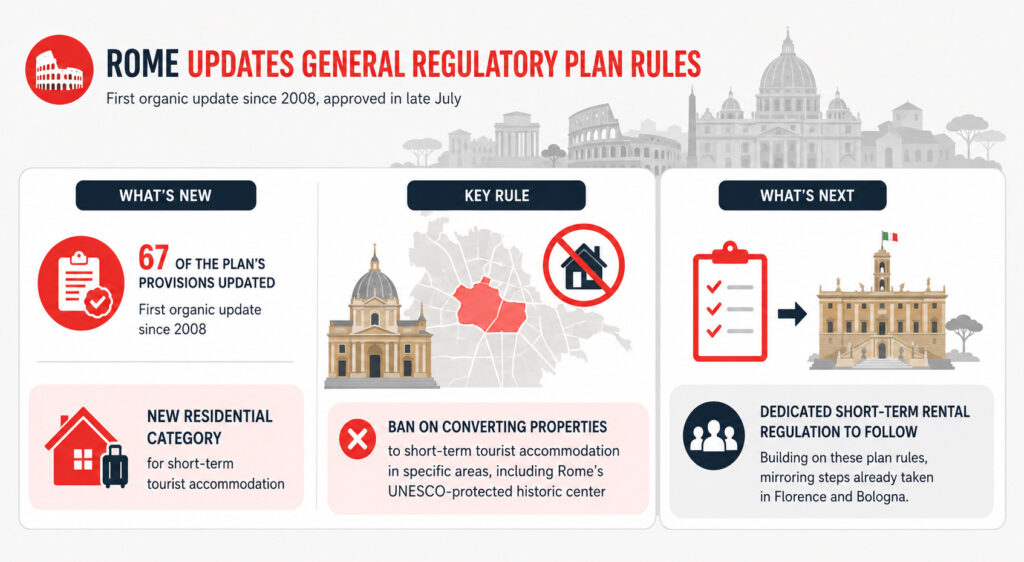
Rome’s Assemblea Capitolina approved new technical implementation rules for its General Regulatory Plan in late July, the first organic update to these rules since 2008, touching 67 of the plan’s provisions. The update creates a new residential category for short-term tourist accommodation and bans converting properties to it in specific areas, including Rome’s UNESCO-protected historic center.

City officials have said a dedicated short-term rental regulation will follow, building on these plan rules, mirroring steps already taken in Florence and Bologna.
Uvika’s views
- Bypassing licensing debates. We’ve tracked Italy’s tightening regulatory landscape extensively, from keybox bans to Florence’s geographic expansion of its short-term rental ban earlier this summer. European capitals are increasingly using urban planning and zoning codes to get ahead of the more contentious tourist licensing fights entirely.
- Navigating change-of-use permits. When a city ties short-term rentals to its master plan, operating an unhosted unit becomes a matter of commercial zoning first. Property managers can audit portfolios now to confirm properties hold the correct designation, rather than relying on a basic tourist tax ID.
- Pivoting to commercial assets. As residential zoning gets harder to work with, acquisition strategies can shift toward commercially zoned properties or boutique aparthotels, which sit outside these residential change-of-use restrictions.
Baguio City moves to require VISITA registration
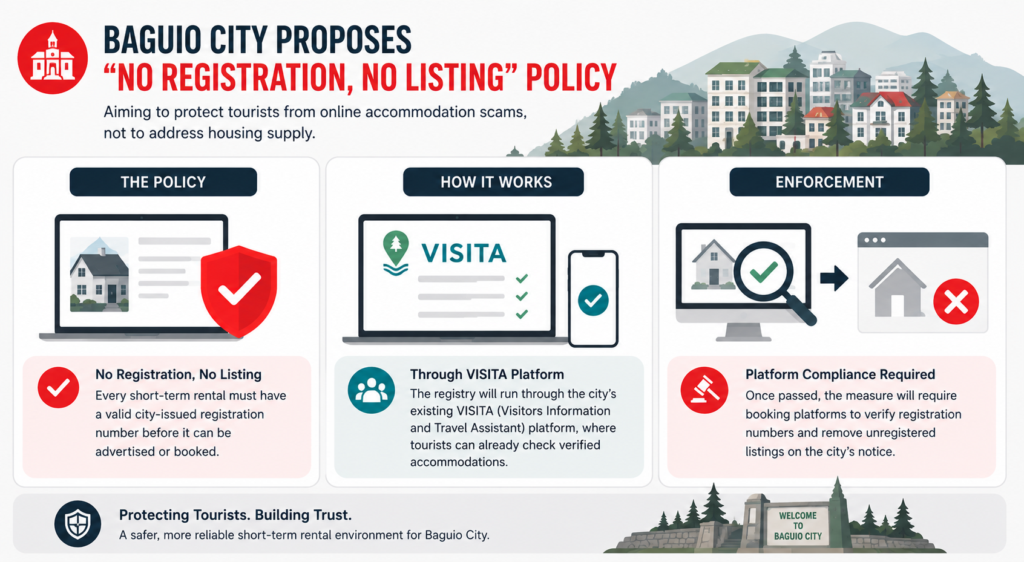
Baguio City’s local government is proposing a “no registration, no listing” policy that would require every short-term rental to carry a valid city-issued registration number before it can be advertised or booked, according to Councilor Yuri Weygan. The measure is aimed primarily at online accommodation scams, where tourists have arrived to find they paid for rentals that don’t exist, rather than at housing supply.
The registry would run through the city’s existing VISITA (Visitors Information and Travel Assistant) platform, which already lets tourists check a list of verified accommodations. Once passed, the measure would also require booking platforms to verify registration numbers and remove unregistered listings on the city’s notice.
Uvika’s views
- The anti-fraud rationale. It’s notable to see a registration mandate built around consumer protection rather than the housing-shortage narrative that usually drives this kind of policy. In APAC markets, tourist safety and fraud prevention can carry as much regulatory weight as preserving local housing stock.
- Leveraging “verified” status. If the measure passes, compliance becomes a marketing edge. Displaying a verified VISITA registration prominently in listing titles and photos could help operators capture booking share from travelers specifically looking to avoid scams.
- Adapting to digital gateways. Central digital portals are becoming a common enforcement tool across APAC markets. Operators can watch how Baguio’s proposal develops and start planning for property management system integrations with local gateways as these registries move from proposal to law.
Stay on top of short-term rental regulation trends and what they mean for your operating environment.

Uvika Wahi is the Editor at RSU by PriceLabs, where she leads news coverage and analysis for professional short-term rental managers. She writes on Airbnb, Booking.com, Vrbo, regulations, and industry trends, helping managers make informed business decisions. Uvika also presents at global industry events such as SCALE, VITUR, and Direct Booking Success Summit.
Related Articles:
 Stricter Rental Laws in Greece, Airbnb Shares Valentine’s Day Trends, and Gen Z’s Winter Travel Shifts
 Amsterdam Eyes Stricter Rental Caps, Hostaway Unveils AI Suite, and Homelike Shuts Down
 Three Cities, Three Responses: Amsterdam Cracks Down, Manistee Finds Middle Ground, Maui Ban Hits Pause
 Chicago Sues Airbnb, Kelowna Gets Provincial Exemption, Ireland Clarifies Planning Rules