

Booking Holdings, the parent company of Booking.com, had a better second quarter than it told investors to expect, and it happened in a quarter where long-haul international travel was genuinely struggling. Flights got more expensive, and there were fewer of them, both consequences of the Middle East conflict, and travelers responded by staying off intercontinental routes.
What they did not do is stay home. They swapped the faraway trip for a closer one, booked it later, and paid a little more per night for it. Booking’s platforms caught that redirected demand, and the company’s own expectations for the third quarter assume the pattern continues.
Here are the numbers that matter from the earnings call held August 4:
- Room nights grew 5% compared to the same quarter last year, ahead of what the company had forecast
- Total travel booked on its platforms (gross bookings) rose 9%, also well ahead of forecast
- Revenue increased 8%
- Adjusted EBITDA, the company’s main profit measure, came in around $2.6 billion, up 9%
- Alternative accommodation room nights on Booking.com grew 4%, slower than the platform overall, and held steady at roughly 37% of Booking.com’s room nights, the same share as a year ago (alternative accommodations is Booking’s umbrella term for everything that isn’t a hotel: vacation rentals, apartments, villas, guesthouses, B&Bs, and aparthotels)
- Domestic room nights grew high single digits globally, while international room nights barely grew at all
- For Q3, Booking expects room nights to grow 3% to 5%, and gross bookings, revenue, and profit to each grow 4% to 6%
Read more: Booking.com Q1 2026: resilience under fire, and why domestic travel may be this summer’s wildcard

Travelers Didn’t Cancel, Yet Swapped Faraway Trips for Closer Ones
What happened
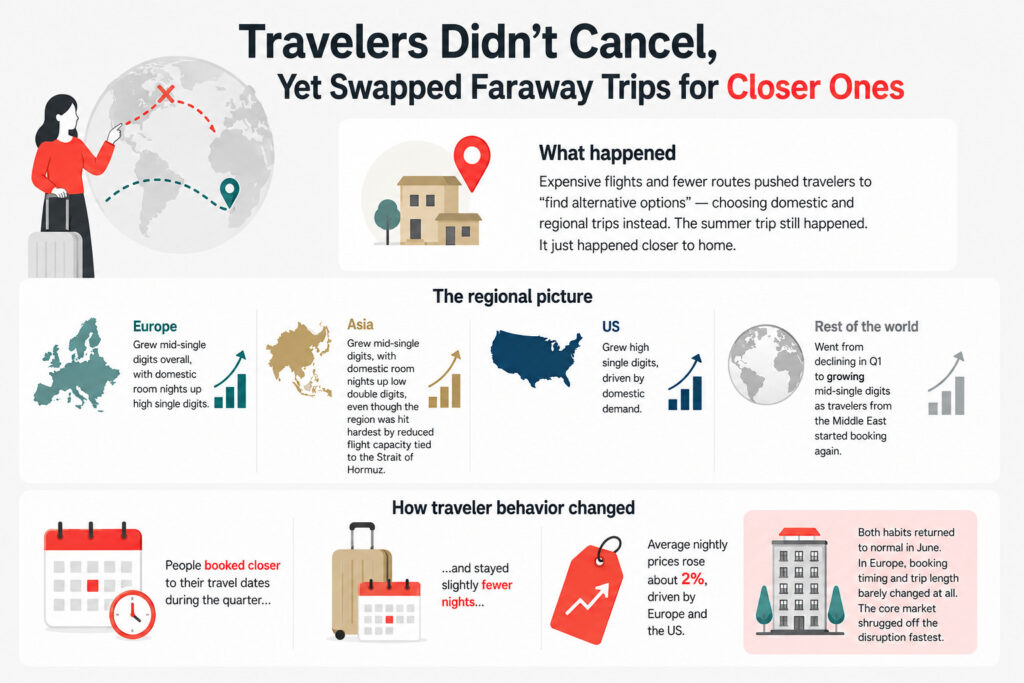
CFO Ewout Steenbergen put it plainly: faced with expensive flights and fewer routes, travelers “found alternative options” and chose domestic and regional trips instead. The summer trip still happened. It just happened closer to home.
The word resilience came up constantly on the call, and it is worth being precise about what it actually describes. Demand did not hold steady everywhere. It held steady in total because one kind of travel picked up what another kind lost. Long-haul international trips suffered. Domestic and regional trips more than covered for them.
The regional picture
The pattern shows up everywhere:
- Europe grew mid-single digits overall, with domestic room nights up high single digits
- Asia grew mid-single digits, with domestic room nights up low double digits, even though the region was hit hardest by reduced flight capacity tied to the Strait of Hormuz
- The US grew high single digits, driven by domestic demand
- The rest of the world went from declining in Q1 to growing mid-single digits as travelers from the Middle East started booking again
How traveler behavior changed
People booked closer to their travel dates and stayed slightly fewer nights during the quarter, which is what last-minute, close-to-home substitution looks like. Both habits returned to normal in June. Average nightly prices rose about 2%, driven by Europe and the US, so travelers paid a bit more for the trips they did take.
In Europe, Booking’s largest region, booking timing and trip length barely changed at all. The core market shrugged off the disruption fastest.
Alternative Accommodations Grew 4%, and Booking.com Wants a Lot More
The numbers
Alternative accommodation room nights on Booking.com grew 4% against 5% for room nights overall, and the category held flat at roughly 37% of Booking.com’s room nights, the same share as Q2 2025.
Booking’s explanation
Mix. Growth this quarter leaned toward Agoda, Priceline, and the US, and all three skew toward hotels compared to Booking.com’s European heartland. The Middle East conflict took its own bite, since vacation rentals rely heavily on exactly the kind of long-haul European travel that suffered most.
The broken record moment
Fogel did not hide behind that explanation. “I’d like that to be a lot higher. Specifically, I want to be a lot higher in the U.S.,” he said, before catching himself sounding like “a broken record” about US inventory, customer awareness, and partner satisfaction.
He has been giving a version of this speech for four years, and the persistence is the story. We trace that arc, from the 2022 “Think Bigger” campaign to today, in a companion piece on Booking’s long US vacation rental push.
Read more: Booking.com Has Spent Four Years Being the Underdog in US Vacation Rentals, and It’s Tired of It
Accommodations Barely Felt the Conflict. Flights Took the Hit for Them
Why accommodations held up
The line from the call that explains the whole quarter came from Steenbergen: most of Booking’s money comes from accommodation bookings, and those “weren’t so much impacted” by what happened to the airlines.
The substitution worked in accommodations’ favor. When a traveler swapped a long-haul flight-plus-hotel trip for a domestic drive-to stay, the flight disappeared but the stay did not. It just moved. Booking lost a flight ticket it earns little on and kept the room night it earns most on. For anyone whose business is the stay itself, that is the structural reassurance in this quarter: the room night proved to be the most durable part of the trip.
Read more: Booking.com Has Spent Four Years Being the Underdog in US Vacation Rentals, and It’s Tired of It
What happened to everything else
Flight tickets grew just 4%, a sharp slowdown, though Steenbergen argued this still outpaced an airline industry flying fewer planes at higher prices. Rental cars softened. Attraction tickets grew double digits, presumably because the closer-to-home trip still needs things to do.
The forecast tells the same story. Booking lowered its full-year expectations for total bookings because of slower flight growth, while its accommodation outlook stayed unchanged. Same mechanism, written into the numbers.
Booking’s Q3 Outlook Assumes the Disruption Continues
The expectations
For Q3, Booking expects room nights to grow 3% to 5%, with gross bookings, revenue, and profit each growing 4% to 6%. For the full year, it still expects high single-digit growth across the board.
The assumptions underneath
Booking is explicitly assuming that expensive flights, reduced capacity on certain routes, and softer long-haul international demand all persist through the end of Q3. It assumes travel into the Middle East stays under pressure while travelers from the region keep booking normally. Steenbergen noted the full-year outlook is still in line with the company’s long-term growth targets despite building in seven months of conflict impact out of twelve.
Our read: this is a company planning for the reroute to be the pattern, not the exception. Booking is not counting on long-haul travel recovering. It is counting on another quarter of domestic substitution and telling investors it can hit its targets anyway.
AI Sends Booking Almost No Bookings, and Google Search Is Quietly Slipping
What Booking shared
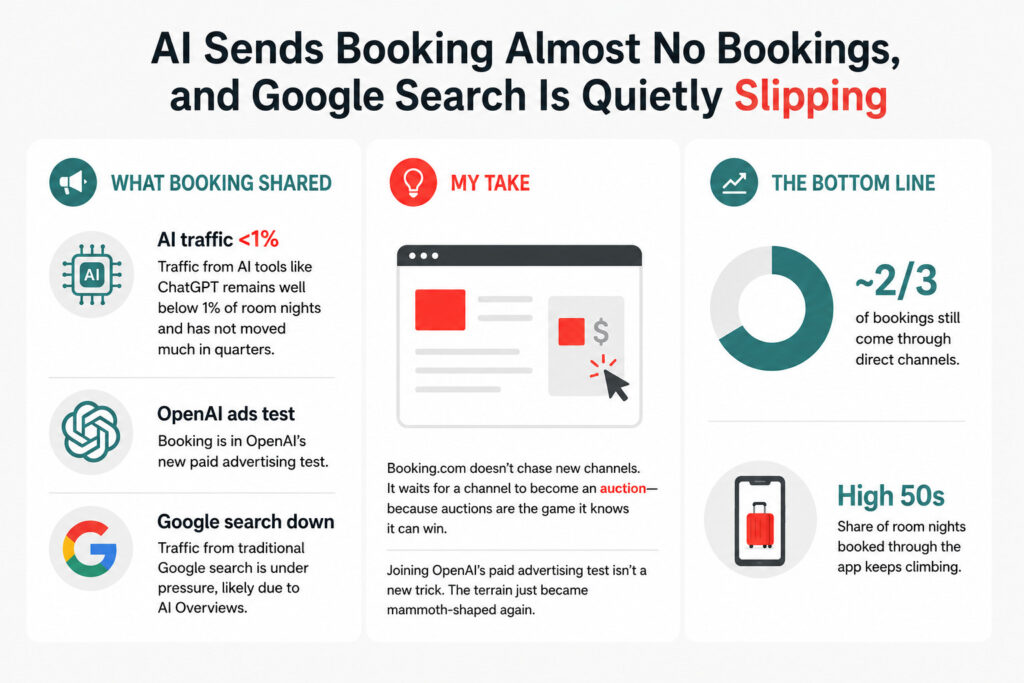
The short version, because this deserves its own article and gets one. Traffic arriving from AI tools like ChatGPT, whether paid or organic, remains well below 1% of room nights and has not moved much in quarters. Booking is part of the test group for OpenAI’s new paid advertising, which Steenbergen said plays to the company’s long-standing strength in performance marketing. Google’s AI-powered booking experience launched around the day of the call, with Booking among the first partners.
At the same time, management acknowledged for the second straight quarter that traffic from traditional Google search is under pressure, pointing to Google’s AI Overviews as the likely cause. Their counter-evidence that the direct relationship with travelers is holding: about two thirds of bookings still come through direct channels, and the share of room nights booked through the app keeps climbing, now in the high 50s.
The most honest moment on the topic came when Fogel was asked whether travelers who research on AI end up booking directly with hotels: “I don’t know, they don’t tell me.”
Our full analysis of what that under-1% figure does and does not capture is in the companion AI piece.
My take
Booking.com is a mammoth, and mammoths do not make quick pivots. You can see it in the company’s marketing over the past year. While Airbnb poured money into brand campaigns and Expedia and Vrbo built partnerships that let travelers book through social media platforms, Booking sat those trends out almost entirely.
But I do not think that is slowness. Listen to Glenn Fogel talk and you hear a performance marketing bent through and through (this is the company that dominated Google’s paid results for a decade while Airbnb bragged about its direct traffic). Booking does not chase new channels. It waits for a channel to turn into an auction, because auctions are the game it knows it can win. That is exactly what joining OpenAI’s paid advertising test is. The mammoth did not learn a new trick. The terrain just became mammoth-shaped again.
What Booking’s Q2 2026 Results Signal for Short-Term Rental Managers
The demand that showed up in Q2 was domestic, regional, booked closer to arrival, and paying slightly higher nightly rates. Booking expects that profile to continue through Q3. The observable pattern for operators: markets serving drive-to and regional travelers absorbed the demand that long-haul routes lost, while destinations that depend on intercontinental arrivals carried the pressure.
The other signal is where Booking’s attention sits. The CEO of the world’s largest travel platform spent part of an earnings call repeating, by his own description, a broken-record speech about needing more US vacation rental inventory and happier partners. That kind of persistence tends to show up over time in partner-facing terms, tools, and visibility, and it has, gradually, for four years running.
The headline is that Booking did better than expected in a disrupted market. The more useful takeaway is how: travel demand did not shrink under pressure, it changed shape, and the platforms and operators positioned where it landed were the ones who caught it.

Uvika Wahi is the Editor at RSU by PriceLabs, where she leads news coverage and analysis for professional short-term rental managers. She writes on Airbnb, Booking.com, Vrbo, regulations, and industry trends, helping managers make informed business decisions. Uvika also presents at global industry events such as SCALE, VITUR, and Direct Booking Success Summit.
Related Articles:
 Bali Targets Illegal Tourist Villas, Booking.com Partners with Antom, British Columbia mandates rental registry
 Booking.com’s Super Bowl LIX Ads Feature The Muppets, Promise Easy Travel for Everyone
 2026 Travel Trends: Intentional, Emotional, Experience-Led
 Airbnb Names New CTO, Booking.com’s Japan Play, Morocco Signals Regulations