

Vacation rental laws moved on three fronts this week. Greece, Spain, and Colorado each acted on policies affecting operators: an aggressive urban phase-out in Europe, a national court win for regional authorities, and mountain-destination formalization in the US. It follows last week’s roundup covering Chicago, Croatia, and Florence.
Greece Moves to Strip Registrations on Any Change of Ownership
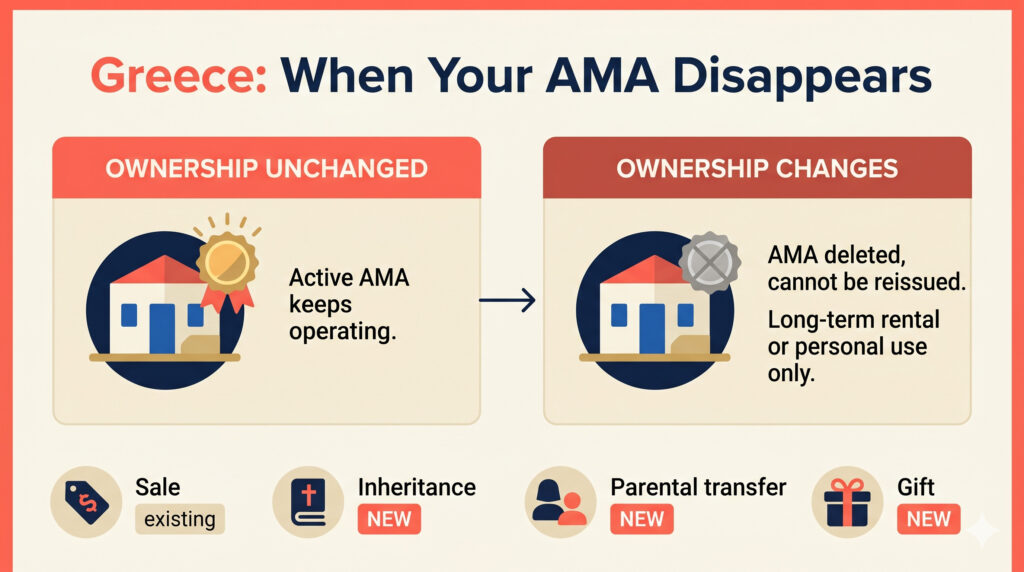
- A new Finance Ministry bill proposes deleting a property’s short-term rental registration number (AMA) in central Athens and Thessaloniki on any change of ownership, including inheritance, parental transfers, and gifts. The current rule already deletes the AMA on sale in these zones.
- Existing active listings can keep operating, provided ownership does not change. The deletion triggers only on transfer.
- The new owner cannot obtain a fresh AMA in the restricted zone and must use the property for long-term rental or personal occupation.
- STAMA Greece and the Panhellenic Property Owners Federation (POMIDA) both oppose the provision. STAMA estimates more than 10,000 owners and families could be affected and argues many of these units were converted commercial spaces unsuitable for long-term housing, so removing them adds little to housing supply. POMIDA argues the AMA is tied to the property’s compliance, not the owner’s identity, and should survive transfer.
Uvika’s Views
- The Squeeze Continues: As we’ve covered previously at RSU, Greece has been steadily tightening the screws: freezing new registrations in central Athens, extending that freeze through 2026, and pushing the same model into Thessaloniki from March. Deleting the AMA on inheritance confirms this is a structural phase-out, not a temporary pause.
- Asset Valuation Risk: Stripping the operational right on transfer hits property valuations directly. An inherited unit that loses its AMA earns far less than an identical neighboring unit that keeps its active status. Operators in central Athens and Thessaloniki are now pricing this generational cliff into long-term portfolio planning, and POMIDA’s proposed “continuity model” (an administrative update rather than full cancellation on transfer) is the compromise the industry will push for during consultation.
Spain’s Supreme Court Overturns the National Short-Term Rental Register
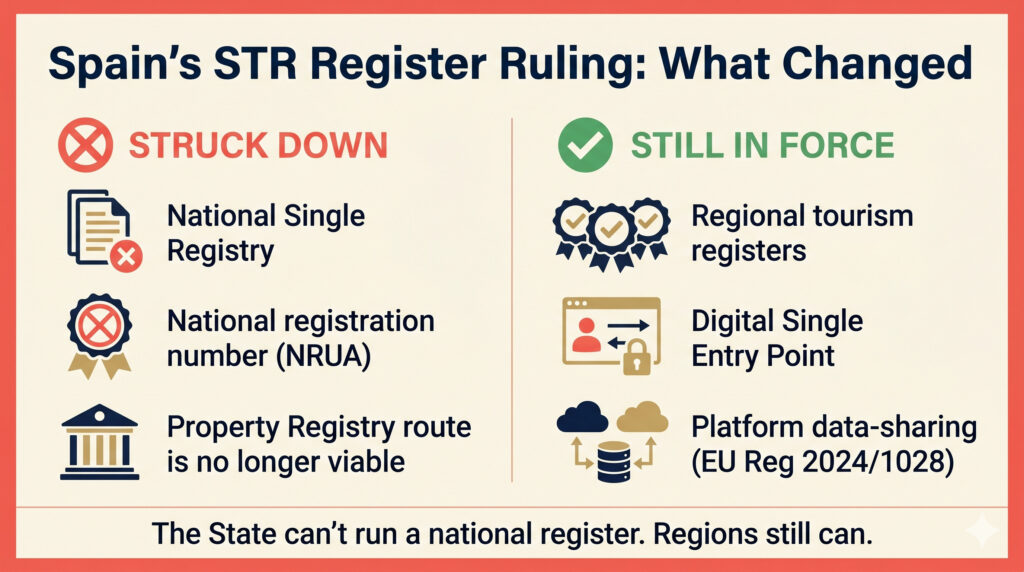
- Spain’s Supreme Court annulled the mandatory national “Single Registry for Short-Term Rentals” and its National Registration Number, created under Royal Decree 1312/2024. Decision No. 620/2026 was dated 19 May and made public on 21 May 2026.
- The Court partially upheld the appeal filed by the Valencian regional government, ruling that the State lacked the constitutional competence to impose a national register that duplicated existing regional tourism registries.
- The judgment held that a single registration procedure is not required by EU Regulation 2024/1028. The regulation allows national, regional, or local registers to coexist, provided one accommodation unit is not subject to more than one procedure.
- The Digital Single Entry Point and platforms’ data-sharing obligations survive the ruling. Regional tourism registers remain the operative compliance layer.
Read More: EU Regulation 2024/1028: How PMs Can Avoid OTA Delistings
Uvika’s Views
- Redundancy Averted: We recently tracked Spain’s enforcement push, including the order to remove nearly 66,000 listings from Airbnb. This ruling provides operational relief on a separate front. By reading EU Regulation 2024/1028 as a data-sharing harmonization measure rather than a mandate for a national registry, the Court removed a duplicative registration burden without touching the data-transparency machinery the EU actually requires.
- Regional Power Confirmed: For managers operating across multiple Spanish regions, regional authorities, not the central State, remain the arbiters of short-term rental compliance. You keep dealing with the regional tourism registers you already know. The ruling also reinforces the pattern behind Barcelona’s 2028 phase-out: the most binding rules in Spain are set at the regional and municipal level, and that is where operators should watch next.
Park County, Colorado Passes Revised Short-Term Rental Ordinance
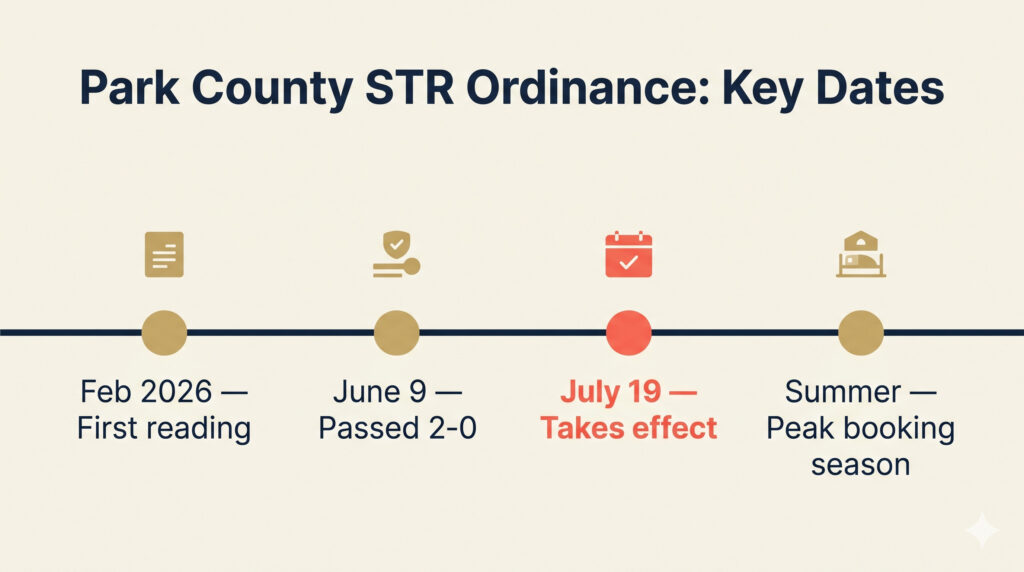
- On June 9, 2026, the Park County Board of Commissioners passed the revised ordinance by a 2-0 vote, with Commissioner David Wissel absent.
- It takes effect July 19, 2026, and replaces the county’s 2021 framework (Ordinance 20-03).
- The county describes the revision as the culmination of several years of work and research to balance community needs with the rights of property owners.
- The move fits the trend of rural and mountain counties formalizing their regulatory frameworks before the peak summer booking season.
Read More: Short-Term Rental Ordinance 2026: The Small-City Wave

Uvika’s Views
- The Pre-Season Push: The July 19 effective date is no accident. Mountain and leisure counties consistently formalize compliance protocols before the height of the summer booking window, locking in rules while inventory is fully booked and enforcement has the most leverage.
- Maturing Mountain Markets: Rural destination markets are adopting the kind of frameworks once limited to major metros. For property managers in Colorado’s high country, the July 19 effective date leaves a narrow window to confirm license status before enforcement begins.
Stay on top of short-term rental regulation trends and what they mean for your operating environment.

Uvika Wahi is the Editor at RSU by PriceLabs, where she leads news coverage and analysis for professional short-term rental managers. She writes on Airbnb, Booking.com, Vrbo, regulations, and industry trends, helping managers make informed business decisions. Uvika also presents at global industry events such as SCALE, VITUR, and Direct Booking Success Summit.
Related Articles:
 Airbnb’s Vision for Fair Regulations in Spain and Elsewhere
 EU Signals Short-Term Rental Regulation as Part of Housing Crisis Response
 The May 20 EU Data Deadline: Should Property Managers Expect Mass Delistings?
 Mexico City Enforces Registration, England Delays Planning Class, Cleveland Caps Density