

Short-term rental policies updates this week: Edinburgh, New York City, and Norwich, Vermont each moved on strategies affecting operators, spanning the UK’s first major tourist tax rollout, a data-driven defense of strict urban bans, and the reality of instant regulatory enforcement in rural leisure markets.
Edinburgh Launches the UK’s First City-Wide Visitor Levy

- As of July 24, 2026, Edinburgh has officially implemented a mandatory city-wide visitor levy, becoming the first city in the UK to do so, arriving the same week Porto rolled out a dedicated Airbnb monitoring portal and the European Parliament advanced its overtourism resolution.
- The scheme imposes a 5% tourist tax on all paid overnight accommodation, including short-term rentals, hotels, and bed-and-breakfasts.
- The 5% fee is calculated on the core accommodation cost (before VAT) and is capped at five consecutive nights per guest.
- The city estimates the levy will generate up to £50 million annually, which is ring-fenced for reinvestment into city infrastructure, affordable housing, and tourism management.
Uvika’s Views
- Managing the Administrative Load: The visitor levy adds a new layer to a market already tightly constrained by Short-Term Let Control Area zoning and licensing, the same framework that held up even under a demand surge during Glasgow’s Commonwealth Games. What professional managers can do in these circumstances is centralize their compliance tracking within their property management software (PMS) to avoid administrative bottlenecks.
- Absorbing the Consumer Pricing Impact: While the 5% fee is a pass-through tax paid directly by the guest, it does bump up the gross cost of the stay, a dynamic we’ve also seen play out as Cape Town moves to tax short-term rentals. To protect conversion rates during highly competitive booking windows, professional operators can dynamically adjust baseline seasonal rates or enhance visible on-property amenities.
- Mitigating Channel Mapping Risks: Because channel errors leave the host legally liable for uncollected funds, professional property managers can execute comprehensive tax audits across their OTA dashboards. Verifying that Airbnb and Vrbo systems are correctly calculating the pre-VAT levy ensures frictionless compliance before quarterly returns are due.
New Report Defends NYC’s Local Law 18 Enforcement
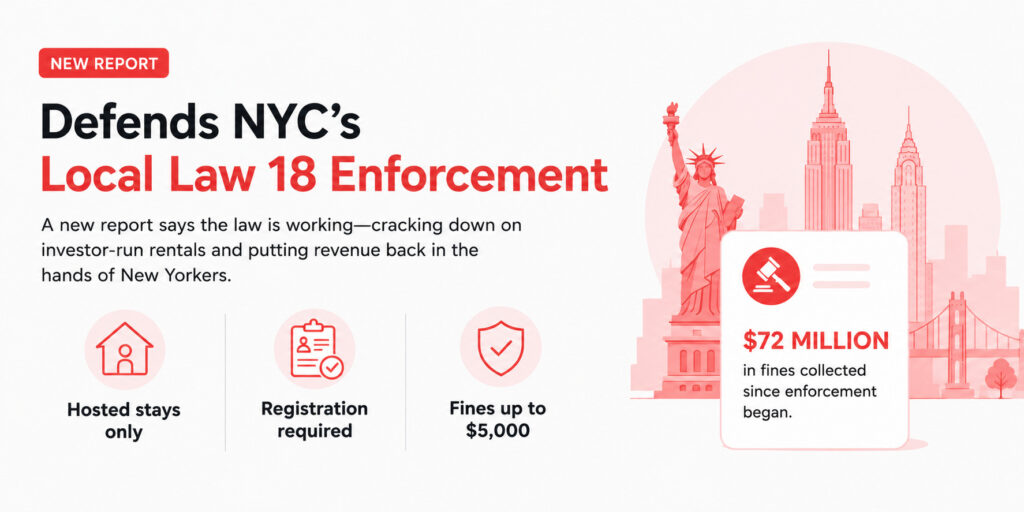
- The Pratt Center for Community Development released a new report in late July titled “NYC’s Short-Term Rental Law Benefits Homeowners over Investors.“
- The report provides data defending the city’s aggressive enforcement of Local Law 18, the same law that went into action in 2023 and was widely expected to decimate the city’s short-term rental supply, arguing the strict regulations successfully purged institutional operators who were hoarding housing supply.
- The researchers highlight that by eliminating whole-home, unhosted rentals, the law successfully redirected revenue back to actual primary residents renting out spare rooms.
- The city’s Office of Special Enforcement (OSE) confirmed that fines levied against illegal short-term rental operators have now crossed the $72 million mark since enforcement began.
Uvika’s Views
- Analyzing the Narrative Shift: This report establishes a formal counter-narrative, framing a massive drop in rental supply as a housing policy success rather than a loss of local tourism GDP, a debate that has only intensified as Local Law 18 faces renewed scrutiny from Airbnb and a growing coalition of local business groups.
- Proactive Local Advocacy: In markets where similar strict regulations are looming, professional short-term rental managers can band together to form localized advocacy networks early, mirroring the coalition-building we tracked around New York’s Intro 1107 pushback.
- Leveraging Economic Data: Rather than waiting for a ban to be introduced, professional managers can commission independent economic impact studies, following the playbook Portugal’s ALEP used to reverse restrictive rules with hard revenue and jobs data. Presenting hard data on local tax contributions and neighborhood business spending allows operators to demonstrate their value before the “investor versus homeowner” debate gains political traction.
Norwich, Vermont Enacts Instant STR Bylaws
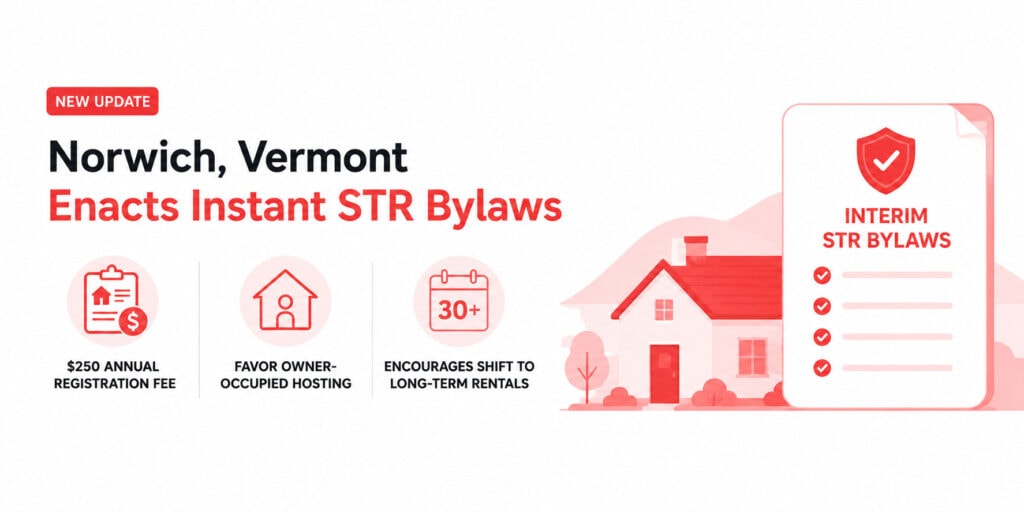
- The Norwich town selectboard voted unanimously to pass interim short-term rental bylaws that took effect immediately upon passage in late July, the same week Salt Lake City activated its own licensing framework, Malaga froze new tourist apartment permits, and Byron Bay’s listings dropped 15%.
- The new rules impose a $250 annual registration fee and place severe restrictions on unhosted (non-owner-occupied) short-term rentals.
- The selectboard indicated that the new restrictions are designed to favor owner-occupied hosting and encourage existing unhosted operators to transition their properties into the long-term rental market.
Uvika’s Views
- Adapting to Interim Regulatory Speed: The use of an “interim” bylaw allows local town councils to bypass the traditional, multi-month notice periods and implement rules instantly, the same race-against-preemption urgency we saw when Cleveland rushed through its density cap before state lawmakers could intervene. Professional managers can insulate their portfolios by maintaining highly agile operations that allow for quick operational pivots.
- Diversifying into Mid-Term Stays: What professional short-term rental managers can do in these circumstances is transition restricted unhosted inventory into the mid-term stay sector (30+ days).
- Targeting Unregulated Demand: By shifting focus toward traveling medical professionals, corporate relocations, or remote workers, professional operators can preserve asset utility and revenue while staying entirely outside the scope of strict under-30-day municipal mandates.
Stay on top of short-term rental regulation trends and what they mean for your operating environment.

Uvika Wahi is the Editor at RSU by PriceLabs, where she leads news coverage and analysis for professional short-term rental managers. She writes on Airbnb, Booking.com, Vrbo, regulations, and industry trends, helping managers make informed business decisions. Uvika also presents at global industry events such as SCALE, VITUR, and Direct Booking Success Summit.
Related Articles:
 Portugal Rejects Ban Referendum, Rentals Face Higher Taxes in Spain, Hostaway Partners with QuickBooks
 Stricter Rental Laws in Greece, Airbnb Shares Valentine’s Day Trends, and Gen Z’s Winter Travel Shifts
 Mint House Acquires Locale, Airbnb Sues New Orleans, Madrid, and Barcelona Debate Rental Rules
 Athens Bans New Rentals Until 2026, Airbnb–FIFA Deal, New Fund to Support Advocacy